
Pressing Where It Hurts: How to Win the Fights That Matter
“Pressing where it hurts” is essential to winning the battles that matter most to regular people — whether it’s reversing climate change, fundamentally reforming U.S. healthcare, or eliminating the financial corruption that has spread throughout the American political system.
There is a pearl of wisdom from the first episode of the TV show Suits that explains why it’s so rare for big problems affecting tens of millions of Americans to get fixed.
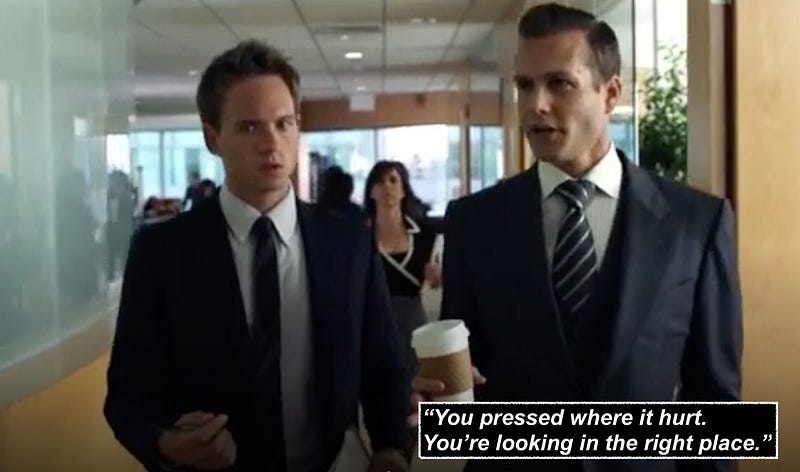
This scene in Suits helps explains why these talker-politicians don’t even pretend to respond to the will of the people…even when strong majorities of the population want change…and even in the cases where there are majorities in both parties who want change.
Yes, I know.
It’s a tall promise I’m making that a 20-second scene from Suits can teach us how to really go after truly big problems like climate change, the U.S. healthcare system, and the corruption of America’s elected officials.
Spend the next 10 minutes with me. Then let me know in the comments below if I end up delivering on the promise.
First, here is the dialogue from that scene in Season 1, Episode 1 of Suits:
Season 1, Episode 1 of Suits. Harvey and Mike walking down a hallway in their law firm. Mike: Um, Devlin McGregor is fighting the subpoena. They filed a motion to dismiss the case based on our lack of evidence.Harvey: Good.Mike: [in a confused, mildly panicky voice] Good? What do you mean, “good”…?Harvey: They don’t want to hand over the files. You pressed where it hurt. You’re looking in the right place. Did you think they wouldn’t fight back?Mike: [now in a sheepish voice] Well, I…uh…now that you mention it….Harvey: [in a "why are you wasting my time?" tone of voice] Oh, my bad. I keep forgetting you don’t actually know anything.Mike: ha ha ha ha ha ha….Harvey: The idea is, you make a move, they make a move. You go back-and-forth until one of you wins.Mike: Ok, what if they win the motion and the case gets dismissed?Harvey: You’re not as good as you think you are.Takeaway #1: The key point that Harvey makes is that you have to press where it hurts the other person/organization if you want to make progress and win.
Takeaway #2: Harvey’s is also correct about it NOT just being a “one-and-done” where you can deliver a single knockout punch to win the fight. Wars are usually made up of a series of battles. You have to be prepared to go the distance.
Takeaway #3: The status quo always fights back. If you’re up against a status quo that needs to be reformed or changed, you’re going to have to fight to get it done.
People who are part of the status quo usually benefit by receiving some combination of power, prestige, and money — and they don’t willingly give it up.
They may promise to change or give small amounts of that power or prestige or money to you over time to neutralize your threat to their status quo, but it will only be small amounts…and there’s a good chance they will renege on even that. Bottom line, status quo players don’t willing give up their power. If you want it, you’ll have to take it. Anything they give you is most often just a stalling or deflecting tactic.
And as long as we’re using TV pop culture for teachable moments, there’s a scene from the original run of Dallas that perfectly encapsulates the idea that if you want real power, it won’t be given freely:
Let’s take a quick look at some current real-world examples to illustrate what it looks like (1) when you press where it hurts…and also (2) when you don’t press where it hurts.
Fair warning: I am going to look examples from both sides of the American political aisle. Whether you identify as a Democrat or a Republican — or you dislike both both D and R politicians — please set aside your preferences and emotions, and focus only on the process and results of each person when they try to press where it hurts.
Donald Trump 2016 vs. Donald Trump 2020
Trump 2016, Primary Elections
Whether you were a Trump supporter or someone who despised him, you have to admit that Donald Trump in 2016 took “pressing where it hurt” to new levels in the world of presidential electoral politics.
Look at how Trump manhandled Jeb Bush in the primaries, particularly with the “Low Energy Jeb” nickname and by tying Jeb to his brother George’s disastrous and unprovoked war of aggression in Iraq. Or how Trump called Cruz a basket case, insulted Cruz’ wife , and attacked Cruz’ father en route toward decisively beating him in the primaries.
Trump systematically dismantled every one of his Republican primary opponents in 2016 because his opponents had never had a political opponent so effectively press where it hurt them personally, politically, and publicly. And Trump not only did it over and over and over again, but he made it look effortless and fun (for him.)
Trump 2016, General Election
During the 2016 general election, Trump continued to display an uncanny ability to press where it hurt.
Whether you liked Trump or not, his punches landed, and he pressed where it hurt in his debates with Hillary Clinton. (By contrast, Hillary showed a stunning inability to press where it hurt — she was simply ineffectual.)
Back to Trump: watch the first 2 minutes of this video — he concedes the point during a debate that, yes, Hillary has experience, but then he presses where it hurts with his counterpoint that what she has is bad experience. And he relentlessly hammered that same point over and over to permanently engrave it into everyone’s memory. Trump pressed where it hurt, and Hillary did not have an answer to it. Trump was objectively effective here in terms of pressing where it hurt.
Let me be clear. I am not saying that Trump is a good guy or that his “pressing where it hurt” ended up being a good thing for the country. I am focusing only on (1) whether he showed skill and relentlessness in “pressing where it hurt” for Hillary and her electability; and (2) whether he got results with it. Objectively the answer is “yes” to both of those questions since he went into that debate as a “dead man walking” and came out of it being back in the race again.
Trump 2020, General Election. Unexpectedly, the strong ability to press where it hurt that Trump wielded to such great effect in 2015 and 2016 was almost entirely missing for Trump in 2020 when he needed it the most.
During the general election campaign in 2020, Trump consistently:
- pressed where it didn’t hurt; and
- didn’t press where it would have hurt.
For an example of “pressing where it didn’t hurt,” see the first few minutes of this video from the morning after “that debate” — you know which one I’m talking about. There is example after example of Trump pressing and pressing…but not really hurting Biden…and instead only hurting himself.
And to make matters worse for himself, Trump also missed real opportunities to go after Biden by pressing where it would have indeed hurt Biden.
For instance, Trump could have homed in on:
- Hunter Biden’s and Joe (“the Senator from MBNA”) Biden’s long histories of peddling influence and being bought by donors;
- Hunter’s laptop (which has turned out to be a legitimate, real, and troubling issue);
- Hunter’s sleeping with his dead brother’s wife
- and then running out on her to go father a child with a Florida stripper
- and then denying paternity on the baby
- until a Florida court ruled it was indeed his child; etc., etc.
These might seem like unfair lines of attack — i.e., to go after a “candidate’s child” — but I would note that:
- This would have been a very similar line of attack to the attacks that Trump used to such great effect in the 2016 primaries, particularly against Ted Cruz and Jeb Bush.
- Every item in the “Hunter list” above is factually true.
- It’s one thing to have a norm where you don’t go after young children of presidents like Chelsea Clinton (12 years old in 1992) or Barron Trump (10 years old in 2016), but in 2020, Hunter Biden was 50 years old — he was, as some might say, “a grown-ass man” who hadn’t been an innocent child for over 30 years.
- Hunter’s emails showed that his father — the presidential candidate — may have been implicated as a beneficiary of some of Hunter’s influence peddling.
In my opinion, that makes the above set of possibilities for how Trump might have pressed where it would have hurt in 2020 fair game for a series of attack ads in that presidential campaign. I’m not suggesting that this should have been the only line of attack — there were plenty of other things to go after Joe Biden on where Trump could also have been pressing where it hurt — but this particular approach seems as though it would have been effective and impactful.
I’m also not suggesting that this is the stuff that presidential politics are made of — or should be made of. But if Trump wanted to win, one narrative that he could have run with — and that probably would have made the difference in such a narrowly-lost election — pretty easily wrote itself.
Remember, Trump walked into that debate with Hillary in October 2016 right after the release of the p**** tape, and he seemed to be on the verge of defeat. But Trump still knew in his gut the importance of pressing where it hurt, so he brought Paula Jones to the debate just to throw Hillary off her game. That version of Trump in 2016 knew how to press where it hurt and to keep pressing and pressing and pressing…but again, the 2016 version of Trump seemed to be entirely missing in 2020.
Final observations on the 2020 race
- Trump lost a re-election campaign in 2020 that 2016 version of Trump probably could have/would have won. Honestly, to this day I am still puzzled as to why Trump did not use more effective lines of attack that would have been consistent with his past political and campaign behavior.
- Which Trump is going to show up for the 2024 Presidential Election — Trump 2016 or Trump 2020? The answer to that — i.e., will Trump 2024 demonstrate an ability to press where it hurts? — may well determine who gets sworn in to the presidency in January 2025.
U.S. Representative Katie Porter (D-CA)
One of the newer members of Congress, Katie Porter first assumed office in January 2019. She has an keen grasp of economics and business; an ability to read and understand corporate financial statements; a personal connection to economic issues that matter for regular people; a deep commitment to serving her voters; and an ability to communicate — without dumbing things down or losing key points — in terms that working Americans understand and relate to.
Most importantly, she is fierce and relentless when it comes to questioning corporate CEOs who appear before her committees. In other words, she knows how to press where it hurts.
This video (below) shows Porter pressing hard with a Big Pharma CEO.
The commentary in the above video provides valuable context to the points Rep. Porter made about how this Big Pharma CEO stood to personally benefit financially by price-gouging consumers/patients.
The second video (below) is a 2–minute tour-de-force of Porter “following the money” in a different Big Pharma company and dragging the CEO along for the ride — i.e., pressing him where it hurt. (Krystal Ball also mentioned in the above video that Rep. Rashida Tlaib and her line of questioning from the same two days of committee hearings were — in my words — pressing where it hurt.)
Btw, see the very large blue circle on Rep. Porter’s whiteboard for “Stock Buybacks & Dividends”…? If you’re not already familiar with stock buybacks and why they are so perniciously effective at funneling massive amounts of money from corporations to the Top 1% in the U.S., here is a quick refresher on why companies do stock buybacks that I wrote in a recent article.
U.S. Senator Elizabeth Warren
For many people, Elizabeth Warren is a polarizing figure. I find much of her work and accomplishments to be impressive and groundbreaking, and there is no question that she has made a real difference in people’s lives through her research on family bankruptcy and research on the real underlying causes of financial stress on the middle class; her books, including The Two Income Trap; and her championing of the Consumer Finance Protection Board.
There are other parts of her political history, though — particularly with regard to the 2020 Democratic primaries — that I’m less inclined to admire.
However, with her background in law, finance, and family bankruptcy, there is no one in the Senate — and perhaps only Rep. Katie Porter in the House of Representatives — who is even remotely close to Elizabeth Warren when it comes to pressing where it hurts during a committee hearing. If you have any doubts about this, check out this hearing from September 2016.
Senator Warren is magnificent here. No two ways about it. This is the epitome of pressing where it hurts.
Nobody else — and I mean nobody else — held Wells Fargo CEO John Stumpf to a public accounting the way she did for the years-long customer accounts fraud scandal that Stumpf presided over. When you watch this video, you’ll see Stumpf try to weasel out of any responsibility for his unethical — and at least seemingly illegal — actions. Because it was so infuriating to watch the CEO of a major bank behave so shamelessly on the record, it was especially gratifying to watch Warren so relentlessly pressing where it hurt.
By the way, in case you think that Warren’s pressing where it hurt during that hearing isn’t really that big a deal today — 6 years later — you would be mistaken. Sadly, it is still relevant.
It turns out that bank salespeople fraudulently opening new customer accounts in order to meet quotas, earn a living, and not get fired was NOT limited to Wells Fargo.
Matt Stoller recently discussed how there is a massive fraud at TD Bank very similar to the fraud at Wells Fargo. He also discusses how these deceptive practices are still at least “semi-routine” across the banking industry.
Elizabeth Warren’s instincts about where to press were noteworthy at the time, but it’s fair to say that few people outside the banking industry realized how widespread the rot was — and still is — that she was calling out.
So did Elizabeth Warren change the world by pressing where it hurt in 2016? While she had some effect on Wells Fargo, the answer is “no, her pressing where it hurt with the Wells Fargo CEO did not single-handedly fix this problem across the banking industry.”
Nor has Rep. Porter been able to reform Big Pharma.
At least…not yet.
But it is fair to say that a necessary first step to fixing any problem — to beginning and ultimately winning a real fight for change — is to recognize there is a problem and be able to articulate that problem with clarity and force.
The process of articulating a problem begins by pressing where it hurts, and we need a lot more people like Rep. Porter and Sen. Warren who are skillful and relentless when it comes to pressing where it hurts if we are going to have any chance of solving the biggest problems in front of us.
My recent articles include:
Life Expectancy vs. Healthcare Costs in the U.S.
3 Things You Didn’t Know about Student Loan Debt and (Potential) Debt Cancellation
Six Behavioral Barriers That Prevent You from Changing the Status Quo 1. Barnacles • 2–4. Caring Enough • 5. Smart Man’s Disease • 6. Blackballing
Want me to cover a topic? Please post suggestions in the comments, and I’ll use your input to help prioritize my writing and research.
If you appreciate my writing, please share it on social media.
Want unlimited access to all Medium articles? Become a member!
As always, thank you for reading, subscribing, clapping, and sharing — I appreciate you sharing your time and attention!


