
AGING
Should I Stop Driving?
Folks with hearing and vision loss have more traffic accidents. My father had both, and so do I.
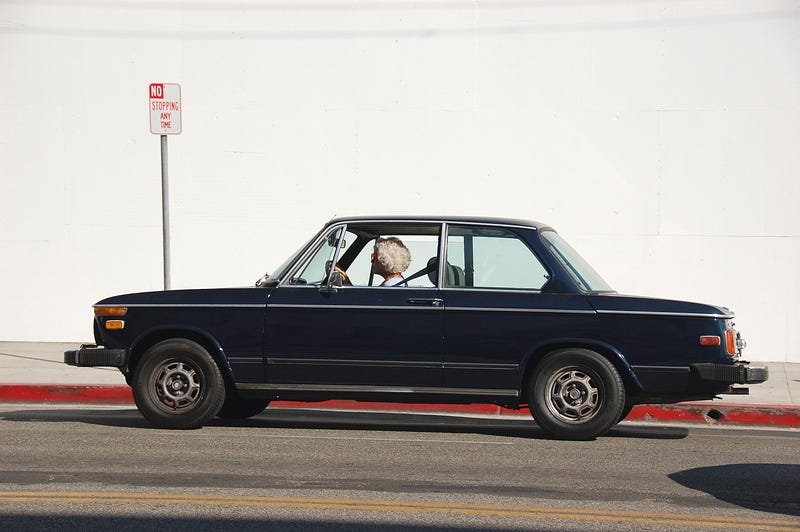
My dad drove right up until the day he died at 87. He was a menace to himself and everyone else on the road, but I couldn’t get him to stop. Giving up his license meant depending on others to get around, and for my fiercely independent father, that was completely out of the question.
Things could get dicey
If he was driving somewhere he’d been to before, it was usually okay. But if he was going someplace new, or something unexpected happened along the way, things could get dicey. Whenever Dad became confused about the route, he’d slow down to ponder his next move — even if we were on the freeway.
“Dad! You have to speed up!” I’d shout, as cars whizzed around us, honking furiously. “You’re only going 25, and the minimum speed is 50!”
Thankfully, nothing catastrophic ever happened. Just a lot of small snafus and close calls. For instance? I remember returning to the car with him once after having lunch at the local deli. He buckled up behind the wheel, turned on the ignition, and hit the gas. The car lurched forward, then stopped. Dad gunned the motor again. We didn’t move. So he gunned it again.
“Dad!” I said. “You just drove over the concrete barrier that separates the lanes and now we’re stuck on top of it. Gunning the motor won’t help.”
He turned the motor off. “That’s not good,” he conceded.
Not so good, but no big deal. We called a tow truck that pulled us off the barrier and drove home. We’ve all done something like that, right? The problem was, in his 80s, my father was doing things like that fairly often.
When he died a year later, he still had a valid driver’s license. Unlike the father of my friend Lori who, after he totaled both his own car and a brand-new BMW, decided it was time to stop.
A recent study concluded that people with hearing loss have more traffic accidents. As do people with vision problems. My father had both.
At 66, so do I. And my reflexes aren’t what they used to be either. Is it time for me to stop driving?
Should I quit while I’m ahead?
I got my first license at 17, and I’ve been driving ever since. I’ve never had an accident. But recently I’ve had a few close calls. Cars that seemed to come out of nowhere that I had to swerve to avoid hitting. Attempts to merge on the freeway that didn’t exactly end in disaster, but were certainly nothing to be proud of.
There’s no question that I’m honked at a lot more often than I used to be. And if you’re a pedestrian dressed in black and walking in the street on a dark night? You’re way too serious of a challenge to my night vision.
It’s not as if I do a lot of driving. I’m really more of a cliché — the AARP-aged librarian with a 20-year-old car that has only 65,000 miles on it. I never drive if I can walk. I fill up the tank about twice a year. I’m almost always on foot. But on a rainy day, I’m glad to have those wheels.
Still, I know I’m not the driver as I used to be. There’s now a danger to my perfect safety record (not to mention local pedestrians).
Growing old means dealing with losses, both big and small. While I still get behind the wheel to run quick errands when the weather is bad, one day soon, I know that I’ll have to put away my car keys and depend instead on the kindness of friends and family, and the reliability of Lyft.
But … not just yet.
Writing Coach and Medium Sherpa Roz Warren writes for everyone from the Funny Times to the New York Times, has been in 15 Chicken Soup for the Soul collections, and is the author of Our Bodies, Our Shelves. Drop her a line at [email protected].