
“Shoot Them for What? They Never Called Me Nigger…” — Mohammad Ali’s Response to America
And why he refused Army induction
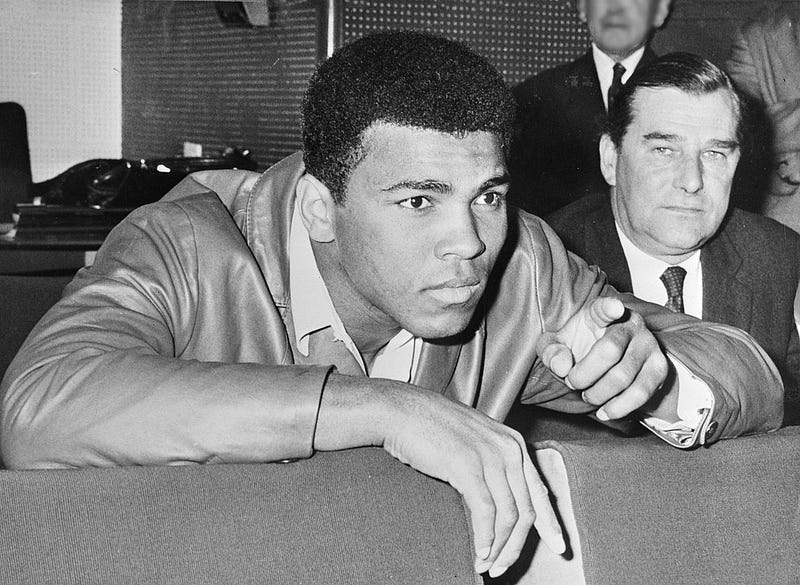
While refusing to be inducted into the U.S. Army on April 28, 1967, and join the Vietnam War, did Mohammad Ali, The Greatest, ever imagine that this decision would make his life a living hell?
Just three years before that, in 1964, this Louisville-born heavyweight champion changed his name from Cassius Marcellus Clay, Jr. to Mohammad Ali after converting to Islam. He was then already a household name for achieving a gold medal at the 1960 Olympic Games in Rome.
However, on February 25, 1964, he defeated the heavily favored bruiser Sonny Liston in six rounds to become the heavyweight champ and then triumphantly declared — “I am the greatest!”
That fight was so intense that it was named the “Fight of the Year” by The Ring magazine.
But soon, everything changed.
When Ali was 18 years old, he registered for conscription in the United States military and was listed as 1-A(available for unrestricted military service) in 1962. Later, in 1964, Ali was reclassified as Class 1-Y(fit for service only in times of national emergency). However, it is to note that he failed the U.S. Armed Forces qualifying test because his writing and spelling skills were sub-standard due to his dyslexia.
Then, again in 1966, the Army lowered the test standards, allowing Ali to qualify for the U.S. Army. That means now he was eligible for induction into the U.S. Army.
It was the time when the United States was in a devastating war against Vietnam. Hundreds of American soldiers were being killed, and those who were “conscientious objectors” of the war were fleeing to Canada.
Being converted to Islam, Muhammad Ali had no intention to join the Army and kill innocent people of Vietnam as it is against the teachings of the Holy Quran. So, he refused to be inducted into the U. S. Army.
On 28 April 1967, 25-year-old Ali arrived at the Armed Forces Induction Center in Houston. And when the lieutenant said, “Mr. Cassius Clay, you will please step forward and be inducted into the United States Army,” Mohammad Ali refused to step forward.
The lieutenant repeated twice and then one final time informing the consequences of that refusal. But Ali was unmoved and firmly refused to step forward.
Then a few moments later, Ali appeared outside the induction center and handed out a statement that wrote —
“It is in the light of my consciousness as a Muslim minister and my own personal convictions that I take my stand in rejecting the call to be inducted. … I find I cannot be true to my beliefs in my religion by accepting such a call. I am dependent upon Allah as the final judge of those actions brought about by my own conscience.”
Later that evening, Ali was stripped of his boxing license by the New York State Athletic Commission. And not only that, on June 20, 1967, he was convicted of draft evasion and sentenced to five years in prison and fined $10,000 and banned from boxing for three years.
But long before being convicted of draft evasion, Ali cleared his stance about the Vietnam war.
He said, “My conscience won’t let me go shoot my brother, or some darker people, or some poor hungry people in the mud for big powerful America. And shoot them for what? They never called me nigger, they never lynched me, they didn’t put no dogs on me, they didn’t rob me of my nationality, rape and kill my mother and father. … Shoot them for what? How can I shoot them poor people? Just take me to jail.”
Just take me to jail…? My goodness! That’s incredibly brave from the greatest boxer of all time.
Ali’s bold stance against joining the army made him the most hated man in his own country. Even worse — he got so many death threats. And the people who supported him at that time also got their fair share of hatred from the American people.
In an article, Sports journalist Jerry Izenberg, who supported Ali, said,— “Some papers that carried my column regularly dropped it. Bomb threats emptied our office, making the staff stand out in the snow. My car windshield was smashed with a sledgehammer. Among the thousand of pieces of hate mail I received, two required the attention of postal inspectors. One turned out to be nothing but a ticking alarm clock, and the second contained what I hoped was dog feces — as opposed to the alternative.”
Understandably, Ali became very vocal about his stance against the Vietnam war and the way he was treated in America.
During his exile from boxing, he said to a crowd of college students (mostly white), —
“You my enemy. My enemy is the white people, not Viet Cong or Chinese or Japanese. You my opposer when I want freedom. You my opposer when I want justice. You my opposer when I want equality. You won’t even stand up for me in America for my religious beliefs — and you want me to go somewhere and fight, but you won’t even stand up for me here at home?”
Anyway, Ali stayed out of jail before the Supreme Court was able to rule on his appeal. Then on June 28, 1971, his case was overturned by a unanimous 8–0 decision, and thus he avoided going into jail.
But he was banned from boxing for over three years. Consequently, he struggled a lot as he had no immediate income at that time. He was banned when he was at the peak of his career. And worse than that — for the people of his own country, he turned into a villain.
He faced tons of hatred, criticisms, and death threats for not joining the U. S. Army and killing the people in a faraway land named Vietnam.
Then three years later, on October 26, 1970, Ali managed to attain a license for a fight against Jerry Quarry in Atlanta. And you know what he did? He recorded a knockout.
Yes, Muhammad Ali was that genius who held 56 wins, five losses, and 37 knockouts before retiring from boxing in 1981, at the age of 39.
Eric Holder, the former U.S. attorney general, while talking about this greatest boxer, said, “His biggest win came not in the ring but our courts in his fight for his beliefs.”
Thank you for reading.
If you want to read more of my writings don’t forget to check out the following ones.


