
Shocking 3D Printing LEGO Bricks Results!
Does 3D printing LEGO bricks at home, work? A double experiment…
One mission, two outcomes. Recreating the classic 2×4 red LEGO brick at home. Is it possible, and if so, what sort of effort and required expertise are we looking at? Is it even a good idea? Or, if it turns out not to be possible, why is that? So many questions that need definitive answers. Agh! What are we to do? But then it dawned on me. I don’t have a 3D printer, but I do have a best friend, and what are best friends for, if not to help when an AFOL like me wants to test out a theory?
Before getting into the meat of this article, first I feel like the least I can do is thank my best buddy Andrew Gribben for lending me, not one but two (out of the three he owns) of his 3D printers, and his expertise for a few hours as I visited him in Northern Ireland. Secondly, I must admit that the idea was re-triggered by my favourite LEGO YouTuber, Balázs (RacingBrick), specifically, this recent video of his. Since the dawn of 3D printers, my curiosity of whether LEGO can be 3D printed at home has never been truly satisfied, and his video reminded me of that. What conclusions he came to, is for you to discover by watching the video.
The “impossible” mission?
My goal was very clear. I didn’t want to create actual LEGO, but I wanted to test whether LEGO compatible bricks can be printed without too much of an investment, and do that all in a home setting. Obviously, we all know that on an industrial scale, with specialised tools, it’s pretty easy to manufacture LEGO compatible bricks. After all, there are dozens of copy-cat companies that have been doing that for years, quite successfully. Some of those are almost indistinguishable from the genuine parts coming from the Danish toymaker.
I knew for a fact that early attempts a few years ago to print LEGO bricks always failed miserably, but as we know, technology evolves and 3D printers were not left out of that evolution. Not only have they become cheaper, but also exponentially more accurate over time.
I chose to print the most classic LEGO brick there ever was — the red 2×4 brick, and made sure it was actually printed in red! Other than satisfying the nostalgia factor, it also needed to successfully interlock with the red 2×4 brick I had on my keychain. No pressure, aye? What I was most worried about, were the studs. Everything else I felt was straightforward enough for the printers to handle.
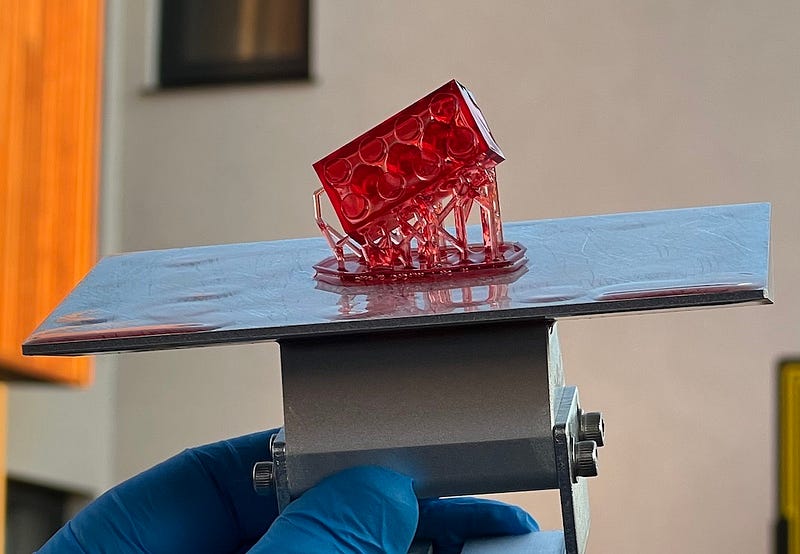
Speaking of printers, we ended up using two 3D printers. The first one was an Ender-3 V2 by Creality with an Endzilla upgrade, while the second one, an Anycubic Photon Mono 2. The key takeaway from here is that we used two very different technologies. Filament with the first printer, and resin with the second. We wanted to see how the material difference would affect the outcome, not just in terms of print accuracy, but also resistance and overall life of the resulting brick.
The shocking outcome…
Over the course of the day, Andrew and I ended up printing three bricks. The very first one, was more of a warm-up attempt, a feasibility study so to speak, whether there was any point giving it a serious go with the tools we had at our disposal. You have to understand that neither of these two printers are considered today to be any more than the lower end of the mid-range printers out there on the market. Costing on average 300 bucks, expectations had to be curbed.
While Andrew has been printing stuff for years, for me, this was the first-ever experience with a 3D printer, while for Andrew, the first-ever attempt at printing LEGO bricks. Not entirely sure what his expectations were — men don’t share feelings, we just grunt at each other, and fist-bump when things work out — but mine were certainly low, somewhere below the frog’s ass, which is why the sensationalist headline will now perhaps make more sense.
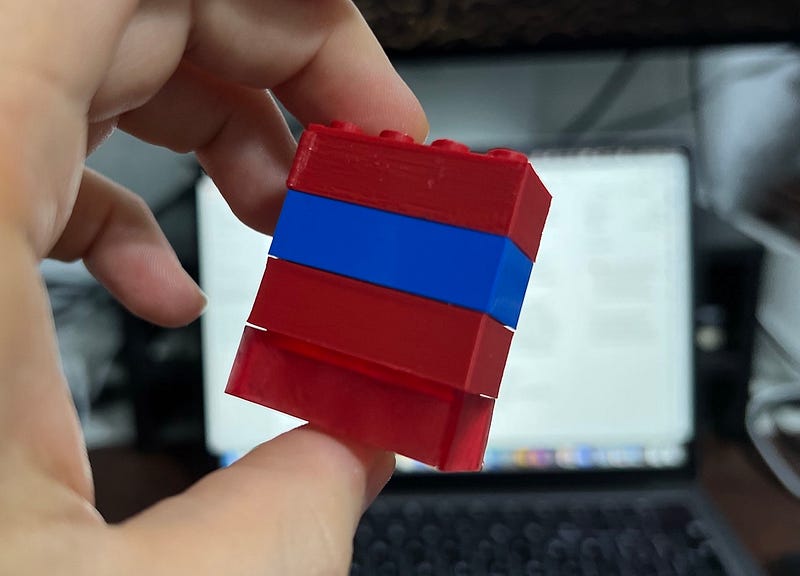
The very first LEGO brick we attempted to print resulted in a shockingly accurate result! It actually worked!
While nowhere near flawless, the result looked like a LEGO brick and worked like one too! It gripped well onto my genuine LEGO brick on both top and bottom end, partial connections were also decent, and while you could tell the difference between the two, our silly first attempt was surprisingly viable! And it only took 22 minutes to print.
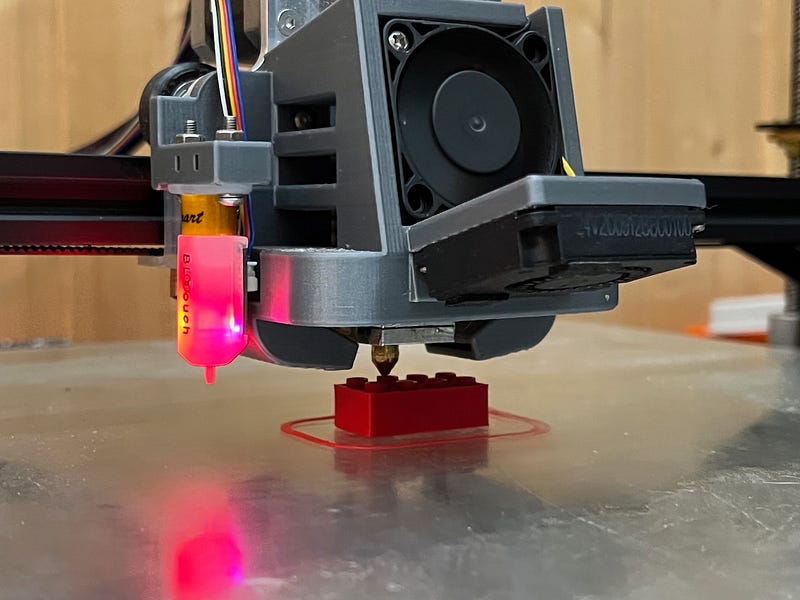
So, we decided to print a second one, again with the same Ender-3 filament printer, this time doubling the resolution, because higher resolution prints theoretically mean more accurate prints. While that was happily stringing together another brick, we also got one going in the Anycubic resin printer. Our expectations for the latter were a tad higher, simply because it’s a 2000 pixel resolution printer, so decent accuracy was kind of a default.
We now had, another two bricks, with different outcomes again, which begs the question — how replicable are 3D prints?
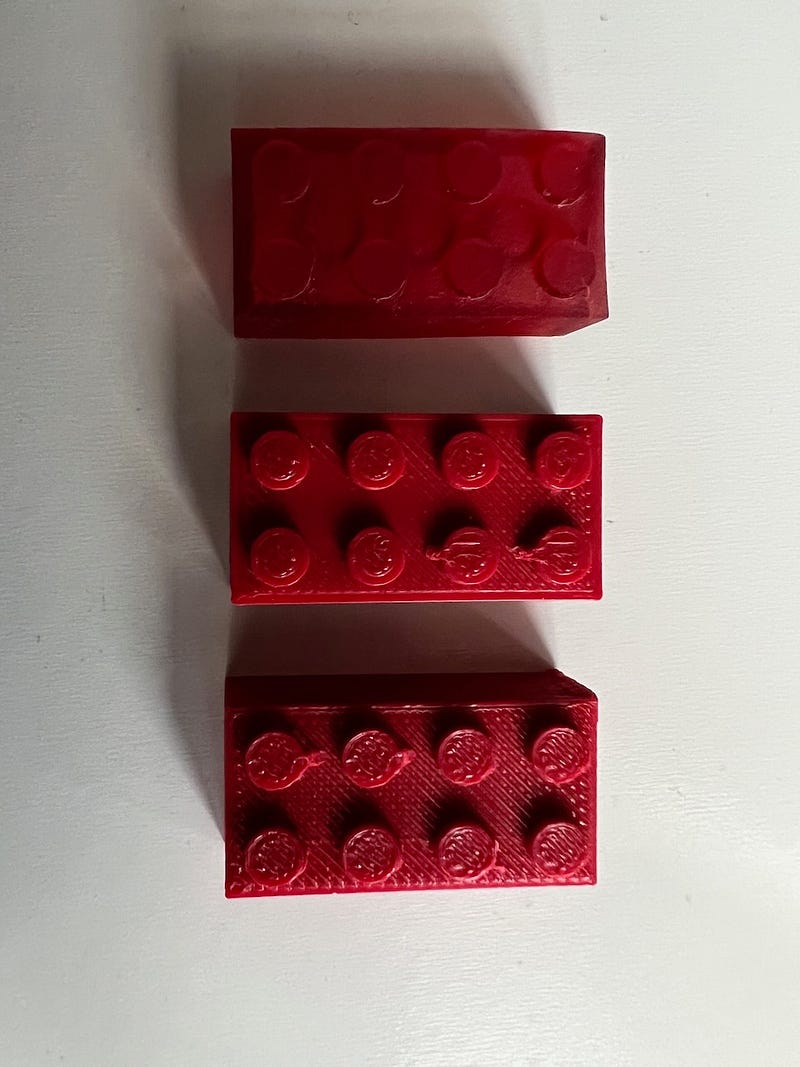
The second, double-resolution PLA filament print actually resulted in a worse render. It seemed that the high resolution resulted in a more error-prone outcome, almost as if the printer had just a tad too much to deal with. That being said, it was still a semi-functional 2×4 red brick.
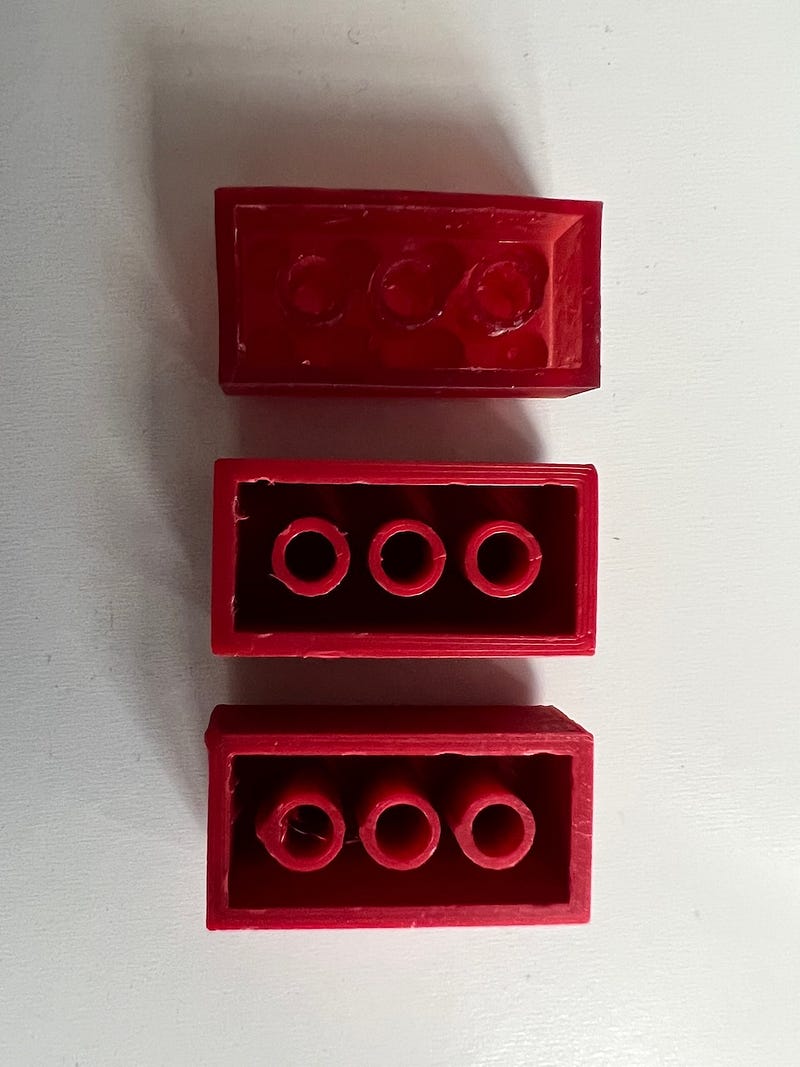
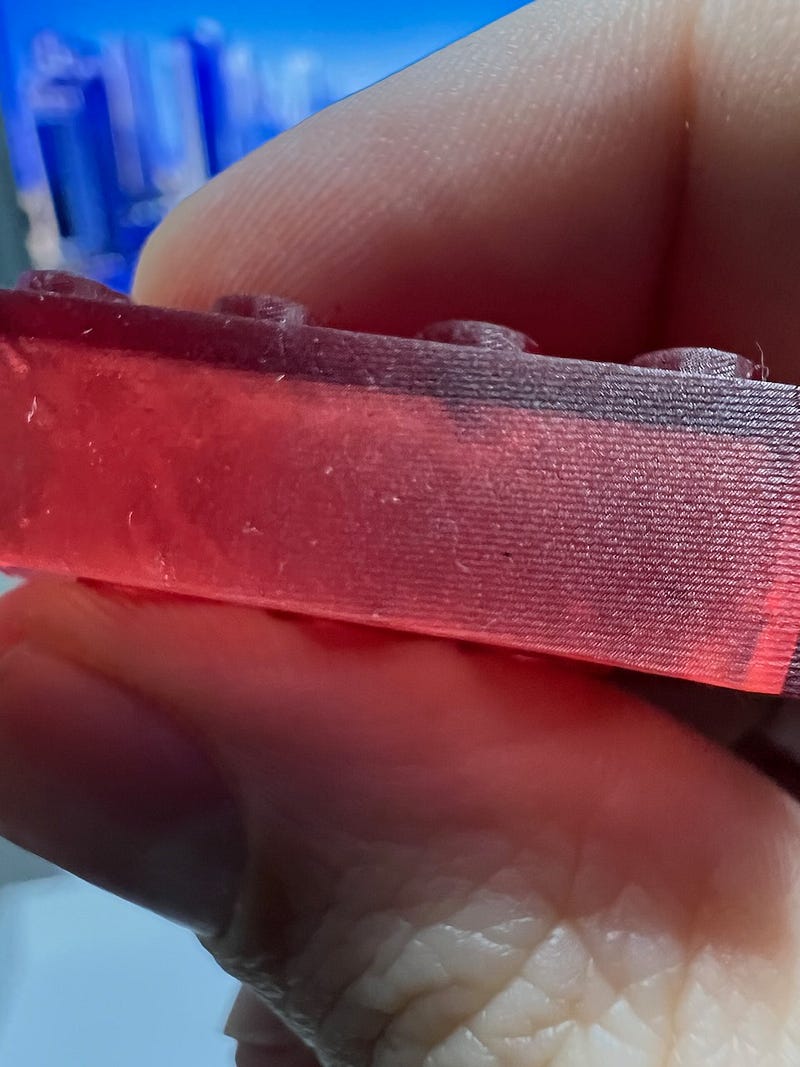
The resin print, on the other hand, turned out to be another shockingly good attempt. About 50% better than the first PLA print, and I have to admit, the difference in technology is very noticeable. Resin does produce results that are a little closer to what I would call production feel/quality. Unsurprisingly, it worked well with the genuine brick, in every combination I tried, except for the inner pipes, where the void was just narrow enough not to allow for a stud to fit, which brings me to the measurements section of this article.
A semi-scientific comparison
The design we used was close enough to the original LEGO brick specs to expect something that worked well-enough with genuine LEGO bricks. However, we did notice certain aspects fell short of expectations, resulting in some issues.
To document these issues, we did some quick checks, which I then followed up on my own, spending some more time measuring certain key points in both the original and the 3D-printed bricks. For this, I used a digital calliper. Nothing fancy, just your average hardware-shop calliper. The numbers are anywhere between completely expected and downright shocking. The order for each measurement will be: genuine, PLA 1st print, PLA 2nd print and finally, resin.
- The studs: 4.86 mm, 4.86 mm, 4.80 mm, 4.72 mm
- Wall thickness: 1.53 mm, 1.85 mm, 1.65 mm, 1.55 mm
- Pipe void: 4.38 mm, 3.83 mm, 3.98 mm, 4.01 mm
- Width/length/height: 15.80 / 31.81 / 9.51 mm, 15.93 / 31.79 / 9.51 mm, 16.07 / 32.42 / 9.51 mm, 16.21 / 31.88 / 9.66 mm
If I’m honest, I find these numbers quite impressive. Some of them are well within the tolerances of LEGO’s own standards, and that’s no small feat for a first try. I’ll try to list out what, I think, are the main findings:
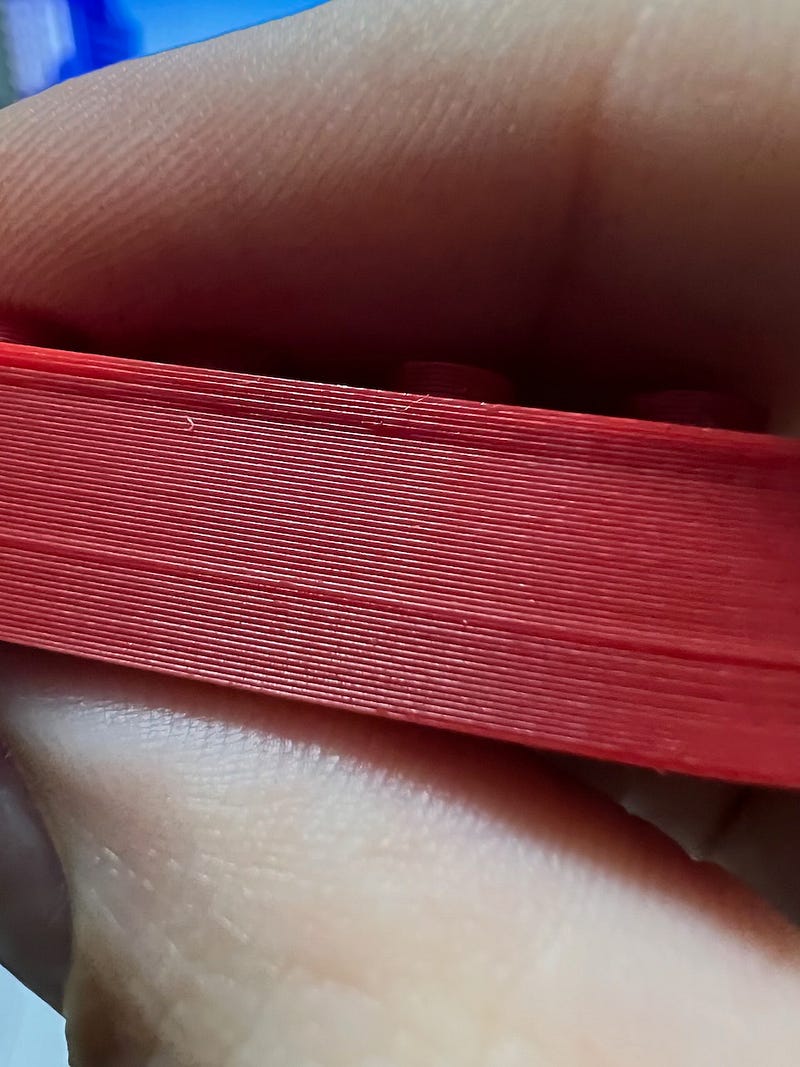
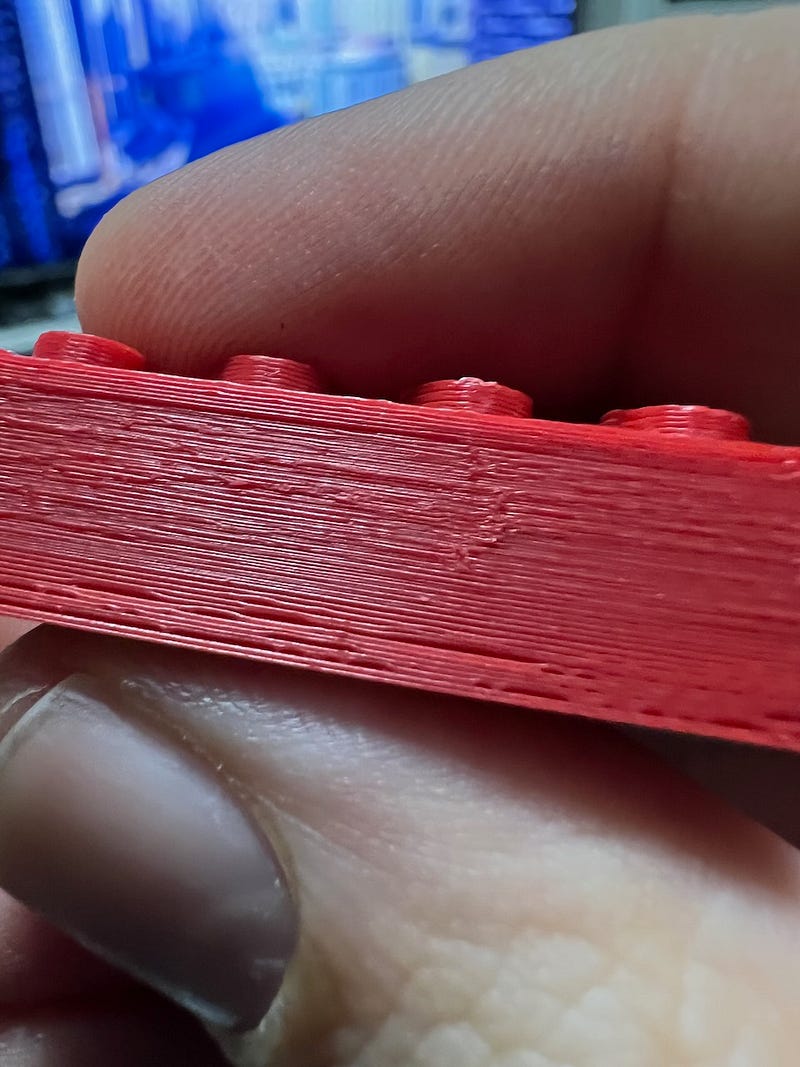
- PLA, while certainly doesn’t have the shine of ABS, and the layers are somewhat visible even at high resolution, is still a capable material to create bricks with near perfect accuracy.
- Resin, while noticeably smoother in texture, suffers a bit from shrinkage and where it’s most noticeable, is the studs. Resin is also brittle enough that after sticking to a few other bricks, both PLA and genuine LEGO parts, one side of it cracked.
- The inner pipes seem to be the biggest struggle for both 3D printers. They’re all simply far too narrow to accommodate a stud.
- Gripping power is excellent on the PLA bricks, and passable on the resin brick.
- The tiny runoffs on the PLA studs can ruin an otherwise near-perfect brick. This is something that might need further adjustments to settings and a few more tests.
- Height seems to be something that the filament printer had the least amount of trouble getting right. Width and length, on the other hand, were compromised by the wall thickness, which was far too much. This can be improved upon, though.
Viable or not?
I think yes. In fact, I think yes to such an extent that in January I am going to order myself a 3D printer, potentially this one made by Prusa Research. It looks like a mid-range printer and according to specs, and my buddy Andrew, it should even surpass the quality that we’ve experienced in our prints. I’ll research a bit more, as I’m happy to go higher in price, should I be able to get my hands on something even more accurate.
Obviously, the goal here is not for me to start printing my own LEGO. I am pretty much a purist when it comes to building with LEGO bricks, but I think I can marry my love for LEGO with a bit of 3D printing science and blog about it in the meanwhile. Given that I am looking to print small enough pieces, I don’t need a large printer, so something small but mighty is perfect for me.
Ultimately, should things go well enough, the secondary goal will be to “invent” new LEGO pieces, that don’t yet exist in The LEGO Group’s inventory. I see myself also doing brick printing time-lapses, which I would then post on YouTube, TikTok, and Instagram.
I think printing LEGO compatible bricks at home is already a reality. The question is more about whether it’s worth it or not?
What do you think?
Attila Vago — Software Engineer improving the world one line of code at a time. Cool nerd since forever, writer of codes and blogs. Web accessibility advocate, LEGO fan, vinyl record collector. Loves craft beer! Read my Hello story here! Subscribe and/or become a member for more stories about LEGO, tech, coding and accessibility! For my less regular readers, I also write about random bits and writing.


