
Shamed as “Fatphobic” for Pursuing Better Health
This feels like some next-level gaslighting
In my journey to improve my health and wellness, I’ve gotten lost within the dark side of the fat acceptance, body positivity, and Health At Every Size (HAES) communities.
Hi, I’m Holly, and I’m a food addict. I’m technically obese. My weight hopped into that range when I gained 60 pounds (in one year!) about five years back. I’ve slowly gained about 10 more pounds since then.
Most of this is a result of my struggle with binge eating, binge drinking, and spending more quality time with Netflix and Hulu than any sane person should.
Over the past several months, I’ve been trying to get back to loving my body and improving my health in a sustainable way.
My health goals are to:
- Overcome my addiction
- Lose the excess weight and feel more comfortable in my body
- Lower my high blood pressure and high cholesterol — and lessen my snoring (which has gotten much worse after the weight gain)
- Help my depression and generalized anxiety disorder (both of which go haywire when I eat too many processed sugars/carbs)
- Gain more energy and improve my mental health by consistently honoring my love of movement, running, and dancing
One way I find inspiration and motivation is by consuming content around health and wellness. I love to read articles, listen to podcasts, and follow people on social media who are in a similar situation, or who have been there and can share their experience.
But in doing this, some pretty extreme diet culture critics made their way into my feeds. I fell down a rabbit hole watching content creators actively shame others for wanting to get in better shape and practice healthier eating.
I’ve seen many body positive content creators make generalized snap judgments by labeling people who want to lose weight, tone up, or get fit as “fatphobic.”
For those critics who sling judgments based on a photo of someone's body — isn’t the whole idea of body positivity to not judge people based on their appearance (whether they be plus-size, straight-size, or any other size)?
It’s gotten to the point where I need to stop consuming this content because it’s affecting my mental health and my physical well-being.
As someone who is trying to make strides in her own health journey, it’s been really confusing to me — and it’s discouraging me from trying to make positive changes.
In some cases, it even set me back into dangerous eating disorder territory.
But it’s important to note that I don’t blame anyone for triggering me — others are free to share their ideas even if I disagree with them. It’s just a matter of knowing when I need to quit immersing myself in a social movement that, for me, personally, is doing more harm than good.
Here are a few pointed examples I’ve found, followed by ways we can work together to promote overall health, inclusion, and self-love — without the shaming.
If You’re Triggered By Seeing Someone Ramp Up Their Health Goals, Ask Yourself Why
A few nights ago, I binged. I binged a lot. I’ll spare you the gritty details, but I consumed enough food for three or four people, and it made me feel physically ill. This was after I’d enjoyed a large, non-restrictive dinner to boot. It was an emotional response to stress, a harmful coping mechanism — and I was not at all hungry when I started.
Everyone has setbacks, and there’s no reason to beat ourselves up for it. The part that concerns me though is that I also purged after my binge, and it’s the first time I’ve had an episode like that in years.
Like everyone on the planet Earth, I’ve been pretty stressed lately. I’m struggling with my mental health, we’re down two team members at my day job, my marriage is kind of in the shitter, and my in-person friendships are pretty much non-existent at the moment.
On top of this — I think I reached a breaking point after reading an article by Shannon Ashley called “How Shall We Deal With Our Pandemic Bodies.”
I greatly admire so much of Shannon’s honest and vulnerable writing, but this piece struck an emotional blow to me and my efforts to get healthier.
The way she judges Will Smith for his desire to get back into nutrition and fitness made me feel judged as well. I even recently made my own similar post, showing my belly, before I know his existed. In his Instagram post, Smith shares that he wants to “feel better” and stop overeating — and that he’s currently in the worst physical shape of his life.
Mr. Smith, I FEEL you. I can relate — and thank you for making me feel like I’m not so alone.
The article I read also deals a heavy dose of criticism to Jamie Lee Curtis for a time when she was vulnerable and shared publicly that she’s not comfortable with certain aspects of her body. The author writes:
People are so, so edgy about their pandemic bodies right now, and that edginess is rooted in fatphobia. They just can’t bear to admit it.
The scary part about that isn’t just the harm they’re doing to themselves and others with preexisting eating disorders. What’s really scary is that we’re currently seeing a swarm of folks start dabbling in diets as a result of the pandemic and associated fatphobia.
Accusations like the above — that assume one’s desire to lose weight is steeped in fatphobia — gut me to the core. I’ve gained my weight due to a terribly unhealthy eating disorder, and wanting to get my body to a healthier state has zero to do with a fear of fat.
Even those who don’t have a specific health reason to lose the excess weight they’ve gained have every right to do it if that’s how they prefer their body to be. Do you love being 450 pounds? Wonderful — enjoy. Do you maybe feel more comfortable at 180 and want to work your way toward it? That’s swell too. It’s not the number on the scale that matters — it’s whether or not you feel healthy and happy with yourself.
Up until now, I hadn’t purged in a long, long time. And it wasn’t Will Smith’s or Jamie Lee’s Instagram that did it. I actually feel understood by their posts, and I feel motivated to love myself better and take better care of this one body I’ve been given.
It’s not helpful to generalize such complex and nuanced ideas by making the sweeping judgment that someone who documents their healthy weight loss journey is “doing harm to themselves and others.” That’s completely backward — and I feel like I’m being told two plus two equals squirrel.
Am I doing harm to myself by not binge eating? By not drinking two full bottles of wine on a Wednesday night? Am I doing harm by going on a long walk on a beautiful day? By documenting my determination to get healthy on my social feed?
I feel like I’m being gaslit — being told I’m acting in an unhealthy and harmful way for wanting to do things that will ultimately make me healthier.
Am I crazy?
We wouldn’t shame a person for getting treatment for a mental illness, like bipolar disorder. So why shame someone for treating their physical health by tending to their fitness and eating habits?
Fashion YouTuber With Lipedema Shamed For Losing Weight
Maybe I’m misunderstanding. Maybe we’re allowed to embark on a health journey without judgment — we just can’t talk about it.
One thing I love about the body positive movement is that it encourages us to be more loving and accepting. It encourages us to drop harmful stereotypes and not judge others by appearance.
Take Anna O’Brien, a fashion blogger with a successful YouTube channel, Glitterandlazers. Anna was shamed by fellow YouTuber, Corissa Enneking (FatGirlFlow), for talking about her health journey on her channel.
The reason for Anna’s new food and fitness journey? To improve her health and mobility. Anna, who always loved her body at the size it was, began to actively lose weight when the pain of walking and getting up and down became too much due to her lipedema.
Anna opens up about her diagnosis and her health journey in an emotional video, explaining that her reason for losing weight is to help with pain management and to slow down the progression of her chronic condition.
In turn, Corissa created a video taking Anna to task, shaming her for “alienating her audience” and “invalidating the experiences of fat people.” All because Anna was taking action to manage her health condition!
“It’s just not something we need to discuss on YouTube,” Corissa says. “It feels almost predatory.”
ObesetoBeast, who changed his own habits when he reached nearly 400 pounds at one point, talks about issues like this with the most common sense I’ve ever witnessed.
Enter: the voice of reason.
But here’s another thought. One that should be obvious in a community that’s all about not judging or shaming others: it’s okay if you want to lose weight for health reasons. It’s also okay if you want to lose weight or tone up for aesthetic purposes. And it doesn’t matter who your audience is, or if you even have one.
My body, my choice, yes? You’re free to get that liposuction (whether it’s for health or looks). And you’re free to work out. If you want to do neither, then do you!
Telling others not to talk about or share their journey on their own platform is absolutely bonkers. But the women of Beauty Redefined are doing that very thing when they discourage people from posting the results of their hard work in before and after photos.
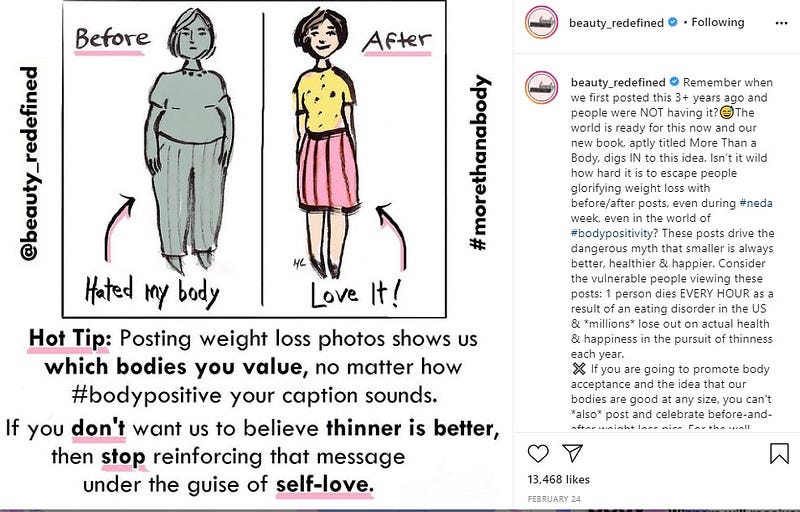
Remember when we first posted this 3+ years ago and people were NOT having it? The world is ready for this now and our new book, aptly titled More Than a Body, digs IN to this idea…
— Beauty Redefined IG post, Feb. 24, 2021
Guess what? Weight loss can totally be an act of self-love! Especially for someone like me, who loses weight when she stops numbing her pain with junk food and booze.
According to some extremists, we must stop glorifying losing weight by showing our transformations online. But, we can glorify gaining weight online. And by this odd logic, I guess it’s not okay for the diet industry to sell you stuff, but it is okay for the body positive or fat acceptance community to sell you stuff?
My view is the same as previously stated — to each their own. It’s okay to show before and after photos, and it’s also okay not to like it. But let’s not demonize those who share their journeys.
And let’s not demonize the health and fitness industry for making and selling products. Everyone’s got a book, affiliate links, or a monetized blog to help sell their opinion. Capitalists gonna capitalize.
It’s up to us, the consumer, to decide if a product is bullshit, or if we want to buy it. We get to choose.
And — if it truly triggers you to see others doing the work to embark on a weight loss journey in a sustainable, healthy way, it may be time to reflect on why that is.
Toxic Acceptance Culture is the Mirror Image of Toxic Diet Culture
I’m a big fan of the Zero F*CKS Podcast. These ladies support and uplift women of all shapes and sizes. They understand that each person’s journey is going to look a little different, and what helps one person may not help another.
One of my favorite episodes is called “F*ck Toxic Acceptance.”
In it, Dawn and Lonnie discuss a woman who was shamed in an intuitive eating support group for asking questions. This woman asked the group if maybe she was doing intuitive eating wrong, or was it possible that it might not work for her? She was trying to listen to her body, but her eating was still completely out of control and her weight was skyrocketing to the point that she didn’t feel healthy. She dared to ask: At what point does some kind of portion control come into play?
The response from the group was to shame her for even thinking about portion control — she just needed to eat whatever she wanted all the time and accept her body.
But for some, personal boundaries are vital. We have social boundaries and physical boundaries when we’re around others. Some online writers set a mental health boundary not to read the comments on their posts.
Some of us who struggle with food addiction need to set a few food limits, and that’s okay. If I think having a fourth donut just isn’t going to make me feel good, even though my sweet tooth intuitively says I need to consume it, it’s okay for me to not listen to that voice.
It’s also okay to have physical goals. If Jamie Lee wants a six-pack or whatever, who are we to judge her for that?
Some of us turn to nutrition and fitness as a way to help us with our eating disorders. Some of us binge not because we restrict our eating, but because we’re addicted to sugar and to the act of eating itself, even when we’re not hungry.
It’s important that we don’t prescribe food freedom or intuitive eating as a blanket cure-all that works for everyone. For some, it works. For others, it doesn’t.
What We Can All Agree On
We can’t accurately gauge someone’s reasons for getting into a new fitness or nutrition routine based on what they look like. When you don’t know someone personally, you don’t know the intimate details of where they’ve been or where they want to go.
Maybe someone is on a fitness journey because they want more mobility and energy to be active with their children.
Maybe they want to climb a mountain.
Maybe they need to build stamina for an acting role that is very physically demanding.
Personally, I rev up my running routine when I’m in a musical theater show, because it increases my breath support and helps my singing.
No matter your size or your health goals, I think there are some things that are ultimately true:
- It’s okay to lose weight for health reasons.
- It’s okay to lose weight for aesthetic reasons. If you don’t go outside completely naked every day, guess what — you’re doing something for “superficial” aesthetic reasons.
- It’s okay if you love and accept your body, just as it is.
- It’s not okay to shame someone for being fat, slim, or anywhere in between.
- It’s not okay to shame a person for wanting to lose weight or strength train in a healthy, sustainable way — even if you don’t think they’re “too big” in the first place. This recently happened to Zita Fontaine, who was called a fat-shamer for wanting to transform her body.
- Healthy food and exercise have so, so many more benefits than just physical — including mental and emotional.
My wanting to lose excess stress weight around my belly because it makes tying my shoes painful does not mean I’m fatphobic. It also doesn’t mean someone else can’t be totally comfortable with and love their bigger belly just the way it is. There is space for all of us, and we need to love and respect our differences.
Sign up for my newsletter, and you’ll get updates on my latest creations. You can also connect with me on the Sex Curious Podcast and Twitter!


