
How Shall We Deal with Our Pandemic Bodies?
We’ve got a real problem, but maybe it’s not the one you think.
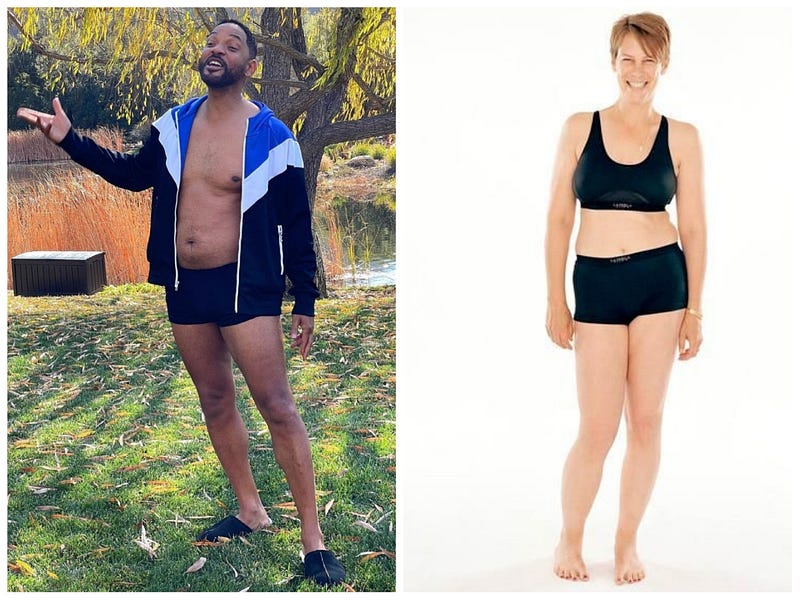
This morning, I ran through my Instagram feed — which is usually a pretty positive experience, honestly — when I saw a post from Jamie Lee Curtis. When I first glanced at the images, I was pleased and thought I was going to read a message of self-acceptance.
Instead, I was deeply disappointed to read one of subtle self-loathing and fatphobia wrapped up in a so-called message of self-love. It’s not that she didn’t say some beneficial stuff — it’s that she contradicted her own positive message with a very negative one.
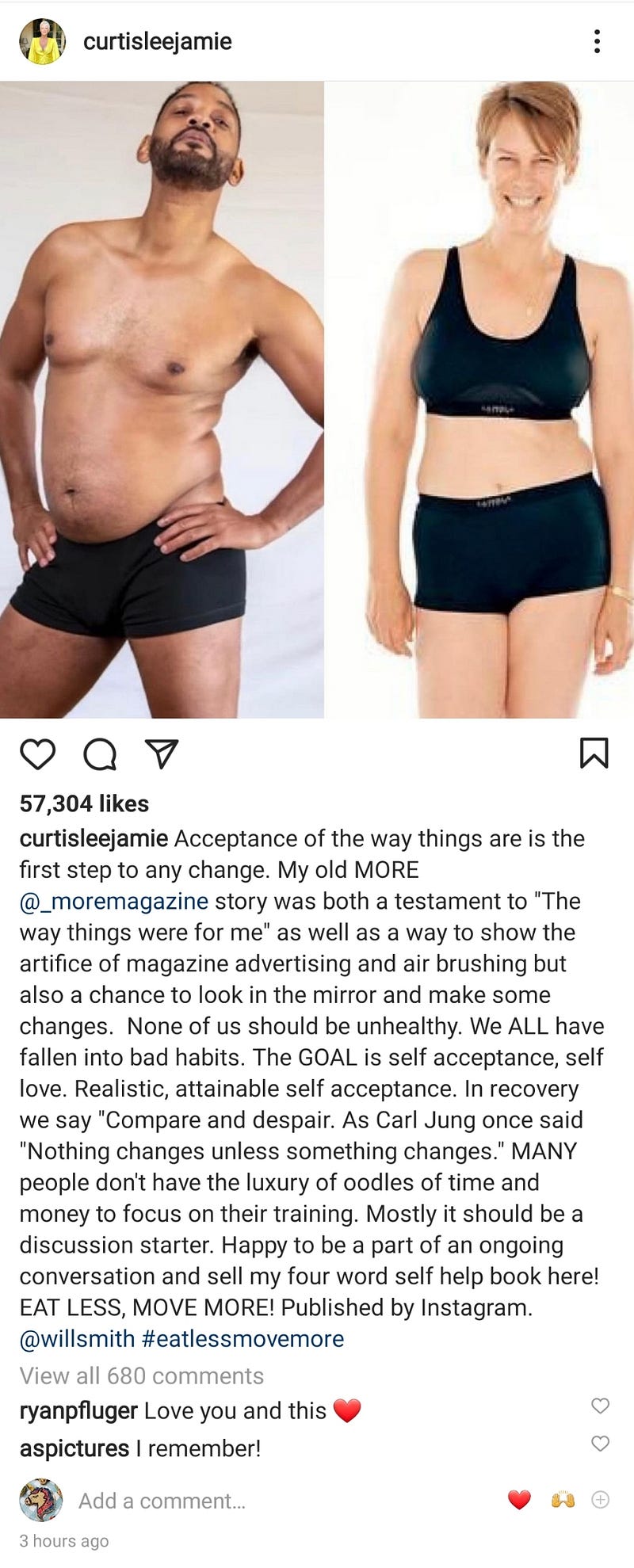
According to Jamie Lee Curtis (emphases mine):
- None of us should be unhealthy.
- We all have fallen into bad habits.
- Self-help is essentially EAT LESS, MOVE MORE!
- #eatlessmovemore (so important, apparently, that she had to say it twice).
If you don’t know what’s so problematic about Curtis’s comments, diet culture has pulled you in too deep. That’s not an insult. I’m not shaming Jamie Lee Curtis either.
Most of us have all said these sort of ableist and tone-deaf things. Trust me, I’ve said them too. That’s how deeply ingrained these ideas are in our society.
I was curious, though, why she posted the picture of Will Smith and tagged him too. So, I went over to his Instagram account and quickly saw these two posts:
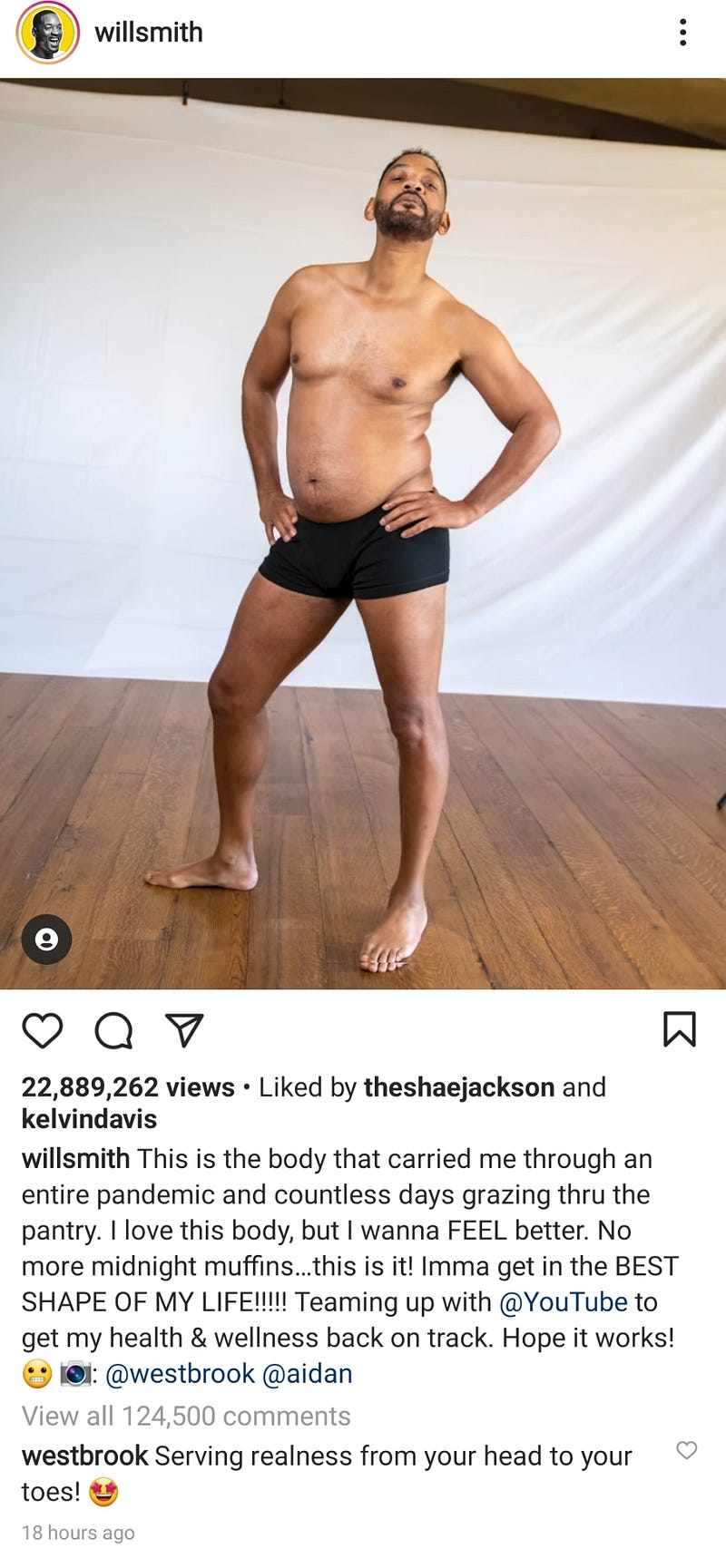
Once again, this post looks amazing! Real and untouched — even less touched — photos from celebrities have an important place in social media. It’s not just women or white people who deal with disordered eating, insecurity, or body image issues. I was so ready to give it all the love… and then I read his caption.
I can’t decide if his caption is better or worse than Curtis’s. Part of me feels like this is ever so slightly better, but then again, that also makes it more subtle. And sneaky.
Here are some of the negatives we — perhaps subconsciously — glean from Will Smith’s post:
- He gained weight from grazing during the pandemic (which isn’t actually over, by the way).
- He doesn’t feel good in this body.
- People can’t be in good shape and eat midnight muffins.
- He’s determined to get into the best shape of his life! (As if this right here is a very low point?)
- His health and wellness is somehow way off track.
- He hopes it works…?
Now, just prior to that post, he uploaded this photo, which is again very vulnerable and commendable. But he shifted his message to such an unfortunate and negative place with that caption:
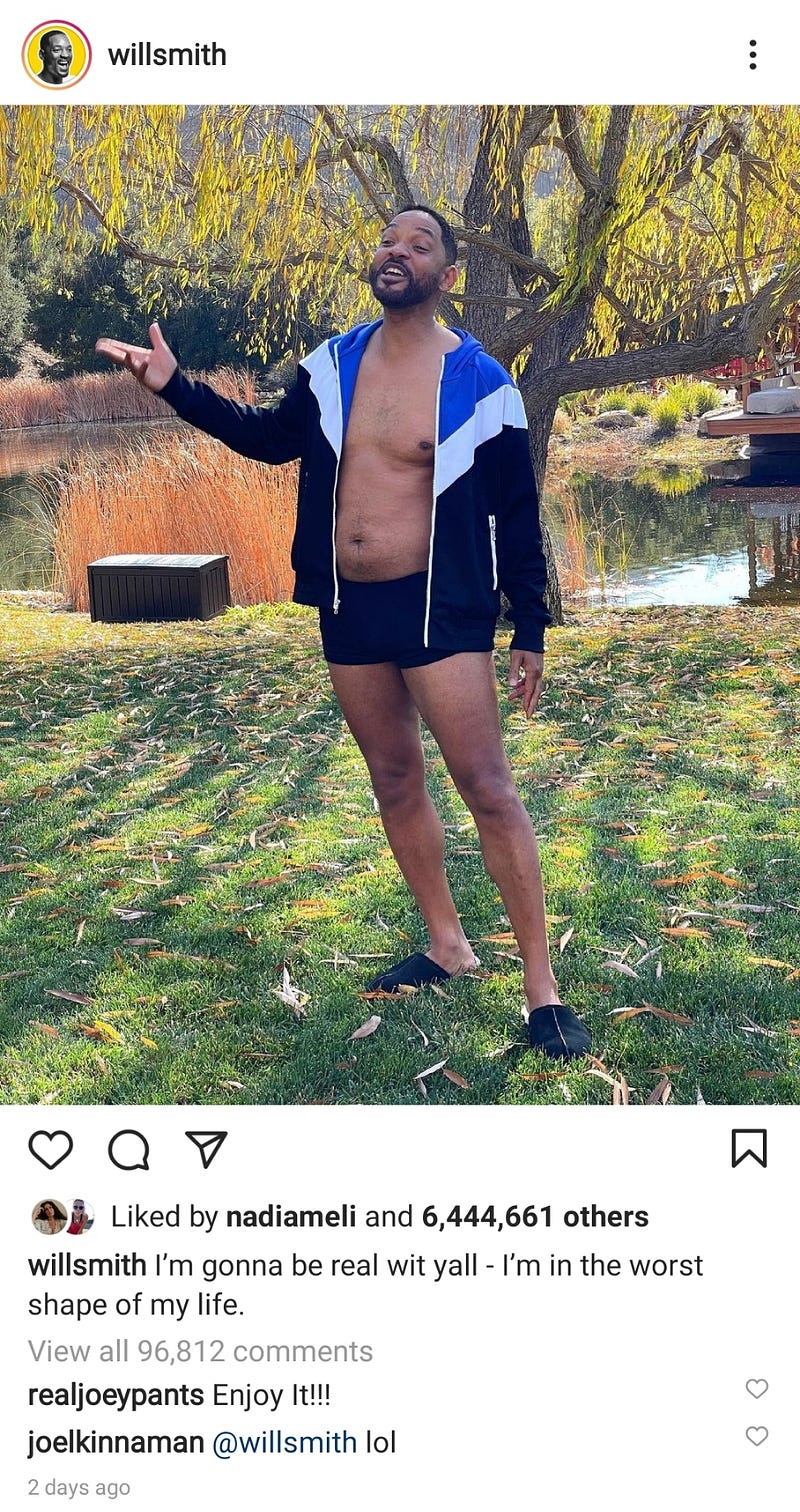
This pic has so much potential and I really do like how he didn’t assign any overt moral value in the moment. Sure, he said he was in the worst shape of his life, but he didn’t equate a person’s overall health to exercise and weight. Not yet, anyway.
He also didn’t bring up the issue of change, training, or eating, etc. So, this really could have been the beginning of an important public conversation about our bodies, diet culture, and the dreaded “pandemic body.”
But that’s not what happened. Instead, he followed up that very vulnerable photo with a diet culture get into gear message that basically says, “I love my body but… I’m too fat.”
And much like Curtis’s post, if you can’t see the problem with Smith’s messages, you’ve absorbed too much diet culture too. I’d like to reiterate that my message is not about shaming you, Smith, Curtis, or anyone for buying into diet culture. I’m putting the message out there for you to see the problem and why it matters.
Many people (and quite possibly most people) are having a tough time with their bodies after more than a year of the coronavirus pandemic. Most of us have had at least some reason to feel stressed out and a lot of folks have felt bad about stress-eating, relaxed exercise schedules, or their perceptions of “unhealthy weight gain.”
Earlier this year, I wrote a story about the whole “skinny jeans debate” of 2021. In it, I talked about how a very liberal, conventionally beautiful, straight-sized Facebook friend became extremely angry and upset with me for pointing out why cracking jokes about people wearing wide-leg jeans (because they supposedly look fat and unflattering) is so privileged. My comments struck a deep nerve and I was virtually laughed off the thread with her and her other friends telling me to drop the “woke brigade” nonsense.
Honestly, they weren’t even listening to what I had to say. They misinterpreted what I meant when I said that skinny jeans aren’t body-positive, and it didn’t matter how much I tried to explain that the jeans themselves are neutral. We’re the ones who try to give clothes a deeper meaning — often at the expense of others.
It was all so ridiculous that I posted a picture of my lipedema legs to clearly illustrate the point I was making that they refused to read. My point was that some bodies might need wide-leg jeans, so, the jokes about them being frumpy or ugly because they think they make people look fat are not helpful. It’s yet another “fat = bad” message.
To my disappointment, rather than accept that she had even an ounce of privilege or had made tone-deaf and fatphobic remarks, she sent me a string of private messages. The gist I gathered was that I didn’t have a right to bring up conversations about body privilege wherever I liked, and that I was wrong to have ever said anything in the first place. Then, there was this weird posturing about how even though she was so hurt and upset about what I’d done (tears were mentioned), she felt for me and my condition and respected the hell out of me.
It was a lot for me to take in, honestly. It’s always a lot to take in when I learn that straight-sized people who claim to be body positive still believe it would cost them too much to be genuinely supportive of fat or bigger bodies like mine.
And it’s not as if I couldn’t see what was going on. She was clearly and deeply uncomfortable with her pandemic body. But she felt that her skinny jeans had more give and support for her new body, and so, all she really heard was skinny jeans aren’t body positive. It didn’t matter that I said wide legs aren’t body positive either. It didn’t matter that I explained there are lots of bodies that can’t fit into skinny styles so it’s pretty devastating when a store only carries those cuts.
Her response was that I should know better because fashion isn’t about accommodating various disabilities. I shouldn’t be shocked when people say such things, but I always am.
At some point, we’re not even talking about fashion. We’re literally talking about the fact that every person needs access to decent clothing that fits.
But people are so, so edgy about their pandemic bodies right now, and that edginess is rooted in fatphobia. They just can’t bear to admit it.
The scary part about that isn’t just the harm they’re doing to themselves and others with preexisting eating disorders. What’s really scary is that we’re currently seeing a swarm of folks start dabbling in diets as a result of the pandemic and associated fatphobia. This means we’re poised to see a significant uptick in eating disorders directly related to quarantine.
And eating disorders are the deadliest mental health issues around. That’s something to take seriously, people.
However you feel about your body, those feelings are real, but they’re not necessarily true. You aren’t a bad person if you put on weight. You also aren’t doomed to be unhealthy at a higher weight. Usually, the human body is pretty great about changing in response to its different needs and new environments. Our bodies are actually built for change and in most cases, a natural weight gain or loss and that sort of unintentional shifting is normal and not unhealthy.
But here’s where it gets weird. Once we start dieting and intentionally try to reduce our body weight or size, that’s when our bodies and minds begin to suffer unintended consequences. It’s quite the list, but here are just some of the dangers of dieting and intentionally trying to lose weight:
- We become more obsessed with food and/or exercise and following the “right” rules.
- We lose touch with our internal hunger and fullness cues and rely upon external voices to tell us how to eat.
- We struggle to know when “enough is enough.” Did we cut out enough calories? Lose enough weight? Exercise enough today?
- We become more critical of our bodies.
- We judge our self-worth or value by our appearance, body shape, weight, or size.
- We oversimplify reality and think that good health = proper diet and exercise.
- We view “good health” as a moral achievement and “poor health” as a punishment for making “bad” choices.
- We experience guilt over eating certain foods, and sometimes, any foods.
- We believe we have to earn our food to deserve it.
- We judge the health, morality, and value of others by simply looking at them.
- We experience physical effects like hair loss, nutritional deficiencies, dental problems, injury, depression or mania, slow healing, a reduced metabolism, headaches, fatigue, muscle loss, menstrual problems, and more.
- Regain is the standard result of dieting, and typically, people gain more than what they lost. Yet, we tell ourselves that regain only happens to weak-willed people.
- We develop an increasingly greater fear of fat.
- We neglect to see the signs of eating disorders in ourselves and others.
- We celebrate eating disorders without even realizing it.
- We ignore the issues of privilege in dieting and standards of beauty.
Sadly, self-loathing and feelings of guilt over eating the supposedly wrong foods or gaining any bit of weight are so widespread, few people even recognize such reactions as unhealthy. Diet culture is an industry, though. It has a vested interest in your constant struggle. Even we talk about self-love and acceptance, the message goes haywire as soon as we turn it into a diet culture, “pull yourself up by your bootstraps” or “show yourself some damn respect” sort of thing.
We demonize being human and actually make it harder to achieve healthy goals. Instead of embracing a full-spectrum or nuanced definition of health and wellness, we turn it into something very rigid and even toxic. Health becomes something only the privileged can achieve.
See, back in 2002 when Jamie Lee Curtis posed in undies for that untouched photo, it felt like such a boon for women and a blow to the false narratives of perfection. But in those days, we also thought Joss Whedon was a feminist, and words like “consent” or “privilege” still weren’t a part of our everyday vernacular.
Do you know what?
It shows.
Jamie Lee Curtis did that photoshoot for More Magazine. And here’s what she said at the time:
“There’s a reality to the way I look without my clothes on,” she told the magazine. “I don’t have great thighs. I have very big breasts and a soft, fatty little tummy. And I’ve got back fat. People assume that I’m walking around in little spaghetti-strap dresses. It’s insidious—Glam Jamie, the Perfect Jamie, the great figure, blah, blah, blah. And I don’t want the unsuspecting forty-year-old women of the world to think that I’ve got it going on. It’s such a fraud. And I’m the one perpetuating it.”
Let’s look at her photo again, folks:
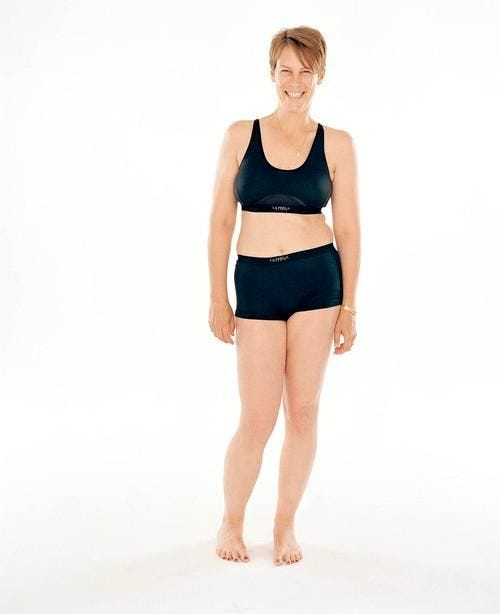
She said, “I don’t have great thighs. I have very big breasts and a soft, fatty little tummy. And I’ve got back fat.”
Isn’t there something sort of unnerving about her comments? A little… self-loathing, even?
Twenty years ago, this was a big deal for positivity, but… today, it looks like it was a diet culture message after all. Hell, Curtis basically said as much today. Today, she even frames it as accepting where you’re at so you can change.
But what do you actually see when you look at that image above? Do you see thighs that aren’t that great? What about very big breasts (which apparently were yet another imperfection)? And a soft, fatty tummy?
When Jamie Lee Curtis talks about her body like that, what message does it send the rest of us?
And when Will Smith sticks out his belly and laments that he’s the most out of shape he’s ever been, so he’s going to quit eating muffins (carbs) at midnight (uh-oh, late-night snacking, a so-called bad habit), and workout for all of us on YouTube… that all sends a pretty powerful and fatphobic message.
The title of this story asks “How shall we deal with our pandemic bodies,” and I’m not asking because the pandemic is actually over. I’m asking because some of the most privileged people in the world are now behaving as if it’s over and they’re taking the whole conversation about pandemic bodies in the wrong direction.
Folks, it’s okay to have mixed feelings about your body right now. You’re also not a bad person if you’re going through your own bout of fatphobia. Given the culture we’re in, it’s pretty much to be expected. However, we know a lot more about the effect of diets on our bodies today. More and more researchers are coming to terms with the fact that diet culture — particularly since the 1980s has been like one big social experiment.
It doesn’t even matter what diet you’re on. The outcomes are pretty much the same. Regain, yo-yo diet, or stay stuck in disordered eating. Most celebrities like Will Smith and Jamie Lee Curtis are going to opt for disordered eating and often, obsessive training and exercise.
That doesn’t mean you should try to follow their examples.
If you’re feeling out of shape from the pandemic, there are resources to help you improve your fitness without obsessing over results, numbers, or food. There is freedom from the shame and pain of unrealistic beauty expectations. But we’ve got to get real and talk about our bodies in healthful ways.
We can’t just do everything that a disordered eater does — as long as we think we’re too heavy or flabby to be healthy. The truth is that disordered eating is unhealthy for any body, shape, weight, or size. Reject diet culture and subtle body hate.
Opt for healing your relationships with food and your body instead.
For further reading:
If you love my work and want to support my efforts to break cycles of stigma and shame, visit me on Ko-fi. From there, you can follow and support my future projects.