
Writing Tips
Several Short Sentences About Outlines
Outlining with clarity using the power of short sentences.
Ever had a bad case of writer’s block?
10 days ago, I experienced it for the first time— IT IS THE WORST!
My brain was in immense pain for days!
I’d brainstorm for hours and still couldn’t form one original thought. I had hit a major wall, and no matter how hard I tried, I couldn’t get over it.
- I tried taking a day or two off to refresh my brain.
- Drinking coffee in the mornings.
- Studying articles on ideation and writing slumps.
- I even tried changing my work environment.
Nothing worked.
That is, until I started this book — “Several short sentences about writing”

After reading only 33 pages, my writing drought came to an end.
Immediately, I began writing this article — “Wohoo, I Think I Finally Found My Niche!”
The ‘Woohoo’ didn’t just represent the excitement I felt from finding my niche but also how I felt while writing the piece. All it took was 33 pages of reading for my fingers to begin writing by themselves as if I had taken a limitless pill. It was my best article up to that point by a long shot, and I owed it all to that book.
The book is so entertaining and filled with an abundance of wisdom on writing — I recommend you read it (affiliate link here). The prologue masterfully prefaced the mindset required to enjoy the book. It got me into a hypersensitive state of mindfulness, and I was able to make connections while I read. His rhythm, word choice, varying sentence structure, use of white space, etc. — I was in awe the entire time!
It challenged my way of writing, it forced me to question my philosophies. Philosophies that I’ve been carrying with me since before I learned to write. I used to think I had to make sentences longer to sound “smart.” Overexplaining concepts — creating unnecessary sentences out of fear.
In only 33 pages, the author made me realize 3 key truths:
- I never truly understood what my words meant.
- The way we are taught to write is unnatural.
- Short sentences can be smart, too.
My stories are more engaging, and my voice has improved dramatically.
I owe all my thanks to this book.
The biggest impact came from my outlining process — it’s something I used to dread. Now, it has become my favorite part of writing. Now, it’s free-flowing and logical. Because of this improvement, writing is no longer filled with unnecessary sentences and weak arguments.
In this article, I plan to show you my new outlining process, along with how I develop my outlines into full-length pieces.
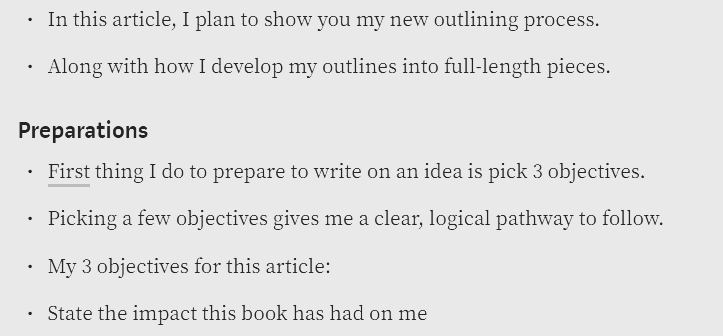
Preparations
First thing I do to prepare to write on an idea is pick 3 objectives. Picking a few objectives in the beginning gives me a clear, logical pathway to follow.
My 3 objectives for this article:
- Share the impact this book has had on me
- Educate readers on how I’ve implemented this book into my writing
- Provide my new process for outlining to readers
Then, I create a rough headline for my idea. It doesn’t have to be perfect, but it does have to capture the essence of the article.
From here, I can start writing my outline.

Rules
Before I begin outlining, there are a couple of rules I keep in mind.
- Write my sentences like I’m speaking them.
- Only delete something after finishing the thought
- If a sentence is longer than one line, ask, “Can it be said better?”
- Ignoring diversification of sentence structure until the end
- Add value with each sentence
Yes, I do edits during my outlining.
Many people say not to do this, but my brain can’t help it. If I see a red line, I will be distracted by it the whole time anyway. If you can ignore the red line of imperfection, then be my guest.
Moving along.
Introductions First
I used to have such a hard time with introductions and hooks.
I’d spend hours trying to figure out how to hook my reader —
- Endless studying of articles on writing.
- Looking at the best examples of a hook.
- I even asked ChatGPT to help me
- and after all that, I still knew nothing — My hooks were bad.
But now, I recognize I was trying to follow someone else’s ideology. None of it was ‘me,’ and that’s why intros were always such a drag. I’ve learned to let go of ‘standardized’ writing. There is no right or wrong formula for anything. Writing has to be acknowledged as an art form for it to truly come alive.
I can force my words to mean what I want them to mean. Or I can let the reader decide.
When I’m writing intros, I take it as a challenge to introduce myself. Whether it’s through my observations or experiences, that’s my main goal. Sometimes, the intro becomes a bulk of my writing, like in this article — “5 Easy Ways to Fail Better.”
Sometimes, it may be a few sentences. It just depends on how I am feeling. And now, I pay attention to how I feel. That’s what I was missing in my writing— mindfulness. It’s the driving force behind all my introductions now.
Here are a few steps I consistently take when crafting my intros:
- I start with something polarizing or with something super relatable.
- Then, I talk about it emotionally. In the intro, I’m speaking on behalf of the reader or from my own perspective — building a connection with them somehow.
- After I’ve presented the subject thoroughly and all emotions are covered — I quickly sum up what the article will (or won’t) provide for the reader.
- My intro doesn’t stop here — I keep going on. I keep writing the next section as if it’s one intro. This helps with the transition between the intro and the body.
That pretty much sums up how I write my introductions now.
Undefined Sections
Next, I work on the bodies of my articles.
When I first started writing, my bodies were so dense and hard to read. I was writing complex sentence, after complex sentence —
“ I was not known as an organized person, and it wasn’t until half a year in I began to develop an organizational process for myself. By learning project management, you begin to have a label and definition for every area of a project’s facilitation along with timelines for completion. This allows for consistent organization and understanding of what goes where, when, and why.” — 3 Skills Every Successful Founder Needs, my 2nd article, ever.
Imagine reading whole articles of that… *cringe* I would never… again.
It also didn’t help that my depth was inconsistent.
My outlining process was to blame for all of this. I would try to predetermine my subtopics. Then, I would write three or four bullet points for each. This caused me to be thorough in some sections and shallow in others. This cookie-cutter method just didn’t make the cut.
Now, my sentences are like the perfect employees. They can function independently or as part of a team. This style allows me to sort my sentences, like legos, to follow a more logical order. It also allows me to remain concise and provide value without any filler.
The key for me here is that I never predetermine my sections.
I let my introduction and objectives guide me as I write. This allows my brain to focus solely on the individual section. I keep following a logical pattern for my sections until I’ve got my point(s) across.
It was unnatural filling in the blanks of an outline and then going back to make the ideas transition smoothly.
With my new method, I can take it one step at a time, and my sections will transition naturally.
And once I feel I have discussed the strongest points of my premise, I…
Move on to the conclusion.
Before I write my conclusions or reflections, I go back and edit my sentences. I’m only trying to clean it up enough to read it all the way through without stopping.

Once I’ve reread my entire outline, my mind automatically begins to summarize everything.
- I start writing out my final thoughts.
- I try to discuss how the body and the intro connect to each other
- If I have something valuable that wasn’t deep enough for its own section, I’ll add it here, too.
Once I have officially said it all, I will add in my call-to-action (CTA). Integrating a CTA seamlessly is something I am currently working on. Sometimes, they come off choppy and seem to interrupt the flow.
But practice makes perfect!
Note: I’d like to know what you think of my call to action in the comments — is it disruptive?
Reflection
Outlining with short sentences provides me with so much confidence.
I am able to visualize my sentences as colors and my articles as pictures. Knowing that no matter what I paint, it will be ‘MY’ painting.
My sentences don’t have to follow ‘the rules.’ I, can put commas anywhere I see fit. And I can start sentences with conjunctions. I can even end them with prepositions if I want to. It’s fun to paint with words.
I hope you enjoyed my art!
If you would like to hear even more unfiltered thoughts of mine, be sure to subscribe to my newsletter Walking the Blue Path.

Get practical tips, heartfelt stories, and a fresh perspective on turning your passion into success. Join a community that values meaningful success and personal fulfillment.
Subscribe now, and let’s continue this journey together.