
SEO: How Vital Is It For Your Success As An Online Writer?
Consider the pros and cons of how things really work behind the scenes
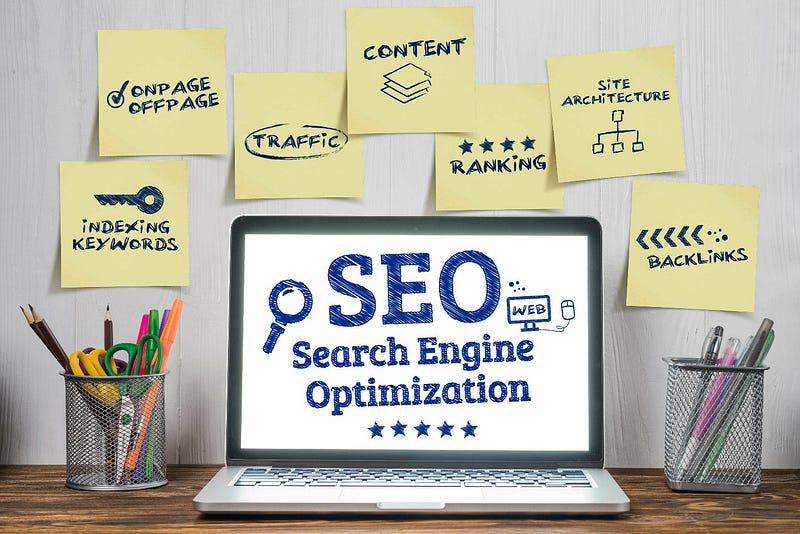
Search Engine Optimization. Read that phrase again. It means what it says. Optimizing your creations to make it easy for Search Engine robots (‘bots’) and crawlers to analyze your content.
Medium is not a search engine. The likes of Google, Bing and DuckDuckGo are.
So how much effort should you expend on it? What’s your ROI?
Also, how much of it can you actually apply to your Medium article?
Let me explain. There is both On-Page-SEO and Off-Page-SEO.
Off-Page-SEO is not really anything you have much control over. It relates to an “authority”, or “trustworthy” measure gleaned largely from the quantity and quality of “back links” to your article.
A “back link” is another site referencing your article –possibly not noteworthy if this is a relatively new article.
Accordingly, let’s stick to On-Page-SEO
…and it’s not just about keywords. On-Page-SEO includes other items such as:
- Time on site — how long the visitor stays reading;
- Page load speed — how long before you actually see anything;
- Article structure — a big blob of text or a series of flowing “subsections”;
- Relevance –don’t target ducks, and talk mostly about ferrets;
- Mobile-friendly — that it can be comfortably read on a mobile ‘phone screen;
- Image optimization;
- Broken links; and
- Other stuff — apparently Google has a couple of hundred factors it considers — forget that! You’re just trying to present an engaging article, not analyze the bejesus out of it to satisfy Google.
The problem is, Google adds up all these factors, and there’s not a lot you can do to directly influence them — certainly not all of them.
Remember, Google ‘bots’ are not human. They need to be able to identify tags in the source code of your article, and examine their contents. These are called ‘metatags’, containing descriptive and structural information about your content.
That’s why, for example, when creating a subheading in your article, don’t just bold it. Select it and mark it as a small capital ‘T’. That makes it a Heading metatag that Google can recognize.
Also, although the ‘bots’ can ascertain the existence of a series of “subsections”, they haven’t got a clue as to whether they flow or not.
Making your creation flow, and keeping your readers engaged — that’s your skill.
Which leads to my proposition…
Applying copywriting practices, will naturally apply SEO practices
By that I mean, applying a variety of tried and true copywriting guidelines, will result in coverage of relevant SEO measures.
For example:
- A well-crafted Title and Subtitle will entice the reader to give it a go in the first place. Have you heard of the ‘4 U’s’? Check out this Medium article by Kathy Widenhouse.
- The first ‘Lead’ paragraph also needs to be well-crafted. What is your promise/benefit for the reader? What is your ‘big idea’ here?
- A well-crafted ‘Body’ — subsections with alluring, curiosity-inducing subheadings.
- Relevance — ‘ducks’, not ‘ferrets’, if ‘ducks’ is your lure.
Of course, the whole thing needs to be interesting — vivacious even. Don’t let SEO constrain your creative expression.
Look, Ma, No Keywords!
How often have you cringed when reading the advice “…make sure you get your keyword into your Title — preferably up the front…”?
What ‘keyword’?. Do you have one particular word or phrase you’re supposed to splatter all over your creation? Kinda stifles your expressive diversity, doesn’t it?
Just for your information, HTML (your page’s source code) does have a ‘keyword’ metatag in its arsenal. Trouble is, Google largely ignores it, and has for some time. People used to stuff the metatag full of keywords, sometimes irrelevant, just to get higher up in the SERPs (Search Engine Results Pages).
Nowadays, Google is much more clever. It uses a “word-vector” approach to scanning your text, and gleaning its relevance to a topic, picking out synonyms, related words, phrases and entities.
Very smart.
This does not stop you from having a main phrase. If your article is about ‘pigs’, use the word, but if you talk naturally, using related phrases (swine, pork, swill, boar, bacon), Google will pick that up.
Advice: Don’t sweat over specific keywords. Sweat over making your article relevant and engaging. Keep that visitor reading right to the end.
Finally, who actually benefits from your spending time specifically targeting SEO?
SEO helps Search Engines.
If, as a result of your SEO efforts, you get a visitor from an external source (external to Medium), and that visitor avidly reads your creation to the end, you won’t get paid for it! Not from the Medium Payment Pool anyway.
Medium articles are not free to read by the general public (apart from 2 free articles a month).
Who might benefit?
- Medium might, if it can entice a visitor to join.
- You might, if you entice a visitor to join, but think about this: if you do, you receive a portion of the new member’s monthly subscription, reducing the amount that would normally go into the overall Payment Pool, hence reducing the amount available for distribution to other members.
- You might, if you are monetizing your article (e.g. through an affiliate link).
So, when you engage in all that SEO, whose side are you on?
Will you improve your writing skills?
Will you get more Medium followers?
Will your professional credentials get a boost (to help with other endeavors)?
Will you get rich?
Depending on your responses to such questions, the main message of this article is: don’t unnecessarily bust a gut on SEO.
Instead, rely on your own copywriting skills, your own natural expressive diversity, your own writing vivacity, to capture those quality readers and followers.
The article below by Tarun Gupta should help you along…


