
The 4 U’s Formula Ain’t Just for Copywriting
Use it to write headlines that pull in readers
Writing headlines is an essential skill for any writer. And it’s a skill you need now more than ever because readers have too much content to process. They skim and then decide what pieces to read. How do they choose?
It’s the headline that pulls them in. That means your headline needs to capture the reader’s attention. How can you check yourself to make sure your headline is doing a good job?
Use a headline-writing checklist
There are all kinds of helpful copywriting formulas you can use as you write headlines. One of my favorites is the 4 U’s. It’s a copywriting formula developed by copywriting master and success coach Michael Masterson.
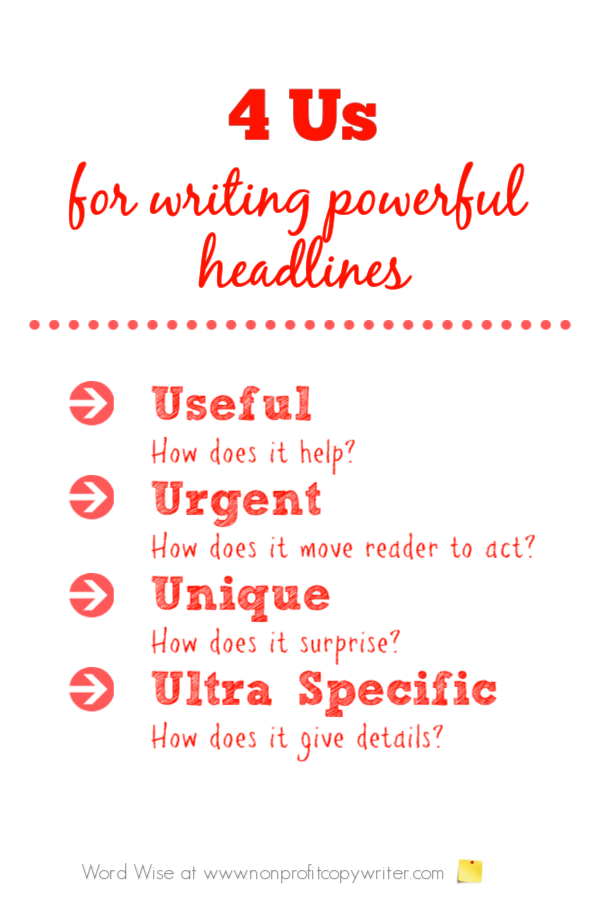
The 4 U’s specify four elements that produce powerful content: useful, urgent, unique, and ultra-specific. Together they create a helpful and easy-to-remember checklist. Here’s how to use them to evaluate and improve your headlines.
1. Useful: how does the headline help the reader?
Write a useful headline by showing benefits. How will what follows help the reader, relieve a problem, answer a question, provide a solution? Show what’s in it for him. When your headline is useful to the reader, he wants to know more and he will keep reading. A useful headline focuses on helping the reader.
2. Urgent: how does the headline move the reader to act?
An urgent headline moves the reader to act sooner than later. You can accomplish this by providing a time frame or deadline in your headline, which can motivate the reader to act before it is too late. Your headline also can reference a specific stress, pressure, or acute need that the reader feels. By tapping into her desire for relief, your headline communicates urgency and moves her to act.
3. Unique: how does the headline surprise the reader?
A unique headline is a surprise. It grabs the reader’s attention with a shocking fact, unusual statement, a special piece of information, or distinctive slant. But be careful in your quest for headline uniqueness that you don’t resort to gimmicks or clickbait. Rather, draw the reader in with a one-of-a-kind approach. Ask yourself, “Would I read more of the piece after reading this headline?”
4. Ultra-Specific: how does the headline give details to the reader?
An ultra-specific headline is big on details. It can include numbers, indicate steps, identify an explicit or exclusive piece of information, or offer a specialized slant.
Use the 4 U’s for headlines of all types
You can call upon the 4 U’s checklist when writing headlines for articles and web pages. But they work wonders for headlines of all other kinds, too: email subject lines, page titles, blog post headings, image captions … and even tweets (which operate like headlines.)
Priority order for using the 4 U’s in headlines
A headline that embodies all 4 U’s is a home run. But all 4 U’s do not have an equal impact on headlines. If you can’t hit it out of the park by including all 4 U’s in your headline, know which of the four elements take precedence.
The priority order is as follows: above all else a headline must give useful content to the reader in order for her to keep reading. Beyond that, it must be urgent — followed in importance by being unique, and finally ultra-specific. When you have those priorities straight, your reader will be enticed to move into your content. You’ve made her priorities yours … and you’ve communicated that in your headline.
Kathy Widenhouse offers tips and tutorials for writers at www.nonprofitcopywriter.com.

You just read another exciting post from the Book Mechanic: the source for writers and creators who want to make more work that sells and sell more work they make.
If you’d like to read more stories just like this one tap here to visit