
Send & Receive — The 7-Layer-OSI-Model
Wireless connection is one of the most important basic requirements that humanity needs. But how is it even possible to send or receive data? What are protocols and which ones are used? This article explains basic knowledge about networks and what the seven layers of the OSI model are all about.

Content
- What is a Network?
- What is a Network protocol?
- TCP & UDP
- Explanation OSI-Layers
- OSI-Model Protocols
- Conclusion
What is a Network?
A network is an association of two or more computers or other electronic devices that enables the exchange of data and the use of shared resources. The simplest network is the peer-to-peer network, in which two computers are connected by cables.
To get more details about networking, please read my article: A brief insight into Networks
What is a Network Protocol?
A network protocol defines how two computers communicate and exchange data. The protocol contains certain rules and definitions what format the data transmission must have and how it gets from computer A to computer B.
In the IP world, the Internet Protocol sets the rules for addressing. Higher level protocols such as Transmission Control Protocol (TCP) use addressing to transmit data. Application protocols such as HTTP, POP, IMAP, SMTP or FTP in turn use transport protocols such as TCP or UDP.
TCP & UDP
The most important protocols to know are TCP and UDP. They are used by most other protocols for data transmission.
TCP
The Transmission Control Protocol (TCP) is a standard that defines how to establish and maintain a network conversation over which applications can exchange data. TCP works with the Internet Protocol (IP), which defines how computers send packets of data to each other.
UDP
User Datagram Protocol (UDP) is a communications protocol primarily designed to provide low-latency, loss-tolerant connections between applications on the Internet
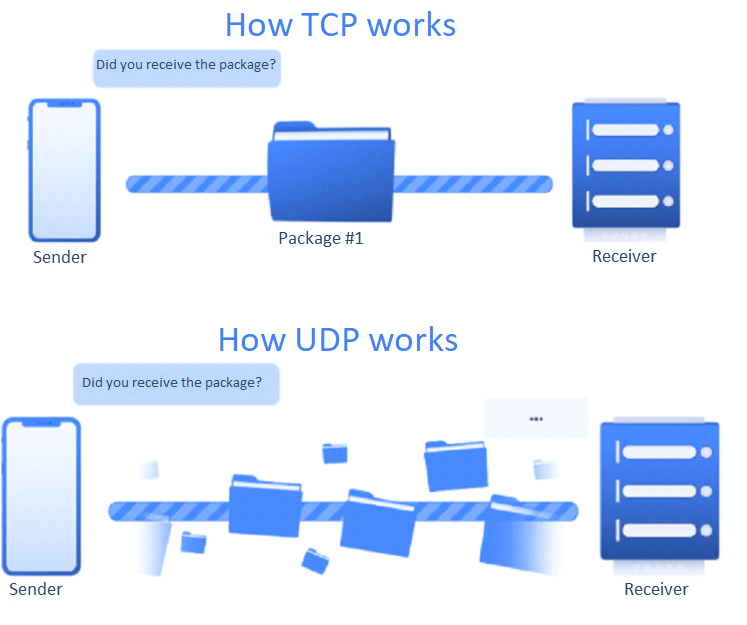
Differences
- the TCP sends individual packages and the receiver checks the information and sends an answer as to whether the package has arrived or is defective. This is used in normal internet usage.
- the UDP sends data packets in quick succession without the receiver checking the respective packets. This is used, for example, in streaming or online gaming because of the importance of speed in this kind of usecases.
The 7-Layer OSI-Model
Open Systems Interconnection (OSI)
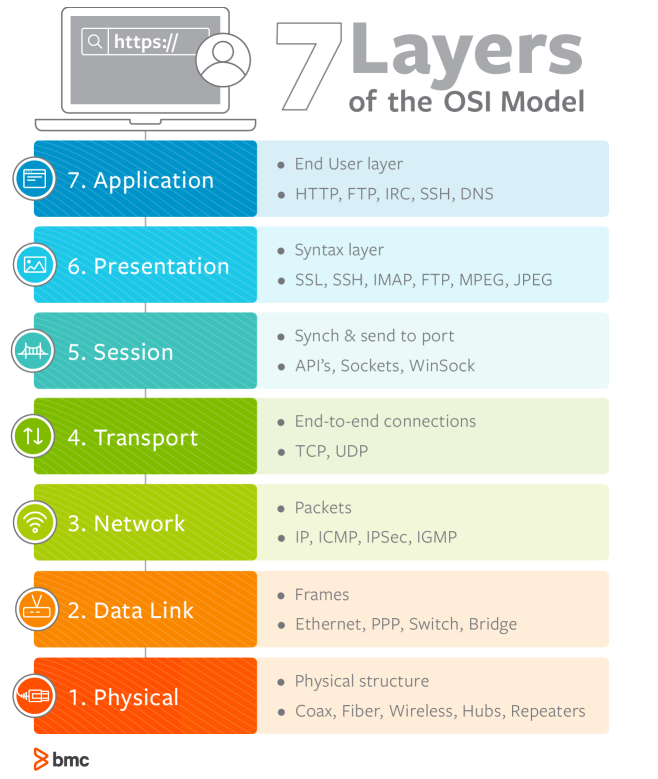
Layer 7 — Application
Layer 7 describes the interaction of a person in which applications access the respective network services. It is the closest layer to the end user and interacts with an application program.
Layer 6 — Presentation
Layer 6 takes care of the translation and adaptation of data formats between sender and recipient. At the same time, tasks related to encryption and compression of the transmitted data are located in this layer.
Layer 5 — Session
Layer 5 enables process communication between two systems. Layer 5 establishes and controls logical connections (sessions) between the systems.
Layer 4 — Transport
Layer 4 represents the interface between the transport system (layers 1 to 3) and the application system (layers 5 to 7). Important tasks are end-to-end and transport control.
Layer 3 — Network
Layer 3 is responsible for switching the data across the individual connection sections and network nodes. It takes care of addressing the communication partners and finding the fastest or cheapest way to reach the destination.
Layer 2 — Data Link
The task of layer 2 is to secure the data exchange in sections. For this purpose, the bits are combined in data blocks. Procedures for error correction, flow control and access to the transmission medium are defined.
Layer 1 — Physical
Layer 1 defines the physical and electrical properties for transferring bits between two components over a medium. In layer 1, the shape, dimensions and assignment of plugs as well as the electrical signals are defined.
Osi-Model protocols
In order not to keep the article listed here too large, I have decided to provide a more detailed description of the protocols used in another article Please click here: 7-Layer Network Protocols easily explained
Conclusion
The 7-layer OSI model describes how data is transmitted on the Internet and shows us that there is more to it than simply pressing a button. In order to get an even better insight into how it works, you should familiarize yourself with the respective protocols and understand what role they play. Thank you for reading my article and if you want to learn more about computing, networking and software development, please follow me on my channel.
Source
- IP-Insider.de
- Imperva.com
- mpcservice.com
Please check out my other articles:
- LINQ — How to avoid nested loops in C#
- .Net C# — Clean Architecture & Dependency-Inversion-Principle
- Programming paradigms — a brief introduction
- C# — Object-Oriented Programming (OOP)
- C# — Single-Responsibility easily explained
- OCP — What really matters
- Top 8 tips to improve your motivation as programmer
- A brief insight into Networks
- 7-Layer Network Protocols easily explained