
MEMBER SPOTLIGHT
Self Interview with Journalist, Poet, Translator, and Feminist Activist, Lola Rosario Aponte
Reflecting on social justice and her journey to find home.
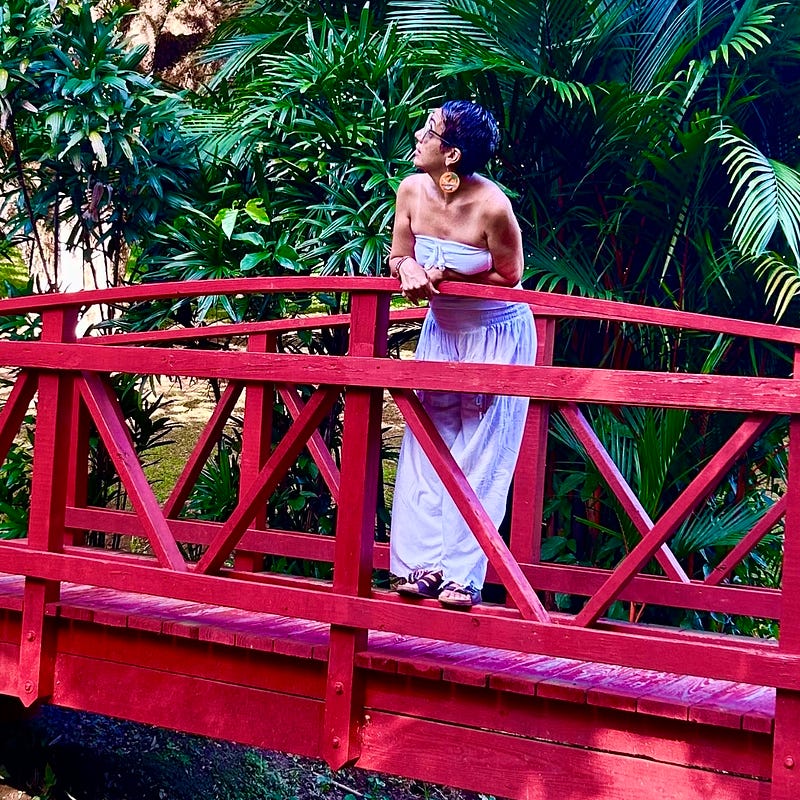
La mujer nacionalista [puertorriqueña] está liberada. A nosotras no nos detiene nada. ~ Dolores ‘Lolita’ Lebrón Sotomayor, Puerto Rican Freedom Fighter
Lola Rosario Aponte is a feminist activist, freelance journalist, spoken word poet, translator, travel blogger, and language tutor from New York City whose work has been featured in NACLA, Palabra, Latina Media, Hip Latina, and Green Left (in Australia), among others. She is the Caribbean/Latin American contributing writer for Rights of Equality, a digital platform committed to gender equality. This past July 2023, Lola’s first poetry collection, Daughter de Borikén was shortlisted and selected for publication by the esteemed Puerto Rican press, Editorial Pulpo.
In this self-interview, Lola speaks about her craft, the decision to return to her ancestral motherland, and an unwavering commitment to the independence of her country.
Rosario Aponte: Tell us how and why you decided to return to the archipiélago of Borikén.
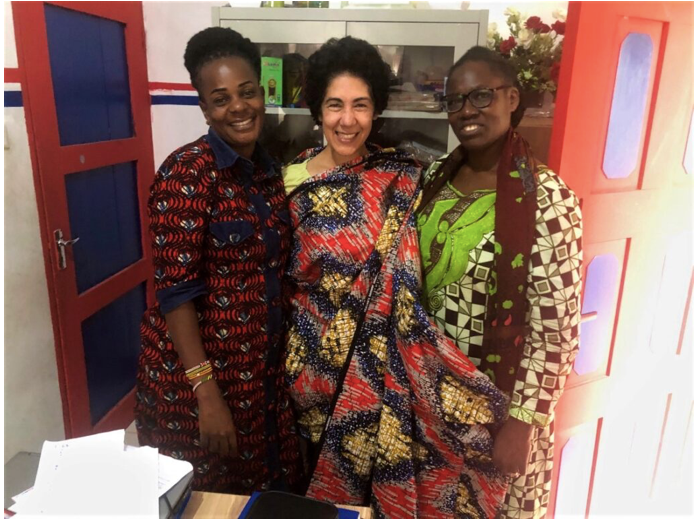
Lola Rosario: My roots in this land go back seven generations. As a child, my mother used to bring me and my two brothers to visit family on the main island. I also spent time here on vacations in adulthood; however, I never thought I would one day live here. That changed in early January 2021 during a three-week trip volunteering in and visiting Tanzania. From the first day, I felt my ancestors: in Dar es Salaam (heading to my lodging), I saw flamboyán trees (originally from Madagascar), and the following day my hostess prepared yuca (they call it cassava) with hard-boiled eggs — just like my abuela used to make.
The lush landscapes and meeting the humble, hardworking, and warm people of Tanzania were reminiscent of earlier experiences in my life — the countryside of my mother’s upbringing and family. This was the beginning of a transformation in my soul and it became clearer when I arrived in the port city of Mwanza in preparation for five days of volunteer work with young women in the region. The morning after my evening flight, I walked outside to the balcony of my host, Mama Miriam’s house. She was attending to the chickens and rabbits, as I stood basking in the rays of the Tanzanian sun when I heard it — a rooster singing in the distance. Tears formed in my eyes, but at the time, I didn’t understand what was happening.
Shortly after returning to Charlotte (where I lived at the time), I dreamed of my cousin Freddy who had been murdered more than 30 years prior. Some days later, as I lay in bed, I felt the presence of my aunt Eva — she had been killed before I was born. I started to put the pieces together — the rooster singing in Mwanza was a connection to Borikén (where I remembered the sounds of roosters crowing at dawn [and other times of the day] from my many visits here, the dream of my cousin where we speak no words, but he’s smiling at me the entire time, then sensing the aura of my tía Eva — it started to make sense. I understood these were messages from my ancestors telling me it was time to move to Puerto Rico. Since I my feet hadn't touched this sacred soil since November 2014 (when I visited for a tango event), I decided to return to first reconnect with my roots, my family and to learn more about our culture and history. I made three trips: in July, September, and October. Then On November 30, 2021, with only a one-way ticket to SJU scanned on my iPhone, I arrived in the motherland.
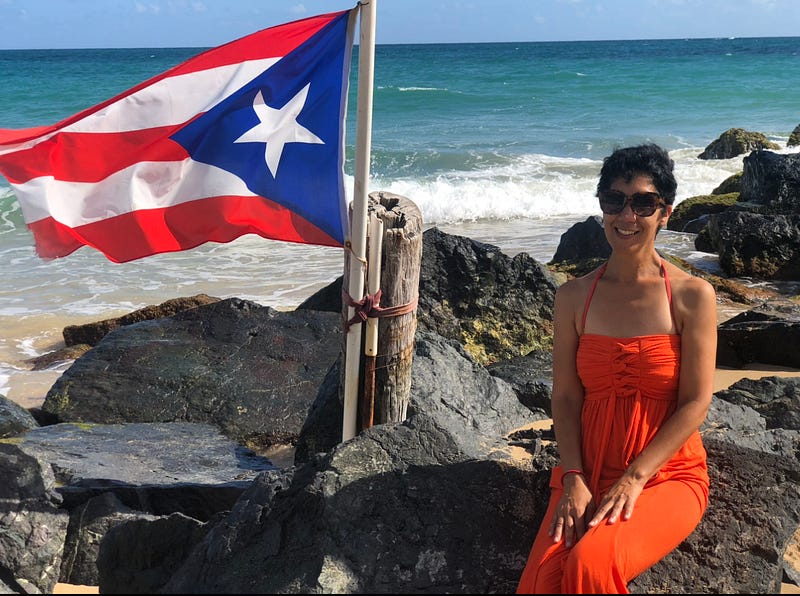
Rosario Aponte: What a story! So, you just had your second anniversary of being in Borikén. How has the experience been?
Lola Rosario: In terms of acclimation, it’s been mostly smooth. I’m mindful to avoid making comparisons to life in New York City and/or Charlotte. We’re a Caribbean country, with a tropical climate — here the vibe is more relaxed and the pace slower. This means sometimes the concept of time is relative. For example, someone saying they’ll meet you at 2 pm, but shows up at 3:10 pm. Of course, the circumstances vary — if it’s pleasure versus work.
A few of the things I enjoy immensely with this change of lifestyle are being surrounded by nature, the friendliness of people, and the many cultural events offered. This last point is a big deal when you consider the fact that our colonial status impacts the pro-American stance of certain segments of our population. The idea that our vibrant cultura is something to be ashamed of and that we should aim to be more like the U.S. is a source of indignation for many of us fiercely proud of our heritages, especially our vibrant Indigenous Taíno, Iñeri (Igneri), and African roots.
As a staunch proponent of an independent Borikén, I’m adamant about supporting Puerto Rican-owned businesses and our communities. Ways I do this: buying eggs from local farmers, offering free group yoga/meditation sessions in my neighborhood and in other pueblos, attending cultural events where I usually purchase an item or two from a local vendor, and even doing something as simple as offering words of encouragement to students walking past my home (to/from Belén Blanco De Zequeira school — grades 6–12).
Of course, there’s no such thing as a perfect place. Living in Puerto Rico presents several huge pain points: the negation of racism, machismo, femicides, continued colonization bringing about displacement, and religious fanaticism (especially vis-à-vis gender equality). To combat these, I use my journalism, my protest poetry, and my activism. The common saying ‘we will not be silenced’ is a mantra I live by.
Lastly, another thing I struggle with (though to a lesser degree), is the language. While I am mostly fluent in español, I communicate mostly in Spanglish (mixing both English and Spanish), with inglés being the language I always revert to when my tongue gets a pinch twisted with our second colonizer’s language.
Rosario Aponte: Since you left the States, has your professional life changed?
Lola Rosario: After over two decades in the banking sector, on 26 December 2019, I finally left. It was a decision years in the making, and I must mention a break in 2013–2015 when I worked as a medical interpreter (Spanish/French to English). My plan at the end of that December was to continue my world travels [which back then was at 32 countries] and launch a blog about my adventures. I made it as far as Lviv for an eight-day tango event and a short two days in Krakow. Shortly after returning to New York City in January 2020, COVID-19 hit, so in April of the same year, I moved south to Charlotte, North Carolina—by May, I had launched my travel blog, La Trekista, and then in June, I started writing on Medium.
With my move to Borikén (Nov 2021), I knew I wanted to continue writing, including improving my poetry [which I started to dabble with in January 2019, after a trip to Perú where I almost lost my life]. Knowing I wanted to participate in telling the vibrant stories of my beautiful people [and using the experience I was building via Medium], I started to read articles on digital platforms like Latino Rebels and Hip Latina since these were places that focused on an audience of folks that look like me. In May of 2022, I got the courage to send my first article pitch to Latino Rebels — it was declined but, the senior editor, Hector Luis Alamo encouraged me to keep the ideas flowing. And it paid off. In July, the publication accepted my pitch showcasing two cultural Puerto Rican icons; the story ran on Sept. 13, 2022.
That was the start of something I already knew — our stories must continue to be shared. Not only that but they must be told by us and written by us. Too often, when you grow up in a colonial country, you start to think that your voice is insignificant. You grow to believe your stories do not merit attention on a world stage. Of course, this is not only untrue, it is harmful to future generations.
So, yes, the work I now do is very different from my former banking days, but it is so much more gratifying. With my cultural and social justice journalism, I’ve had several doors open — one of my articles on displacement and disaster gentrification in Puerto Rico was published in the Australian digital publication, Green Left in January 2023. I was featured on an Instagram Live interview with Hector Luis Alamo to talk about my journey home to Borikén and in August, I was featured on a Pulso Podcast, Leaving the American Dream.
I’ve also gotten serious about my poetry — getting out to perform at open mic nights, submitting my work for publication, and hosting my first poetry event on Oct 7, 2023, dedicated to Celestina Cordero Molina, the Mother of Puerto Rico’s Public Education System. Just recently, I [along with Puerto Rican esteemed poet, Verónika Reca] was interviewed for Hound Magazine, the digital platform showcasing emerging Caribbean and Latin American artists, both on the archipelago and around the world. I also started tutoring (Spanish, English, and French) and have been hired for translation work. Currently, I’m collaborating with renowned Palestinian poet, Sheikha Helewy on several Spanish translations of her work.
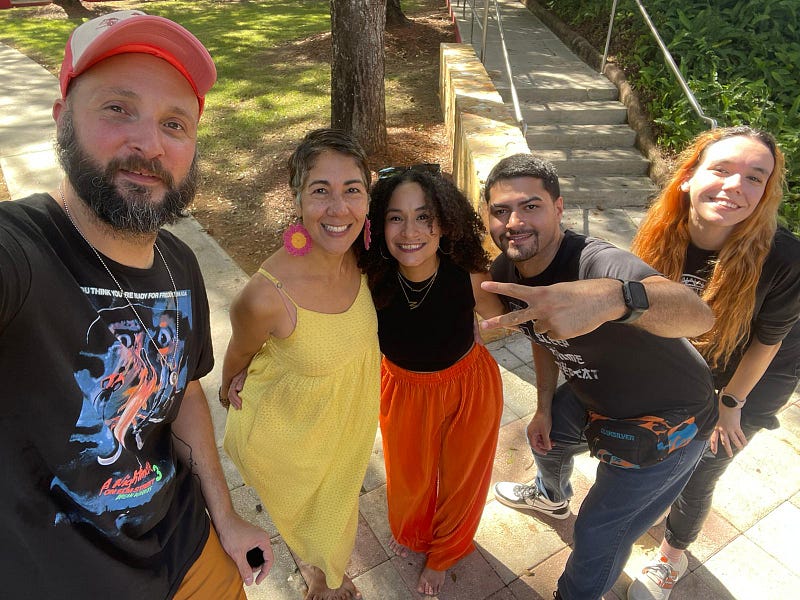
Rosario Aponte: Your passion in this transition in your life is palpable. Share with us the factors influencing your decisions to pursue a story and the role feminism and activism play in your craft.
Lola Rosario: As I mentioned earlier, it’s imperative we tell our stories and also that they be written by us — by those who look and sound like us, people whose lived experiences we can relate to. As someone who grew up reading American (Anglo) poets, for example, Emily Dickinson, Sylvia Plath, and Robert Frost, it didn’t occur to me [in child/young adulthood] to ask my parents or family members about Puerto Rican poets and authors. It wasn’t until late 2016 that I started to research our history. In the subsequent years, I learned about a few of our renowned writers like Esmeralda Santiago, Pedro Pietri, Julia de Burgos, Miguel Algarín, and more recently, Angelamaría Dávila Malavé.
As a writer, I’m interested in stories that confront, question, and change harmful narratives. An example is an opinion piece I wrote for El Adoquín Times about our vejigante folk tradition. By presenting a brief look at our historical colonial background alongside the demonization of el vejigante’s Afro-Puerto Rican influence, I asked readers to re-visit their long-held negative perceptions of one of our culture’s most beloved characters. In another article published at Latino Rebels, The Colonization of Christmas, I wanted les puertorriqueñes to think about the commercialization of the holiday season, the emphasis and priority given to ‘Santa Claus’ over The Three Kings. It was an interesting piece for me because I (a) don’t celebrate the holidays (except for New Year’s Eve) and (b) am well aware that both the fat bearded guy and the Reyes Magos became embedded in our culture from our two colonizers; however, my intention was for [certain] Puerto Ricans to ask themselves why the American representation of Christmas holds such grand significance over the Three Kings. Both articles were controversial — and that’s a positive thing because it means people are thinking, perhaps starting to question these narratives.
I’m interested in stories that directly impact my people, whether here on the archipelago, in the place of my upbringing (NYC), or anywhere else in the world where a descendent of Borikén lives. When it comes to my verses, I’m continuously reflecting on my and our experiences. Regarding my poetry, most of it is protest in nature and as a spoken word poet, the verses flow differently on the page. Still, I view poetry as a vehicle through which to expose others to the Puerto Rican experience — as seen through my New York City-born and raised eyes lens. My feminist perspective informs my work as does my activism — these are what dictate I remain unapologetically bold in my convictions as well as in my writing.
Voices like mine have been silenced for a long time. It’s past due to remind the world we exist and have always existed. Our stories are being told and will continue to be told.
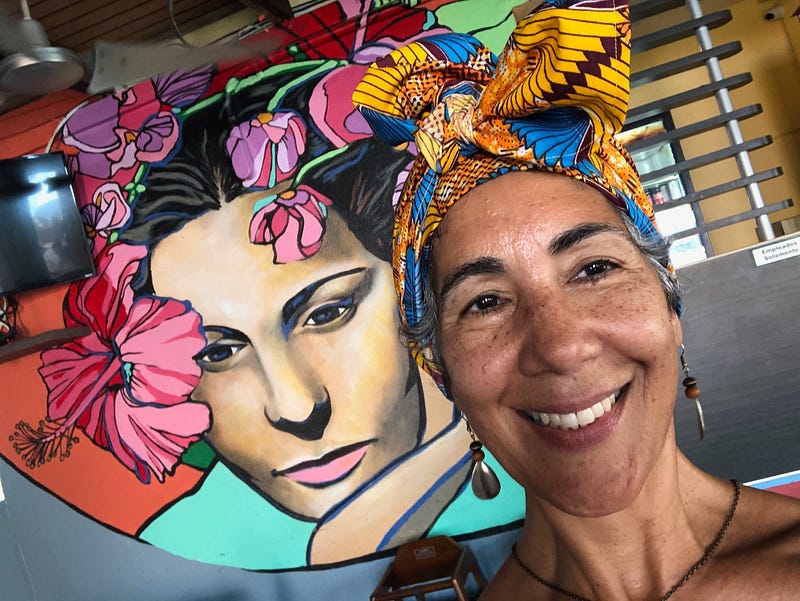
Rosario Aponte: Share with us something only a few people know about you.
Lola Rosario: [Smiling] I can give a peek into a couple of things about me. As a kid, I dreamed of becoming a pilot and having a few hours of single-engine flight as well as some simulator time under my belt. But, after graduating from Embry-Riddle Aeronautical University (aka The Harvard of the Sky), I caught myself in the banking sector. I used to have such regret about not getting my flight wings, but I’ve seen the world (35 countries so far) — just not as a pilot.
Another thing about me is I was super shy as a child and I was bullied. Both factors greatly influenced my mindset as a young adult and are two reasons why I became outspoken and opinionated. I take nonsense from no one!
My name, Lola is not something I made up. The birth certificate lists me as ‘Annette Rosario’ because my mother was a fan of the Italian-American actress (and original Mouseketeer), Annette Funicello. Since I was little, my mother used to call me Lola — it was her endearing term for me. The interesting this is no one else in my family ever called me Lola— not even my two brothers. In 2006, I started dancing tango and in 2011 I moved (with my then-husband (Özgür) to Austin, Texas). It was there that I decided to use the name for my business, Lola’s Tango Tease where I sold the Turkish tango shoe brand, Turquoise. I also sold clothing and accessories. It was a new chapter in my life, the name is closer aligned to my personality (i.e., fiery, passionate, and warm) and it helps me feel more connected to my vibrant culture as a Caribbean Puerto Rican woman. So in 2015 (already back in New York City), I went to the court with my documentation and had it legally changed.
Lastly, two items. Because I love to talk, being a polyglot comes naturally — currently, I’m at five languages: español, français, türkçe, italiano, inglés. My preferred state of being is barefoot. Especially since returning to la matria (the motherland), having the soles of my feet physically connect to this soil is a gift my soul waited too many decades for.
Final note (this is not part of the original article). In returning to my ancestral motherland, I am unlearning so much of the colonial history of my valiant people. This brings me to one of our fiercest femme freedom fighters, Lolita Lebrón. The opening quote of this article (translated below):
The women of the Puerto Rican Nationalist Movement are liberated. Nothing stands in our way. ~ Dolores ‘Lolita’ Lebrón Sotomayor, Puerto Rican Freedom Fighter
I dare not compare myself to her. Rather, I will say that as a feminist Boricua woman, I identify with her words. Now that I returned home, Lolita Lebrón’s sentiments echo in my soul with each passing day. I stand on the shoulders of Ms. Lebrón’s legacy and countless others. Àṣẹ.
Gracias for reading.
Note: this self-interview was first published in Spanish at El Post Antillano on Oct. 20, 2023.
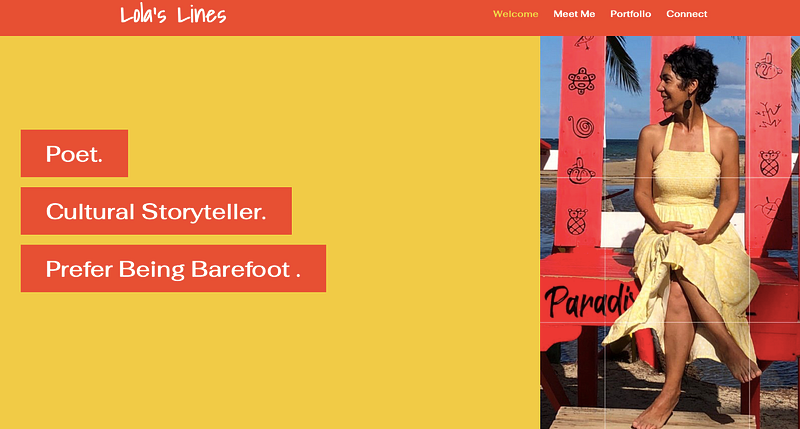
You can learn more about Lola at Instagram: @lolaslines, at her [still being updated] website, Lola’s Lines, via LinkedIn, her travel blog, La Trekista, and her Ko-Fi page.
I appreciate each of you.

Acknowledging the Arawak, the First Peoples of Borikén, on whose unceded lands my work is created. In gratitude for and in honor of our Elders, past, present, and emerging. May my work always unapologetically and boldly uplift our wondrous Indigenous Taíno, Iñeri, and African roots.


