
Seeing a Cop In Line At Starbucks Gave Me The Jitters
The fear is real, so I acknowledge and respect the situation.
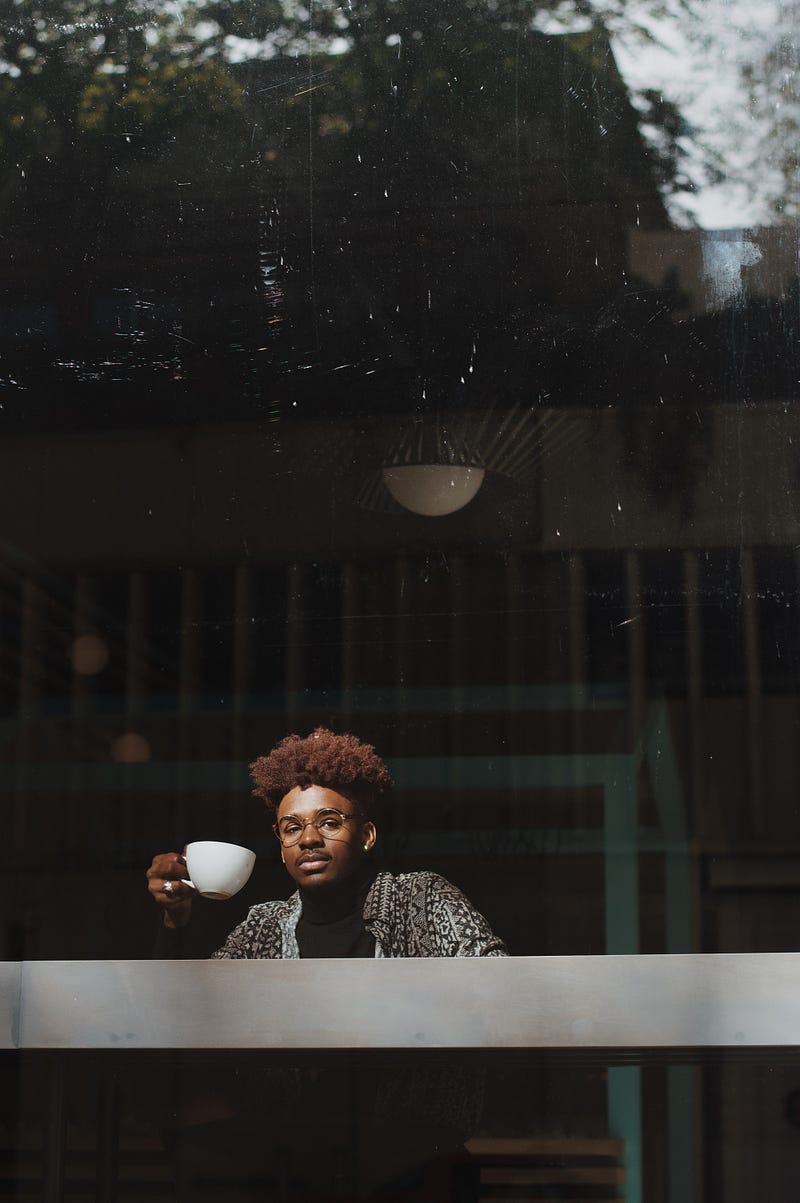
I love coffee. Truth be told, I am an unapologetic java junkie — one whose DNA resonates with all the goodness that is the coffee bean. Further, when I need a fix — and this is every day — Starbucks is my go-to.
Recently, however, while visiting my father, my Starbucks love language was put to the test. No matter who I’m with, I often ask if anyone is up for visiting the siren. On this day, my father, also a self-proclaimed Java connoisseur, agreed eagerly.
Black and blue
We arrived at the Starbucks, but as bad luck would have it, we happened to follow a cop into the parking lot. Careful not to park near this black and white, I kept driving in hopes of finding a space further away.
I have never been a fan of being in proximity to those who have the power to alter my freedom. This is not just an idle thought but is based on long personal experience.
Our arrival at the entrance to the coffeehouse coincided with that of the cop we had followed into the lot. He went in first while I asked my father to hold back. He understood my trepidation.
As expected, when we walked in, an all too familiar feeling came over me, as if I were floating above myself. I could not will my legs to move toward the line, ultimately volunteering my father to be the necessary buffer between myself and the officer. Though I must admit, the gap between my father and myself was abnormally wide for people in a line. Frozen, I just didn’t have it in me to move any closer — not toward “the enemy.”
Whenever I find myself near the po-po, I get a bit anxious. Experience has taught me that “anything goes” when it comes to the police and Black people. There is no rhyme or reason, just an awareness of generations of proven systemic racism and consistent and targeted mistreatment of the Black community.
I try to avoid at all costs the “potential” by keeping a distance; out of mind (well, that’s tough), out of sight (even tougher), especially in a white space. For the most part, this strategy has served me well. However, Black people are not always afforded the luxury of choice.
Standing in line for those brief minutes felt like an eternity — my mind flashed with vibrant scenarios of being harassed, being gunned down, being tackled, being questioned as to why I was at this Starbucks, and so on. I was unable to move. Honestly, I didn’t want to give this boy in blue any reason — or no reason — to come at me.
Am I being paranoid? Could be.
However, this uneasiness was not unexpected based on past situations. Throughout the years, I have experienced my fair share of unsavory treatment (as has my young adult son) by the “brotherhood;” thus, I am used to being unjustly interrogated and, on occasion, worse. Certainly, I wasn’t about to poke the bear.
My father who often busts my plums any chance he gets, leaned back toward me and said under his breath “Don’t do anything stupid, I don’t want to get shot.” He was joking of course but my anxiety was legit, and my retort was simply… “nor do I.”
In the end, my uneasiness crested and marionetted me to the point of uncontrollable hand tremors. Yes, this was happening.
It’s rare for me to be this affected by anyone, especially someone with whom I hadn’t engaged. The idea that a person (cop) could, or would, look at me with such disdain or disgust and potentially perceive me as a criminal is enough to make anyone’s nerves ratchet up a notch.
I do understand on an intellectual level that the mere presence of this civil servant is nothing more than a manifestation of my anxiety — he’s only a prop and did nothing provocative except exist. On a visceral level, however, I react.
This isn’t a crippling fear, mind you, not an inability to function when interacting with law enforcement; it’s an awareness of the reality of my community being historically dehumanized.
To protect and serve
A logical question would be, “Why are you letting a non-encounter with a cop affect you like this?” There is no need to get worked up over something that could result in nothing, particularly in an environment such as this — a public space with lots of witnesses (and smartphones) around.
To this, I say, nothing is certain. The feelings that came over me were real, especially as a Black person who had been on the receiving end of less-than-ideal and unjust encounters with the police. If I can proactively avoid any engagement with cops, I will (and have).
Don’t do anything wrong or break the law; there will be no reason for the 5–O to confront you. Well, I think we all know this isn’t always the case if you are Black in America. Just being Black can often get you stopped, harassed, or shot.
I have known a few cops; not all are “out to get me” or have an agenda. Just like not all Black people are criminals or thugs. Funny how that works.
The current divide in this country often feeds this for both groups and perpetuates a constant mistrust between citizens and law enforcement.
The reluctance to allow myself permission to exhale in the presence of the police is justified by prior experiences and the current state of our culture in general.
I am not proud of being someone who is constantly on high alert when the police are present or by potentially being targeted by the very institution that “supposedly” is in place to protect me.
This is about plain and simple survival and is the reality for Black America. Everyone has an opinion on what can be done about the mistreatment of the Black community by the police in this country, yet there is no easy answer. Or is there?
In the article Solving racial disparities in policing by Colleen Walsh, according to historians, the treatment of Black people by law enforcement in America is a direct result of slavery, racial disparities in policing that are sustained by systemic exclusion and discrimination, and fueled by implicit and explicit bias. One could argue that the seeming lack of progress or concerted effort to address this stain on American history is sustained by design.
Seismic social change is needed to level the playing field and keep all citizens from having to fear their supposed protectors and enforcers of the law. For this to happen, acknowledgment of our country’s dark past and coming to terms with how Black people have been treated is a first step. A tall order, but if we aspire to move forward as a functioning society, we must address what is in front of us — inequality and racial bias.
I’m optimistic but realistic.
The fear never goes away (on either side)
Being pulled over while Black, for instance, isn’t your run-of-the-mill nuisance as it might be for many in the white community. Logical and legitimate reasons don’t have to apply to being stopped by the police. America has always been a country with two societal realities.
For generations, Black people have been forced to live by a different and oppressive set of rules. In the past, when I have been pulled over, my first thought was never, “Sh!t, now I’m going to be late.” Or “Doesn’t this idiot have anything better to do?” Or “Why am I being stopped? I didn’t do anything wrong.” When a Black person is stopped by the police, the first thought is usually, “Today is the day I might get shot.” Or “I’ll never see my family again.”
Who would want to live like this? No one.
Has the Black community been afforded the opportunity to think differently? I, like so many others, have not had the pleasure of knowing any other way of living. This is our life, and as I continue with my days, witnessing and experiencing unrelenting injustice, I grow more convinced this will never change. Fortunately, I refuse to let this weight upon my shoulders hold me hostage, nor should you. Controlling your feelings (or anxiety) at the moment might be a challenge, but you can choose to divert your reactions and remain unaffected.
Perhaps the badge should follow this as well.
I will however, be mindful of how chance encounters with cops might not go my way — not because of anything I might have done wrong but because of ingrained fear, bias, and possible hostility from those who wear the uniform.
This is where we are today, fearful of those who are considered our protectors. Those who work for us. When I think of the feelings that germinate when I’m near a cop — someone who has the authority to fabricate whatever narrative they want about me, who might have preconceived biases about my community, or who is simply having a bad day — these are instinctual alerts of self-preservation and must be respected.
What is needed to get through everyday run-ins that could ignite past traumas is knowing you have unquestioned support from your community, ideally an unbiased societal landscape, and hopefully a newly realized system that treats (and views) everyone equally and justly.
Like many, I am a product of my surroundings. My life reflects the experiences I’ve gathered over time, and because of this, said life experiences have shaped me into who I am today — for better or for worse. This same thing can be said about anyone who grew up in an environment that offered few opportunities to explore the world outside their immediate orbit.
In this country, if you are Black or from another marginalized group, it is only natural to feel uncomfortable around those who might look at you as anything other than human. Encounters with law enforcement, for example, shouldn’t be a reason to deviate from living your best life.
Not letting those inner demons win and take control of who you are makes all the difference in how you interact with others, especially with those who should have no influence on you.
Though my journey continues in not succumbing to future anxiety when around the police, the challenge is ever-present; with a societal aspiration to create change, this can be overcome. It is a win for everyone in the end.
Come to think of it, maybe I’m just being overly sensitive. After all, it could be the coffee that gives me the jitters.
Thank you for reading!
Here are some sample stories related to this topic.
As a Black Person in America, Am I Allowed to Have a Bad Day?
When You Are Black in America, Every Action Is Met With Suspicion