
Searching for a Yellow Bird
Black-hooded Oriole and my fascination with the yellow
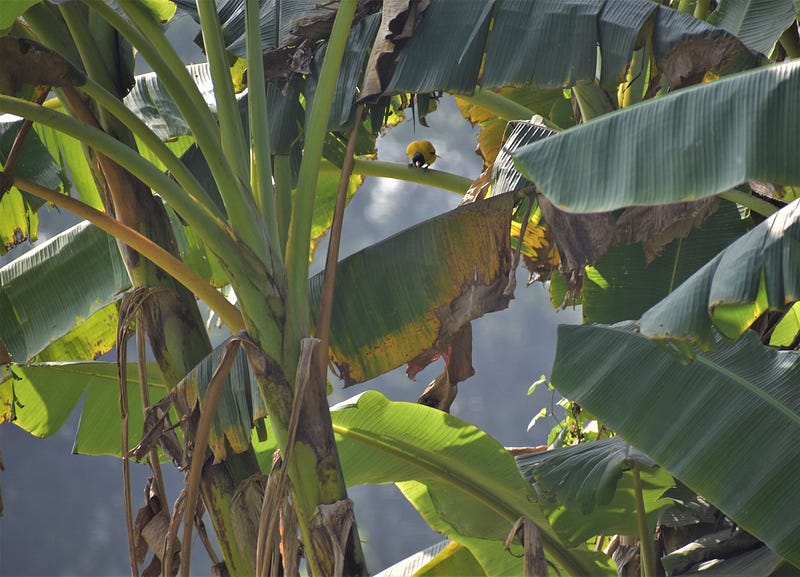
I have had a crush on this yellow-bird since my childhood.
In one of my childhood textbooks, there was a poem from where I first learned its name. In my language, we call it Holde pakhi(yellow-bird). It also has two other local names Isti kutum(guest) and Bene bou.
Back then, I didn’t know that it is called Black-hooded oriole(Oriolus xanthornus) in English.
I was fascinated by its beautiful yellow and black color combination. As a kid, I wanted to have one. So when they appeared on a tree-branch and call with its sweetest tone, I would try to follow their movement with a slingshot in my hands.
Now, as a grown man, the slingshot has been replaced by a camera. But the bird — don’t know why! — always keeps a safe distance from me.
Capturing the yellow-queen
In 2019, while wandering through a mustard field, I spotted one. And I followed this lovely yellow-bird cautiously. It was like slowly entering into my childhood memories.
But as soon as I approached the bird, it flew away to a distant tree. I followed again and clicked the camera. But no luck, the bird didn’t like my interference and moved to another tree branch.
Finally, I gave up the temptation to capture the yellow beauty. Instead, I sat on the ground and enjoyed its sweet call.
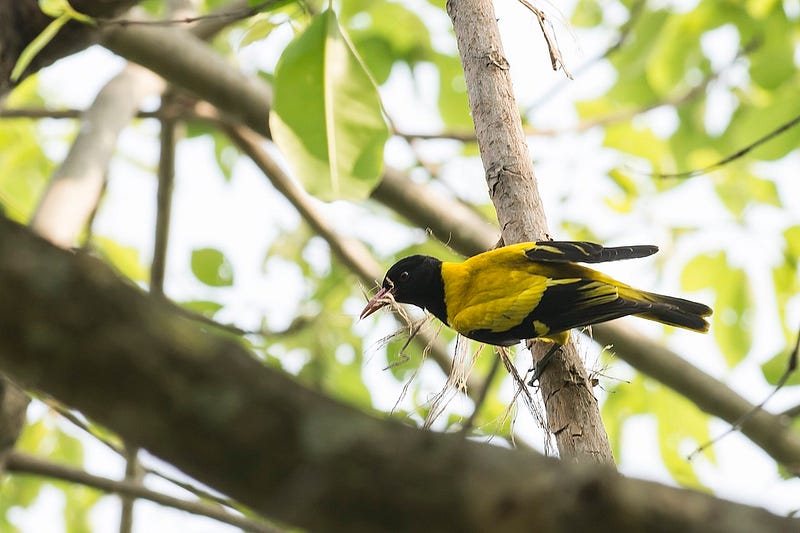

Yellow yellow, lovely fellow
Black-hooded Oriole is common in our country, Bangladesh. This bird of open woodland and cultivation is also found in many South Asian countries, including India, Sri Lanka, Pakistan, Indonesia, etc.
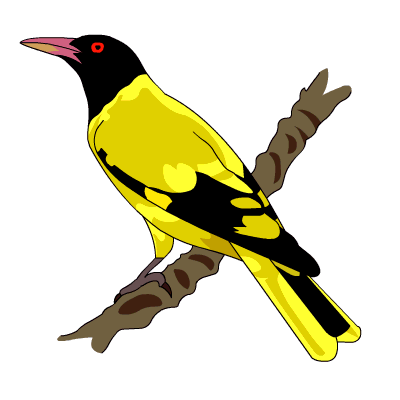
You can easily spot this bird in the green treetops for its yellow-colored body. The head, hood, tail-center, and some parts of the wings are black. In the female bird, you will notice the greenish underparts. The beak is peach-color, and the eyes are reddish with a black pupil.
Their majestic color combination pleases my eyes whenever I encounter any of them.
This bird of rhythmic flight eats fruits and insects. It builds the nest on the tree-branches and lays two eggs. Here, in Bangladesh, its breeding season is summer.
This bird’s call is high-pitched yet lovely to hear.
If we see this bird, calling on a tree-branch near our home, we assume that some guests will visit us soon. From that belief, this bird has got its local name Isti Kutum(guest).
Yellow is one of my favorite colors. No doubt, my childhood yellow-bird black-hooded oriole had an influence on me.
But the sad reality is due to deforestation and lack of green all around, the number of black-hooded orioles is slowly decreasing. Once abundant has now become a rarity.
We are responsible for this.
We are destroying our forests and greenery in the excuse of development. And we are so selfish that we never think of its residents when we devour a tree.
The situation can only improve if we become less selfish and more sensible and coexist with the natural world peacefully.
Thank you for reading.
If you are a lover of the environment, nature, and wildlife, you may enjoy the following articles published in The Environment.
- The School of Nature
- I Saw My Darlings on a Dye-Fig Tree
- Color Your Life With Some Birds
- Where Have All the Birds Gone?
- Global Warming Is Going to Destroy Your Children’s Life
You can also inspire others to share their love and concerns for this lovely planet. Just click the below image and write for The Environment
