
Sea and Sand and Cedar
Family myths nourish as well as drain the soul
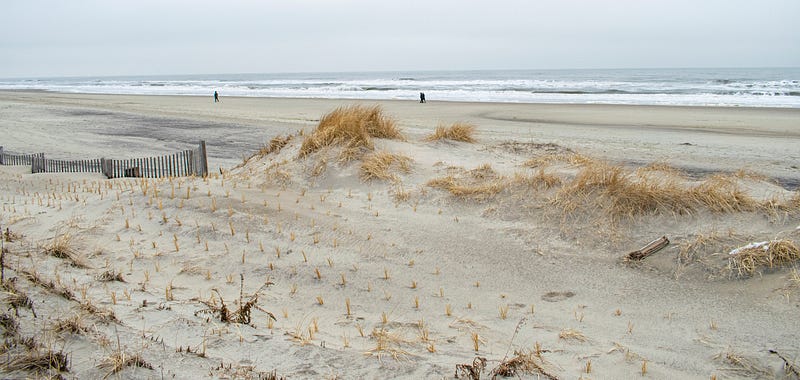
My future maid of honor Megan asked of all the places after a fight with your fiancé, why drive to Atlantic City? Why not come to me?
She didn’t know much about my father. No one did. Why didn’t more ask? He was hard to fathom, and his own storms kept him tied up at the dock.
Why did my father both sadden and infuriate me?
Thomas and I were still planning the wedding. We had our own places. The planning was not going well, nor was the “moving in together.” Was I really old-fashioned?
Why go to my father on such a day?
I didn’t think “why” as I crossed the Delaware from Pennsylvania and found my way through the familiar backstreets of New Jersey.
The smell of sea and sand and cedar water felt familiar.
I remember the times with my father at the Jersey Shore and on the Chesapeake Bay, before and after the divorce, the boat, his floating oasis, a man cave on the water. My older brother Stuart and I were his first and second mates, but I was young.
Barbie dolls were still a thing for me.
By then, Stuart barely cared. Much to his ignorance, he vowed to maintain family myths that nourish as well as drain the soul. He manufactured his own weather forecast to steer clear of storms. He was so much like Dad. He’d be better if he recognized this.
Anger and fear can feel safe — like weighted blankets that suffocate anxiety. Thomas had been lifting off that blanket, to see me for me, asking sensitive questions about former relationships. What was I hiding?
On that sudden trip to AC, I would have my phone off for the entire day. “I’m off the grid,” I told him sternly.
It was one of those arguments with him that drove me to the end of the AC Expressway
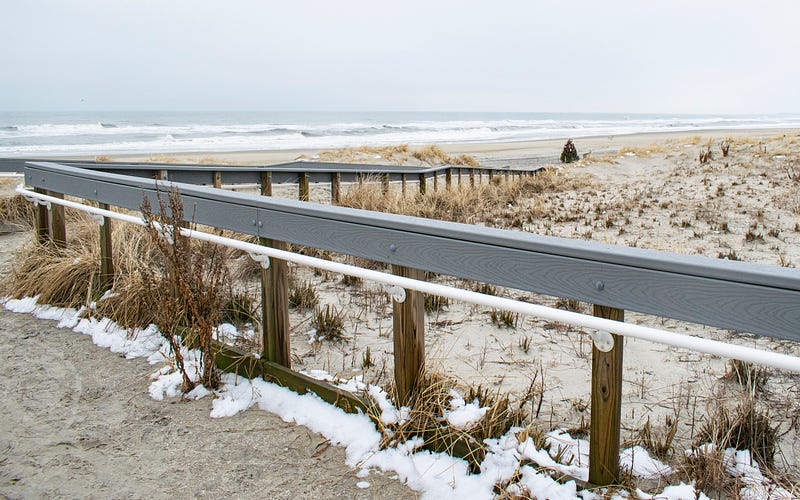
Pockmarks of snow still scarred the sand.
It was the misty, lonely, and cold beaches of late February. I was alone. It was now my place of refuge. I wanted his boat again — a sanctuary. I wanted to climb to the flybridge like that little girl and hide in the sky, as he did when he was the happiest.
As I stood on the Boardwalk, underneath the street sign of Providence, I thought of that episode with my father. How old was I? Five? Or six? I walked out on the desolate beach, the way I always love the beach, looking for our footprints and the footprints of the ghost of that mysterious Donkey Man he talked about so much, some old man who was kind to him and gave him rides on the donkey when he was a boy.
When he was young, he thought the Donkey Man near Steel Pier was actually a crazy pirate who captured parentless boys.
It was just the two of us that weekend. His dizzy spells were bad. He had vertigo. We missed the circus he had promised. And then he was humiliated at a party on one of those luxury boats that made ours look like shit. The owner of that yacht was nice. Didn’t he look like Indiana Jones? The other mariners — rich men without an ounce of empathy — teased him for not knowing how to hold a fish he caught. I recall holding him back on our boat, rocking his head back and forth to clear the “ear crystals.”
Why was balance always a problem for him?
It takes time to understand the symbols and the stories of our parents. That’s if we’re lucky to have symbols to hold. If we are lucky, we can decode what has always remained a mystery. When we meet again, if such fantasies are possible, we can sit down with them, as spirits, and tell them what we have learned of the mysterious road signs composed in hieroglyphics.
We absorb so much when we are young as if we are diaries without memories. Our parents write their Book of Life along our veins and arteries, thinking that such lines are merely verbal, and not tattooed with the Judgement of God.
We are unable to resist the baggage they place upon our backs as if our backs are stronger because we are young. Are we mere sounding boards? Or an audience of one? Listening to a monologue from a darkened stage? Or mirrors without memory cards? Just too naïve to feel the weight?
Until our own adult crisis intersects suddenly with theirs. And then: the invisible ink appears in the diary; the legs of our donkey-like captivity collapse, the house lights come on, and then: The Weight.
As I stood with my bare feet in the calm, cold Atlantic, I knew I had to decide: would I go back to Thomas? I loved this man. I feared him, too, because he was so different. Should I apologize and listen? Would he do the same? Could he do the same? Should we continue with the marriage and the plans and the beautiful life we were planning together?
We each so challenge the way we view the world. Or would I go home, and seek the familiarity of my mom who would surely take my side, even if I was the devil, crying the devil’s defense?
Perhaps it was the memory of my father who had lost everything that brought me to this edge; this memory of that weekend in Atlantic City when it was just the two of us. When he still had me.
It was during that hour, my feet numb by the end, I reconstructed, to the best of my ability, that haunting and tender weekend with my father.
A solitary Christmas tree stood guard at the end of the path. Was it a sign?
My dad could never hide his emotions. His pockmarked face was like reading Braille. When I was young, my fingers only knew basic words on his face. Not every letter. I knew the word for sad, though.
After the divorce, nothing was easy. This line has always stayed with me when something broke — “easy enough to replace.” Does it even seem a privilege for some people to replace what has been lost? And what about those who will deny the loss of such division and state that division is actually an addition?
Any additive changes everything.
I’ll be thirty in two months. It’s hard to picture starting life and marriage and children so young, like my parents. Who can navigate the wreckage of youth while still young and married and with two children?
My father was the happiest on the flybridge with his arms outstretched, the atmosphere, an elixir that rejuvenated his soul; he was Dedalus, escaping from captivity, with the exception of forgetting about Icarus.
Why couldn’t Dad have been more like other men, fighting for his peace? Why step aside, move away, and vanish? At least the flybridge was his place, like a bird on his perch, a pedestal. Mom said it was dangerous up there. Why did they even get a divorce? My mom said she shivered at the thought of him touching her. Cold shivers. Not the hot ones.
And my dad said my mom “was born in the Arctic Zone,” singing the line from The Rolling Stones. And that she was a real Nutcracker. They both told me different stories about their honeymoon. They were both virgins. Let’s just say it did not live up to their expectations. And why tell this stuff to children? I was so young.
Didn’t they have anyone else to dump this on?
Once, near St. Michael’s, he took the wake of a tugboat the wrong way and the boat rolled under to the left. She almost fell into the Chesapeake, with me in her arms. My mom yelled that he did it on purpose! Did it on purpose? Wanting to dump into the water! She had no facts, and yet her voice was nothing but fact.
Perhaps it indicated the two lives I lived: my dad always called me Mary Rose with two distinct syllables with a breath of God in between. My mother always married the two as one: MaryRose, as in a rush. She was always in a rush. Perhaps even for marriage.
Years later, when I was a teenager, I wrote an episode in a diary my mom gave me for Christmas. Did she recognize my budding interest in writing? I flushed out the details for my girlfriend who didn’t know the story. I haven’t even told Thomas.
What holds me back from telling people truths about my life? Is it shame? My therapist says that trauma is best shared. I hate when she uses the term PTSD. That’s for soldiers in Vietnam and Iraq: not little girls caught in the rip currents of divorce. Can’t there be another term?
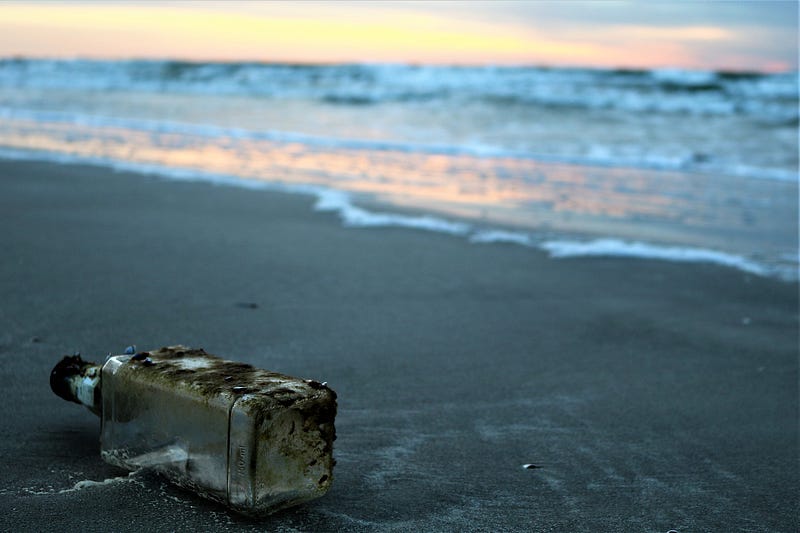
When I think of my father, now, on that beach, looking up at the sky, staring across the Atlantic, I see him in that bottle he once picked up as trash on the beach, riding the swells.
This was what I remember, and this is what I told my girlfriend

There were three people I needed to call; my brother Stuart, my girlfriend, Megan, and, of course, Thomas. He was never Tom or Tommy. Always Thomas. It was cold and getting dark in Atlantic City. I could barely feel my feet from the cold ocean.
With the car engine warming up, I called Stuart. Would he agree to the wedding party? For some reason, he was jealous of Thomas. Why? For all these reasons males are jealous of other males. Thomas was replacing him, I guess, too. Thomas just wanted his own brother, to keep the wedding simple, but I had three close girlfriends — plus Meghan. How could I pick just one?
Stuart was surprised to hear from me. I told him where I was and why and I was thinking about Dad and the divorce and depression, and that I was now seeing someone for depression. And I didn’t feel like hearing what he had to say about this, because he was not licensed for anything except being a pain in the ass, but we needed to talk, and that I wanted some part of my family in the wedding party.
My tone, I think, shocked him.
“Seems like the therapy is working,” he said, half-jokingly.
I also said that Thomas must be included as one of us, by you, and mom, and everyone else, or I would “punch him in the nut sack.” We planned an afternoon lunch, “to talk things through.” I told him I loved him, which must have floored him, and that being kind and faithful and soft was not “unmanly.”
“Being so much like Dad is not a curse,” I told him. “He was faithful as any man alive, and the sooner you can accept that the sooner I think you can open yourself up to someone who can love you.” I’m not sure, but I think I heard my brother cry for the first time.
“We can fix things for the next generation,” I told him. “History does not have to repeat itself, and we can stop blaming our parents. They were so young, Stu.”
I called Megan, telling her this story, and what I told Stuart. She was shocked. No, no, I was not crazy.
“The medication seems to be working,” she said, laughing. The brain is an organ, and it’s complicated, but depression is one of the easiest things to fix with the brain.
“It’s about the serotonin,” I told her. “And facing the uncomfortable truths that are buried with time.” Would she meet me for a drink after my lunch with my brother? She offered to stay behind a bush to protect me. I laughed and said that wouldn’t be needed. “I don’t think Stuart hits too many people anymore.”
Then I called Thomas. The phone didn’t even seem to ring. I told him all of the following in such a way that may not have been logical or methodical; it all came rushing out; I love you, but I do not want to live together before we were married; you are the love of my life, and I will get married in your Catholic Church and will raise our children with a belief in a higher power than ourselves, and that I wanted Stuart in the wedding party, and I wanted my three girlfriends and that I was not damaged, and I was no longer afraid of not being good-looking enough for him and his olive skin and dark hair.
I was so jealous of the way other women looked at him, and that the path of our parents did not “have to be our path.” And I didn’t want a huge reception — but I wanted three bridesmaids, and my maid of honor, of course. He just wanted his best man, and he would just have to choose from his cadre of buddies. “You can just blame me,” I said. But that church thing was okay, now.
I was no longer that angry with me or my mom or Stuart or God or anyone for not protecting my father. And by this time I was crying, gushing nonsense and love and kissing the phone, looking at the moon that suddenly appeared, and I thought of the word Providence. Did God reveal that to me? Or was it just a convenient symbol? Does it even matter?
I’m not sure if God or a higher power lured me back
I’m not sure if the probing of wounds during therapy with Janice brought me back. All I know is that I’m thankful that what I have learned can help build a better marriage.
And if God willing, Thomas and I can have children, and raise children without fear, knowing that fear is just a fact of life, but I know that fear will no longer keep me tied up at the docks; I will finish that degree; I will marry Thomas; I will try to mend the ties with my family, and that the transit across the ocean no longer terrifies me.
I drove back to Thomas where he held me for hours. For once, he said nothing. His warm embrace said everything. I told him everything, so much I kept secret: mental illness, the possible suicide of my father, the rips without sutures that never fully healed.
For once, I actually think he heard me. He wasn’t trying to solve anything, or fix anything, the way men can do, right?
Megan, my maid of honor said I should write this all down. “Just do it for yourself,” she said. So I did — even just for the two of us — my father and me. And maybe, you. Maybe I’ll place a copy of this in a bottle and throw it into the ocean.
That’s where I always feel him the most.
For more short fiction from Walter Bowne on Lit Up, check out: