
048 | FOLKLORE | MEMORIES | STORYTELLING
Scratching Rashes — Tending Fire
A memory of folklore told on a rainy day
Read this article for free here.
These days, we are experiencing unusually heavy rain. It starts early in the morning and lasts until late in the evening. And it resumes again at next morning.
As a result, we have been spending a lot of our time huddled together in the comfort of our cozy black kitchen, in the warmth of the firewood stove. It gives me a “Little House on the Prairie” vibe.
While we are sharing some stories about old times over freshly brewed coffee and freshly baked rotis, it triggered a memory from my past.
This is a memory of a story, but it holds a special place in my heart. While most of the stories I heard growing up were told by my grandma, this particular one was from my father and it is a prized possession of mine.
My father, being a hardworking farmer and small-scale businessman, rarely had the luxury of time to tell us a story. Even today, he cannot sit still for long and be relaxed.
On one of those rainy days, much like the ones we are experiencing now, my father came home early and took a bath. While my mother prepared dinner, he sat at the kitchen table, sipping his coffee and engaging in conversation with her.
My brother and I wanted to be near him and feel his warmth, so he comforted us by taking us both on each leg. It is a fond memory, holding on tightly to him on those rainy days while inhaling the clean, fresh scent of soap emanating from him.
“Father, please tell us a story,” we pleaded.
“Let your father be, he has worked hard all day. Give him to catch his breath,” our mother scolded us.
“Please, Father,” we pleaded.
“Once upon a time, there were two farmers,” Father began, launching straight into the story. “One was Maha Gamaya [the elder farmer], and his brother Podi Gamaya [the younger farmer].”
“They began cultivating a Chena and they took turns guarding it,” Father continued. “At night, the elder farmer stayed at the Chena while the younger farmer looked after it during the day.”
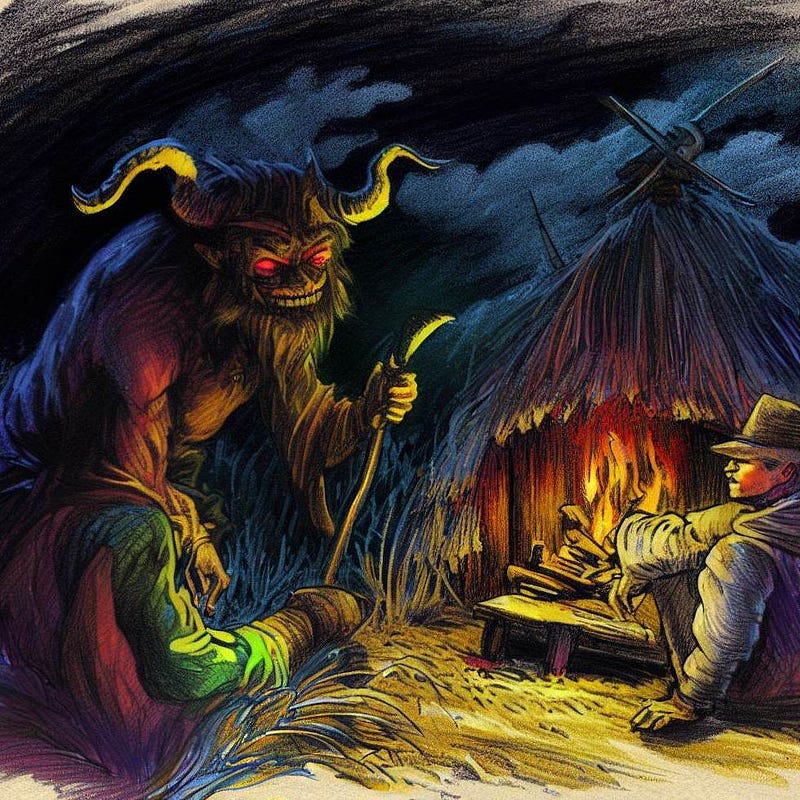
“The younger one was very brave, and the elder one was not so. Everyone in the village knew it. One night, a demon came to the Chena.”
“The demon demanded, ‘Who is on duty tonight?’ ‘It is Maha Gamaya, sir,’ the elder farmer replied, trembling in fear.”
“The demon raised his voice, ‘Very well then, bring me your meal and tend the fire.’ ‘ After the meal, you will scratch my rashes,’ the demon commanded. The elder farmer, consumed by fear, said, ‘As you wish, sir,’ agreeing to the demon’s command.”
“So this went until the morning— ‘Scratching Rashes — Tending Fire’. Then continued for the next day, the day after that. After a week or two, the elder farmer began to waste away day by day.”
“Why is that? It was because he had no food. He had to scratch the demon all night and he was always in fear. One day, the younger farmer asked his brother, ‘Ayiya, why are you becoming so thin day by day? What is wrong?’ The elder farmer reluctantly told the entire story,” Father continued.
“This made the younger one angry. ‘Well, tonight you stay home. I will go to the Chena,’ he declared. So that night, the younger farmer went to the Chena.”
“The demon arrived, as usual, he asked, ‘Who is on duty tonight, the elder one or the younger one?’ ‘It’s Maha Gamaya, sir,’ replied the younger farmer, pretending to be his brother.”
“So the demon instructed the younger farmer as usual, ‘Give me your meal and tend the fire. After the meal, scratch my rashes until morning.’ The younger farmer was now shivering, not out of fear, but out of anger.”
“However, he agreed, ‘As you wish, Sir.’ He then gave his meal to the demon and tended to the fire, but he placed an iron bar in the fire. As he scratched the demon’s rashes, the iron bar became red hot, and he placed it on the demon’s back, causing the demon to run away screaming.”
“After that incident, the demon never came to the Chena again,” my father concluded the story.
Later, I came to know that there are several versions of this story. Compared with them, I feel that my father’s version is quite raw and lacks details. However, I always liked his version, since it holds a special place in my memory.
If we dig a little bit deeper into this story, we can see that it is related to a unique cultural aspect of our country, an earlier marriage system — now abandoned, called ’Eka Geyi Kema’ [Living in the Same House]. In English, it was known as ‘Polyandrous’, which describes the situation of two or more brothers marrying a single woman.
We could find this same system in the story of Draupadi from Mahabharatha. A century ago, this was not a rare practice in some regions of our country. It allowed for family assets to remain undivided within the family.
As two brothers were taking turns in protecting the Chena and managing family affairs, one of them may have an advantage over the other. Normally, the elder one, but in some cases the younger one who was more forward.
One always preferred to stay home at night and took advantage of the family affair. It caused a strain on the other brother’s mental health, because he had to stay at the Chena at night, and rarely had time to spend with his wife during the day.
If it was going to continue for an extended period, the elders used this story to warn them. It was an indirect message to switch their shifts. It’s remarkable how even a simple story can have deep cultural roots in our society.
Fortunately, as children, we were not aware of these bizarre details. Otherwise, my father may not have shared it with us.
Well, this is my memory of a folklore story. It’s a memory that I love most and often like to revisit. So face your demons, instead of obeying their commands. It will help relieve you from your burden.
My father shared this story with us on a rainy day, and now I share it with you on this rainy day. Why not pass it on to your own children or grandchildren? It would make me happy and undoubtedly make my father proud.


