
Scientists suggest Earth’s inner core could potentially reverse rotation, based on observed indications
Deep beneath our feet lies a mystery that is very difficult to explain. The Earth’s inner core — that is, the deepest part of the planet — is slowing down the rate of its rotation. And it may even be changing its spinning direction, two geophysicists believe.
The dramatic consequences of problems with the planet’s core are depicted in the 2003 film “The Core.” Its fictional starting point is the stoppage of the Earth’s core and the disappearance of the planet’s magnetic field. This causes tragic consequences: tornadoes, floods, disorientation of animals. The Earth is facing a catastrophe.
The story — and especially its finale, the re-movement of the Earth’s nucleus with the help of explosives — has almost nothing to do with science. The only thing that is true about it is that the Earth’s nucleus is indeed rotating and that the rate of this rotation can change. However, we are not in danger of any misfortune because of this. For this, there is an opportunity to increase scientific knowledge.
How is the Earth’s interior built?
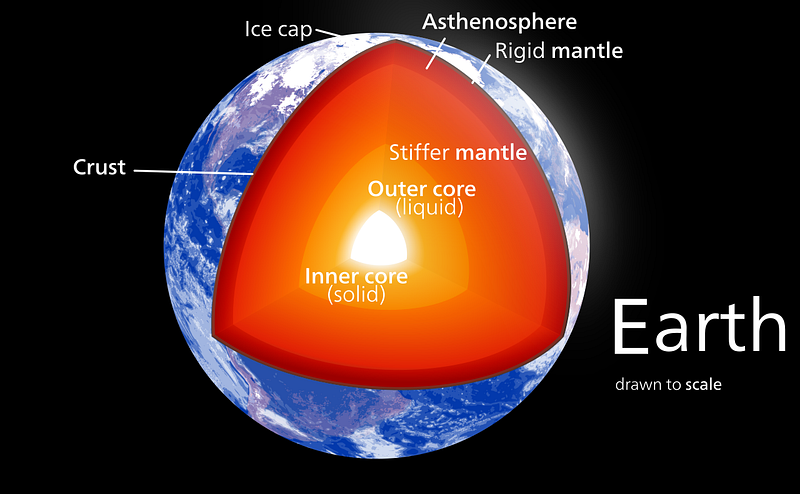
Although we walk on a hard crust on a daily basis, inside, our planet also has liquid layers. The Earth’s mantle consists of liquid rocks, or magma. Beneath it lies a two-part nucleus, the existence of which was confirmed in 1936.
The outer core is about 2,000 km thick. It is a very hot ocean of iron and nickel. On the other hand, at the center of the globe hides a hard inner nucleus, most likely made mainly of iron. And the outer nucleus closely separates it from the rest of the globe.
Our knowledge of the inner nucleus is relatively new. It was only in 1996 that evidence emerged suggesting that it rotates relative to the Earth’s mantle. This was demonstrated by geophysicist Xiaodong Song and seismologist Paul Richards.
The scientists reviewed seismic wave records from three decades of earthquakes originating in one region. They were recorded at different locations on Earth, thousands of kilometers apart. Scientists have long been studying the rotation of Earth’s inner core and its relationship to the Earth’s mantle. Recent recordings of seismic activity have led to the conclusion that the inner core is spinning faster than the Earth’s mantle. However, this theory has not been without controversy. Some experts have argued that the timing of earthquake recordings may have been influenced by physical changes on the surface of the inner core. This has led to a deeper investigation on the possible causes of this discrepancy.
A year ago, a study was conducted on the rotation of the inner core between 1969 and 1971, which surprisingly showed that the inner core rotated slower than the mantle. This further adds to the complexity of understanding the dynamics of the Earth’s inner core.
Is the Earth’s core spinning slower?
Xiaodong Song continued his research. He compared the historical data that led him to the 1996 breakthrough with more recent data from 1995 to 2021, and concluded in a paper just published in the scientific journal Nature Geoscience.
The conclusions turned out to be surprising. Until 2009, the Earth’s inner core was spinning faster than the layers above it. Fourteen years ago, however, there was a change. The rotation of the inner core slowed down, and it may even have stopped.
Song and Yi Yang, co-authors of the paper, say that this is not just a local change relating to certain parts on the surface of the inner nucleus, but to it as a whole. According to the researchers, this may even indicate that the inner nucleus will soon change its direction of rotation.
Seventy-year oscillation of the nucleus
Fortunately, this is nothing unusual. Such an event can occur once every seven decades, according to the two scientists. As they wrote in their paper, the previous such change occurred in the early 1970s. It is probably related to other changes we periodically observe: the rate of rotation of the entire planet (that is, the length of the day) and changes in the magnetic field.
Song and Yi Yang also point out that the oscillation is very slow and barely noticeable. Nevertheless, changes in the direction and rate of rotation of the Earth’s inner core affect all the layers of the globe above it.
“Our observations prove that there are dynamic interactions between the Earth’s layers, from the innermost to the surface”, they wrote in their paper.
Source: Nature Geoscience, Nature, ScienceAlert
Cool that you made it to the end of this article. I will be very pleased if you appreciate the effort of creating it and leave some claps here, or maybe even start following me. It would be nice if you also left a tip! Thank you!


_(24244288558).jpg)
