
We Work Best in 90-Min Cycles — Why Work 9 to 5?
The science of working in cycles
In 1920, a guy named Symanski noticed behavioral rhythms and patterns in rodents and fish that seemed to respond to rules encoded in their DNA. Because the technology to continuously monitor physiological parameters was not yet developed, however, he left it at that and wasn’t able to push the research further.
30 years later, sleep researcher Nathaniel Kleitman discovered that the human body tends to move through 90–120 minute cycles that repeat 3 to 5 times through the night, and this time there was more available technology for better data collection around something called ultradian rhythms. “Ultradian” means “many times a day”, and rhythms refer to the regular oscillating (up-and-down) wave patterns these cycles follow (source).
In this article, we’re focusing on what ultradian rhythms mean in our modern capitalist society, and how to better adapt our schedule to match those natural cycles (hint: it’s not easy). In order to study that, we need to quickly cover circadian rhythms too.
“Circadian rhythms are physical, mental, and behavioral changes that follow a 24-hour cycle. These natural processes respond primarily to light and dark and affect most living things, including animals, plants, and microbes.” — National Institute of General Medical Sciences
This is what a basic circadian rhythm looks like for us humans:

As you can see, it covers a whole day and is usually represented as a circular diagram. Ultradian rhythms are based on a much smaller timeframe and represented on a horizontal timeline:
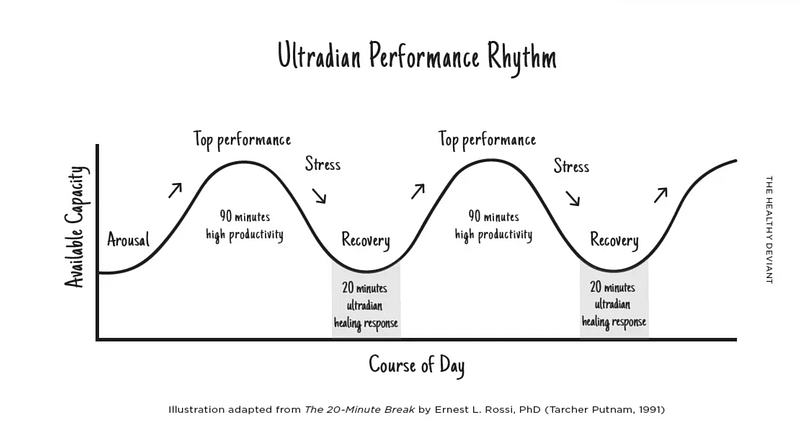
They’re like mini-versions of circadian rhythms, they’re much shorter, they repeat several times in a day, and not being in sync with them will cause us to be tired, stressed, and less efficient (source). The problem is, we live in a time where it’s pretty challenging to be in sync with our natural cycles. Try to postpone a meeting by 30 minutes with the reason: “Because I need my power nap” and you’ll see what I mean.
The modern work cycle problem
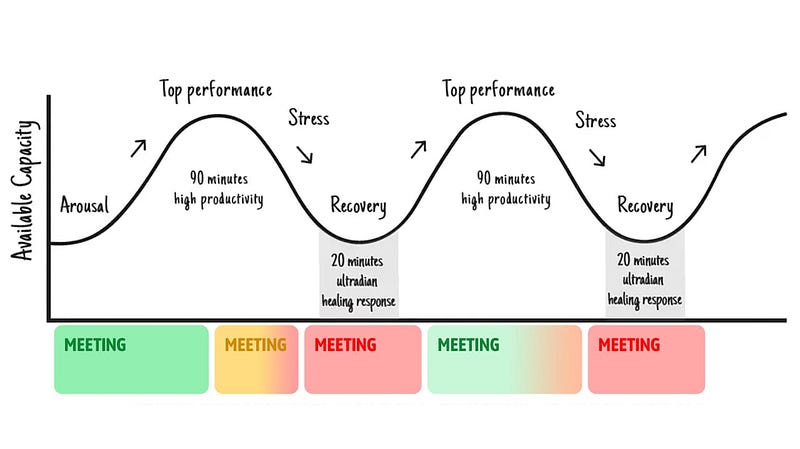
As you can see in the image in the previous section, one of the core principles of ultradian rhythms is that they’re based on stimuli and response, with a recovery period in between. This implies one stimulus at a time, for one response at a time. After each stimulus, performance steadily increases to reach a peak, and then slowly decreases towards a 20–30 minute recovery phase. After that, the cycle can start again.
The problem is that this almost never happens in a modern work environment. From the moment you show up at the office to the moment you leave, you’ve interacted with 20 people, been asked to complete 5 tasks, had to deal with 3 unexpected items that popped up during your day, with none of those items responding to any type of cycle.
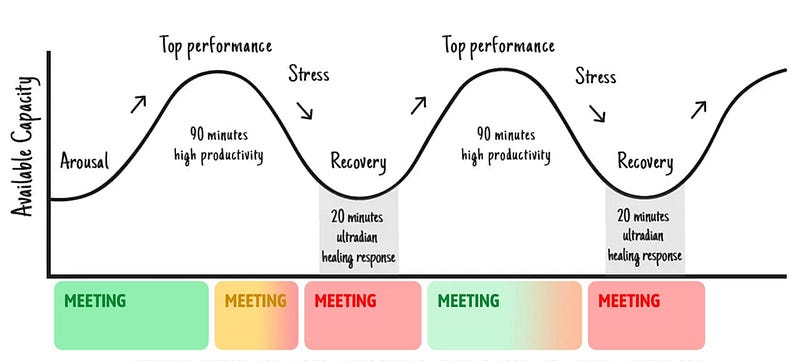
Not only does the cycle get broken that way, but the speed at which this happens is often exhausting too. Have you ever tried to count the number of interruptions you get while you work at the office? You’d probably quickly lose count. Assuming one productive cycle without interruptions is 90 minutes long, you’d be lucky to get 2 or even 1 full cycle during your “working” hours.
Meetings often follow one another without much structure or routine over the week, and this doesn’t help to try to stick to regular cycles. Sure you may have some weekly check-ins that always happen at the same time, and that’s actually great. But let’s face it, the bulk of a typical workweek is usually not structured. It’s fine to have a meeting that lasts only 30 minutes, but if it’s followed by 2 back-to-back one-hour meetings, your ultradian healing response (when you’re the most tired) is basically happening right in the middle of your third meeting, and that’s not going to bode well with your productivity.
It wasn’t always like this
I wrote about circadian rhythms in the past and argued that our natural circadian rhythms started being challenged with the advent of industrialization, and its main actors like Henry Ford.
Now that we’ve talked about ultradian rhythms, it’s pretty easy to see how working (almost) nonstop 8-hour shifts at a factory would also mess with those cycles, but at least the guys at the factory lines knew when their day/shift would end. They knew they got to go home and relax after a long workday, and they didn’t have to worry about anything work-related until the next day. What really started messing with our ultradian rhythms is technology, which brought work into every aspect of our daily lives.
Nowadays, you can keep checking your emails as soon as you get home, and you can stress about deadlines all the time because you always have access to your calendar. You often don’t have to physically be in the office to have access to your work files, to work on the sidelines of your kid's soccer game, to send a quick Slack message in bed…
Take that and add on top of it the huge recent advances in Artificial Intelligence and Augmented Reality, and within a few decades (maybe even less) we’ll all be connected to our work 24/7 through our VR Glasses, sending prompts to ChatGPT while asking our virtual assistant why the 10 emails from an hour ago are still not replied to. And please stop pinging me with non-work-related notifications like my son’s birthday party next weekend. Oh, wait.
Now, it’s true that this “new work age” can’t be held accountable as the only culprit for crushing our ultradian cycles. There’s also social media, the dopamine loop, apps always sending us notifications… There’s Instagram, which makes us more stressed by trying to either emulate the life of the people we follow who seem to have it better than us, or by trying to impress others and seeking validation through fake posts that don’t reflect our actual, miserable and non-enviable life. Wait, am I the only one?
So in an ever-busy world that’s getting ever-busier, what’s the solution to be more in sync with our ultradian cycles?
The modern ultradian solution: The Pomodoro Approach
How funny is it that one of the most efficient time management techniques to fight the non-stop high-tech inflow of information throughout the day was developed by a guy in the 1980s when there was no internet, and only requires a good old tomato timer, a pen, and a sheet of paper? Very satisfying, if you ask me.
Francesco Cirillo was an Italian land developer and entrepreneur who always had a lot on his plate and never seemed to have time to work on the important stuff. He decided to start using a physical timer (he found a tomato-shaped one in his kitchen, hence the name of the method) to organize his schedule and work on one thing at a time. He experimented with different time intervals and settled on 25-minute work sessions and 5-minute breaks. After 3 of those cycles, he had a longer 20 to 30-minute break. Does that sound familiar?
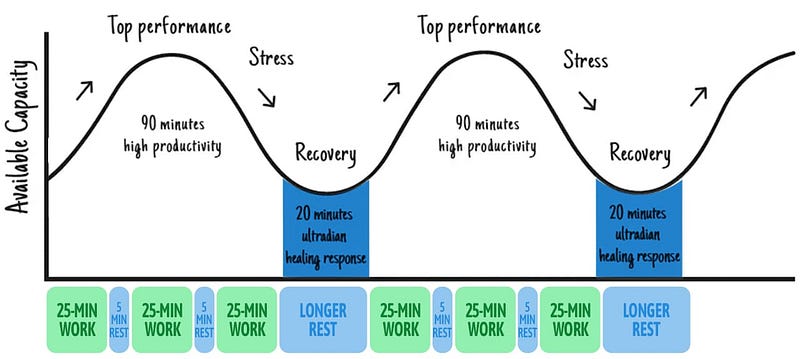
That’s right. The Pomodoro approach matches (almost) exactly the natural ultradian cycle timeline. The best part about it is that it’s a lot more popular time management approach than mentioning the term “ultradian”, so your boss may even have heard about it and be ok with you giving it a shot.
So get yourself a timer, a pen and a sheet of paper (to track the cycles), and Pomodoro away:
- Decide on the task to be done. You can theme your days and work only on tasks related to topic X on Mondays, for instance.
- Set the Pomodoro timer (typically for 25 minutes) and work on the task. At home, put your phone away and don’t allow yourself to lose focus (this will take training at first). At the office, make it clear to people that you can’t be disturbed. Putting the ticking Pomodoro timer in evidence on your desk might be deemed a too “passive-aggressive” approach. Instead, maybe you can listen to classical music with noise-cancelling headphones, or opt for a white noise app.
- End work when the timer rings and take a short break (typically 5–10 minutes). At home, walk around, enjoy a quick walk in your backyard, say hi to your kids (don’t forget the birthday party). At the office, time for a coffee run with your colleagues, a light stretching session in your chair… Again don’t bring an actual ringing timer to the office, people might take it the wrong way.
- Go back to Step 2 and repeat until you complete four Pomodoro cycles. Then, take a long break of 20 to 30 minutes. Once that’s finished, return to step 2 and repeat the cycle as many times as necessary.
The Pomodoro technique has seen a huge surge in popularity in the past decade, mainly following the explosion of online content around productivity, time management, and personal organization. There’s a reason these topics have stayed in fashion for so long: people are overwhelmed and looking for solutions.
Of course, the Pomodoro technique is not the answer to all the stress and anxiety you may get from work, those are much more deeply-rooted problems and an article for another day. But if those feelings are related to your workload, your schedule, or the speed at which things are moving in your work environment, then this technique may help you to get back on track while being able to take a breather, albeit small.
Pomodoro resources
Here are some great resources to get you started with the Pomodoro technique. In general, I don’t recommend using a Pomodoro app on your phone (although there are dozens of those) because it’s too easy to get distracted by a notification while using it.
- Pomofocus — The OG Pomodoro website, with all the customizable options available.
- Forest app — While you’re working and not being distracted, the extension grows a nice virtual tree for you. After a while, you’ll get a nice little forest, a fun incentive to stay productive.
- Ticktick — My favorite productivity app of all time. You can do 1000 more things than just Pomodoro, but if you’re already using it and like to keep your number of tools to a minimum (like me), just use the timer in there.
- Aesthetic Pomodoro Timer — A Pomodoro timer that’s more aesthetically pleasing than a regular one, with an option to listen to chill vibes while working.
I interviewed 50 productivity/business experts and made a 150+ page guide out of the project. Get it for free here.


