
Circadian Rhythms Dictate Our Lives — Here’s How to Build Your Schedule Around Them
No matter how busy you are
In 2017, a team of 3 geneticists and biologists won the Nobel Prize in Physiology or Medicine for their discoveries of molecular mechanisms controlling the circadian rhythm. If that sounds complex, it’s because it is, but in this article, we’re only focusing on what this discovery means, not on how the whole process actually works: it means that our human biological clock helps us anticipate and adapt to the regular rhythm of the day.
This may sound obvious, but it somehow took 288 years and a group of 3 70-something friends experimenting with fruit flies to explain how this works scientifically. You see, this whole “circadian rhythm” thing started with a French researcher, who in 1729 placed a mimosa plant in a light-tight dark room to see what would happen. To his surprise, the plant continued to unfold its leaves in the morning and close them in the evening, despite having no indication about the current time of the day. Almost 3 centuries later, 3 geneticists realized it’s the same for humans. That’s why you feel like crap if you have to wake up at 4 am, it’s not time for your petals to open yet.
The “modern inner clock” problem
The term “circadian rhythm” originates from the Latin words circa meaning “around” and dies meaning “day”. This is what a basic circadian rhythm looks like for humans:
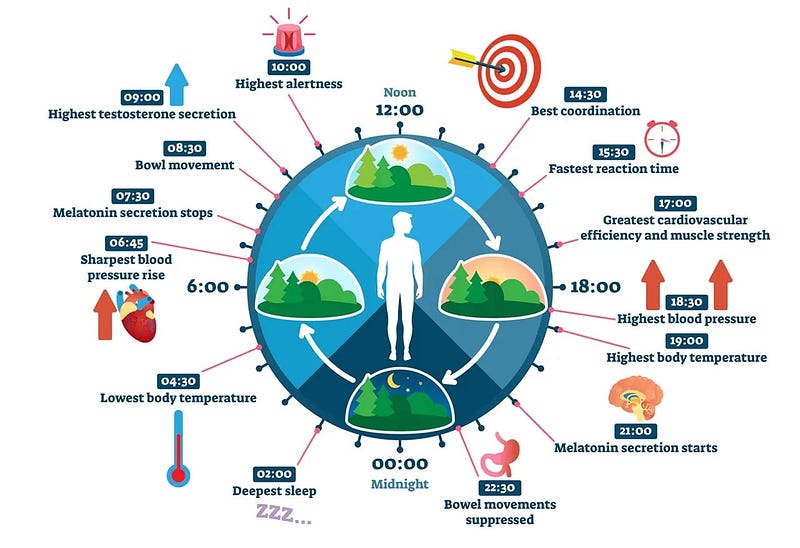
In this whole article, we’re focusing on how to better sync our everyday schedule around our circadian rhythm. The goal is to develop a more “natural” routine in order to increase our productivity and well-being in a scientifically proven way. So with that in mind, a few things stand out right away with this visual:
- The melatonin secretion (the sleep-regulating hormone) only stops at 7:30 am, yet most of us have to wake up earlier than that. Whether it is commuting to work, dropping off the kids to school, or all at the same time, most of us have to perform these tasks while still under the effect of melatonin (aka “groggy”).
- Our highest alertness is around 10 am, but this is also the busiest time of the day for many people. Alertness may sound like it’s great for business, but it’s usually a double-edged sword. If you work in an office, it’s nearly impossible to get “focus time” at 10 am, because that’s when people schedule meetings, hang out at the coffee machine, or need you to work on this very urgent thing that’s really not that urgent in your opinion but whatever.
- Our best coordination and fastest reaction times are between 2:30 pm and 3:30 pm, yet most of us are usually sitting at a desk around this time, so what’s the point of having good reflexes there?
- The melatonin secretion (to put us back to sleep) starts earlier than most of us would assume, around 9 pm. Yet many people like to watch Netflix until much later in the evening, sometimes falling asleep watching TV. What does this mean for our brain and our body?
It’s pretty apparent that for most of us in our modern, capitalist society, our daily routine is not in sync with our natural biological clock at all. So how to fix this, and is it even possible? Is an urban, modern lifestyle unequivocally incompatible with natural cycles? Are we all doomed, forever unable to escape a rat race that not only sells us a utopia most of us will never reach but also tires the hell out of us a little more every day, until we die? No, there’s got to be more to it.
The natural inner clock foundation
You see, back in the day, a lot of this circadian stuff made a lot of sense (and it still does today by the way, it’s just that we tend to forget that burning out at 30 should not be expected and is not a “normal career step”). Looking back to the prehistoric age, people didn’t really have to worry about getting to the office by 9 am. They did have to watch out for tigers, dinosaurs (ok, not dinosaurs), and all these wild animals that could annihilate you, so they were probably not big fans of sleeping in until late in the morning, but it’s not like they HAD to get somewhere by 9 am. Similarly, they didn’t have to fetch the kids right when they thought their work day was over, they had fewer errands to run, and when it was all said and done, they even got to breathe some nice fresh air before going to bed (people didn’t live in air-conditioned houses back then).
Even later in history as societies developed more, people were probably a lot more in sync with their inner circadian rhythm than we are today. I’ve been out of school for a while but I don’t remember gladiators having to clock in and out of work at a certain time, or Aztecs checking on their colleagues that they didn’t leave the office temple (or wherever they worked) too early to fetch the kids. There was more danger out there, but if you stayed in your lane you were probably fine, right?
The natural inner clock foundation only started being challenged with the advent of industrialization, and later mass production. Take Henry Ford, a guy who changed the face of the automobile industry (and by extent of America). To reduce costs and increase production of his most successful car (the Model T), Henry Ford borrowed a tactic from the meatpacking industry and implemented the assembly line in his manufacturing plant. This revolutionized the industry, and it came with another groundbreaking concept: the Five Dollar Day wage for an eight-hour shift.
From now on, whether you were a family man worried about being able to put food on the table, a car mechanic who was looking for a job, or just anyone wanting to make a guaranteed, fixed income every day, you could work for Ford, and not for peanuts. $5 in 1914 is equivalent to $153 today. This revolutionary offer also meant one thing: you had to clock in and out of work. You were expected at a certain location, at a certain time, to get to work and only leave 8 hours later. Does this sound familiar?
Take that exact concept and let 100 years of more industrial, technological, and societal development do their job, and you get exactly where we are today. Most of us work in offices, spend our days staring at a computer screen, for exactly 8 hours per day and a fixed salary. Most of us have kids, so we need to wake up early to take care of them, and to go to bed late to make some time for ourselves and our so-called “well-being.” In reality, literally our entire schedule is centered around our 9–5, making money, and making sure we don’t get panic attacks too often. Is this working? Here are a few numbers to try and answer that question:
- 17 million annual sick days are lost due to work stress, depression, or anxiety. Talk about being productive.
- 6 in 10 workers in major global economies experience workplace stress.
- In one study, 34% of workers reported difficulty sleeping because of stress.
- Not getting enough sleep can cause a negative mood, low energy, difficulty concentrating, and a general inability to function as usual.
Now, it would be too easy to blame all of these problems solely on the 9–5 grind. As we know, there are also wars, revolutions, inflation, bad and scary news everywhere… Technology and social media have never had a larger place in our lives, and the speed at which we are expected to process information and consume content is extremely stressful and anxiety-inducing. Add to that fast food, pollution, and people being scared of their neighbors, and you get a recipe for a life stressed beyond reason.
Those factors are part of the problem, but it’s also undeniable that long work hours, tiring commutes, and never-ending traffic jams greatly contribute to making us more stressed, tired, and unhealthy. So what if we tried to go back to basics, and live more in harmony with our inner cycles, aka our circadian rhythms? What would that look like?
Finding sync again
Of course, most of us don’t have the luxury of waking up between 7:30 am and 8:00 am to accommodate our circadian rhythm. But without sticking to our natural clock to the minute, we can try to improve our daily routine. Take a look at this Chinese medicine circadian clock:
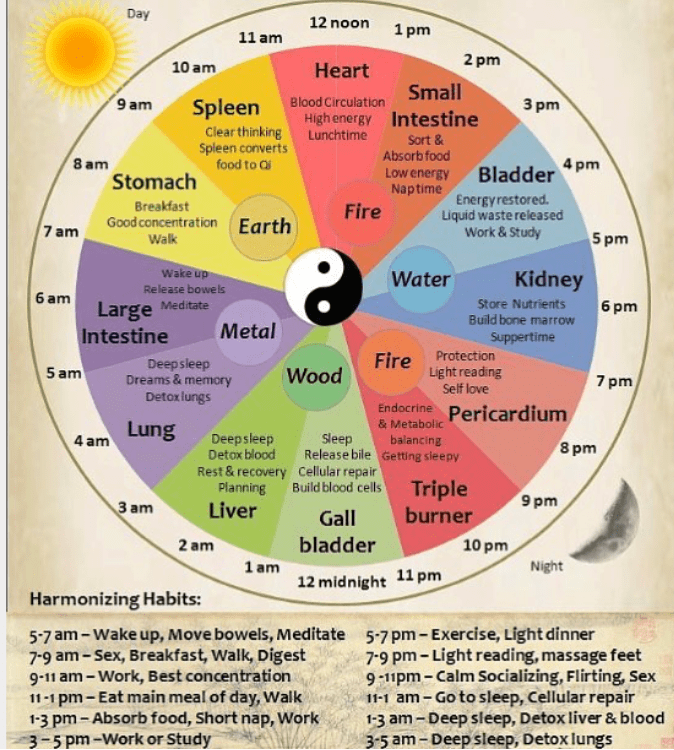
The 24-hour clock has 12 segments that are 2 hours each, and they all focus on one specific part of the body. In the context of this article we’re not focused as much on the anatomy, but more on the activities that are best to do in each of the segments, which are also highlighted at the bottom of the visual.
5 am — 7 am: Wake up
Most people wake up in this window, but how many take the time to greet the day, be grateful for the life they have, or simply relax and take a deep breath in? Meditation doesn’t have to be a full-on 30-minute session, yoga poses included. It can be as simple as sitting down for 10 minutes with your legs crossed, not thinking of anything, only the waves going in and out on a white-sand beach, and syncing your breathing on them.

7 am — 9 am: Breakfast
For a long time, breakfast was said to be “the most important meal of the day”, but these days the saying has generally been debunked as a marketing gimmick. The truth is, all meals of the day are important, but there is a substantial body of research that suggests that those who omit breakfast are at an increased risk of disease.
The negative health consequences of skipping breakfast include:
- A 27% increase in risk of heart disease
- A high risk of type 2 diabetes in both men and women (21% and 20% respectively)
- An increased risk of obesity
And, wait for it…
Circadian rhythm abnormalities.
Many of us have fast lives and prefer rushing out the door with a bagel (or worse than that) and grabbing coffee at Starbucks rather than taking the time to sit down and have a proper breakfast. But this messes with your circadian rhythm and has long-term negative health impacts. Plus, you need food to be able to focus, which is key in the next part of the day.
9am — 11am: Focus time
This time window is generally considered by scientists to be the most prone to deep thinking and intense focus. Sure, you may be a night owl and could swear you work best at night from 8 pm to 10 pm, but that’s not listening to your inner chronobiological clock, which with a name like this you should obviously trust, right?
It’s also worth noting that according to research, most people need at least an hour of uninterrupted work to get in “the zone”, and then 1 or 2 extra hours on top of that.
11 am — 1 pm: Lunch time + Walk
There are only 2 situations in which most of the greatest ideas to ever come out of the human mind were found: in the shower, and out for a walk. Aristotle, Einstein, Darwin, Seneca, Steve Jobs… They all used walking as a way to not only clear their minds but also get revolutionizing ideas (I’m sure they also showered but we’re not intersted in that here).
Another upside of walking is that it’s surprisingly compatible with office life. I used to work at offices in a very nice location near a park, and many people used 15–20 minutes after lunch to go for a quick walk and chat (walking is an amazing way to socialize). Depending on how fast you walk, you can use the time to clock in a light workout too.
My CEO used to spend hours walking around the building, taking phone calls. It’s a much more fun and productive way of having meetings than sitting in a chair in front of a camera all day, and I guarantee you this guy was getting his 10,000 recommended daily steps.
1 pm — 2 pm: Low energy
Here we come across one of the most challenging discrepancies between what our natural body clock expects us to do (rest for a bit) and what our office schedule is demanding us to do (jump into a meeting and finish 10 important tasks before leaving at 5–6 pm).
After eating, our body needs time to digest and process the food intake, and this also consumes energy. That’s why we tend to feel a bit tired after eating, and that’s why our body would love us to take a nap after lunch.
I once had a business trip to my company headquarters in Europe, and around lunch break, I noticed a person lying on his back right on the floor, with his hands resting on his chest and a face mask covering his eyes. For a split second I wondered “Is this person okay?”, but then I realized the guy was just taking a good ol’ nap. 20 minutes later we crossed paths on the way to the coffee machine, and he looked fresh as ever.
It goes without saying that napping at the office is not a very popular approach. You’d be forgiven for feeling judged, or even afraid of your boss’ reaction learning you’re using the office to catch up on your zzzs. Besides, who has the time to nap? Especially when the report you’re working on was due yesterday. But again, it’s about making a conscious effort to be more in sync with your internal clock. Maybe you don’t have to nap but you can take 10 minutes to sit and rest on a bench outside? Or, maybe you can sit at your desk doing (dare I say it?) nothing, listening to calming music for a bit?
2 pm — 6 pm: Energy restored
A lot of people who go to the gym like to do it after work, usually around 5 pm. Based on our circadian rhythm, that’s when our body has the greatest cardiovascular efficiency and muscle strength, so that’s actually not a bad time at all.
We also get a lot of our focus back right around the beginning of that time slot (3:30 pm is our fastest reaction time of the day), so focusing on some light work then can be a good idea (if you’re at the office, you probably don’t have much else to do anyway).
6 pm — 9 pm: Wind down
Many people underestimate the power of a good wind-down routine. It can help you keep your mood balanced, boost your ability to learn and remember, enhance creativity, and improve attention span.
A good wind-down routine starts around 2 hours before bedtime and includes the following 3 core components:
- Turning off screens. The blue light emitted from our device screen has been shown to disrupt our circadian rhythm.
- Doing mindfulness exercises. About ten minutes before bedtime, practice mindfulness in a chair in a dimly lit room. Take five minutes to be aware of your body and being present in it. Research shows the impact of mindful-based therapy on insomnia.
- Breathing deeply. Breathing awareness is directly correlated to mindfulness and a good night’s sleep.
The evening time is also the best time of the day to do some light reading if you have enough energy for it.
9 pm — Almost time for bed
At 9 pm, your body starts secreting melatonin, the sleep-inducing hormone. Although a lot of us like to wait until way later to go to bed, 9 pm is right around the time you should get ready to put on those pajamas, cozy up under that blanket, and get those zzzs. Feel free to slap on a sleeping mask as well, as our body recuperates better in total darkness.
The thing is, it’s not as bad to go to bed late as it is to wake up later because we’re tired from a Netflix binge-watching evening.
Research shows that many people who go to bed later tend to oversleep the next day. This can lead to waking up with sleep inertia, which is the transitional state between sleep and wake. That’s why people who sleep in for a long time don’t necessarily wake up less groggy and are often more irritable than people who are used to waking up at the same time every day (including on the weekends).
Breathe in, breathe out
That’s still the best way to get through your day, no matter how stressed, busy or tired you are. For the lucky bunch of us living in the most developed parts of the world, the comfort of the life we have has a hard price to pay. No matter how hard we try, it just so happens that modern society is not synced with the natural clock our circadian rhythms are based upon. We may have made a lot of technological advances, and developed at a rate faster than ever before in the history of humanity, but we still haven’t figured out a way to do it more “naturally”.
It somehow makes sense, because if we had prioritized natural rhythms over technological advances, we probably would still be living in nature, hunting wild beasts and keeping an eye out for the tigers at night. It’s just that we’ve taken the whole “progress” concept to an extreme that’s hard to come back from. Most of us have forgotten our primal, animal side in the process, even though it’s also part of our DNA.
So what now? Should we all go back to the forest and hunt wild boar? Or should we forget our circadian rhythms for good, move past them, and go live in the matrix? Well, as often in life, it’s not all black or all white, and the answer lies somewhere in the middle, in a grey area between both worlds. Picture a world full of emails, calendar invites, and AI robots taking over, just like the daily life you know. But add to it a more simple, “back to basics” lifestyle, and sprinkle in a few walks in nature, fresh air, meditation, awareness… Think star gazing instead of binge-watching, smiling more instead of always scrolling, and going to bed at 9 pm instead of midnight (unless you’re staring at the stars).
That right there is probably the sweet spot, the “Circadian Nirvana” you want to aim for.
I hope you found this article insightful, and I wish you a great rest of your day. I hope that above all the noise of your busy life, you will once in a while remember to listen to your inner circadian rhythm.
I interviewed 50 productivity/business experts and made a 150+ page guide out of the project. These guys are really good at following their circadian rhythm. Get the guide for free here.


