
Science Monday: Does Sugar Really Make You Hyperactive?
Learn a new fact for the week: if you give a child sugar, do they really get an energy rush — or is it all in their heads?
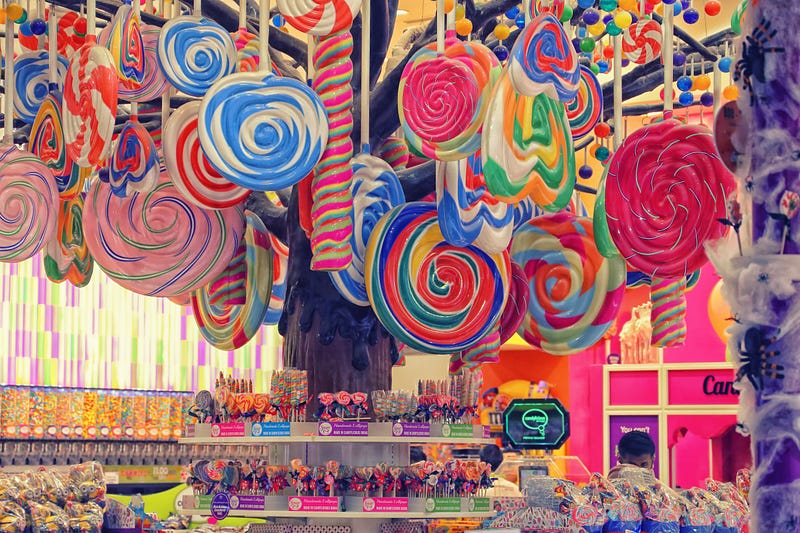
Late on the night of Halloween, after my sister and I finished trick-or-treating to collect a pillowcase full (often literally!) of candy, we’d sit down and divvy up the spoils, eager to start stuffing our faces with sweets.
Not so, our parents would caution us. Only a few pieces each.
“After all,” my mom would add, “sugar makes you hyper, and it’s late enough already! You don’t want to be up all night from having too much!”
I’ve heard that statement plenty of times, repeated by many parents (and enough times that children parrot it as well). Sugar makes you hyper. And it seems to be the case, at least in real-life anecdotal examples; just go to a child’s birthday party and watch the children run around, screaming and chasing each other and burning seemingly limitless stores of energy, after they’ve filled their little mouths with squares of birthday sheet cake.
But is it true?
Does sugar really give us a burst of immediate energy? Or is the whole thing just another urban myth, like the idea that MSG gives us headaches?
Let’s find out!
Sugar or White Bread: Not Much Different, Actually
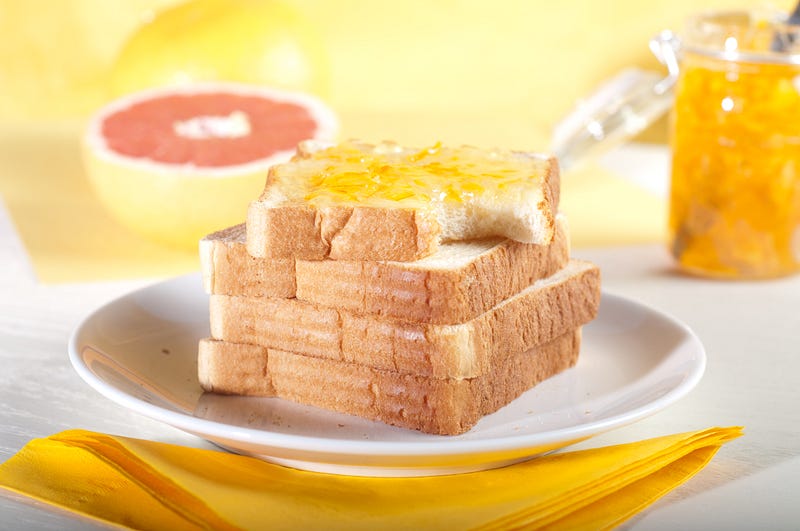
Here’s a revelation that your parents probably never shared with you — in terms of how we break food down into energy, white bread is pretty equivalent to sugar.
See, when we eat or drink something, it travels down through our mouth, esophagus, and stomach until it reaches the small intestine. This narrow twisted liquid-filled tube is where most of the absorption of food happens, where it crosses the intestinal wall and truly gets into the body.
Our bodies absorb basic sugar molecules — but we should digress here and mention that there are many different forms of “sugar”, molecularly speaking. All of these sugars are made of one or more rings, consisting of five or six carbon molecules, but have other variations (I promise I won’t go too deep into chemistry here):
- Glucose is one of the “basic sugars”, with just a single six-carbon ring. Our body loves glucose for energy, and will convert many other things into glucose.
- Fructose is also a basic sugar, but it has five carbons in its ring. As the name suggests, fructose is commonly found in fruit (and fruit juice).
- Sucrose is the granular stuff that we call table sugar and use in cooking. Sucrose has two rings of carbon molecules — it’s one glucose and one fructose molecule, bonded together.
- Glycogen is a carbohydrate — but carbohydrates are just made of many sugar molecules linked together! Glycogen is a bunch of glucose rings, linked together in a branching, tree-like structure.
- Cellulose is indigestible fiber — and once again, it’s made of glucose! However, this glucose is in long, unbranched chains, which our bodies cannot easily break apart to get at the individual glucose molecules.
There are other types of sugar, but these are the basic ones to know.
Now, let’s get back to eating sugar. When we eat sugar, we’re eating sucrose, which gets broken apart into fructose and glucose. These simple sugars are then either burned for energy, or stored for later.
When we eat bread, especially white bread, we’re eating glycogen — but again, it’s broken apart into glucose, and either used for energy or stored for later.
The speed at which we absorb the sugar and have it ready for use is measured on a scale, known as the glycemic index. The higher some food scores on the glycemic index, the faster we absorb it and convert it into glucose, ready to be used as energy.
Pure table sugar has a glycemic index score of 65.
Plain white sandwich bread has a glycemic index score of 100 — the highest possible score!
So we get energy even faster from white bread than we do from shoveling spoonfuls of table sugar into our mouths — but there’s no such thing as a “bread high”, or someone getting “bread hyper”!
Maybe sugar doesn’t make us hyper? Where did we even come up with this idea?
Evidence As Wobbly As Jello
The original theory that sugar causes hyperactivity came from the 1970s, from a children’s diet that quickly gained popularity. Created by pediatrician and allergist Benjamin Feingold, the diet advocated for parents to avoid giving their children food that contained additives, such as artificial colorings or flavorings. He believed that these additives contributed to hyperactivity in children.
Although it was initially popular, the Feingold Diet has been repeatedly debunked; there’s no correlation between eating artificial foods and hyperactivity (or attention deficit disorder, ADD, which known as hyperactivity in the 1970s).
The linking of sugar to hyperactivity, however, has managed to stick around.
Other studies have repeatedly disproven the link between sugar and hyperactivity, and instead pointed to a different source of the burst of energy. It’s one that you may not immediately suspect, since it doesn’t have anything to do with what the child puts in his or her mouth.
It’s the parents.
It turns out that, when children are given a sweetened beverage, the parents are more likely to consider them hyperactive, full of excess energy — even if the drink given to the child contained only zero-calorie artificial sweeteners! Parents insisted that the children must have been given sugar, despite the facts of the experiment.
The reason this myth of sugar causing hyperactivity sticks around is probably due to a common tendency of humans: mixing up correlation and causation.
Ice Cream Causes Shark Attacks??
If you correlate when people eat ice cream with shark attacks, a horrifying trend emerges. The more people eat ice cream, the more likely they are to be attacked by a shark! This is not made up; it’s 100 percent true.
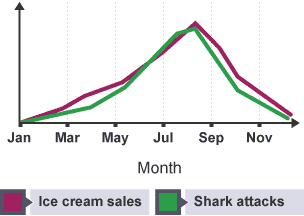
Now, obviously sharks aren’t seeking out people with ice cream cones to eat. That would be preposterous. Instead, this is a case where we mix up correlation and causation — we tend to eat most ice cream in the summer, when it’s hot. We also go to the beach in the summer, where shark attacks occur.
Ice cream consumption doesn’t cause shark attacks; both ice cream sales and shark attacks go up during the summer.
Now, let’s apply this same philosophy to sugar. When do most children get to eat a bunch of sugar?
- At birthday parties?
- On holidays, like Halloween?
- While out in exciting new places (think about ice cream on the beach, or cotton candy at a theme park)?
In these situations, are children hyper because they’re eating sugar? Or are they hyper because they’re in an exciting and energizing situation, where there also happens to be plenty of sugar to eat?
Based on the scientific evidence, this is the reason for hyperactivity; it’s not the sugar, but the setting.
So, while sugar is a delicious delectable in desserts, it’s not actually responsible for any hyperactivity that may follow. Instead, that burst of energy likely comes from the settings — sugar is often consumed in exciting settings, like at birthday parties, holidays, or out with friends.
The original theory that sugar causes hyperactivity came from a diet in the 1970s, which has since been discredited. Many follow-up studies have demonstrated that there’s no link between the level of sugar consumed and the level of activity.
So while sugar isn’t a great thing to include in a child’s diet, there’s no harm in letting kids have a small dessert before bed. It won’t fill them with energy and leave them unable to sleep — unless the parents or surroundings get that kid energized and psyched up.
Sam Westreich holds his PhD in genetics, focusing on methods for studying the gut-associated microbiome. He currently works at a bioinformatics-focused startup in Silicon Valley. Follow on Medium, or on Twitter at @swestreich.
Have a science-related question? Comment to suggest a topic for my next story. Or check out this related story:


