Ukraine and Russia have Zoopark radars, but additionally Ukraine has some NATO radars such as the US AN/TPQ36.</p><figure id="eb3b"><img src="https://cdn-images-1.readmedium.com/v2/resize:fit:800/1*X8_rXShxnne_t_H_dYAXfg.jpeg"><figcaption>Credit: By Staff Sgt. Adriana Diaz-Brown, 10th Press Camp Headquarters — US delivers two Q-36 Counter Battery Radar Systems to Ukraine, United States Army, Public Domain, <a href="https://commons.wikimedia.org/w/index.php?curid=49536561">https://commons.wikimedia.org/w/index.php?curid=49536561</a></figcaption></figure><p id="60c0">Early counter-battery radars were usually used against mortars, whose lofted trajectories were highly symmetrical and allowed easy calculation of the launcher’s location. Then digital computers with improved calculation capabilities allowed more complex trajectories of long-range artillery to be determined and the origin of the projectiles to be established quickly.</p><figure id="0ae8"><img src="https://cdn-images-1.readmedium.com/v2/resize:fit:800/1*jyGn-OK3h3GyLn4YRKQ2MA.png"><figcaption>Principle of counter-battery radar. Credit@ By Sandstorm de — Own work, CC BY-SA 4.0, <a href="https://commons.wikimedia.org/w/index.php?curid=117676740">https://commons.wikimedia.org/w/index.php?curid=117676740</a></figcaption></figure><h1 id="0adb">Response</h1><p id="5704">Once the enemy artillery positions have been located, friendly artillery units can initiate a counter-battery attack. This typically involves the rapid and accurate firing of artillery rounds onto the enemy positions. High-explosive rounds are commonly used to destroy the enemy artillery.</p><p id="8522"><b>Key considerations in counter-battery artillery include speed, accuracy, and coordination.</b></p><p id="35f1"><b>Speed</b> is crucial to disrupt the enemy’s firing cycle and minimise the number of rounds they can launch. Rapid target acquisition and engagement are essential to prevent the enemy from relocating the friendly artillery and avoiding enemy counter-battery response.</p><p id="c0ad"><b>Accuracy</b> is equally important in counter-battery operations. Precise targeting minimises collateral damage and maximises the chances of hitting the intended enemy artillery position. Advanced artillery systems, such as self-propelled howitzers, can employ automated systems and sophisticated targeting algorithms to improve accuracy.</p><p id="9c14">Ukraine’s use of the highly accurate and mobile HIMARS, M270 MLRS and Excalibur guided shells, as well as other precision NATO artillery systems, means the kill probability is very high.</p><p id="dd30"><b>Range: </b>If there is artillery range disparity between the friendly and enemy artillery then the side with the longer range has a clear advantage. It’s beyond the scope here to start comparing the full range of Ukrainian and Russian artillery systems, but I did cover them in an <a href="https://readmedium.com/ukraine-whats-the-balance-of-heavy-artillery-weapons-2d0d25468733">earlier story</a>.</p><p id="7910">Here are the principal Russian artillery systems:</p><figure id="7bd4"><img src="https://cdn-images-1.readmedium.com/v2/resize:fit:800/1*jM1AqOjyd_Uvd2LnSjVDnQ.png"><figcaption>Author table of principal Russian artillery systems</figcaption></figure><p id="4fd5"><b>Coordination</b> is vital in counter-battery artillery to ensure effective results. This involves the integration of various intelligence sources, radar systems, and artillery units.</p><p id="8481">A centralised command and control structure allows for real-time information sharing and the efficient allocation of resources. Effective communication systems enable artillery units to receive and process target data swiftly, leading to rapid response times and improved operational effectiveness.</p><p id="94e1">Ukraine is probably the current world leader in this C3 aspect of counter battery artillery operations.</p><h1 id="1feb">Enemy countermeasures</h1><p id="ad84">Counter-battery artillery should also consider the enemy’s countermeasures and tactics. The enemy may employ camouflage techniques, dispersion of artillery units, or the use of decoys to deceive and mislead counter-battery fire.</p><p id="9b97">Therefore, counter-battery operations need to adapt and employ counter-countermeasures to maintain effectiveness.</p><h1 id="1f4c">Mixing it up</h1><p id="4644">In Ukraine, use of precision long-range artillery was initially prioritised above counter-battery engagements against Russian artillery systems.</p><p id="5b70">Spotting by lower-end drones combined with guided artillery resulted in numerous examples of ‘one shot, one kill’ destruction of Russian artillery systems.</p><p id="73b4">With the adjustment to Ukrainian strategy/tactics to focus more on artillery, Russian counter-battery radars have been a problem, as General Major Popov pointed out, to the displeasure of his superiors — and the rankers. More unrest — a direct consequence of the lack of Zooparks.</p>
<figure id="e08f">
<div>
<div>
<img class="ratio" src="http://placehold.it/16x9">
<iframe class="" src="https://cdn.emb
Options
edly.com/widgets/media.html?type=text%2Fhtml&key=a19fcc184b9711e1b4764040d3dc5c07&schema=twitter&url=https%3A//twitter.com/igorsushko/status/1680656116517343233%3Fs%3D20&image=https%3A//i.embed.ly/1/image%3Furl%3Dhttps%253A%252F%252Fabs.twimg.com%252Ferrors%252Flogo46x38.png%26key%3Da19fcc184b9711e1b4764040d3dc5c07" allowfullscreen="" frameborder="0" height="281" width="500">
</div>
</div>
</figure></iframe></div></div></figure><p id="6cee">And the attritional tactic is working, with shell rationing by Russia, according to British Defence Intelligence:</p><figure id="695b"><img src="https://cdn-images-1.readmedium.com/v2/resize:fit:800/0*W2_lAqWIh6qk7Xjy"><figcaption></figcaption></figure><p id="e2d7">So what is this Zoopark?</p><h1 id="f232">Zoopark-1 L219M</h1><p id="ad5e">This is a mobile passive electronically scanned array radar (based on a tracked MT-LBu chassis) for the purpose of enemy field-artillery acquisition. The system can detect moving ground targets at a distance of up to 40 kilometers. (<a href="https://en.wikipedia.org/wiki/Zoopark-1">Wikipedia</a>)</p><figure id="6d2e"><img src="https://cdn-images-1.readmedium.com/v2/resize:fit:800/1*BqvEOX9jxZnoGdBjlE-WqA.jpeg"><figcaption>Zoopark L219M radar. Public Domain, Wikipedia</figcaption></figure><p id="fdd4">It’s not publicly known how many units Russia has/had, but <a href="https://www.oryxspioenkop.com/2022/02/attack-on-europe-documenting-equipment.html">Oryx</a> lists twelve units and variants as having been destroyed or damaged, and one captured, by Ukraine in the current illegal occupation.</p><p id="a600"><b>Why is it so important to Russia? </b>According to <a href="https://en.wikipedia.org/wiki/List_of_equipment_of_the_Russian_Ground_Forces">Wikipedia’s list of Equipment of Russian Ground Forces</a>, it appears to be the only counter-battery radar that Russia has. And with Ukraine’s adjustment of the counter-offensive strategy to a heavier focus on attrition by artillery, then Russia has a much higher dependence on them.</p><p id="be89"><b>Ukraine has developed its own Zoopark-2:</b></p><blockquote id="c46f"><p><i>The Zoopark-2 WLS [weapon location system] has detection ranges as follows: ≥30 km for 152-mm artillery guns and 82-mm/120-mm mortars; 30–40 km for BM-21-type MLRS; 50–55 km for short-range rocket launchers. It is capable of friendly fire adjustment ranges as follows: 20–25 km for 152-mm artillery guns, 25–30 km for 82-mm/120-mm mortars; 21–40 km for BM-21-type MLRS; 80 km for rockets. — <a href="https://en.defence-ua.com/weapon_and_tech/ukraine_made_weapon_locating_radar_systems-6017.html">defence.ua.com</a></i></p></blockquote><p id="91a4">I wrote recently about the Moscow State Circus and its clowns, and now it seems that a Zoopark is linked to it and causing a few more personnel changes. But so far the ringmaster and clowns are still holding their posts…</p><div id="3d59" class="link-block">
<a href="https://readmedium.com/moscow-state-circus-update-2-july-14-2023-4ecd4ae68182">
<div>
<div>
<h2>Moscow State Circus: Update #2, July 14, 2023</h2>
<div><h3>Roll up, roll up for the baddest show on Earth!</h3></div>
<div><p>medium.com</p></div>
</div>
<div>
<div style="background-image: url(https://miro.readmedium.com/v2/resize:fit:320/1*NxNR9VEkw0aWvqA0cUIgYQ.jpeg)"></div>
</div>
</div>
</a>
</div><p id="1aef"><i>If you follow me I guarantee variety in your inbox with some unusual perspectives! I write on a wide range of topics that interest me including humour, tech, space, geopolitics and travel. I also write about…</i></p><p id="441a"><b>…fault-finding</b></p><p id="5ef8"><i>If you appreciate stories like these and want to support me and other writers, please consider signing up to become a Medium member. It’s only $5 a month, giving you unlimited access to incredible stories on Medium. If you sign up using <a href="https://james-marinero.medium.com/membership">my link</a>, I’ll earn a small commission at no extra cost to you.</i></p><p id="1d91"><i>Or maybe just <a href="https://ko-fi.com/jamesmarinero">buy me a coffee?</a> and tell me what you liked reading (or not)…</i></p><figure id="4277"><img src="https://cdn-images-1.readmedium.com/v2/resize:fit:800/1*0chfaohu-z_vrO8sI4wdJA.png"><figcaption></figcaption></figure><p id="196e"><i>My novels are available at my <a href="https://jamesmarinero.gumroad.com/">Gumroad</a> bookstore. Also at <a href="https://www.amazon.com/stores/James-Marinero/author/B0055RWF6U">Amazon</a> and <a href="https://books.apple.com/us/author/james-marinero/id490200686">Apple</a></i></p><p id="d17e">Author’s note: The concept, structure, style and creative content in this story are all my own and I hope that is obvious to a reader. I do not employ third party writers. However, I do occasionally use an AI assistant to research and present small sections of factual content and data. All facts are checked where possible and sources quoted.</p></article></body>
Ukraine War
Russian Counter-Battery Artillery: Zoopark is Important and Increasingly Rare
General-Major Ivan Popov was sent to Syria for pointing out the obvious to the Russian high command
As 2023 has progressed, we have seen a change in Ukraine’s counter-offensive strategy and tactics as the lack of Ukrainian air cover led to heavy initial losses.
In the first two weeks of Ukraine’s grueling counteroffensive, as much as 20 percent of the weaponry it sent to the battlefield was damaged or destroyed, according to American and European officials. The toll includes some of the formidable Western fighting machines — tanks and armored personnel carriers — the Ukrainians were counting on to beat back the Russians.
The startling rate of losses dropped to about 10 percent in the ensuing weeks, the officials said, preserving more of the troops and machines needed for the major offensive push that the Ukrainians say is still to come.
Some of the improvement came because Ukraine changed tactics, focusing more on wearing down the Russian forces with artillery and long-range missiles than charging into enemy minefields and fire.
This change of strategy/tactics has hit the Russian forces hard.
In this context the importance of counter battery radars cannot be underestimated.
Ukraine possesses a variety of counter-battery radars, drones and highly accurate artillery which is having a significant attritional effect on Russian artillery battalions.
We don’t know how many counter-battery radars Russia has, but the Zoopark-1M radar is the only type in their armoury. And they are losing them steadily.
Ukraine’s successful integration of technology into its C3 systems has made it probably the most efficient army in the world in this respect, exceeding even NATO’s capability.
I was amazed to learn that the US is still training the old paper based approach without use of, for example, tablet computers for artillery spotters, or drones, much to the amusement of the Ukrainians that the US Rangers were training. I’m sorry that I can’t immediately find the link to that story.
Certainly, technology isn’t everything and the ability to fall back on the old methods is important. I should know — I live on a boat and although I have electronic charts they can be inaccurate and then I need to fall back on paper charts.
Counter-battery artillery: the objective
The primary objective of counter-battery artillery is to locate, track, and destroy or suppress enemy artillery systems. By neutralising the enemy’s artillery, counter-battery fire can significantly diminish the enemy’s ability to inflict casualties, disrupt friendly operations, and maintain defensive positions.
Counter-battery artillery is a proactive measure that aims to gain a tactical advantage and reduce the enemy’s overall combat effectiveness.
Detection/Location
The first step is the detection and location of enemy artillery positions. This can be accomplished through a combination of intelligence gathering, such as signal interception, human intelligence, and aerial reconnaissance such as drones.
Advanced radar systems are also used to detect and track incoming artillery rounds, allowing for a more precise determination of the enemy’s firing position. Both Ukraine and Russia have Zoopark radars, but additionally Ukraine has some NATO radars such as the US AN/TPQ36.
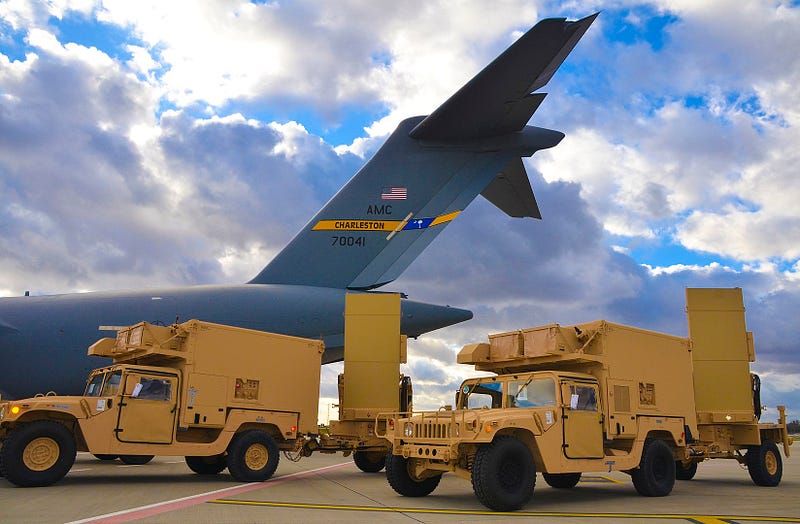
Credit: By Staff Sgt. Adriana Diaz-Brown, 10th Press Camp Headquarters — US delivers two Q-36 Counter Battery Radar Systems to Ukraine, United States Army, Public Domain, https://commons.wikimedia.org/w/index.php?curid=49536561
Early counter-battery radars were usually used against mortars, whose lofted trajectories were highly symmetrical and allowed easy calculation of the launcher’s location. Then digital computers with improved calculation capabilities allowed more complex trajectories of long-range artillery to be determined and the origin of the projectiles to be established quickly.
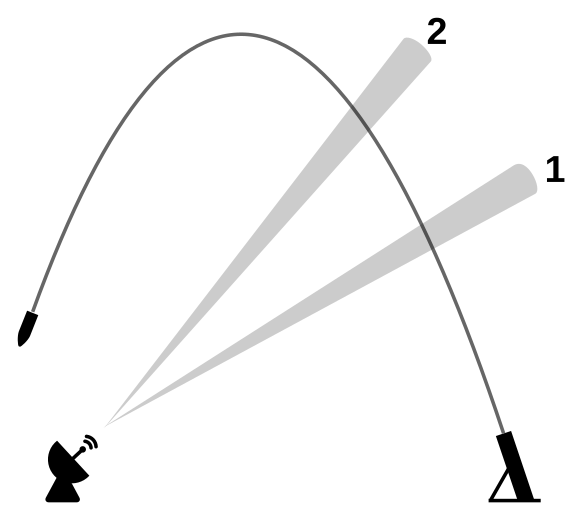
Once the enemy artillery positions have been located, friendly artillery units can initiate a counter-battery attack. This typically involves the rapid and accurate firing of artillery rounds onto the enemy positions. High-explosive rounds are commonly used to destroy the enemy artillery.
Key considerations in counter-battery artillery include speed, accuracy, and coordination.
Speed is crucial to disrupt the enemy’s firing cycle and minimise the number of rounds they can launch. Rapid target acquisition and engagement are essential to prevent the enemy from relocating the friendly artillery and avoiding enemy counter-battery response.
Accuracy is equally important in counter-battery operations. Precise targeting minimises collateral damage and maximises the chances of hitting the intended enemy artillery position. Advanced artillery systems, such as self-propelled howitzers, can employ automated systems and sophisticated targeting algorithms to improve accuracy.
Ukraine’s use of the highly accurate and mobile HIMARS, M270 MLRS and Excalibur guided shells, as well as other precision NATO artillery systems, means the kill probability is very high.
Range: If there is artillery range disparity between the friendly and enemy artillery then the side with the longer range has a clear advantage. It’s beyond the scope here to start comparing the full range of Ukrainian and Russian artillery systems, but I did cover them in an earlier story.
Here are the principal Russian artillery systems:
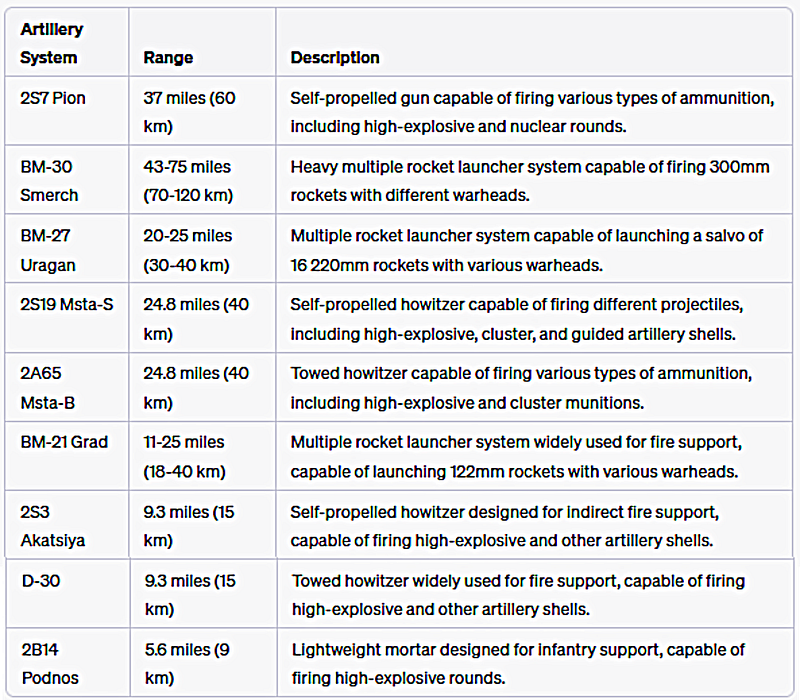
Author table of principal Russian artillery systems
Coordination is vital in counter-battery artillery to ensure effective results. This involves the integration of various intelligence sources, radar systems, and artillery units.
A centralised command and control structure allows for real-time information sharing and the efficient allocation of resources. Effective communication systems enable artillery units to receive and process target data swiftly, leading to rapid response times and improved operational effectiveness.
Ukraine is probably the current world leader in this C3 aspect of counter battery artillery operations.
Enemy countermeasures
Counter-battery artillery should also consider the enemy’s countermeasures and tactics. The enemy may employ camouflage techniques, dispersion of artillery units, or the use of decoys to deceive and mislead counter-battery fire.
Therefore, counter-battery operations need to adapt and employ counter-countermeasures to maintain effectiveness.
Mixing it up
In Ukraine, use of precision long-range artillery was initially prioritised above counter-battery engagements against Russian artillery systems.
Spotting by lower-end drones combined with guided artillery resulted in numerous examples of ‘one shot, one kill’ destruction of Russian artillery systems.
With the adjustment to Ukrainian strategy/tactics to focus more on artillery, Russian counter-battery radars have been a problem, as General Major Popov pointed out, to the displeasure of his superiors — and the rankers. More unrest — a direct consequence of the lack of Zooparks.
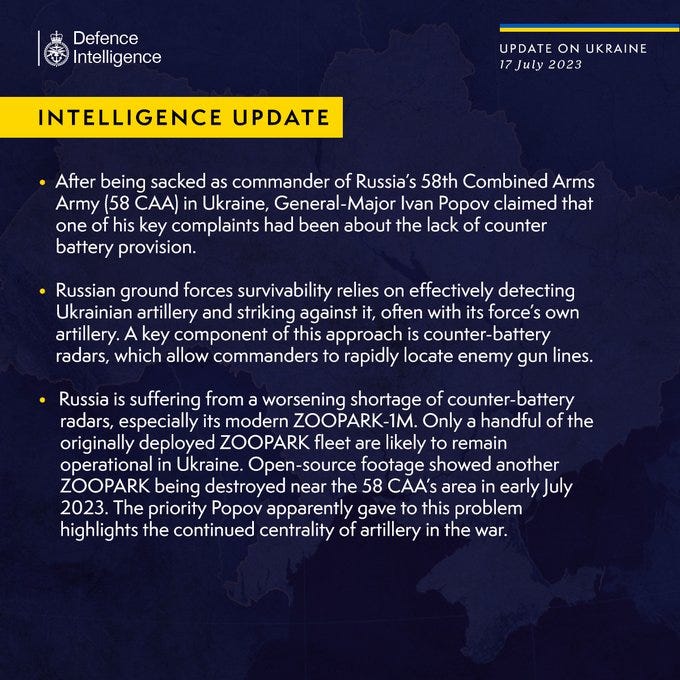
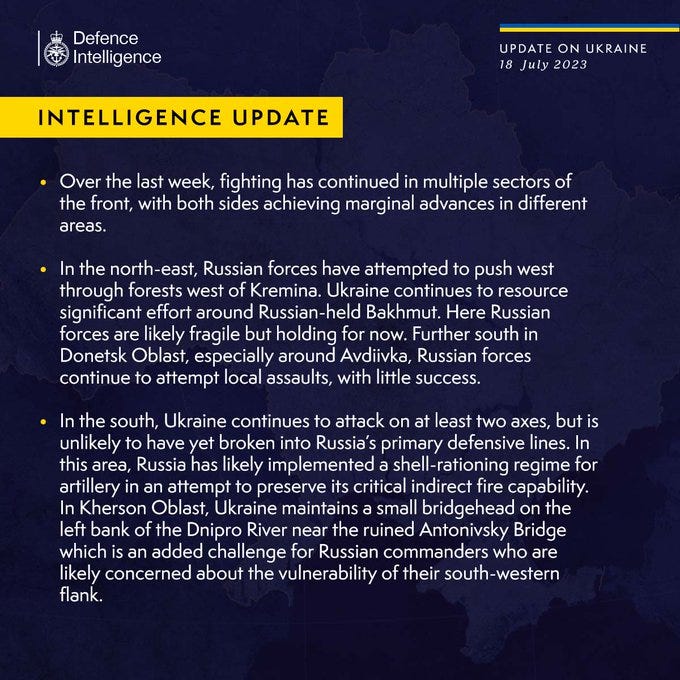
And the attritional tactic is working, with shell rationing by Russia, according to British Defence Intelligence:
So what is this Zoopark?
Zoopark-1 L219M
This is a mobile passive electronically scanned array radar (based on a tracked MT-LBu chassis) for the purpose of enemy field-artillery acquisition. The system can detect moving ground targets at a distance of up to 40 kilometers. (Wikipedia)
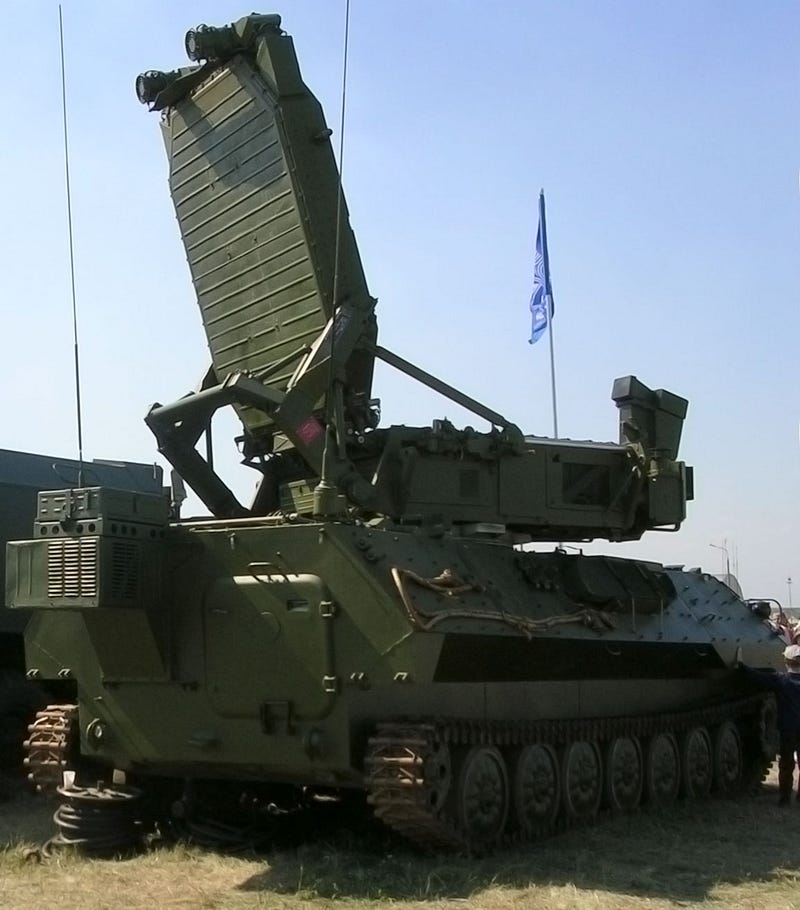
Zoopark L219M radar. Public Domain, Wikipedia
It’s not publicly known how many units Russia has/had, but Oryx lists twelve units and variants as having been destroyed or damaged, and one captured, by Ukraine in the current illegal occupation.
Why is it so important to Russia? According to Wikipedia’s list of Equipment of Russian Ground Forces, it appears to be the only counter-battery radar that Russia has. And with Ukraine’s adjustment of the counter-offensive strategy to a heavier focus on attrition by artillery, then Russia has a much higher dependence on them.
Ukraine has developed its own Zoopark-2:
The Zoopark-2 WLS [weapon location system] has detection ranges as follows: ≥30 km for 152-mm artillery guns and 82-mm/120-mm mortars; 30–40 km for BM-21-type MLRS; 50–55 km for short-range rocket launchers. It is capable of friendly fire adjustment ranges as follows: 20–25 km for 152-mm artillery guns, 25–30 km for 82-mm/120-mm mortars; 21–40 km for BM-21-type MLRS; 80 km for rockets. — defence.ua.com
I wrote recently about the Moscow State Circus and its clowns, and now it seems that a Zoopark is linked to it and causing a few more personnel changes. But so far the ringmaster and clowns are still holding their posts…
If you follow me I guarantee variety in your inbox with some unusual perspectives! I write on a wide range of topics that interest me including humour, tech, space, geopolitics and travel. I also write about…
…fault-finding
If you appreciate stories like these and want to support me and other writers, please consider signing up to become a Medium member. It’s only $5 a month, giving you unlimited access to incredible stories on Medium. If you sign up using my link, I’ll earn a small commission at no extra cost to you.
Or maybe just buy me a coffee? and tell me what you liked reading (or not)…

My novels are available at my Gumroad bookstore. Also at Amazon and Apple
Author’s note: The concept, structure, style and creative content in this story are all my own and I hope that is obvious to a reader. I do not employ third party writers. However, I do occasionally use an AI assistant to research and present small sections of factual content and data. All facts are checked where possible and sources quoted.