avatarJames Marinero, MSc, MBA

Free AI web copilot to create summaries, insights and extended knowledge, download it at here

12041

Abstract

a></p><p id="d663">Effective firing range is 30 km or 40 km with a <a href="https://en.wikipedia.org/wiki/Base_bleed">base-bleed</a> shell, sustained at a rate of 6 rounds per minute.</p><p id="d7d8">This weapon is also used by the United Kingdom.</p><p id="1bec"><b>Slovak Republic: Zuzana 2 self-propelled howitzer 155 mm</b></p><p id="f112">This is Slovakia’s own build and they are supplying 8 to Ukraine.</p><p id="d78f">The main armament is 155mm/52 calibre gun. It can fire six 155mm Nato projectiles per minute in automatic mode and two rounds per minute in manual mode. It offers a minimum firing range of 5km and a maximum range of 41km with ERFB-BB shells. —<a href="https://www.army-technology.com/projects/zuzana-2-155mm-self-propelled-gun-howitzer/"> army-technology.com</a></p><div id="c178" class="link-block"> <a href="https://t.me/ukrainenowenglish/9497"> <div> <div> <h2>Ukraine NOW [English]</h2> <div><h3>⚡️Minister of Defence of the Slovak Republic Jaroslav Naď said that his country will hand over eight 155 mm…</h3></div> <div><p>t.me</p></div> </div> <div> <div style="background-image: url(https://miro.readmedium.com/v2/resize:fit:320/0*PrTSn-rwp_hrFoDY)"></div> </div> </div> </a> </div><p id="2723"><b>United Kingdom</b></p><p id="04c0">As of 27 May 2022, heavy artillery does not appear to be included in the extensive <a href="https://www.msn.com/en-us/news/world/what-weapons-is-the-uk-giving-ukraine/ar-AAXMdfb">list of military equipment</a> that the UK is supplying to Ukraine.</p><p id="40bb">Update 17June 2022:</p><p id="493e">Per <a href="https://t.me/ukrainenowenglish/10990">Ukraine Telegram</a>:</p><p id="409f">⚡️The United Kingdom has purchased and refurbished more than 20 long-range self-propelled howitzers M109 from a Belgian arms company, which it will send to Ukraine — Secretary of State for Defence Ben Wallace.</p><p id="1767"><b>United States: US M777 Howitzer</b></p><figure id="1bd6"><img src="https://cdn-images-1.readmedium.com/v2/resize:fit:800/1*_iWno3EEF4Wi8NMcPdo8QQ.png"><figcaption>Image source: <a href="https://t.me/ukrainenowenglish/9033">Telegram</a></figcaption></figure><p id="73dc">The US is sending 89 M777 howitzers to the Ukraine.</p><p id="fee7">The British Aerospace M777 howitzer is the primary towed artillery piece of the US armed forces and it is one of the smallest and lightest weapons of its type ever constructed. Firing range is 30 km or 39 km with <a href="#excalibur">Excalibur</a> loads. Maximum rate of fire is 4 rpm, or 2 rpm sustained. A key design criterion was easy air-portability so a large amount of weight-saving titanium is used in its construction.</p><p id="0686">Although it is towed, emplacement/displacement times are less than 3 minutes.</p><p id="9136"><b>Update: Norway</b></p><div id="a093" class="link-block"> <a href="https://t.me/ukrainenowenglish/10262"> <div> <div> <h2>Ukraine NOW [English]</h2> <div><h3>💪 Norway delivered 20 upgraded 155mm M109/A3GN self-propelled howitzers to Ukraine This was publicly announced in Oslo…</h3></div> <div><p>t.me</p></div> </div> <div> <div style="background-image: url(https://miro.readmedium.com/v2/resize:fit:320/0*dvCE5QZpUyXZaoui)"></div> </div> </div> </a> </div><figure id="2e69"><img src="https://cdn-images-1.readmedium.com/v2/resize:fit:800/1*BO09y_oXDA184_tnwLKyyw.png"><figcaption></figcaption></figure><h2 id="7b25">3.3 Precision Ammunition</h2><p id="ad66">Ukraine will receive Western precision-guided rounds as part of the package. The American-developed M982 and M982A1 Excalibur artillery shells can home in on a set of GPS coordinates. Unlike artillery of the past, it can hit a target with the first round.</p><figure id="07b6"><img src="https://cdn-images-1.readmedium.com/v2/resize:fit:800/1*dtKiz93niGzWaTLYKlqNPg.jpeg"><figcaption>XM982_Excalibur guided artillery round. Image credit: <a href="https://commons.wikimedia.org/wiki/United_States_Army">https://commons.wikimedia.org/wiki/United_States_Army</a></figcaption></figure><p id="3c57">Ammunition will not be in short supply for Ukraine as those countries listed above will be sending ammunition and others in the <a href="https://twitter.com/ZelenskyyUa/status/1527625956038524933?s=20&amp;t=CW8RgOTQnZ4TYXqxWE1fvQ">group of 42</a> supporting countries which are not sending artillery will be sending or funding ammunition. These countries include Sweden and Canada for example.</p><h1 id="c4f4">4. Drone target spotting</h1><p id="e9da">I think there’s little doubt that with the use of drone spotters and precision munitions Ukrainian forces have been very effective with artillery. I read recently that their artillery efficiency was one of the key reasons that Russian forces pulled back from their assault on Kyiv.</p><p id="22ec">Maybe.</p><p id="be45">Here’s a picture which arguably shows poor Russian accuracy, but of course we’re only seeing this from the Ukrainian side.</p><figure id="e0e5"><img src="https://cdn-images-1.readmedium.com/v2/resize:fit:800/1*F_rY7P9kqCWSNhWwq2UBgQ.png"><figcaption>Russian shelling of the town of Lyman. Note the large number of wasted rounds in the fields. Image source: <a href="https://t.me/ukrainenowenglish/9316">Telegram</a></figcaption></figure><p id="3cb8">And on the other side we have…</p><h1 id="291e">5. The Russian Artillery</h1><p id="f27b">Russia has long been a proponent of the use of long-range artillery within its apparent doctrine of the intense use of stand-off munitions and the indiscriminate obliteration of towns, as they did in Chechnya and Syria. Planes, cruise missiles, rocket systems, artillery — throw it all at the target, any target. That’s my impression.</p><p id="58b8">They have a considerable number of 152 mm, 122 mm, 120 mm and 100 mm howitzers, plus a 203 mm (yes) self propelled howitzer and a 240 mm (yes) gun-mortar 2S4 Tyulpan (‘Tulip’) which I have not included here, as it’s outside the definition of howitzer, and relatively short range of 9 km (1 has been destroyed in the Ukraine war).</p><p id="148d">You can probably see a big issue here for the Russian forces: Ammunition and spares logistics.</p><p id="6e41">The logistics involved in managing all these different shell and spares requirements must be considerable, whereas all the NATO howitzers can share ammunition at will.</p><p id="8f85">However, some of these artillery pieces have barrels and other parts which are used in self-propelled versions. This simplifies the logistics somewhat, but not a lot.</p><p id="5464">It reminds me of that old bit of British military lore about communications:</p><p id="d0e7">Message to go up the line:</p><blockquote id="f219"><p>Send reinforcements, we’re going to advance</p></blockquote><p id="2462">Message received at brigade HQ:</p><blockquote id="b13f"><p>Send three and fourpence, we’re going to a dance</p></blockquote><p id="da08">So, to minimise the logistics risks (and we know that Russia has had huge problems with logistics in Ukraine) they would have to manage artillery deployment very carefully. This could restrict their operational flexibility.</p><p id="adf9">They have a curious way of nicknaming their artillery after flowers such as the hyacinth (‘Giatsint’), carnation (‘Gvozdika’) and peony (‘Pion’). Flowers for Putin (with apologies to Leonard Cohen’s ‘Flowers for Hitler’, RIP).</p><p id="f99a">So, what have they got? (get a coffee because this is a long list if you intend reading it).</p><h1 id="c468">5.1 Russian towed artillery</h1><p id="a355"><b>2A65 Msta-B 152 mm Howitzer</b></p><figure id="2c34"><img src="https://cdn-images-1.readmedium.com/v2/resize:fit:800/1*qZ2WvFPj1pmijfyUa4V9aQ.jpeg"><figcaption>2A65 “Msta-B” artillery pieces of Russia’s 90th Guards Tank Division. Credit: <a href="http://By Mil.ru, CC BY 4.0, https://commons.wikimedia.org/w/index.php?curid=63819349">Wikipedia</a></figcaption></figure><p id="46bd">This is a Soviet-era towed howitzer and is known to be deployed in Donbas. It is believed that Russia has 850 (250 active, 600 reserve) available, though many are thought to be in Perm in Siberia (Wikipedia).</p><p id="d571">Firing range 30 km at up to 6 rounds per minute. Nuclear-capable.</p><p id="ff4f">Also widely used by Ukraine forces (130 units) pre the war.</p><p id="b693"><b>2A36 Giatsint-B 152 mm Field Gun</b></p><figure id="c477"><img src="https://cdn-images-1.readmedium.com/v2/resize:fit:800/1*Vah9JBXVXn1mR-bRNymVRg.jpeg"><figcaption>Image credit: <a href="http://By George Shuklin - Own work, CC BY-SA 1.0, https://commons.wikimedia.org/w/index.php?curid=2910558">Wikipedia</a></figcaption></figure><blockquote id="94ae"><p>This is a Soviet/Russian towed 152 mm field gun which entered service in 1975. The 2A36 is designed to suppress and destroy enemy manpower and equipment. It is also suitable for counter-battery fire. — Wikipedia</p></blockquote><p id="44d4">The gun uses separate-loading cased charges, so more logistical complexity is likely. Known to be deployed in Donbas, but also used by Ukraine forces.</p><p id="202a">Nuclear-capable. Range is up to 40 km, 6 rpm. 140 active, 1100 in reserve.</p><blockquote id="5981"><p>The guns are usually deployed in batteries of six to eight guns; promotional material claims that a battery can place more than 1 tonne of projectiles on a target in one minute. As of 2022 the 2A36 is still considered to be reliable, mobile, and capable of delivering heavy firepower.</p></blockquote><p id="6b86"><b>2A18 (D-30) 122 mm Howitzer</b></p><figure id="91e7"><img src="https://cdn-images-1.readmedium.com/v2/resize:fit:800/1*6Llezth5D3N0Q8cBY1MexQ.jpeg"><figcaption>Image credit: By Тснена at Serbian Wikipedia — Transferred from sr.wikipedia to Commons by Micki using CommonsHelper., Public Domain, <a href="https://commons.wikimedia.org/w/index.php?curid=18172315">https://commons.wikimedia.org/w/index.php?curid=18172315</a></figcaption></figure><blockquote id="3b2a"><p>A Soviet howitzer that first entered service in the 1960s. It is a robust piece that focuses on the essential features of a towed field gun suitable for all conditions. The D-30 has a maximum range of 15.4 kilometers, or over 21 km using rocket assisted ammunition. — <a href="https://military-history.fandom.com/wiki/122_mm_howitzer_2A18_(D-30)"><i>Military History Fandom</i></a></p></blockquote><p id="b52f">550 pieces active, 4400 in reserve (Wikipedia).</p><p id="4d8b"><b>2B16 Nona-K 120 mm Howitzer</b></p><p id="dcd0">These are old and there are thought to be less than 100 in the Russian inventory, so I’ll skip any more detail, although 7 have been reported as <a href="https://www.oryxspioenkop.com/2022/02/attack-on-europe-documenting-equipment.html">destroyed or captured in Ukraine</a>.</p><h1 id="d927">5.2 Russian self-propelled artillery</h1><p id="c2c2"><b>2S7 Pion 203 mm self-propelled howitzer</b></p><figure id="d396"><img src="https://cdn-images-1.readmedium.com/v2/resize:fit:800/1*SAF-sRf7X4REQFaXj5gzGA.jpeg"><figcaption>Image credit: <a href="https://en.wikipedia.org/wiki/2S7_Pion#/media/File:Army-2018-29.jpg">Nick Nitride Wikipedia</a></figcaption></figure><blockquote id="723a"><p>The 2S7 is fitted with the massive 56-caliber 203mm 2A44 howitzer. With standard ammunition it has a range of 37.4 km and a rocket-assisted projectile can be fired out to 47.5 km. The rate of fire is 1.5 rounds per minute. Four rounds of ammunition are carried on the 2S7 with the remainder on a support vehicle. The improved 2S7M carries 8 rounds and has a rate of fire of 2.5 rpm. No secondary armament. -<a href="https://weaponsystems.net/system/144-2S7+Pion"><i>weaponsystems.net</i></a></p></blockquote><p id="8e48">It has 11 crew. The estimates of numbers

Options

available vary between 250–1000, but it is known to be deployed in Donbas and elsewhere in Ukraine.</p><p id="59b5"><b>2S35 Koalitsya-SV 152 mm self-propelled howitzer</b></p><figure id="5294"><img src="https://cdn-images-1.readmedium.com/v2/resize:fit:800/1*QegiV1uK2-Txg_5EiBsbJQ.jpeg"><figcaption>Image credit: Dmitriy Fomin from Moscow, Russia, CC BY 2.0 <<a href="https://creativecommons.org/licenses/by/2.0">https://creativecommons.org/licenses/by/2.0</a>>, via Wikimedia Commons</figcaption></figure><p id="9750">This is relatively new design first seen in 2015 built to succeed the 2S15 Msta- S and other dated 152 mm designs. It is thought to be one of the most advanced artillery pieces in the world.</p><p id="35e0">With a 52 calibre barrel and ammunition load of 40 shells it can fire at 8 rpm with full automatic loading to a range of at least 30 km.</p><p id="16ee">A twin-barrel version has been seen with barrels operable at different elevations and separate loaders.</p><blockquote id="2b49"><p>A new long-range precision-guided round has been developed in Russia. It has a maximum range of 70 km and high level of accuracy. The Koalitsiya-SV It is also capable of firing older Krasnopol laser-guided munitions with a maximum range of 20–25 km. — <a href="http://military-today.com/artillery/koalitsija_sv.htm"><i>Military-Today</i></a></p></blockquote><p id="d28a">Although there are believed to be only about 72 in operation pre- the Ukraine war, I could not omit it as it is such a powerful artillery piece.</p><p id="5dc7"><b>2S19 Msta-S 152 mm self-propelled howitzer</b></p><figure id="5705"><img src="https://cdn-images-1.readmedium.com/v2/resize:fit:800/1*4b9TbBklDBYsU2xqmduF1Q.jpeg"><figcaption>Image credit: <a href="http://By Michael - Parade @ Kiev (cropped), CC BY 3.0, https://commons.wikimedia.org/w/index.php?curid=12709767">Wikipedia</a></figcaption></figure><p id="3643">The 2S19 Msta-S is a Soviet-era design.</p><blockquote id="e1e6"><p>…armed with a 152 mm/L47 howitzer, which is similar to that used on the <a href="http://www.military-today.com/artillery/msta_b.htm">2A65 Msta-B</a> towed howitzer. The howitzer is fitted with an semi-automatic loader and fume extractor. The gun can be loaded at any angle. Maximum rate of fire is 7–8 shells per minute. The Msta-S is compatible with all standard 152 mm shells used by the <a href="http://www.military-today.com/artillery/d20.htm">D-20</a> towed gun-howitzer and <a href="http://www.military-today.com/artillery/2s3_akatsiya.htm">2S3 Akatsiya</a> self-propelled howitzer. — <a href="https://www.military-today.com/artillery/2s19_msta_s.htm"><i>Military today</i></a></p></blockquote><p id="8135">There are believed to be 935 operational and they are still in production although it is planned to replace them with the Koalitsya.</p><p id="2cbf">These are also used by Ukraine (40).</p><p id="bd08"><b>2S5 Giantsint-S 152 mm self-propelled howitzer</b></p><figure id="0f51"><img src="https://cdn-images-1.readmedium.com/v2/resize:fit:800/1*BuVzXYKYWKRkYYWPdOqIdw.jpeg"><figcaption>Image credit: <a href="https://www.military-today.com/artillery/2s5_giatsint.htm">Military Today</a></figcaption></figure><p id="9fcb">The <b>2S5 <i>Giatsint-S</i></b> is a Soviet/Russian 152 mm self-propelled gun. It is NBC protected. The 2S5 is capable of engaging targets at longer ranges and at a higher rate of fire than the more widely produced 2S3 Akatsiya 152 mm self-propelled gun. — <a href="https://en.wikipedia.org/wiki/2S5_Giatsint-S">Wikipedia</a></p><p id="36bc">Fitted with a turretless 152 mm/L54 gun and load assisting system. Maximum rate of fire is 5–6 rpm using standard and rocket-assisted HE-FRAG, HEAT, cluster and smoke shells. Firing range is 28 km (standard round), and up to 33 km with a rocket assisted shell. Can also use nuclear rounds.</p><p id="91ae">Russia had 114 active pieces pre-war, with 850 in reserve.</p><p id="1b1e">Ukraine had 24 of these units pre-war.</p><p id="f12f"><b>2S3 Akatsiya 152 mm self-propelled howitzer</b></p><figure id="5217"><img src="https://cdn-images-1.readmedium.com/v2/resize:fit:800/1*rd1WH8cbFHJ4AgOCfj558w.jpeg"><figcaption>An Akatsiya of the Ukrainian forces. Image credit: By President.gov.ua, CC BY 4.0, <a href="https://commons.wikimedia.org/w/index.php?curid=50907259">https://commons.wikimedia.org/w/index.php?curid=50907259</a></figcaption></figure><p id="c90b">The <i>Akatsiya</i> (‘Acacia’) is armed with a 152.4 mm <a href="https://en.wikipedia.org/wiki/Howitzer">howitzer</a> based on the Soviet 152.4 mm <a href="https://en.wikipedia.org/wiki/152_mm_towed_gun-howitzer_M1955_(D-20)">D-20</a> towed howitzer. It is NBC protected.</p><p id="2fbb">It has some interesting features:</p><ul><li>self-entrenching equipment which allows to prepare a trench within 20–40 minutes</li><li>a crew of 4–6 including two ammunition bearers, who are positioned to the rear of the vehicle feeding rounds through two hatches in the hull rear when in masked firing position</li></ul><p id="7ea5">Rate of fire is 2–4 rpm with a maximum range of 24 km using rocket-assisted ammunition.</p><p id="d980">It is thought that Russia has around 1800 units available.</p><p id="6b95">Ukraine has about 500.</p><p id="4223">All numbers are pre Ukraine war.</p><p id="4626"><b>2S1 Gvozdika self-propelled howitzer 122 mm</b></p><figure id="da03"><img src="https://cdn-images-1.readmedium.com/v2/resize:fit:800/1*Xa947AiN2gjd_l9Ux_QQjQ.jpeg"><figcaption>2S1 Gvozdika. Image credit: By Andrew Bossi — Own work, CC BY-SA 2.5, <a href="https://commons.wikimedia.org/w/index.php?curid=5062207">https://commons.wikimedia.org/w/index.php?curid=5062207</a></figcaption></figure><p id="f4f1">This design (‘Carnation’) is a Soviet era self-propelled 122 mm howitzer dating from 1958 (prototype), but like much of the Soviet era armour has undergone modernisation.</p><p id="409d">Interesting features include:</p><ul><li>fully amphibious and once afloat is propelled by its tracks (I’d like to know more about that — it weighs 16 tonnes)</li><li>a variety of track widths are available to allow the 2S1 to operate in snow or swamp conditions</li></ul><p id="fb76">It has semi-automatic loading, with a range of 15 km and extended at 21 km, rocket assisted.</p><p id="1b46">Estimates as to availability vary from 600 to 2230 in the Russian armoury.</p><p id="54ad">Ukraine is estimated to have 638, pre war. They have been considerably enhanced as the Kevlar-E, introduced in 2018.</p><p id="fb31"><b>Other Russian artillery</b></p><p id="cec7">There are several other disparate artillery pieces that I could include here, but their numbers are relatively low.</p><h1 id="d652">6. Conclusions</h1><p id="fa37">NATO quality against Russian quantity — is it that simple? I asked that question at the start and if you’ve worked through this with me you may conclude that no, it’s not that simple. But I’m just an amateur in an armchair, so to speak, trying to judge the balance of firepower.</p><p id="7616">The Russian forces have some outstanding artillery, but not in great quantities (for example the fearsome 2S35 Koalitsya). They do, however, have huge quantities of adequate artillery, but the older, shorter range pieces such as the 2S1 Gvozdika will be of little use in a long-range — 30 km — artillery exchange(Ukraine has over 600 of these too).</p><p id="a9c8">Ukraine on the other hand has the adequate, largely Soviet-era artillery, in lesser quantities, backed up by NATO-supplied artillery (less than 150 pieces at my rough count).</p><p id="da4e">Numbers do matter in a war of attrition and as far as I can see in this context the Western supplies of howitzers so far will not make a huge difference, other than to morale.</p><p id="4ca7">It’s basically Russian hardware versus Russian hardware, with window-dressing from NATO countries.</p><p id="eedd">Score 2 for Russia.</p><p id="924b">I’ve been reading recently about the heavy toll that’s been taken on Russian drones. These are essential for modern, precise artillery spotting and there are stories that sanctions are slowing down the building of new drones (and other electronics).</p><p id="0a2a">So I think that’s score 1 for Ukraine.</p><p id="0b3d">Add in the fact that there is apparently low morale and commitment on the part of Russian forces with a huge loss of middle rank officers (a fundamental structural issue) and refusal to fight.</p><blockquote id="a47a"><p>The Krasnodar-based Rosgvardiya soldiers who took part in the war against Ukraine in February-April and tried to be sent there again have filed reports refusing to go to war.</p></blockquote><blockquote id="5972"><p>This was reported by the Kavkaz.Realii website with reference to a source in the General Directorate of Federal Forces of the National Guard of the Krasnodar Krai.</p></blockquote><blockquote id="520d"><p>According to it, the members of Rosgvardiya are extremely dissatisfied with the payments received for the two months of their stay in Ukraine — they turned out to be significantly lower than the propaganda media have been telling. — <a href="https://t.me/ukrainenowenglish/9505"><i>Ukraine Telegram</i></a></p></blockquote><figure id="af62"><img src="https://cdn-images-1.readmedium.com/v2/resize:fit:800/0*gmWcP0sHBcKs1x_R.png"><figcaption>Source: UK MOD</figcaption></figure><p id="689d">I think that this issue of personnel is a major one and I score 2 for Ukraine.</p><p id="1ab8">Artillery mobility together with a coherent command and control system will be critical. Russia has proven to be lacking in this regard.</p><p id="c552">Score 1 for Ukraine</p><p id="7dc6">And then we have logistics. This has been a major problem for Russia because of long supply lines and fractured communications with poor command and control. All topped off with, I think, 3 variants of ammunition size.</p><p id="2c2b">Score 1 for Ukraine.</p><p id="8c85"><b>In summary</b> I judge that it’s finely balanced, but in Ukraine’s favour, though my scorecard doesn’t show that, does it?</p><p id="8c62">What do you think?</p><p id="886e">*One final qualification: All the estimates as to numbers available have been drawn from Wikipedia, which appears to be the go-to repository which other military websites draw from. Many of the numbers of Russian artillery pieces in Wikipedia are referenced back to a few Russian contributors. So, there is always the possibility that they are deliberately inaccurate…</p><p id="8ffd"><i>About me: If you follow me I guarantee variety in your inbox! I write on a wide range of topics including humor, tech and travel, together with daily news events and the minutiae of my daily life living on a boat. I also write techno-thrillers…and about…</i></p><p id="f806"><b>…big guns</b></p><p id="62a1"><i>If you appreciate stories like these and want to support other writers and me, consider signing up to become a Medium member. It’s only $5 a month, giving you unlimited access to incredible stories on Medium. If you sign up using my link below, I’ll earn a small commission at no extra cost to you.</i></p><div id="6333" class="link-block"> <a href="https://james-marinero.medium.com/membership"> <div> <div> <h2>Join Medium with my referral link - James Marinero</h2> <div><h3>As a Medium member, a portion of your membership fee goes to writers you read, and you get full access to every story…</h3></div> <div><p>james-marinero.medium.com</p></div> </div> <div> <div style="background-image: url(https://miro.readmedium.com/v2/resize:fit:320/0*U7R41M0zLT7NDRzi)"></div> </div> </div> </a> </div><p id="0808"><i>Or maybe just <a href="https://ko-fi.com/jamesmarinero">buy me a coffee?</a></i></p><figure id="8712"><img src="https://cdn-images-1.readmedium.com/v2/resize:fit:800/1*F7CRvNpnsbM3yYySfOeIjA.png"><figcaption></figcaption></figure></article></body>

Ukraine

Ukraine: What’s the Balance of Heavy Artillery Weapons?

The battle for Eastern Ukraine is being fought on a wide front, with long range artillery and NATO quality pitched against Russian quantity
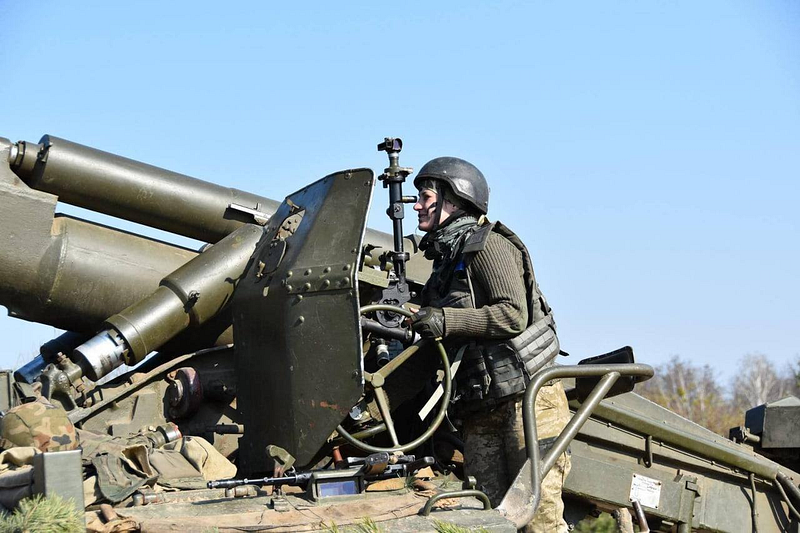
Lyubov Plaksyuk became the first female head of an artillery unit of the Armed Forces of Ukraine. But what’s the wepaon? Image source: Telegram

The battle for Eastern Ukraine is being fought on a wide front, with long range artillery and NATO quality pitched against Russian quantity. Is it really that simple?

I’ve looked at the equipment and numbers and tried to arrive at an answer.

So, this article is about the heavy artillery, specifically howitzers, being deployed in eastern Ukraine. We know more about what Ukraine is deploying than about Russian deployments (subject of course to propaganda aspects), although we do know what the Russians have in their armoury.

When I started writing this I didn’t realise what a magnum opus (ton of work) it would turn out to be, mainly due to the huge range of Russian artillery. Grab a coffee if you’re staying.

To make it easier I’ve set some links to the main headings. For the NATO-supplied weapons, the artillery is organised by supplying country; for Russia the artillery is organised under Towed and Self-propelled.

I’ve also included a section on Drone Target Spotting, which I think is relevant and hopefully gives a breather to those of you with the stamina and coffee for this marathon.

Contents

  1. What are we talking about?
  2. The changed face of artillery deployment
  3. Ukraine’s artillery

3.1 In Ukraine’s own armoury

3.2 NATO-supplied artillery

3.3 Precision ammunition

4. Drone target spotting

5. Russian Artillery

5.1 Towed artillery

5.2 Self-propelled artillery

6. Conclusions

1. What are we talking about?

This blew my mind because every country seems to have its own definition of ‘Howitzer’ and the definitions change with time.

A howitzer is a long-ranged weapon, falling between a cannon (also known as artillery gun in the United States), which fires shells at flat trajectories, and a mortar, which fires at high angles of ascent and descent. Howitzers, like other artillery equipment, are usually organized in a group called a battery.

Howitzers, together with long-barreled guns, mortars, and rocket artillery, are the four basic types of modern artillery. — Wikipedia

Since World War II, most land-based artillery weapons have combined the conventional features of guns and howitzers: high muzzle velocity, long barrels, long range, multiple charges, and a maximum elevation angle of greater than 45 degrees.

The term “gun-howitzer” is sometimes used for them (e.g., in Russia), and many nations call these guns “howitzers.”

I will be including both towed and self propelled versions, and also a new ‘crawling’ version, which uses a small VW diesel engine to move slowly, but fast enough to escape return fire.

Mortars are not included, with one notable exception.

In 21st century, howitzers are usually deployed in a battery which might comprise 6–8 howitzers.

2. The changed face of artillery deployment

I remember seeing WWII images of heavily dug-in long-range artillery. Today with improved spotting, accurate geo-location, guided ammunition and anti-artillery radar, the deep digging-in of artillery is fatal. It has to be quickly movable.

Hence the plethora of truck-mounted, tracked and even VW-propelled crawling artillery in the field.

And those that are towed have to be quick movers too. The US/UK M777 ultralight 155mm towed howitzer, for example can be emplaced in 3 minutes and displaced in 2–3 minutes.

It seems to me that this is a battle of highly mobile artillery working at 30 km range with heavy use of spotting drones — and jamming equipment to blind drones and radar artillery. And there are shells with jamming devices.

3. Ukraine’s artillery

3.1 In Ukraine’s own armoury

Pre-war the Ukrainian Ground Forces were armed with a large number of Soviet-era artillery pieces. The inventory includes 2S3 Akatsiya 152-millimeter and 2S1 122-millimeter Gvozdika self-propelled howitzers; as well as D-20 152-millimeter and D-30 122-millimeter towed artillery pieces.

Although numerous, the weapons are almost all old, produced by the Soviet Union before its collapse in 1991.

These weapons are described in the section on Russian artillery together with Ukraine’s numbers.

3.2 NATO-supplied artillery

Unlike the Ukrainian army’s Soviet-era big guns, these artillery pieces come in the larger NATO calibres and are the key to delivering the West’s precision-guided artillery technology. The NATO artillery munitions apparently include US-developed GPS-guided artillery shells and tank-hunting munitions.

NATO howitzers are standardized at 155 mm. The bulk of Russia’s arsenal is split between 152 and 122 mm.

The bigger calibres mean longer range and warhead load. I noticed that the artillery pieces come in different calibres but use the same ammunition. I checked that out. In relation to artillery calibre is a dimensionless measure of barrel length (basically barrel length) divided by bore diameter.

The Netherlands: Pz2000

The Dutch have committed six of their German-built Pz2000 155-millimeter self-propelled (tracked) howitzers.
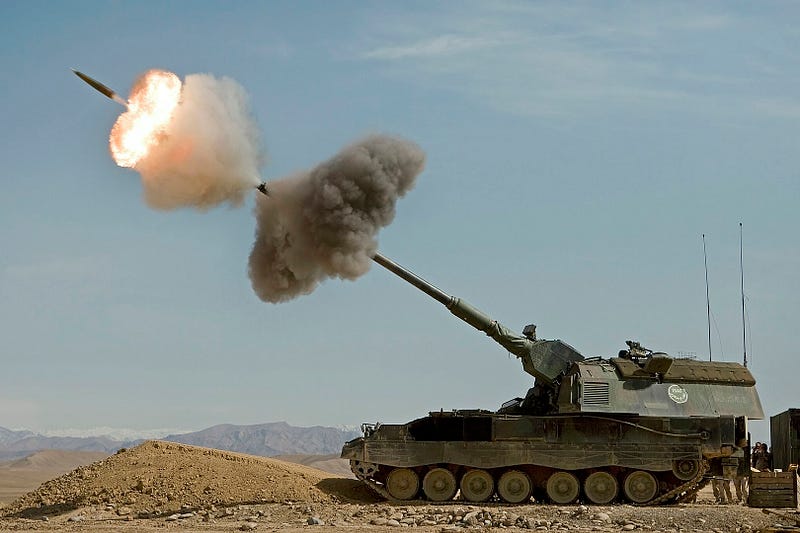
A Dutch Panzerhaubitze 2000 fires a round in Afghanistan. Image credit: Wikimedia

This is a formidable artillery piece reaching 47 km (conventional) and 67 km with rocket-assisted projectiles.

The Panzerhaubitze 2000 is a German 155 mm self-propelled howitzer and is one of the most powerful conventional artillery systems deployed in the 2010s. It is capable of a very high rate of fire; in burst mode it can fire three rounds in nine seconds, ten rounds in 56 seconds, and can — depending on barrel heating — fire between 10 and 13 rounds per minute continuously (disputed). The PzH 2000 has automatic support for up to 5 rounds of Multiple Rounds Simultaneous Impact (MRSI). The replenishment of shells is automated. Two operators can load 60 shells and propelling charges in less than 12 minutes. — Wikipedia

France: Caesar truck-mounted 155 mm

France has sent between 10 and 12 CAESAR truck-mounted 155s to Ukraine.
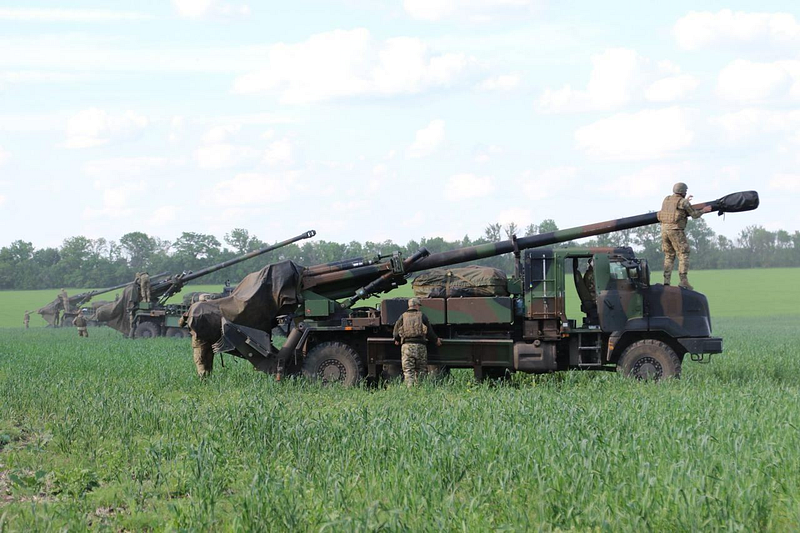
Image source: Telegram Ukraine Official Channel

The CAESAR is a French-built self-propelled 52-calibre gun-howitzer firing NATO-standard 155 mm artillery shells.

According to data on Wikipedia it has a firing range of approximately 42 km using an Extended Range, Full Bore (ERFB) shell, and more than 50 km using rocket assisted shells. The system is integrated with a fully computerized system, providing automatic control.

The ground forces showed the work of Ukrainian artillerymen who mastered the French self-propelled guns CAESAR.

“Arriving at the position, … 50 seconds to charge, range — 22 kilometers, 4–5 rounds per minute, repeat in 55 seconds, and disappear!”

The result — two tanks of invaders, two armored vehicles, a truck with ammunition. — Ukraine Telegram

Italy: FH-70

The Italy-supplied FH-70 155mm is a towed howitzer but has its own 1700 cc VW diesel engine for localized movement. Italy has 163 of these weapons with 90 of them sealed in reserve. It has not been disclosed how many will ship to Ukraine.
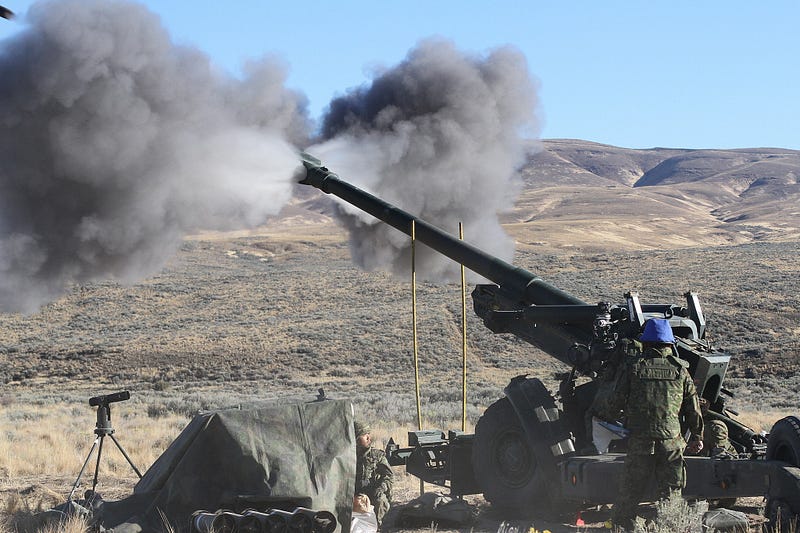
Japanese FH-70 in a training exercise. Image credit: Staff Sgt. Mark Miranda, Public domain, via Wikimedia Commons

The weapon was designed and produced jointly by the UK and Germany but is no longer in their armouries. However, within NATO, Estonia and The Netherlands still have it in operation. There have been suggestions, based on the camouflage paint scheme seen in Ukraine, that the Italian-supplied FH-70s originated in Estonia.

It has a semi-automatic projectile loader. The crew can fire up to 6 rounds per minute, almost one every 10 seconds, from a 39 calibre barrel. Maximum firing range is 30 km. It was the first artillery piece in the world to have an auxiliary power unit.

Poland: AHS Krab

Polskie Radio has reported that Poland will send 18 AHS Krab self-propelled howitzers to Ukraine.
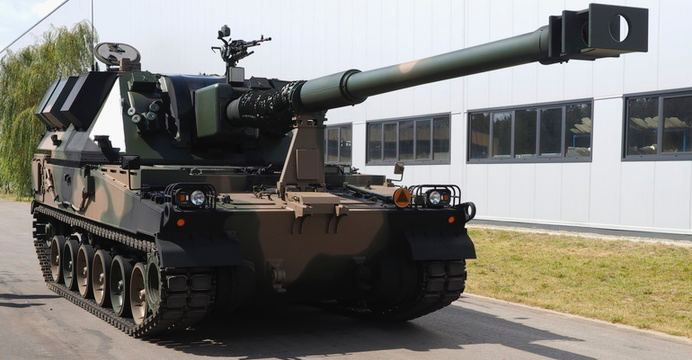
Image source: Telegram

The AHS Krab is a 155 mm NATO-compatible self-propelled tracked gun-howitzer combining the South Korean K9 Thunder chassis with a British AS-90M Braveheart turret with a 52-calibre gun and WB Electronics’ “Topaz” artillery fire control system. — Wikipedia

Effective firing range is 30 km or 40 km with a base-bleed shell, sustained at a rate of 6 rounds per minute.

This weapon is also used by the United Kingdom.

Slovak Republic: Zuzana 2 self-propelled howitzer 155 mm

This is Slovakia’s own build and they are supplying 8 to Ukraine.

The main armament is 155mm/52 calibre gun. It can fire six 155mm Nato projectiles per minute in automatic mode and two rounds per minute in manual mode. It offers a minimum firing range of 5km and a maximum range of 41km with ERFB-BB shells. — army-technology.com

United Kingdom

As of 27 May 2022, heavy artillery does not appear to be included in the extensive list of military equipment that the UK is supplying to Ukraine.

Update 17June 2022:

Per Ukraine Telegram:

⚡️The United Kingdom has purchased and refurbished more than 20 long-range self-propelled howitzers M109 from a Belgian arms company, which it will send to Ukraine — Secretary of State for Defence Ben Wallace.

United States: US M777 Howitzer
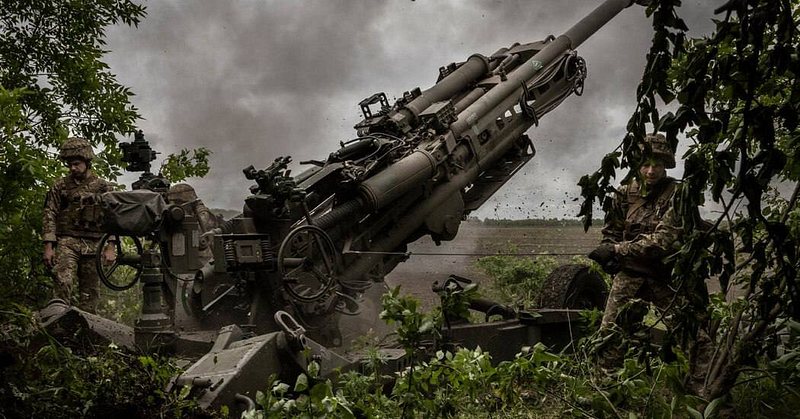
Image source: Telegram

The US is sending 89 M777 howitzers to the Ukraine.

The British Aerospace M777 howitzer is the primary towed artillery piece of the US armed forces and it is one of the smallest and lightest weapons of its type ever constructed. Firing range is 30 km or 39 km with Excalibur loads. Maximum rate of fire is 4 rpm, or 2 rpm sustained. A key design criterion was easy air-portability so a large amount of weight-saving titanium is used in its construction.

Although it is towed, emplacement/displacement times are less than 3 minutes.

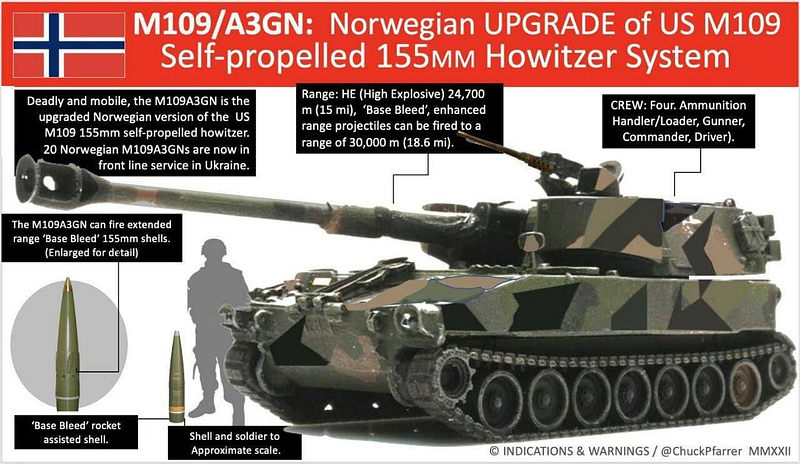
Update: Norway
3.3 Precision Ammunition

Ukraine will receive Western precision-guided rounds as part of the package. The American-developed M982 and M982A1 Excalibur artillery shells can home in on a set of GPS coordinates. Unlike artillery of the past, it can hit a target with the first round.
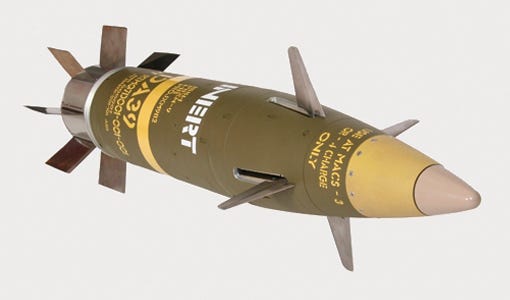
XM982_Excalibur guided artillery round. Image credit: https://commons.wikimedia.org/wiki/United_States_Army

Ammunition will not be in short supply for Ukraine as those countries listed above will be sending ammunition and others in the group of 42 supporting countries which are not sending artillery will be sending or funding ammunition. These countries include Sweden and Canada for example.

4. Drone target spotting

I think there’s little doubt that with the use of drone spotters and precision munitions Ukrainian forces have been very effective with artillery. I read recently that their artillery efficiency was one of the key reasons that Russian forces pulled back from their assault on Kyiv.

Maybe.

Here’s a picture which arguably shows poor Russian accuracy, but of course we’re only seeing this from the Ukrainian side.
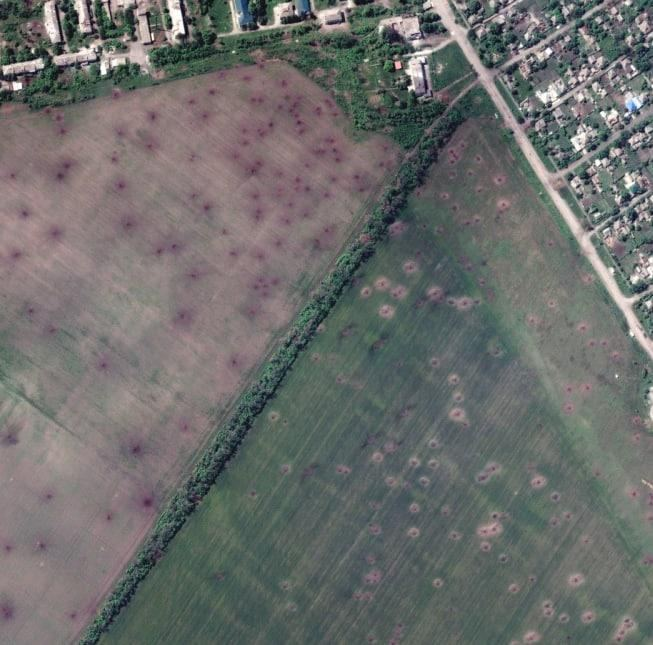
Russian shelling of the town of Lyman. Note the large number of wasted rounds in the fields. Image source: Telegram

And on the other side we have…

5. The Russian Artillery

Russia has long been a proponent of the use of long-range artillery within its apparent doctrine of the intense use of stand-off munitions and the indiscriminate obliteration of towns, as they did in Chechnya and Syria. Planes, cruise missiles, rocket systems, artillery — throw it all at the target, any target. That’s my impression.

They have a considerable number of 152 mm, 122 mm, 120 mm and 100 mm howitzers, plus a 203 mm (yes) self propelled howitzer and a 240 mm (yes) gun-mortar 2S4 Tyulpan (‘Tulip’) which I have not included here, as it’s outside the definition of howitzer, and relatively short range of 9 km (1 has been destroyed in the Ukraine war).

You can probably see a big issue here for the Russian forces: Ammunition and spares logistics.

The logistics involved in managing all these different shell and spares requirements must be considerable, whereas all the NATO howitzers can share ammunition at will.

However, some of these artillery pieces have barrels and other parts which are used in self-propelled versions. This simplifies the logistics somewhat, but not a lot.

It reminds me of that old bit of British military lore about communications:

Message to go up the line:

Send reinforcements, we’re going to advance

Message received at brigade HQ:

Send three and fourpence, we’re going to a dance

So, to minimise the logistics risks (and we know that Russia has had huge problems with logistics in Ukraine) they would have to manage artillery deployment very carefully. This could restrict their operational flexibility.

They have a curious way of nicknaming their artillery after flowers such as the hyacinth (‘Giatsint’), carnation (‘Gvozdika’) and peony (‘Pion’). Flowers for Putin (with apologies to Leonard Cohen’s ‘Flowers for Hitler’, RIP).

So, what have they got? (get a coffee because this is a long list if you intend reading it).

5.1 Russian towed artillery

2A65 Msta-B 152 mm Howitzer
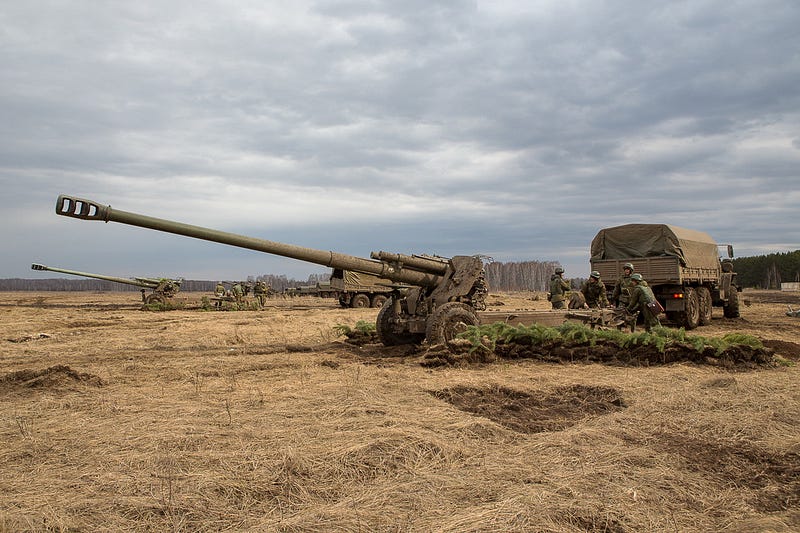
2A65 “Msta-B” artillery pieces of Russia’s 90th Guards Tank Division. Credit: Wikipedia

This is a Soviet-era towed howitzer and is known to be deployed in Donbas. It is believed that Russia has 850 (250 active, 600 reserve) available, though many are thought to be in Perm in Siberia (Wikipedia).

Firing range 30 km at up to 6 rounds per minute. Nuclear-capable.

Also widely used by Ukraine forces (130 units) pre the war.

2A36 Giatsint-B 152 mm Field Gun
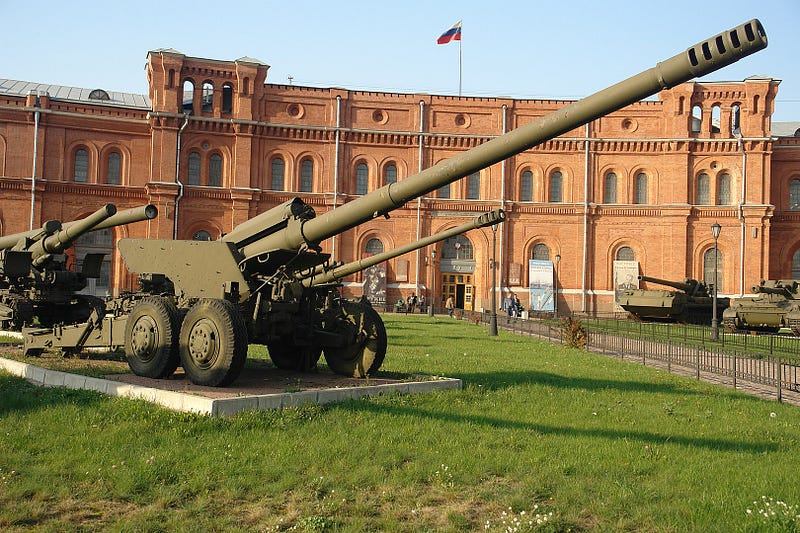
Image credit: Wikipedia

This is a Soviet/Russian towed 152 mm field gun which entered service in 1975. The 2A36 is designed to suppress and destroy enemy manpower and equipment. It is also suitable for counter-battery fire. — Wikipedia

The gun uses separate-loading cased charges, so more logistical complexity is likely. Known to be deployed in Donbas, but also used by Ukraine forces.

Nuclear-capable. Range is up to 40 km, 6 rpm. 140 active, 1100 in reserve.

The guns are usually deployed in batteries of six to eight guns; promotional material claims that a battery can place more than 1 tonne of projectiles on a target in one minute. As of 2022 the 2A36 is still considered to be reliable, mobile, and capable of delivering heavy firepower.

2A18 (D-30) 122 mm Howitzer
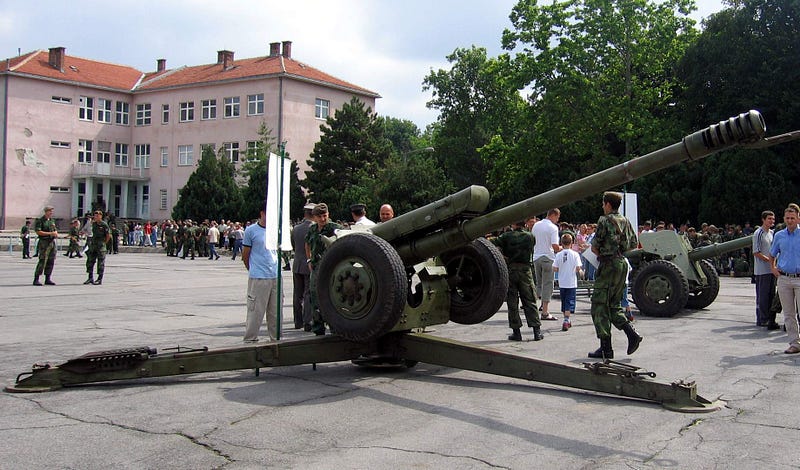
Image credit: By Тснена at Serbian Wikipedia — Transferred from sr.wikipedia to Commons by Micki using CommonsHelper., Public Domain, https://commons.wikimedia.org/w/index.php?curid=18172315

A Soviet howitzer that first entered service in the 1960s. It is a robust piece that focuses on the essential features of a towed field gun suitable for all conditions. The D-30 has a maximum range of 15.4 kilometers, or over 21 km using rocket assisted ammunition. — Military History Fandom

550 pieces active, 4400 in reserve (Wikipedia).

2B16 Nona-K 120 mm Howitzer

These are old and there are thought to be less than 100 in the Russian inventory, so I’ll skip any more detail, although 7 have been reported as destroyed or captured in Ukraine.

5.2 Russian self-propelled artillery

2S7 Pion 203 mm self-propelled howitzer
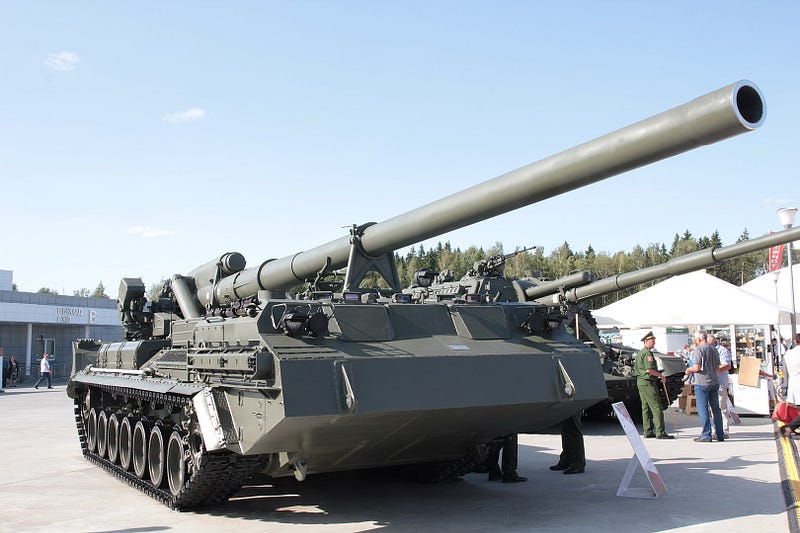
Image credit: Nick Nitride Wikipedia

The 2S7 is fitted with the massive 56-caliber 203mm 2A44 howitzer. With standard ammunition it has a range of 37.4 km and a rocket-assisted projectile can be fired out to 47.5 km. The rate of fire is 1.5 rounds per minute. Four rounds of ammunition are carried on the 2S7 with the remainder on a support vehicle. The improved 2S7M carries 8 rounds and has a rate of fire of 2.5 rpm. No secondary armament. -weaponsystems.net

It has 11 crew. The estimates of numbers available vary between 250–1000, but it is known to be deployed in Donbas and elsewhere in Ukraine.

2S35 Koalitsya-SV 152 mm self-propelled howitzer
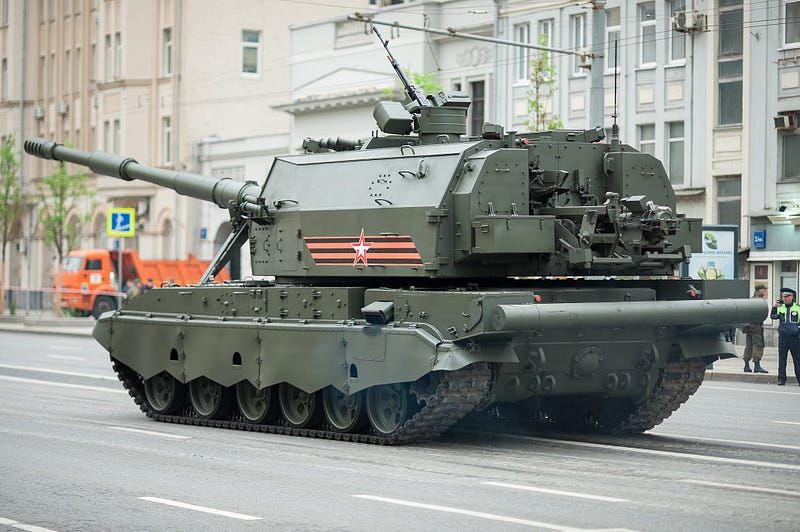
Image credit: Dmitriy Fomin from Moscow, Russia, CC BY 2.0 <https://creativecommons.org/licenses/by/2.0>, via Wikimedia Commons

This is relatively new design first seen in 2015 built to succeed the 2S15 Msta- S and other dated 152 mm designs. It is thought to be one of the most advanced artillery pieces in the world.

With a 52 calibre barrel and ammunition load of 40 shells it can fire at 8 rpm with full automatic loading to a range of at least 30 km.

A twin-barrel version has been seen with barrels operable at different elevations and separate loaders.

A new long-range precision-guided round has been developed in Russia. It has a maximum range of 70 km and high level of accuracy. The Koalitsiya-SV It is also capable of firing older Krasnopol laser-guided munitions with a maximum range of 20–25 km. — Military-Today

Although there are believed to be only about 72 in operation pre- the Ukraine war, I could not omit it as it is such a powerful artillery piece.

2S19 Msta-S 152 mm self-propelled howitzer
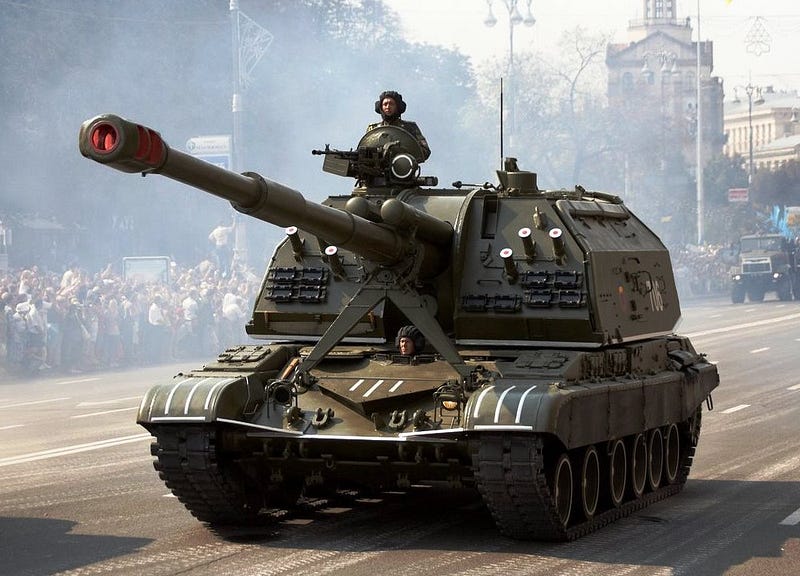
Image credit: Wikipedia

The 2S19 Msta-S is a Soviet-era design.

…armed with a 152 mm/L47 howitzer, which is similar to that used on the 2A65 Msta-B towed howitzer. The howitzer is fitted with an semi-automatic loader and fume extractor. The gun can be loaded at any angle. Maximum rate of fire is 7–8 shells per minute. The Msta-S is compatible with all standard 152 mm shells used by the D-20 towed gun-howitzer and 2S3 Akatsiya self-propelled howitzer. — Military today

There are believed to be 935 operational and they are still in production although it is planned to replace them with the Koalitsya.

These are also used by Ukraine (40).

2S5 Giantsint-S 152 mm self-propelled howitzer
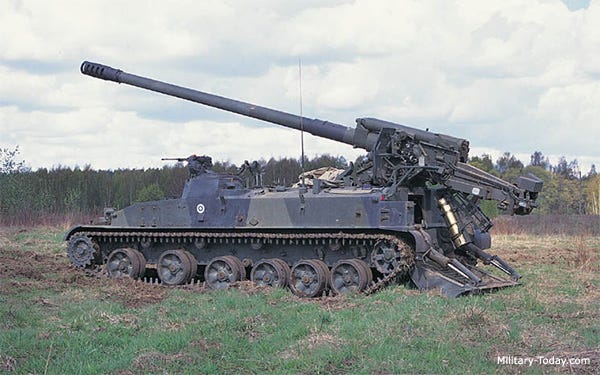
Image credit: Military Today

The 2S5 Giatsint-S is a Soviet/Russian 152 mm self-propelled gun. It is NBC protected. The 2S5 is capable of engaging targets at longer ranges and at a higher rate of fire than the more widely produced 2S3 Akatsiya 152 mm self-propelled gun. — Wikipedia

Fitted with a turretless 152 mm/L54 gun and load assisting system. Maximum rate of fire is 5–6 rpm using standard and rocket-assisted HE-FRAG, HEAT, cluster and smoke shells. Firing range is 28 km (standard round), and up to 33 km with a rocket assisted shell. Can also use nuclear rounds.

Russia had 114 active pieces pre-war, with 850 in reserve.

Ukraine had 24 of these units pre-war.

2S3 Akatsiya 152 mm self-propelled howitzer
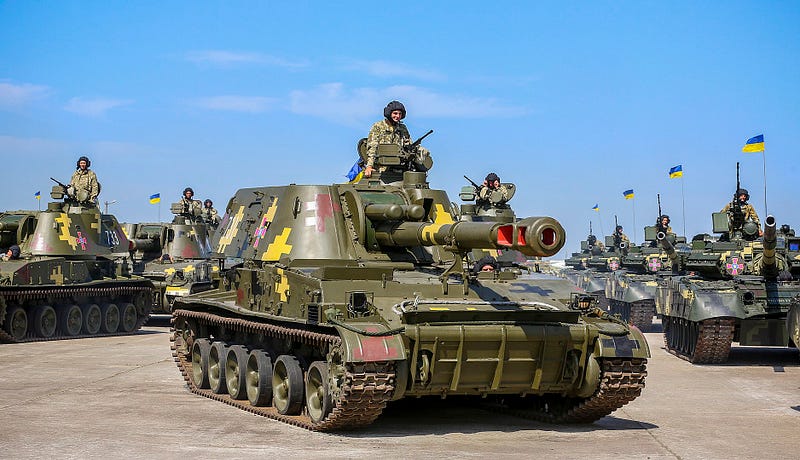
An Akatsiya of the Ukrainian forces. Image credit: By President.gov.ua, CC BY 4.0, https://commons.wikimedia.org/w/index.php?curid=50907259

The Akatsiya (‘Acacia’) is armed with a 152.4 mm howitzer based on the Soviet 152.4 mm D-20 towed howitzer. It is NBC protected.

It has some interesting features:

  • self-entrenching equipment which allows to prepare a trench within 20–40 minutes
  • a crew of 4–6 including two ammunition bearers, who are positioned to the rear of the vehicle feeding rounds through two hatches in the hull rear when in masked firing position

Rate of fire is 2–4 rpm with a maximum range of 24 km using rocket-assisted ammunition.

It is thought that Russia has around 1800 units available.

Ukraine has about 500.

All numbers are pre Ukraine war.

2S1 Gvozdika self-propelled howitzer 122 mm
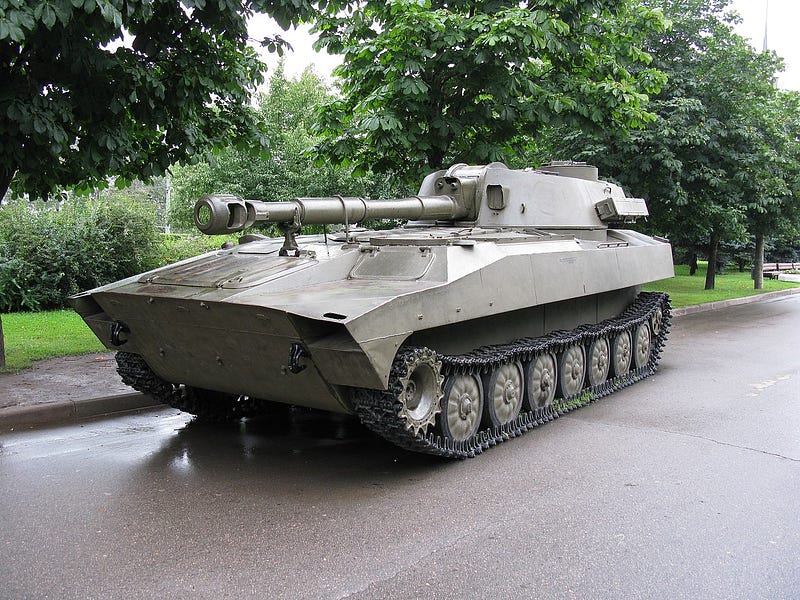
2S1 Gvozdika. Image credit: By Andrew Bossi — Own work, CC BY-SA 2.5, https://commons.wikimedia.org/w/index.php?curid=5062207

This design (‘Carnation’) is a Soviet era self-propelled 122 mm howitzer dating from 1958 (prototype), but like much of the Soviet era armour has undergone modernisation.

Interesting features include:

  • fully amphibious and once afloat is propelled by its tracks (I’d like to know more about that — it weighs 16 tonnes)
  • a variety of track widths are available to allow the 2S1 to operate in snow or swamp conditions

It has semi-automatic loading, with a range of 15 km and extended at 21 km, rocket assisted.

Estimates as to availability vary from 600 to 2230 in the Russian armoury.

Ukraine is estimated to have 638, pre war. They have been considerably enhanced as the Kevlar-E, introduced in 2018.

Other Russian artillery

There are several other disparate artillery pieces that I could include here, but their numbers are relatively low.

6. Conclusions

NATO quality against Russian quantity — is it that simple? I asked that question at the start and if you’ve worked through this with me you may conclude that no, it’s not that simple. But I’m just an amateur in an armchair, so to speak, trying to judge the balance of firepower.

The Russian forces have some outstanding artillery, but not in great quantities (for example the fearsome 2S35 Koalitsya). They do, however, have huge quantities of adequate artillery, but the older, shorter range pieces such as the 2S1 Gvozdika will be of little use in a long-range — 30 km — artillery exchange(Ukraine has over 600 of these too).

Ukraine on the other hand has the adequate, largely Soviet-era artillery, in lesser quantities, backed up by NATO-supplied artillery (less than 150 pieces at my rough count).

Numbers do matter in a war of attrition and as far as I can see in this context the Western supplies of howitzers so far will not make a huge difference, other than to morale.

It’s basically Russian hardware versus Russian hardware, with window-dressing from NATO countries.

Score 2 for Russia.

I’ve been reading recently about the heavy toll that’s been taken on Russian drones. These are essential for modern, precise artillery spotting and there are stories that sanctions are slowing down the building of new drones (and other electronics).

So I think that’s score 1 for Ukraine.

Add in the fact that there is apparently low morale and commitment on the part of Russian forces with a huge loss of middle rank officers (a fundamental structural issue) and refusal to fight.

The Krasnodar-based Rosgvardiya soldiers who took part in the war against Ukraine in February-April and tried to be sent there again have filed reports refusing to go to war.

This was reported by the Kavkaz.Realii website with reference to a source in the General Directorate of Federal Forces of the National Guard of the Krasnodar Krai.

According to it, the members of Rosgvardiya are extremely dissatisfied with the payments received for the two months of their stay in Ukraine — they turned out to be significantly lower than the propaganda media have been telling. — Ukraine Telegram
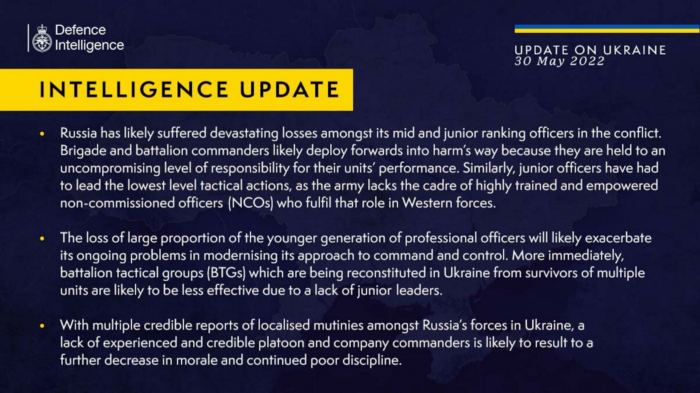
Source: UK MOD

I think that this issue of personnel is a major one and I score 2 for Ukraine.

Artillery mobility together with a coherent command and control system will be critical. Russia has proven to be lacking in this regard.

Score 1 for Ukraine

And then we have logistics. This has been a major problem for Russia because of long supply lines and fractured communications with poor command and control. All topped off with, I think, 3 variants of ammunition size.

Score 1 for Ukraine.

In summary I judge that it’s finely balanced, but in Ukraine’s favour, though my scorecard doesn’t show that, does it?

What do you think?

*One final qualification: All the estimates as to numbers available have been drawn from Wikipedia, which appears to be the go-to repository which other military websites draw from. Many of the numbers of Russian artillery pieces in Wikipedia are referenced back to a few Russian contributors. So, there is always the possibility that they are deliberately inaccurate…

About me: If you follow me I guarantee variety in your inbox! I write on a wide range of topics including humor, tech and travel, together with daily news events and the minutiae of my daily life living on a boat. I also write techno-thrillers…and about…

…big guns

If you appreciate stories like these and want to support other writers and me, consider signing up to become a Medium member. It’s only $5 a month, giving you unlimited access to incredible stories on Medium. If you sign up using my link below, I’ll earn a small commission at no extra cost to you.

Or maybe just buy me a coffee?

Ukraine
Russia
War
Artillery
Howitzers
Recommended from ReadMedium