
Geopolitics
Russia v Turkey — and it’s not Football
Russia has withdrawn its guarantees of maritime safety in the Black Sea following collapse of the grain deal. The impacts could be profound, but why is Turkey so powerful? Is there conflict ahead?
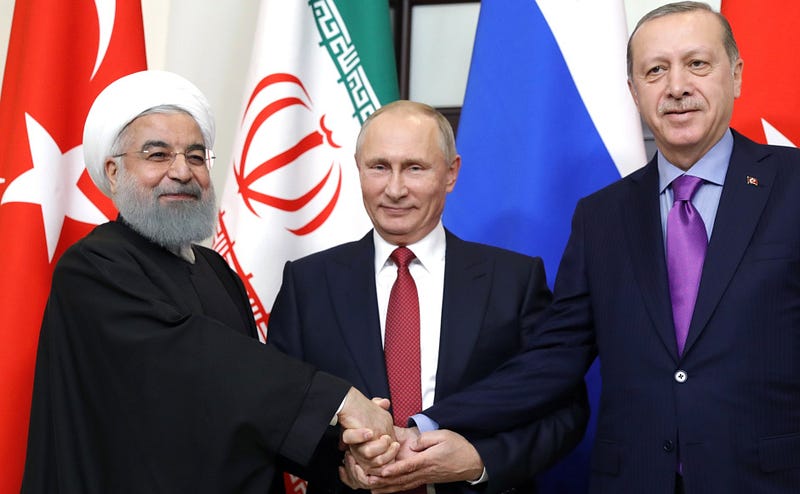
The history of relations between Turkey and Russia is one of cooperation, rivalry, and conflict. From the Ottoman-Russian rivalry to the contemporary pursuit of strategic cooperation, these two nations have navigated a complex path shaped by historical events, including the Crimean War, World War I, and the decline of the Ottoman Empire.
Influential figures like Sultan Abdulmejid I, Tsar Nicholas II, and Mustafa Kemal Atatürk, have played critical roles in defining the trajectory of Turkish-Russian relations.
Atatürk created the modern, secular Turkey but in the 21st century Recep Erdoğan has moved the country towards a less democratic, more Islamic stance during his 20 year rule.
And now in July 2023, relations between the countries have become further stressed as Erdoğan juggles to balance Turkey’s NATO membership and desire to join the EU against a desire to be seen as a neutral power broker in the Russia-Ukraine conflict.
History may be seen as boring by some people but it does help us understand modern day tensions between those two nations with very different cultures and political systems. Unfortunately, politicians seem incapable of learning from it.
This a very long story, not least because the issue is hugely complex. I’ve tried to make sense of it all and I hope I can successfully distill that for you.
And as I write, the Ukraine export deal has collapsed and Turkey may well confront Russia in the Black Sea.
Some history
The Ottoman Empire dates back well into medieval times.
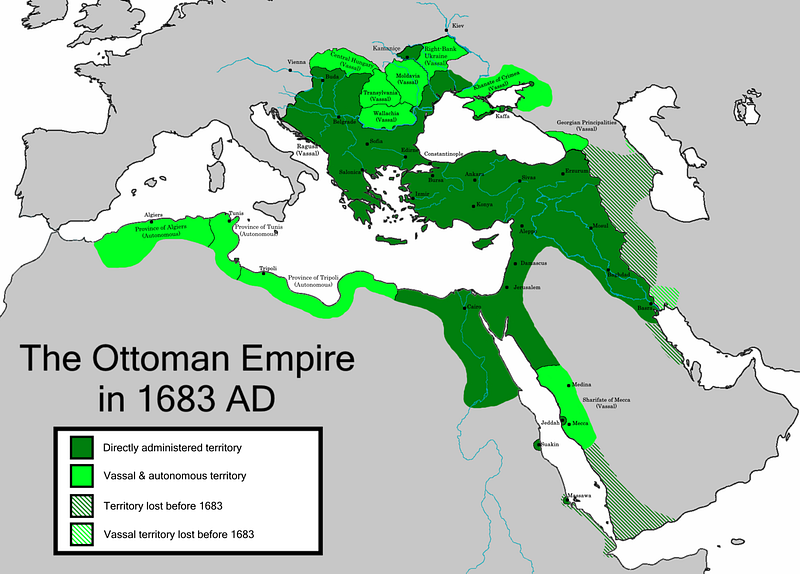
The earliest recorded interactions between the Turks and Russians date back to the medieval era when the expanding Ottoman Empire and the emerging Russian Tsardom came into contact. Ottoman expansion into southeastern Europe and the Crimean Khanate’s allegiance to the Ottomans fuelled tensions between the two powers.
One significant event during this time was the Ottoman–Cossack War. In 1620 Zaporizhzhia Cossacks carried out a naval raid on Istanbul.
The Russo-Turkish War of 1676–1681 was a war between the Tsardom of Russia and Ottoman Empire, caused by Turkish expansionism in the second half of the 17th century. This was fought in the region of the Dnieper river in central Ukraine.
Crimean War
The mid-19th century witnessed a major turning point in Turkish-Russian relations with the Crimean War (1853–1856). This conflict pitted the Ottoman Empire, supported by Britain and France, against Russia. The war resulted in a decisive Ottoman victory, but it also exposed the weakening state of the empire, ultimately leading to decline and disintegration.
World War I
This terrible conflict had a significant impact on the relationship between Turkey and Russia. The Ottoman Empire found itself embroiled in the conflict alongside the Central Powers, which included Germany and Austria-Hungary. In contrast, Russia aligned itself with the Entente Powers, including Britain, France, and later the United States.
During this period, Mehmed V Reşâd was the Ottoman Sultan. The Ottoman Empire’s decision to join the Central Powers strained its relations with Russia, which had historical rivalries with the empire. Russia’s Tsar Nicholas II viewed the Ottoman Empire’s alliance with the Central Powers as a threat to Russian interests in the region.
In the Caucasus region (mainly today’s Armenia, Azerbaijan and Georgia), the Ottomans and the Russians clashed, and even today the Caucasus remains a troublesome thorn in Russia’s underside.
Inter-war years
After World War I the Ottoman Empire was carved up and partially occupied, leading to the Turkish War of Independence.
Meanwhile, Russia had undergone a huge revolutionary transformation as the USSR was forged out of previously sovereign European nations.
The Turkish War of Independence was a series of military campaigns waged by the Turkish National Movement after the Ottoman defeat in World War I. These campaigns were directed against Greece in the west, Armenia in the east, France in the south, loyalists and separatists in various provinces, and British and Ottoman troops around Constantinople (Istanbul).
The political chaos which had triggered Russia’s withdrawal from World War I and its increased inward focus led to the signing of the Treaty of Brest-Litovsk in 1918. This treaty recognized the independence of several territories, including Ukraine, Belarus, and the South Caucasus, which had implications for the future of Turkish-Russian relations, even today.
However, during the Turkish War of Independence, Russia’s initial support for Atatürk stopped and the USSR underwrote the Turkish Communist Party, hoping to influence Turkish politics.
World War II
During this conflict, Turkey pursued a policy of neutrality, maintaining a delicate balance between the Axis and Allied powers. The Soviet Union, however, viewed Turkey’s position with suspicion, particularly due to the Turkish Straits’ strategic importance as a vital maritime route connecting the Black Sea and the Mediterranean.
The Cold War
The Cold War era intensified tensions between Turkey and the Soviet Union. The Turkish alliance with NATO, coupled with its close cooperation with the United States, deepened the divide between the Turkey and the USSR.
The Cyprus conflict in the 1970s increased these tensions when Turkey intervened militarily in response to a Greek-backed coup on the island. The Soviet Union supported Greece, further straining Turkish-Russian relations. The island was partitioned and remains divided. It is a popular holiday destination for Russians and some Russians oligarchs have (had) homes there — and passports. And bank accounts.
Post-Cold War
With the collapse of the Soviet Union in 1991, a new chapter began in Turkish-Russian relations. Both countries sought to redefine their roles in the post-Cold War era. Turkey recognized the opportunities for economic cooperation and started building closer ties with Russia. A Russian gas pipeline to Europe passes through Turkey, and another Russian gas pipeline supplies Turkish domestic demand.
Turkey has been a member of NATO since 1952.
Syrian Conflict
The Syrian conflict, which began in 2011, continues to stress Turkish-Russian relations. Turkey supported various rebel factions opposing the Syrian government, while Russia aligned itself with the tyrannical regime of President Bashar al-Assad. This difference in approach brought the two countries into direct confrontation at times. Turkey has even shot down Russian aircraft with one of its F-16s — with no apparent comeback.
Russia knows that Turkey is not to be trifled with.
Turkey’s modern power
Turkey’s power today derives from two main levers: Maritime access to the Black Sea and NATO membership with powerful armed forces.
Black Sea access
‘Constantinople’, as Istanbul was known in the time of the Crusaders, is arguably one of the most beautiful and magical cities in the world. It sits astride the Bosphorus, controlling maritime access to the Black Sea and two of Russia’s few major ice-free seaports.
In 1936, the ‘Montreux Convention regarding the Regime of the Straits’, usually referred to as the ‘Montreux Convention’, was concluded. It is an international agreement governing control of the Bosporus and Dardanelles Straits. This agreement is still applicable and Turkey has acted in accordance with it during the Russia-Ukraine war. For example, one condition means that Russian warships not having a home base in a Black Sea port are prevented from transiting the Straits inward.
As I understand it, Russia is still able to send military supplies to Syria through the Straits as Syria is not a belligerent in the war with Ukraine.
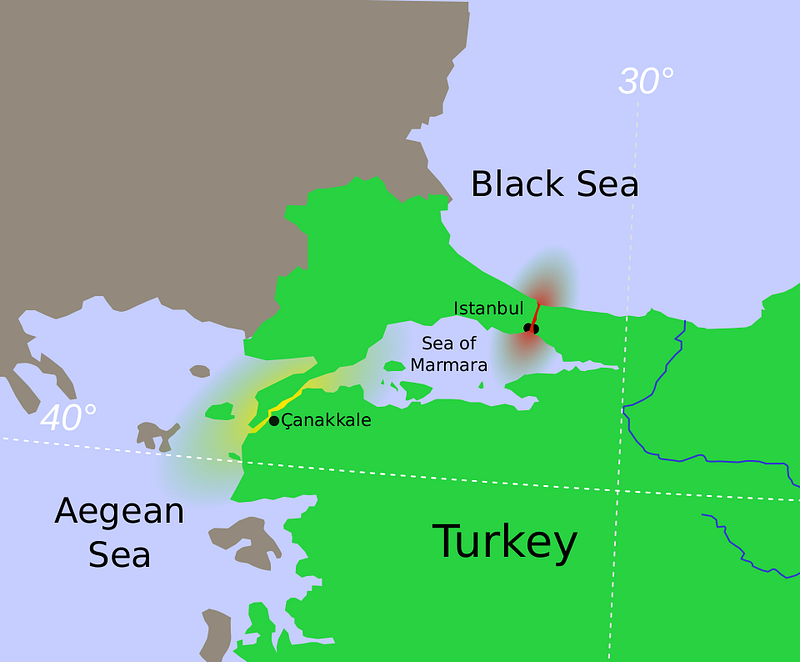
Note: The United States isn’t a signatory of the Montreux Treaty, so technically these rules don’t apply to the U.S. Navy.
NATO membership
Turkey has NATO’s second largest army (262,000 active personnel) and is the host of the Allied Land Command headquarters. The Incirlik and Konya Airbases have both been involved in several NATO military operations since their establishment.
Turkey is a participant in NATO’s nuclear sharing arrangement, which involves the sharing of nuclear weapons among NATO member states. Under this arrangement, some NATO allies, including the United States, have deployed nuclear weapons in Turkey. Military.com estimates that there are 50 US B61 nuclear bombs held at Incirlik airbase. Until 2019, the US maintained an ambiguous position on nuclear weapons locations.
‘Recently, however, the Trump administration confirmed the existence of the devices at Incirlik’ — military.com (2019)
I’m not sure what other secrets Trump let out from his bathroom.
Turkey’s NATO membership has another aspect: It can delay or veto the applications of aspiring members of NATO, as it is doing with Sweden’s application.
Turkey’s President Recep Tayyip Erdogan has agreed to support Sweden’s bid to join Nato, the military alliance’s chief Jens Stoltenberg says.
He said the Turkish leader would forward Sweden’s bid to parliament in Ankara and “ensure ratification”. — BBC 11 July
Sweden had given political asylum to Kurdish individuals who Turkey asserts are Kurdish terrorists. The historic Kurdish tribal area spans parts of several countries, including southeastern Turkey, northern Syria, northern Iraq, and western Iran. The Kurds have been fighting for independence, battling against Turkey, Iran and Iraq.
This NATO veto gives Turkey a lever over both NATO and Russia, as Russia does not want Sweden to join NATO.
Turkey is keen to join the EU but its internal politics with dubious elections, press freedom and human rights issues have prevented its progress. Cynics would say that this EU membership aspiration of Turkey is undoubtedly another factor affecting Sweden’s NATO membership bid, but the EU and Turkey would deny a linkage.
Russia does not want the EU to be further strengthened by Turkey’s membership.
I should note here that Turkey has a 534 km border with Iran, another country at odds with member states of NATO. But Iran is friendly with Russia which needs Iranian drones and artillery shells in exchange for SU-35s (Reuters). Then just recently, Russia strayed…
Russia has waded into a territorial dispute in the Gulf this week, provoking a rare outpouring of criticism from its regional partner Iran.
On Monday, Russia and the Gulf Cooperation Council (GCC) issued a joint statement in support of the United Arab Emirates’ claim on three islands in the Gulf that Tehran argues are Iranian. — Middle East Eye (15 July 2023)
It’s all very complex isn’t it?
Arms manufacture in Turkey
Turkey has a powerful military-industrial complex.
When militaries throughout the world need armored vehicles to deal with emerging threats, such as improvised explosive devices, they often look to Turkey.
The defense industry within Turkey has specialized in 4x4, 6x6 and 8x8 armored platforms, tracked infantry fighting vehicles as well as main battle tanks and weapon systems are manufactured by local private companies like FNSS, Otokar, BMC and Nurol Makina. Besides its National Security Forces use of them, these systems are exported to a wide range of users worldwide… KAPLAN Medium Tanks are the most remarkable product samples of Turkish Defense Industry competing at the global markets. — defensenews.com
And let’s not forget Bayrakhtar aerial drones, which have been exported to Ukraine in high volume. Baykar Makina Sanayi ve Ticaret A.Ş, the manufacturer is now setting up an assembly plant in Ukraine. Some of the drones are powered by Ukraine-made engines.
Also, Turkey recently committed to supplying its self-propelled T-155 Firtina 155 mm NATO calibre howitzer to Ukraine.
There’s no doubt that these Black Sea access and multiple NATO levers give Turkey heavy geopolitical bargaining power. And that has become apparent in the negotiations over the safe export of Ukrainian grain.
Russian-Ukraine conflict today
Grain
The ‘Ukraine Grain Agreement’ expired on 17 July 2023. The so-called agreement is actually a set of inter-related agreements involving Ukraine, the UN, Turkey and Russia.
Turkey reportedly said that if Russia refused to renew the agreement then Turkey would guarantee the safety of grain transport ships in the ‘grain corridor’. This reported has not been confirmed.
As of 18 July 2023 the grain agreement is dead. This follows on from Ukraine’s second successful attack on the Kerch Bridge on 17 July. Russia has said that it would not guarantee the safety of ships in the Black Sea.
Azovstal
Early in July 2023, five Ukrainian commanders from the epic Azovstal battle returned to Ukraine from Turkey, flying back to Ukraine from Ankara with President Zelenskyy in a Czech government jet. This was apparently contrary to an agreement Turkey had with Russia. Why did Erdoğan release them? Did he want to humiliate a weakened Putin?
The Kremlin reacted negatively: “no one informed us about the decision to extradite Azovstal commanders to Kyiv,” said Dmitry Peskov, Putin’s mouthpiece.
Russia clearly has extremely limited room for manouevre in its relations with Turkey and Putin is being humiliated.
Another Russia-Turkey conflict to come?
We may be approaching another crunch point in the face-off between the two countries.
Russian vlogger Igor Girkin aka Igor Strelkov who planned and executed the 2014 annexation of Crimea is suggesting that a confrontation between Russia and Turkey is very likely:
Although a Russian war criminal, Girkin is known for a fairly reliable view of the reality of the Russian war on Ukraine, although his forecasts are just that — forecasts.
Translation: thanks to @Natalka at Twitter. I have bolded what I think are the key parts:
“The moment of truth is getting closer. Or rather, the time is getting closer when my oldest (from the beginning of the Syrian campaign) forecasts about the development of the situation in the “Ukraine-Turkey-Syria” connection will come true.
For those who did not read and did not listen to me in 2015–2016, I remind (point by point) my theses, which have never changed since then and have not become (in my opinion) less likely:
Sooner or later, the Russian Federation will have to enter into a direct military clash with Turkey on the initiative of the latter. The fighting will take place in Syria, in the Transcaucasus and on the Black Sea.
The direct participation of large contingents of Turkish troops (under the guise of “volunteers” or even without such cover) in operations against our army in Ukraine and Crimea is not ruled out.
The Turks will begin to move on to a direct open confrontation with the Russian Federation after they “squeeze dry” from the Kremlin’s amazing people all the concessions that can be obtained peacefully.
Then they will begin to put pressure with military force. The Turks will choose the moment of entry into the war, taking into account the maximum weakening of the military forces of the Russian Federation and our unpreparedness to repel Turkish aggression.
The first stage will be the closure of the Bosporus and Dardanelles for our fleet and supply ships delivering reinforcements to Syria (Erdogan may take this step this year).
This will be followed by a series of armed provocations in Syria by the so-called. “armed opposition” against our troops in order to expand the zone of control of the pro-Turkish authorities. After waiting for the depletion of ammunition and supplies, Turkish troops will try to completely defeat our expeditionary force and Syrian troops in northern Syria. Naturally, only the Russian Federation and official Damascus will be blamed for the escalation of the conflict. Our expeditionary corps cut off from supplies and reinforcements, won’t have a chance to defeat the Turkish army.
The fate of our peacekeeping contingent in Karabakh and Armenia seems just as unenviable. It will be crushed and (at best) interned by the Armenians, or simply destroyed and captured by the Turkish-Azerbaijani coalition.
The only thing that can deter the Turks (apart from the direct threat of the use of nuclear weapons, which could lead to a worldwide nuclear war) from defeating our troops in Syria is the direct intervention of Iran and its readiness to directly enter into a military confrontation with Turkey in Syria and the Transcaucasus (I remind you that Turkey is now strenuous friends with the main opponents of Iran — Israel).
In any case, even if Ankara does not dare to go into a full-scale military conflict with the Russian Federation, the Turks will “strangle” our group in Syria, since all communications are based on sea supplies through Novorossiysk to Tartus [the Bosphorus], and blocking the airspace with Syria is also not a problem for the Turks .
The question of the timely withdrawal of our expeditionary force in Syria has long been “overcooked”, but has not yet been raised as such.
A large group of our military remains Erdogan’s “hostage”. We can expect with high probability that the long-awaited rejection of the shameful and senseless “grain deal” will set in motion a chain of consequences that naturally leads to a sharp aggravation of Russian-Turkish relations and an acceleration of Turkey’s inevitable transition to the camp of our open enemies.
The time allotted for the possibility of evacuating our troops from Syria during the “deal” is apparently lost forever.”
End of translation
Therefore we could see the grain deal as a potential ignition point.
Conclusion
It’s clear that Erdoğan has repeatedly ‘rubbed Putin’s nose in it’ without any serious comeback, indicating the relative strengths of the two leaders.
Erdoğan is known for having a stubborn and independent streak. He is a very capable negotiator and power broker with an open line to Putin. NATO has difficulty with some of his policies. But NATO needs him.
Can NATO control him? Probably, but what can they trade?
There’s no doubt that the Black Sea/Russia/Turkey political situation is hugely complex, and as an amateur I’m still struggling to get my head around it.
The grain deal has become a focus, watched by the whole world. My betting is that Russia will back down. Even if the grain deal is not resurrected, I think we will see grain ships in convoy from Ukraine transiting the western Black Sea to the Bosphorus.
But there’s a BIG BUT…
I doubt that Putin would dare attack any grain ships, but he might well attack the port infrastructure to prevent the loading of grain ships. However, with the demonstrated inaccuracy of Russian missiles any ships loading grain would likely be at risk.
Would Russia agree to a new grain deal if one of their banks could be linked to the SWIFT interbank payments system? Reuters reported on July 12 that the UN made the suggestion to Russia. The UN has no control whatsoever over the SWIFT system.
However, the EU is considering connecting to SWIFT a subsidiary of Rosselkhozbank to allow specifically for grain and fertilizer transactions, three sources familiar with discussions told Reuters on Wednesday. The European Commission did not immediately respond to a request for comment
…
As a workaround to the lack of access to SWIFT, U.N. officials have gotten U.S. bank JPMorgan Chase & Co JPM.N to start processing some Russian grain export payments with reassurances from the U.S. government.
The United Nations is also working with the African Export-Import Bank (Afreximbank) to create a platform to help process transactions for Russian exports of grain and fertilizer to Africa, the top U.N. trade official told Reuters last month. — Reuters ibid.
The grain deal is dead.
The grain terminals are being attacked.
Is grain Putin’s last major non-nuclear weapon?
What will be Erdoğan’s next play in Turkey’s never-ending relationship with Moscow?
It seems to me that Erdoğan holds most of the high cards.
If you follow me I guarantee variety in your inbox with some unusual perspectives! I write on a wide range of topics that interest me including humour, tech, space, geopolitics and travel. I also write about…
…relationship difficulties
If you appreciate stories like these and want to support me and other writers, please consider signing up to become a Medium member. It’s only $5 a month, giving you unlimited access to incredible stories on Medium. If you sign up using my link, I’ll earn a small commission at no extra cost to you.
Or maybe just buy me a coffee? and tell me what you liked reading (or not)…

My novels are available at my Gumroad bookstore. Also at Amazon and Apple
Author’s note: The concept, structure, style and creative content in this story are all my own and I hope that is obvious to a reader. I do not employ third party writers. However, I do occasionally use an AI assistant to research and present small sections of factual content and data. All facts are checked where possible and sources quoted.