
Russian Navy
Russia is Challenged by 11 Time Zones with Few Ice-Free Ports
Ice-free maritime access is a major concern for Russia’s projection of naval power and has driven policy for centuries
Background
Russia, the largest country in the world by land area, possesses vast coastlines and a rich maritime heritage. However, much of its coastline is icebound during winter months. With its strategic location connecting Europe and Asia, Russia has long recognized the importance of its seaports as gateways to international trade and its ability to project naval power. The development of ice-free seaports has emerged as a crucial solution to maintain year-round accessibility.
Russia’s ice-free seaports play a pivotal role in the country’s economic development and global connectivity. Unlike their counterparts in the Arctic region (other than Murmansk), ice-free ports remain open throughout the year, enabling uninterrupted maritime trade even during the severe winter months.
Before the Ukraine invasion they enhanced Russia’s participation in the global supply chain by reducing transportation costs, shortening shipping distances, and ensuring timely delivery of goods.
These ports also served as gateways for landlocked countries in Central Asia, offering them a vital maritime outlet for their imports and exports.
Now that status is changing rapidly as trade falls due to international sanctions.
Strategically, Russia has SLBM platforms but the limited number of ice-free ports means that it has few maintenance and overall ports for the valuable submarines. So it has relied in the main on land-based and air-launched nuclear weapons.
The ice problem
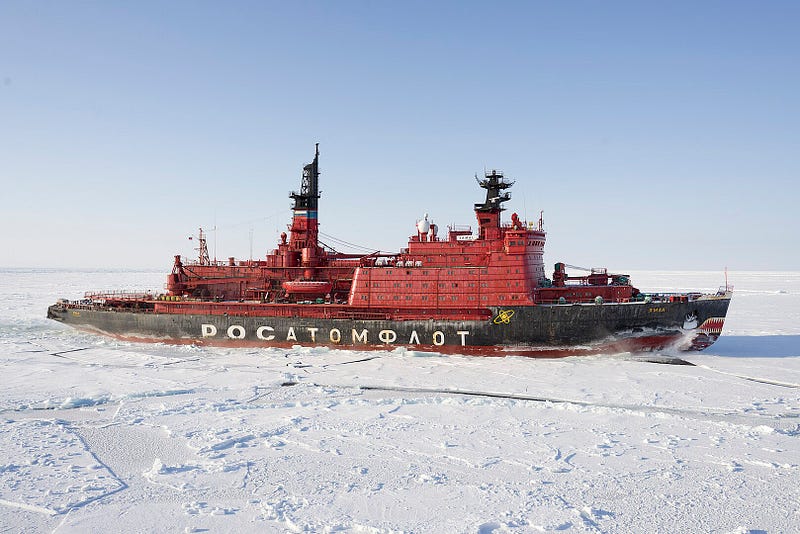
During the winter, the ice along the Northern Sea Route varies in thickness from 1.2 to 2.0 m (3.9 to 6.6 ft). The ice in central parts of the Arctic Ocean is on average 2.5 m (8.2 ft) thick. Nuclear-powered icebreakers can force through this ice at speeds up to 3 kts (6 km/h; 3 mph). In ice-free waters, the maximum speed of the nuclear-powered icebreakers is as much as 22 kts (41 km/h; 25 mph). (Wikipedia)
Nuclear ice breakers
Russia’s nuclear icebreakers play a crucial role in facilitating Arctic exploration, supporting maritime trade, and ensuring a passage for ships in icy conditions.
With its extensive Arctic coastline and vast reserves of natural resources, Russia has long recognized the importance of developing a fleet of powerful icebreakers to maintain its presence and assert its interests in the region. The use of nuclear propulsion systems in icebreakers offers distinct advantages, such as increased power, greater maneuverability, and longer operational range, enabling them to navigate through thick ice and escort cargo ships to their destinations.
One of Russia’s most notable nuclear icebreakers is the “Arktika,” the world’s first nuclear-powered icebreaker. Launched in 1975, the Arktika heralded a new era of Arctic exploration and opened up previously inaccessible areas for resource extraction and shipping.
On August 17, 1977, Arktika was the first surface vessel in the world to reach the North Pole.
Subsequently, Russia has built several more advanced icebreakers, including the “Yamal,” “50 Let Pobedy,” and the “Arktika II, each demonstrating the country’s commitment to developing its Arctic capabilities.
These nuclear icebreakers have significantly contributed to the growth of economic activities in the Arctic region.
However, they may work commercially but in a naval context a very restricted sea lane through ice for a warship moving at 3 knots is highly vulnerable.
Russia‘s ice-free ports
Novorossysk
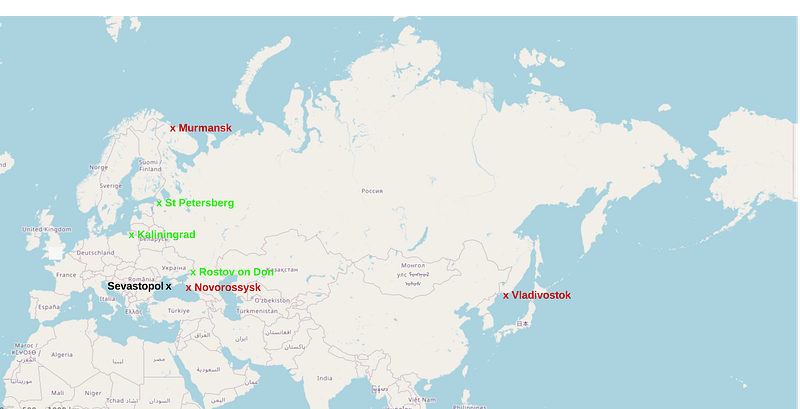
Located on the Black Sea coast in Krasnodar Krai, the Port of Novorossysk was one of Russia’s busiest ice-free seaports. It served as a major gateway for oil exports from the Caspian Sea region and provided a vital link between the Mediterranean and the landlocked countries of Central Asia.
Novorossiysk’s strategic location and state-of-the-art infrastructure made it a critical transit point for the transportation of various goods, including grain, coal, and chemicals.
Since Ukraine’s ability to target Russian capital naval vessels with surface and aerial drones, and with Neptune and Harpoon missiles, its importance as a naval port has increased. Sevastopol is no longer a safe haven.
Vladivostok
Situated in the Russian Far East, the Port of Vladivostok serves as a key trade hub in the Asia-Pacific region. It offers excellent connectivity to the Trans-Siberian Railway and serves as a major transshipment point for goods moving between Russia, China, Japan, and South Korea although that trade has fallen significantly as international sanctions on Russia have increased.
Murmansk
Located on the Barents Sea, the Port of Murmansk is Russia’s largest ice-free port in the Arctic region. Despite its challenging climatic conditions, Murmansk had become a significant hub for Arctic shipping, providing access to natural resources, such as oil, gas, and minerals.
The Murmansk Naval Base, located in the city of Murmansk in Northwestern Russia, holds great strategic importance for the Russian Navy. Situated on the Kola Peninsula near the Barents Sea, it is the largest and most significant naval base in the Russian Arctic region. The base plays a crucial role in Russia’s maritime defense capabilities and serves as a gateway to the Northern Fleet.
Following the World War II when it was a key Allied supply port, the Murmansk Naval Base continued to grow and modernize, becoming an essential asset for the Soviet Navy’s Northern Fleet. With the collapse of the Soviet Union in 1991, the base came under the jurisdiction of the newly formed Russian Federation. The base has remained a cornerstone of Russia’s naval power projection in the Arctic.
The Arctic region is rich in natural resources and is becoming increasingly accessible due to melting ice caused by climate change. As a result, competition among countries for control and influence in the Arctic has intensified. Russia, with its vast Arctic territory, views the region as a vital strategic asset. The Murmansk Naval Base serves as a crucial outpost for asserting Russian dominance and safeguarding its interests in the Arctic, including the protection of valuable offshore oil and gas reserves, as well as shipping routes. There are competing claims about the sea-bed rights, particularly with Canada.
However, climate change remains a significant concern. As the Arctic ice melts, new opportunities and challenges arise for Russian ice-free seaports.
Sebastopol is not a Russian port
Its significance reached a turning point when Crimea was transferred from the Soviet Union to the Ukrainian Soviet Socialist Republic in 1954. Following the collapse of the Soviet Union, Sevastopol became part of an independent Ukraine, and a lease agreement was established allowing Russia to maintain its naval presence in the port.
But this major naval base — and land access to it — was a key reason for Russia’s illegal annexation of Crimea in 2014.
Other key ports are not ice-free
These ports include:
Rostov-on-Don
This is a major port city located on the Don River in southwestern Russia. It connects to the Black Sea via the Sea of Azov and the Kerch Strait. While the port is a crucial transportation hub for various goods and commodities, it is subject to seasonal variations in ice conditions. It’s also a significant Russian naval shipbuilding port.
During the winter months, ice formation in the Don River and the surrounding waterways affects navigation in the area.
St Petersburg
St. Petersburg experiences significant ice conditions during the winter months. Located on the Gulf of Finland, which is connected to the Baltic Sea, the port experiences significant ice conditions during the winter months.
Although the port is equipped with icebreaking vessels to help maintain navigation during the winter season, ice can still pose challenges and restrictions to shipping activities. The severity and duration of the ice conditions varies from year to year but it is common for icebreakers to be required to clear passages for ships entering or leaving the port.
Kaliningrad
Kaliningrad Naval Base is a significant Russian naval facility situated on the Baltic Sea. The Kaliningrad oblast (region) is an exclave of Russia, surrounded by Poland and Lithuania, making the naval base strategically crucial for projecting Russian naval power in the Baltic region. But it is not ice free.
In summary
The development and maintenance of ice-free seaports has posed unique challenges for Russia across its eleven time zones.
To overcome these natural challenges, the Russian government has implemented various strategies, including war, infrastructure development, modernization of port facilities, and enhanced navigational aids.
Investment in icebreaker fleets has been a priority, but ice is still a major strategic constraint on the country.
But global warming is thawing Arctic waters and that may impact strategic naval policy.
About me: If you follow me I guarantee variety in your inbox with some unusual perspectives! I write on a wide range of topics that interest me including humour, tech, space, geopolitics and travel. I also write about…
…ice cold international relations

My novels are available at my Gumroad bookstore. Also at Amazon and Apple
Author’s note: The concept, structure, style and creative content in this story are all my own and I hope that is obvious to a reader. I do not employ third party writers. However, I do occasionally use an AI assistant to research and present small sections of factual content and data. All facts are checked where possible and sources quoted.