
Russia Has Launched Nuclear Missiles Into Ukraine
But it’s not what you think.
The brutal and nonsensical invasion of Ukraine has plunged the world back into Cold War tensions and placed the world on high nuclear alert. Putin’s constant threats to use nuclear weapons were only quelled when the ally he relies upon the most, China, condemned his atomic tantrums (read more here). Yet, despite this, Russia has recently fired nuclear missiles at residential areas of one of Ukraine’s largest cities, Lviv. So why has Putin used such a weapon? Why hasn’t Lviv been flattened? And why could this counterintuitively be good news for Ukraine?
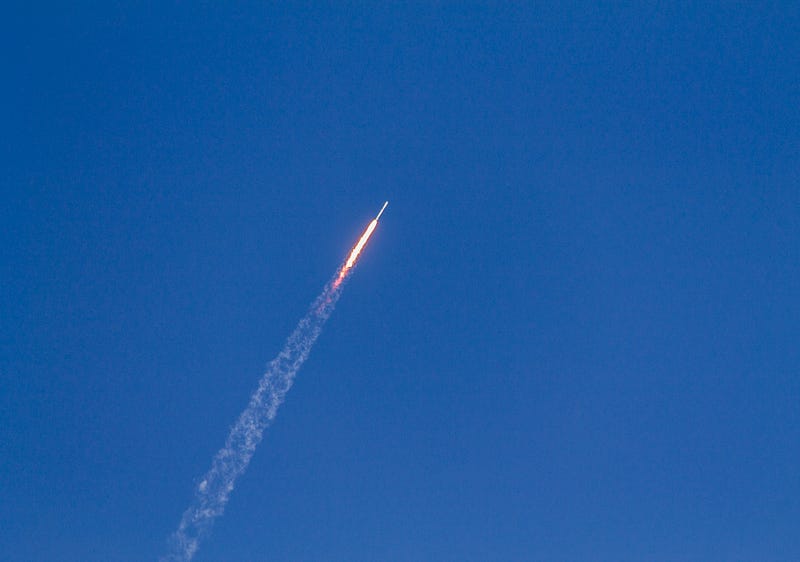
First, let’s get to know this missile. Putin fired an X-55 nuclear cruise missile designed and built by the Soviet Union. These were specifically designed to carry thermonuclear payloads of up to 200 ktn (13 times more explosive than the bomb that destroyed Hiroshima) and to be launched from fighter bomber aircraft such as the Su-30s the Russian Air Force currently uses. With a simple radar guidance system, X-55s can target specific coordinates and, thanks to their powerful yet efficient turbofan propulsion system, travel up to 2,500 km at a maximum speed of Mach 0.75. But this firepower doesn’t come cheap. An X-55 costs the equivalent of $13 million per missile without the nuclear bomb!
During the 1980s, this was one of the most powerful aircraft-launched nuclear weapons out there. However, these days, they are significantly outgunned by modern air defences and don’t match up to more up-to-date nuclear delivery systems. Nevertheless, Russia has kept hold of much of its comparatively ancient Soviet-era weaponry, as its wartime approach is less about focused attacks (like NATO forces use) and more adapted to brute force.
Yet, during a briefing on Thursday, December 1st, military official Mykola Danyliuk displayed fragments of an X-55 missile fired at Ukraine and claimed that another had impacted residential areas of Lviv. It turns out these weapons hadn’t been loaded with a nuclear warhead; in fact, no radiation contamination was found among the fragments. Russia hadn’t even loaded conventional explosives and instead used a dummy head, which consists exclusively of a weight, as the missile’s payload. This means these X-55s resembled dummy missiles used to test the launch and targeting systems.
So, why has Russia launched a fully decommissioned nuclear weapon delivery system against Ukraine? On the surface, it makes no sense.
Well, such a large and heavy missile can still cause a massive amount of damage through pure kinetic energy and residual fuel, causing additional explosions. So Putin is still able to use it to devastating effect. But Russia has more modern, far more accurate, cheaper, and more capable missile systems able to cause the same, if not more, damage, such as the Kalibr Missile (which costs less than $6.5 million). What’s more, the Kh-38 missile can reach Mach 3, making it a far more effective kinetic bomb than the X-55.
So we come back to the question: Why is Putin using these weapons? Well, one reason is that the X-55 is a subsonic missile, meaning it can draw firepower from Ukraine’s anti-air defences. As such, the X-55 can be used as a way to deplete the Ukrainian air defences until they no longer have enough rounds to defend themselves, allowing Russia to gain air superiority once more. While this is plausible, Russia does have better weapons systems available to do this. So why aren’t they using them?
This question has led Ukrainian and British intelligence to conclude that Russia actually doesn’t have these other missiles in their arsenal. Or even that the missiles they do have aren’t working properly and are experiencing high failure rates. You see, Russia has utterly bombarded Ukraine with missiles throughout this invasion. It is believed that this has depleted their available weaponry to the point where they must adapt old-school nuclear technology or even use low-quality missiles to fill in the gaps.
This decision isn’t unheard of. Russia has previously modified X-55s to carry conventional explosives to keep their stock of high-tech, more accurate missiles high. This happened as recently as 2015 when Su-30s fired non-nuclear X-55s in Syria. But these still carried explosives; the X-55 fired into Ukraine didn’t even have that!
This shows that Russia is scraping the bottom of the barrel and doesn’t have the weaponry available that it needs. In effect, Putin has tried to deliver his give-it-all killer blow to Ukraine with a deluge of all his missiles, rockets, and cluster bombs, and yet Ukraine still stands strong, ready to continue fighting. Meanwhile, Russia doesn’t even have explosives to load into its missiles. This demonstrates just how woefully underprepared Russia was for this invasion to last so long. Putin expected to pull a smash-and-grab and be in control of Kyiv in a matter of weeks, but he simply didn’t have the staying power to last that long, and it is starting to show.
This is why these X-55s are surprisingly good news for Ukraine. They demonstrate the waning might of the Russian military and the less-than-ideal measures they must take to continue fighting. While Ukraine has suffered utterly devastating losses, they have support from NATO countries and, as such, still have the proper firepower and equipment needed to fight with deadly force. So, these missiles could signal a change in the balance of power.
We can’t draw too many conclusions about this yet. Russia has deep reserves and could receive proper support from its partner countries any day now. But we can hope that this, along with many other signals, foretells the retreat of Russia and possibly even the end of Putin.
Slava Ukraini.