
Putin’s Nuclear Threats Have Been Thoroughly Defused
Thanks to an unlikely source, an atomic WW3 is now off the table.
To say that Putin’s invasion of Ukraine was a misstep is an understatement. Russia was so inundated with Putin’s propaganda that they thought they could besiege Kyiv in a matter of days and take the country in under a week. But instead, Ukraine has easily held them at bay for months and, in the process, exposed to the world just how weak Russia’s military really is. This has put Putin between a rock and a hard place. He could withdraw his troops and leave Ukraine as an act of surrender, but this would likely cause him to be removed as leader in Russia, given the level to which his militia failure would cast him in a poor presidential light. Alternatively, he could continue fighting the war, even while losing, and run the risk of the Russian population getting fed up with being unendingly sent to the slaughter and eventually revolting against him. After all, the Russian people are used to forcefully removing those in charge. In other words, it is no wonder that Putin has turned to using his trump card and threatened to incite a nuclear war if NATO doesn’t stop supporting Ukraine. Fortunately, the sting has just been removed from this nuclear threat. But how?
The risk of Russia using nuclear weapons in Ukraine is genuine, so Putin’s recent threats to go nuclear over Ukraine should be taken very seriously.
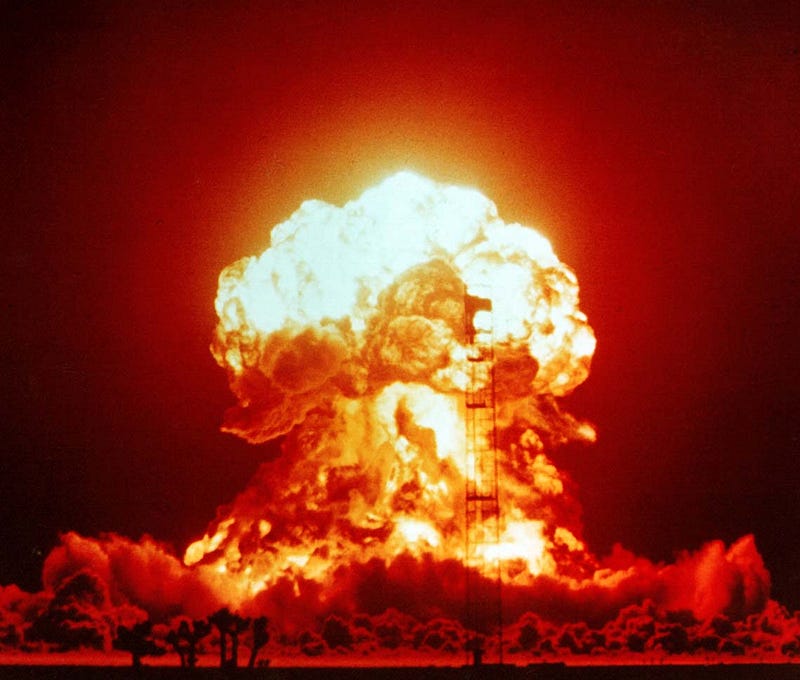
You see, while Russia’s massive hydrogen bomb-equipped Intercontinental Ballistic Missiles (ICBMs) aren’t applicable for such a war and might be useless anyway (read more here), they have another type of nuclear weapon that is perfect for this war. These “tactical nuclear weapons” are far smaller, at about 1–50 kilotonnes, compared to Russia’s 800-kilotonne ICBMs. For some context, the nuclear bomb that wiped out Hiroshima was around 15 kilotonnes. They also have a far smaller range, at approximately 1,000 km, due to their being designed for launch as a shell from an artillery gun or as a small short-range missile launched from a truck. Putin could use these weapons with deadly accuracy and rapidly destroy the Ukrainian resistance.
But surely there would be retaliation from NATO if Putin did this? Well, yes, but NATO really doesn’t want to start a nuclear war, so their retaliation won’t be nuclear. France, for example, has stated that if Putin uses nuclear weapons in Ukraine, they will not retaliate with nuclear weapons. As such, Putin knows there is a chance he could use his nuclear weapons, bring the war in Ukraine to a close, and then weather the ensuing non-nuclear retribution from NATO in an attempt to help him escape his wartime bind.
Even if Putin never uses nuclear weapons, the threat of them might be enough to make NATO countries think twice about continuing their support for Ukraine. So if Putin plays a bluff and raises the stakes by threatening an all-out nuclear war, it could be enough to reduce support for Ukraine, weaken them, and give him a path to victory.
However, one world leader has not only managed to make Russia’s nuclear threats hollow but has also made Putin’s nuclear bluff impossible. This person wasn’t Biden, Macron, Sunak, or Scholz. No, instead, it was Putin’s closest and most powerful ally, Xi Jinping, the President of China. As part of his firm stance against Putin’s pro-atomic rhetoric, Xi stated that the international community should “jointly oppose the use of or threats to use nuclear weapons.” He then went on to say that nuclear weapons should not be used in the war in Ukraine. This piercing, direct, and public criticism of Putin has thoroughly extinguished any risk of a nuclear threat. Let me explain.
China isn’t just a military ally of Russia. They are a cornerstone of the Russian economy. But their military and economic cooperation is massively skewed to China’s advantage, meaning that China could break their alliance, experience no economic consequences, and, in the process, deal a massive blow to Russia.
Take trade, for example. China made up 15.5% of Russian trade in 2019, a figure that is bound to be significantly higher now thanks to international sanctions against Russia. Meanwhile, Russia only made up 0.8% of China’s trade in 2019. So if China distanced itself from Russia, their already fragile and disrupted economy would tumble even further, while China wouldn’t notice a thing. Putin simply can’t risk any more damage to the Russian economy.
Russia’s military also heavily relies on Chinese support. They share technology and conduct military exercises among themselves in a similar fashion to how the US and UK armed forces do. China has even stated that it is willing to support Putin’s military in achieving its goals of stability and improving the country’s international perception. Again, China’s military is far more extensive than Russia’s, with 77% more funding. Russia’s military, in comparison, is severely underfunded and is currently massively underperforming in Ukraine.
So Putin can’t risk losing Chinese support, as it would severely cripple his military and cause a Russian economic meltdown of biblical proportions.
But will Xi really follow through with his anti-nuclear warning to Putin? Well, it seems so. There is one massive reason why it is likely he will.
China is on the verge of its own version of the 2008 housing market crash. House prices there are soaring, and their banking system relies on these soaring prices in order to properly function. Unfortunately, now that costs are so high, people are struggling to afford houses in the first place. Soon, this bubble will likely burst. To lessen this self-inflicted blow, China needs to keep its economy as prosperous as possible in the meantime. Because China is mainly an export economy (they are the largest exporter in the world), this involves keeping ties with NATO countries as healthy as possible. After all, the US and EU accounted for a massive 30% of Chinese exports in 2018.
This could be the motivation that made Xi criticise Putin’s nuclear threats and explain why Xi has yet to try to annex Taiwan. China simply can’t afford to back Russia in this race, as it would mean economic suicide. It is far more beneficial to them to relinquish ties with Russia and keep their economic ties with the West as strong as possible. This, in combination with how little abandoning Russia will impact China, means that Xi Jinping’s criticism holds significant weight over Putin.
There is a lot to dislike about Xi, as he has a horrific track record of instigating a variety of humanitarian and ecological catastrophes. Yet, he may have just prevented an atomic war from occurring, or at the very least, put a stop to Putin’s nuclear threat tantrums. We will have to see how Putin reacts to this new pressure from his own ally, but for now, it seems we can all sleep a little easier knowing that the world is now mildly safer. For the sake of every human being on the planet, let’s hope Putin heeds this criticism and steers clear of the nuclear button.


