
Ruana
Let’s cover this word
Today’s New York Times Spelling Bee letters:
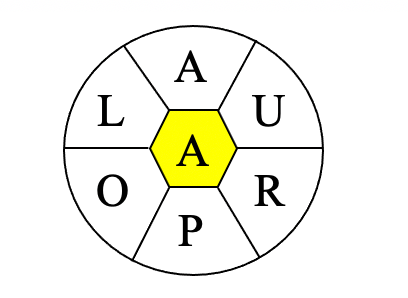
A, L, O, P, R, U, and center N (all words must include N).
Merriam-Webster says…
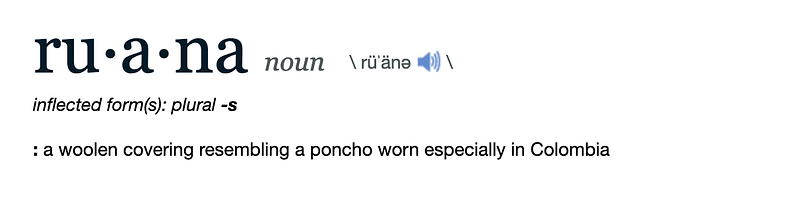
Silly little dictionary! Don’t you know ruana can’t possibly be a word if the New York Times says it ain’t?
For further fascinating facts, check out the Spelling Bee Master.
What’s your favorite dord* from today’s puzzle?
My Two Cents
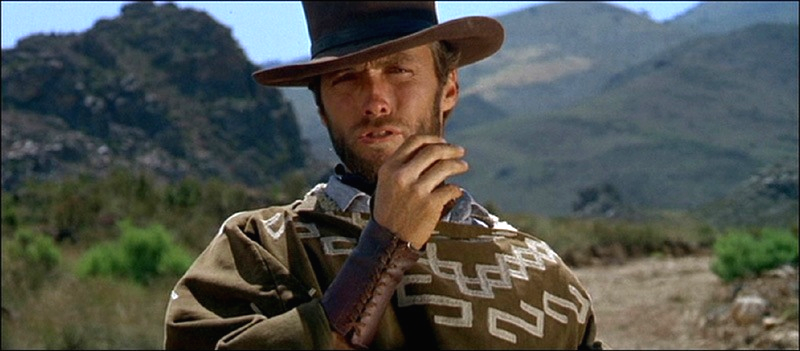
I found a few beautiful and relevant photos on Unsplash, but I just couldn’t resist using the above picture of Clint. (I’m not being rude or casual; he and I have that kind of relationship. I’ve always called him Clint, and he’s always ignored me, like I don’t even exist to him.)
And if your first thought was “Go ahead, make my day”, then I’m extremely disappointed. You’ve got the wrong movie, wrong decade, and wrong country.
That still is from the movie For a Few Dollars More, the middle flick in what is known as the “Dollars trilogy” or “Man with No Name trilogy”. Eastwood plays the man with no name in all three, although he is called “Joe” and “Blondie” by some of the other characters. Despite the fact that the films revolved around Old West themes and were supposed to take place in the American Southwest and Northern Mexico, they were shot mostly in Italy and Spain by Italian directors.
Hence the origin of the term “Spaghetti Western”, also called “Macaroni Western” in Japan.
Perhaps one of the most famous of all the movies in this genre is The Good, the Bad, and the Ugly (the third film of the above-mentioned trilogy). I urge you to watch it if you haven’t already. And if a local movie house near you happens to screen it one day, go check it out on the big screen.
Anyway, in all three films Clint traipses about in a poncho that looks very much like a ruana. Hence my selection of that photo.
And, well… it’s Clint Eastwood.
Local or imported?
Merriam-Webster says the word ruana comes from the same Spanish word meaning “woolen fabric”. The Dictionary of the Royal Acadamy of Language in Spain clarifies that ruana comes from the archaic adjective “ruano”, which referred to a woven wool garment worn to go out. In turn, this came from the Portuguese rúa. In Spanish, rúa means “road” or “town street”.
However, there has been some debate about this.
According to the official agency in charge of international tourism in Colombia, ruana comes from the Chibcha-language word ruana meaning “land of blankets”. This, in reference to the woolen fabrics made by the Muisca, an indigenous people of Colombia. Muisca ruanas were warm enough to protect against the cold temperatures of the region and could also be used as blankets or folded as cushions.
But most Colombian scholars deny this theory. Their explanation is that, although pre-Columbian Muisca peoples wore garments similar to ruanas, the their is no continuity in the the history of those garments that shows them evolving into the modern ruana.
Furthermore, these scholars posit two possible origins. (1) Ruanas were brought over to the Americans by Spaniards who, in turn, got them in Ruan, France. (2) The ruana was introduced after the Spanish conquest by a foreign Quechua population. These indigenous people were brought to Colombia by local Spanish landlords during the early Colonial period.
Wait! So where does that leave the explanation about the Portuguses rúa? Who knows.
In other words, we end up with a conclusion that makes no one happy: “of unknown origin”.
Colombia and Venezuela
In Colombia, the ruana is a popular garment commonly used in the cold climate of the páramo, a variety of alpine tundra ecosystem found in the northern Andes of South America.
The typical ruana of these areas is a traditional hand-crafted product made of 100% virgin sheep wool that is woven on looms. It’s high quality, resistance, and soft texture make it an ideal outwear in that region, especially during the colder months.
In 2001, some clever ruana fans in Colombia created a festival in honor of the traditional garb in the town of Nobsa: World Ruana Day. One of the men responsible for this journalist Wilson Daniel Carreño Laverde, had the idea of covering the town’s church with a giant ruana in 2008. This was actually achieved and earned its makers a place in the Guinness Book of World Records for having woven the planet’s largest ruana.
In the Venezuelan Andes they were used regularly by everyone. For some reason this caught the eye of a German painter and naturalist named Ferdinand Bellermann. He was there between 1842 and 1845 as part of an expedition to South America sent to make scientifically accurate depictions of the plants and landscapes. Back then this meant drawing and painting them, since there were no smartphones or Instagram accounts yet.
At the time, the Venezuelan ruana had two different versions. In the mountains it was handcrafted from animal fabrics to better weather the cold, while residents of the plains made a lighter style to protect themselves from the heat. (Today the ruana has lost its daily use in Venezuela, and is wore mostly only in the upper regions of the Mérida mountain range.)
Here is an illustration Bellermann made.
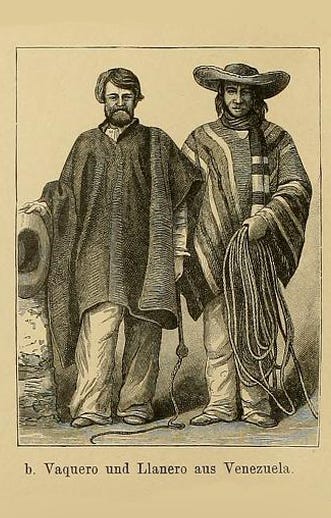
According to Ferdinand, the one on the left is a cowboy, while the guy on the right is a llanero, or herder.
And just in case you were wondering how good this German painter was, here is a small sample of his paintings. First, the German mountain colony near Caracas, called Colonia Tovar.
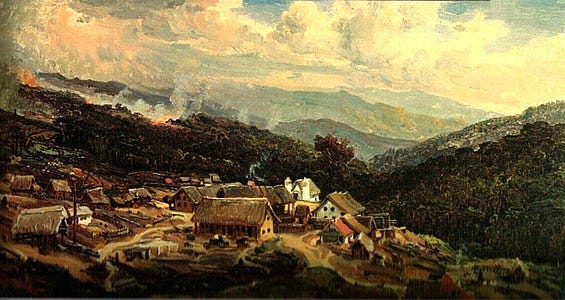
And here is the port city of Puerto Cabello.
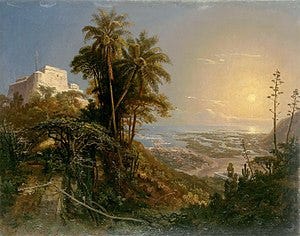
I guess Bellermann earned his pay.
Next time you find yourself cold and shivering somewhere in Colombia, buy yourself a ruana. Just remember to call it a “poncho” when you return home.
Because the editors of the Spelling Bee saw the word ruana and decided that it’s a dord.*
Hmm… maybe if I send Clint Eastwood over to the office of The New York Times, he can convince them otherwise.
Please check out my previous entry on another dord*:
*What the heck is a dord, anyway? Here you go: