
Alba
Parting is such sweet sorrow
Today’s New York Times Spelling Bee letters:
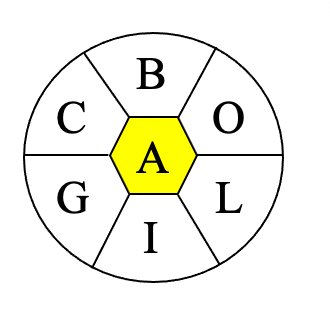
B, C, G, I, L, O, and center A (all words must include A).
Merriam-Webster says…
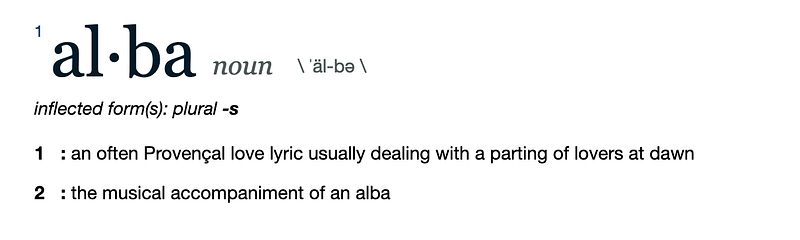
Silly little dictionary! Don’t you know alba can’t possibly be a word if the New York Times says it ain’t?
For further fascinating facts, check out the Spelling Bee Master.
What’s your favorite dord* from today’s puzzle?
My Two Cents
As a Spanish speaker, I’m familiar with the word alba as a reference to “dawn”, “twilight”, and “white”. Also as the last name of a certain actress named Jessica who has been the best Sue Storm ever — go ahead, fight me to the death on that!
I was expecting a similar, although possibly obscure, definition in English, but I was surprised at what the dictionary spit out when I typed in the word.
L’Occitane en Provence (and other places, too)
Okay, alba is poetry. But in order for a poem to be considered an alba, it has to be (1) in the Old Occitan language (2) lyrical [expressing personal emotions, usually in first person] (3) about that longing feeling lovers have at (4) dawn.
Why longing feelings at dawn? Well, the two lovers were usually meeting in secret; she hiding from her husband, he from a jealous rival. And at dawn they had to end the nightly tryst and go their separate ways.
Let’s take, for example, Toto’s classic soft rock hit, “Rosanna”. It covers points 2–4 (I count the lyrics “all I wanna do when I wake up in the morning” as a reference to dawn). However, it’s written in Modern English, and therefore does not qualify as an alba. This despite having a video inspired by West Side Story and winning a Grammy in 1983.
Also, “Rosanna” does not feature a wingman, a typical character in the albas sung by troubadours in the Middle Ages. What? You didn’t know wingmen existed back then? Of course they did! Wingmen have existed since that first insecure caveman needed a buddy to go out and club with a cavewoman. And by club I don’t mean the nighttime social venue.
Back when troubadours troubadded (or whatever it’s called), the wingmen were friends of the lovers who stood guard and alerted them when it was time to stop canoodling. Why the emergence of the sun over the horizon (dawn, remember?) wasn’t enough of a hint is beyond me. The situation sometimes became a rhyming sitcom in which the anxious couple blamed the wingman for falling asleep or separating them before it was time.
As if it wasn’t enough for an alba to have such a specific description, it’s also extremely rare. According to Josef Zemp, who wrote Les poésies du troubadour Cadenet — meaning “The Adventures of Wallie the Wingman”, or so I gather — there are only 18 albas known to exist. And since I couldn’t read the book before this article’s publication deadline, I don’t know if that means only 18 albas were written or if only 18 were found in a chest in Languedoc right before Zemp wrote his fancy-pants book.
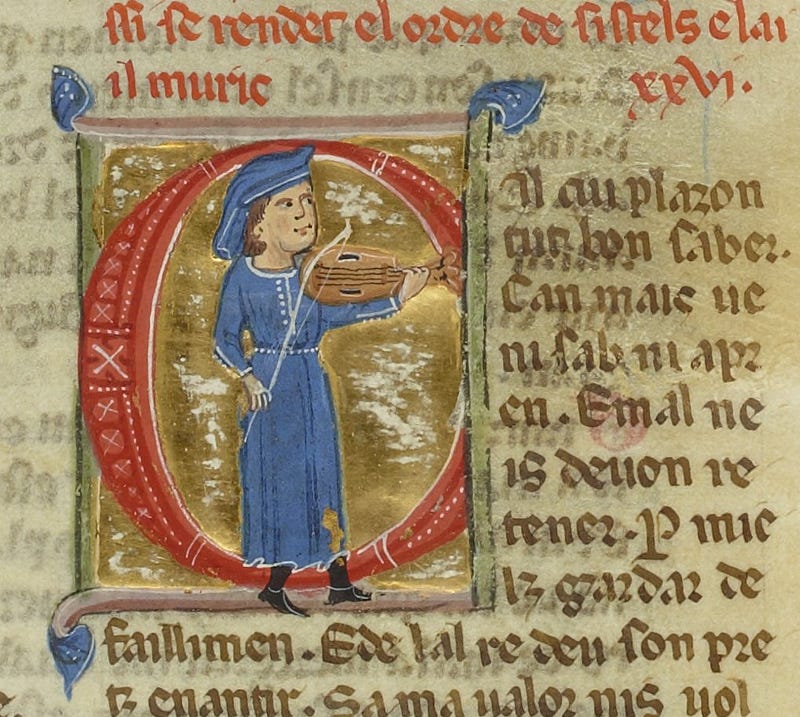
Not to fear, dear reader, I did the hard work of finding five of the eighteen albas for you. Why five? Those were the only working links I found in Wikipedia. However, those five are really cool and interesting to read. Here is Gaita de gaiteta del castel, by Bernart de Venzac.
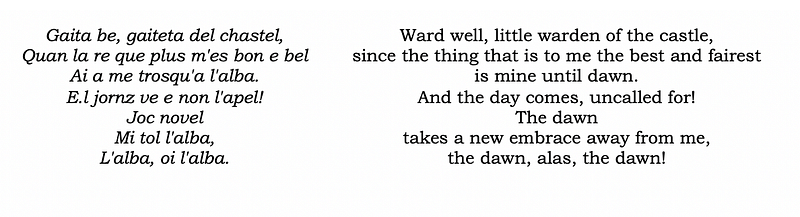
This goes on for another three stanzas, all ending with “the dawn, alas, the dawn!”
The web site that hosts this content even gives you the option to play the original melody (recorded on 8-track by the troubadours themselves) as you read or sing along. Try it with S’anc fui belha ni prezada, by Cadenet:
Guess what the music composed for albas is called. That’s right. Alba. (Good, you were paying attention at the beginning and read the second definition, too.)
White lines
No, I’m not referring to a recreational drug in powdered form snorted in a club. (And this time I do mean the nighttime social venue.)
Another English definition of alba has to do with white lines found on your body. Both are called linea alba. Which means, um, “white line”.
- Dentistry The linea alba is a horizontal streak on the inner surface of the cheek, which can extend from the outer edge where your lips meet to the back of your teeth on either or both sides. It can be caused by pressure, suction or chaw.
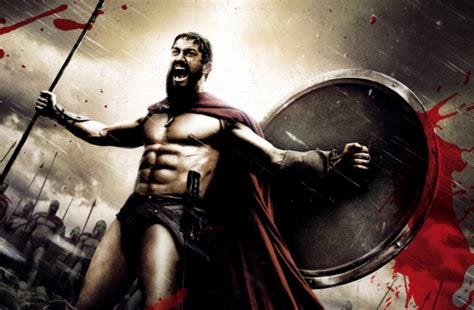
- Medicine The linea alba is a fibrous structure made of collagen that runs down your abdomen, from the point where your breastbone ends to where your groin starts. Picture Gerard Butler’s six pack in 300. That line in the middle is the linea alba.
Here’s a visual aid in case you had a hard time picturing Mr. Butler:
So now you know. If you broke up recently with your significant other and want to win them back, you can stand outside their window and hold a boom box blaring out Toto’s “Rosanna”.
You won’t be able to sing them a bittersweet alba, though. Because the editors of the Spelling Bee decided that alba is a dord.*
Please check out my previous entry on another dord*:
*What the heck is a dord, anyway? Here you go: