Dark Skies at 25
‘Roswell and JFK in an Atom Collider’
Twenty-five years ago, NBC’s landmark alien invasion series Dark Skies linked two of the most speculated events of the century together: the Roswell crash recovery and the JFK assassination.
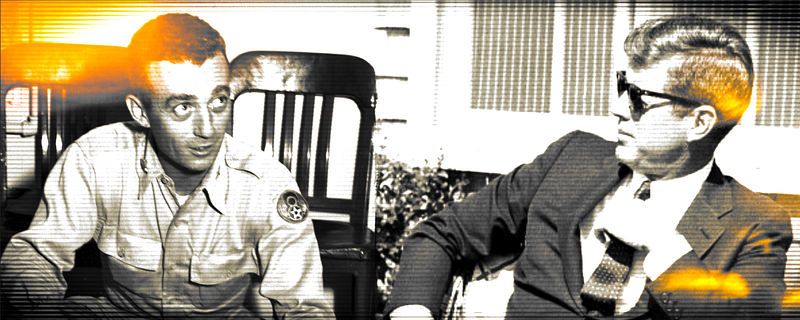
A Mashup of the Two Great American Conspiracies
We know that something crashed outside of Roswell, New Mexico in the summer of 1947. We also know that President John F. Kennedy was assassinated by someone on the streets of Dallas, Texas in 1963.
These two events, separated by sixteen years and hundreds of miles, are easily the most talked-about and speculated events in post World War II American history. Aside from conspiratorial overtones, they otherwise have no connection, at least on the surface. Or do they?
In 1996, a television series airing on the NBC network in primetime tied the two events together. Dark Skies presented an intriguing mix of 1960s nostalgia with a science fiction laced alternate history, mixing in a hefty dose of ufology among its tale of a secret war fought between the forces of the US government’s Majestic and the alien Hive. A quarter-century after its premiere, its linkage of these two events remains one of its most intriguing legacies.
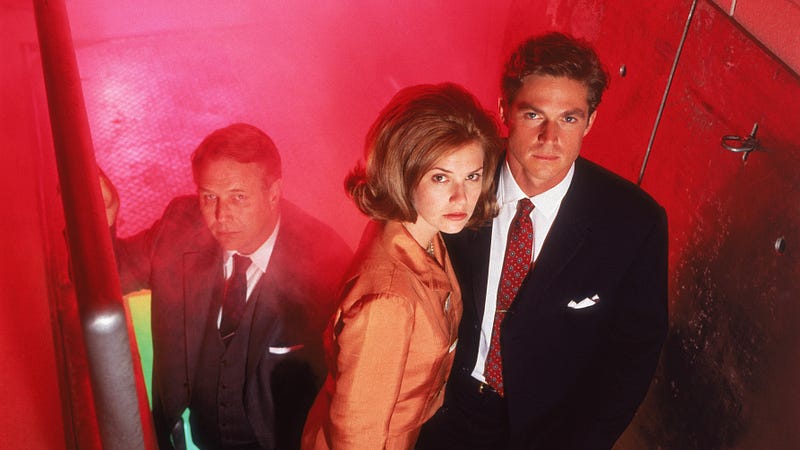
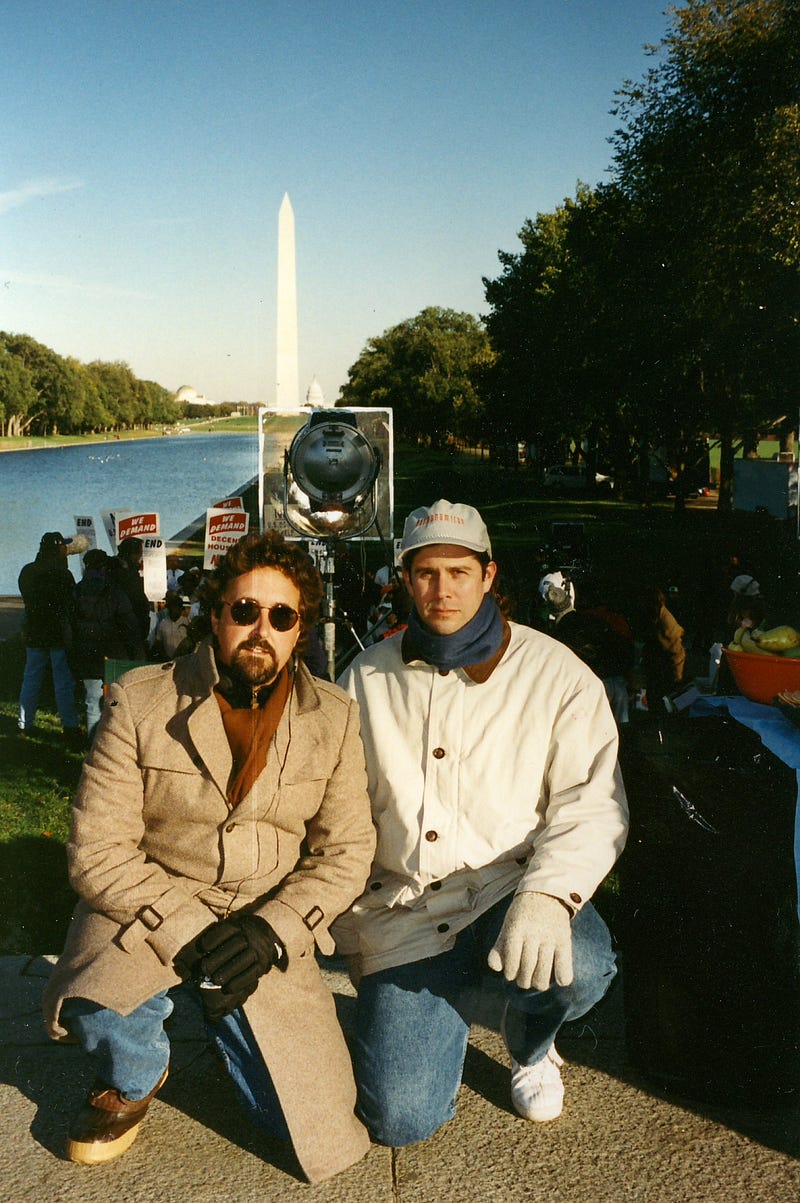
Brent V. Friedman and I chose to set our Dark Skies in the 1960s for a variety of reasons. It was the most colorful, musical, political, and dramatic decade in post-war America. Yet it was more than that:
“Our high concept for the series was to take the two largest conspiracy theories in the world — the JFK assassination and the UFO mystery — put them in an atom collider and fuse them together into the greatest secret that no one had ever heard of.”
This “unified field theory of conspiracy” allowed us to find their central character, John Loengard (Eric Close) — a naive congressional assistant, determined to start his own political career in the light of John Kennedy’s New Frontier. It’s worth remembering that 1961 was the first year of the Kennedy Administration and the first time any Americans had claimed to have been abducted by aliens as happened with the Betty and Barney Hill case.
What emerged from that creative atom collider were the charged particles of crashed saucers and political assassination. As creators, we came to one central conclusion: if Roswell was a true event, one that was the crash and retrieval of an alien craft and bodies, then whatever you thought was going on in the Kennedy years was impacted by it. And, given that JFK met an untimely end from an assassin’s bullet, maybe even his murder had the taint of alien invasion about it.
Roswell Rising
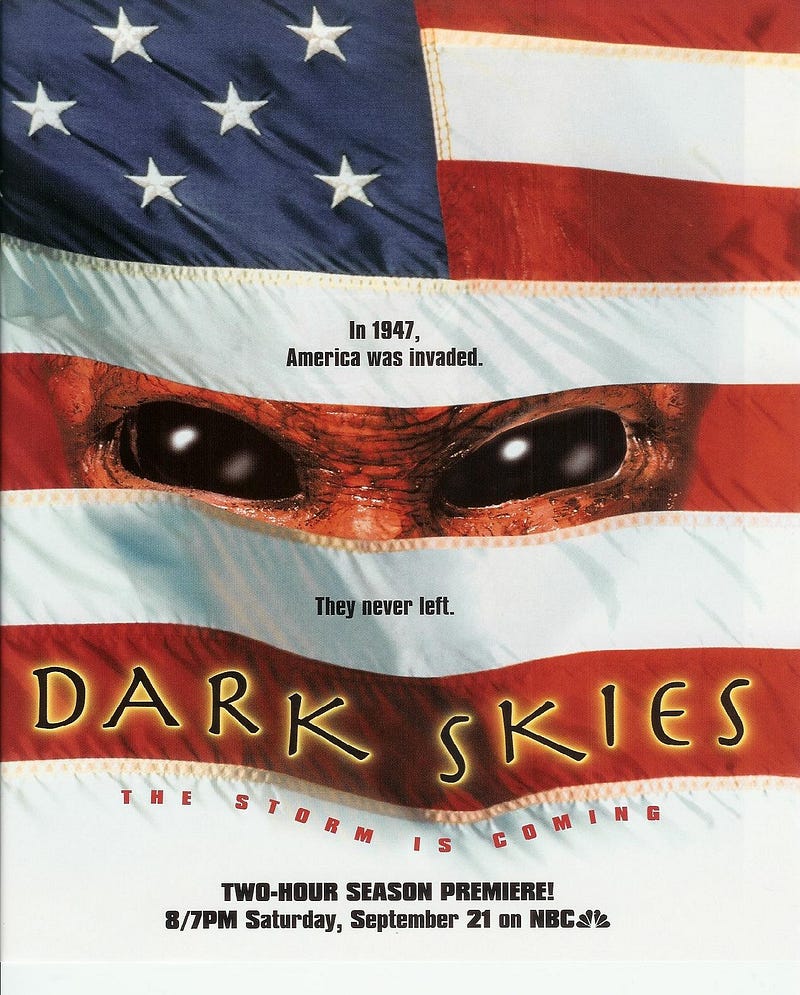
Dark Skies aired as a two-hour premiere on Saturday night, September 21, 1996, as the anchor series for the NBC “Thrillogy” — Dark Skies at 8pm, The Pretender at 9pm, and Profiler at 10pm.
That first episode, “The Awakening,” wove both Roswell and the Kennedy assassination into a twisting DNA strand of conspiracy from its very first moments. John Loengard and his girlfriend Kim Sayers (Megan Ward) arrive in Washington, D.C. ready to take on the world. They’re young, in love, and idealistic to a fault. Kim shows up her upwardly mobile boyfriend when she lands a job working for First Lady Jacqueline Kennedy in the White House.
Loengard, as introduced to viewers, is nothing more than an ambitious coffee collecting grunt in the congressional office of Representative Charles Pratt. The Fresno congressman is looking for budget cuts to propose to show his constituents he’s tight with their money so he sends Loengard out to look into “flying saucers” with an eye toward trimming Project Blue Book out of the budget.
Loengard does his job too well. He digs, burrows, and investigates and rather than bringing back evidence that it’s all a bunch of nonsense, his earnest efforts attract the attention of the Majestic-12 organization run by Navy Captain Frank Bach (J.T. Walsh). This secret group was said to have been created by President Harry S Truman to deal with the Roswell crash back in 1947. Documents discovered (leaked) in 1984 first brought it to light. Fact or fiction, as writer/producers of Dark Skies, Brent and I chose to embrace it in a giant creative bear hug, making it the central nexus of contact between its characters. I had just come off working on ABC’s Lois & Clark followed by showrunning Fox’s M.A.N.T.I.S. superhero series, and had concluded that hour dramas tend to work best when there is a central set to stage your talk scenes. Hence, the Daily Planet lead the way to Majestic.
Majestic’s origin story then was Roswell. All that was necessary to unify the grand conspiracy was to roll in the JFK assassination. The two-hour pilot knows exactly what it’s doing in that regard and scores its dramatic bulls-eye in its final two scenes.
In the beginning of that pilot, after being roughed up by some of Bach’s Men-in-Black, Loengard becomes even more dogged in his research, eventually finding and confronting Bach, “I already know the truth about Roswell.”
Bach laughs at his naivete. “The truth is overrated,” he says, and lights another cigarette.
The Truth is Three Doors Down on the Left
It all gets Loengard a visit to the underground headquarters of Majestic and a scene that is all about Roswell. He sees evidence from the craft and when he wonders if it might be Russian, Bach gets to show him something that, in the hands of director Tobe Hooper, is one of the great surprise moments of the entire series.
Introduced to a body from the Roswell crash, the young staffer finds himself now inside an organization he never planned to join and now can never leave, living a double-life in the process. Loengard becomes a Man-in-Black himself, a Majestic operative dedicated to the fight against the alien Hive.
On one of his first assignments, he goes to the farm of Elliot Grantham, a farmer in Boise, Idaho who’s got a crop circle in his field. Grantham tries to run Loengard over with his truck, but ends up dead himself. An autopsy of the erratic farmer reveals he has a living, twisting alien ganglion resident in his brain.
What makes Grantham, now known as “Patient Zero,” vitally important becomes clear when Bach produces a jar with an identical preserved ganglion in it — from the Roswell crash!
As it turns out, the Grays aren’t the enemy, they were a race like humans that were infected and conquered by the ganglions.
That’s right. It all started at Roswell. All this, and the first night’s episode is only half way done.
The Brothers Kennedy
The other strand in the series DNA comes from both President John Kennedy and his brother, Attorney General Robert Kennedy.
Outside of a brief glimpse in series opener “The Awakening,” JFK himself is never featured directly, though his wife Jackie, appears briefly during the series opener. The pilot and the first episode give the starring role to the President’s brother, Bobby Kennedy (James F. Kelly). It’s a wise choice. Most of us don’t know RFK as well as JFK, and it’s less jarring to see him playing real alternative history scenes in the series.
Kennedy’s trial of fire in the 1962 Cuban Missile Crisis forces Loengard to face the truth that Kennedy doesn’t know about Roswell. The young agent believes the public has a right to know but the leader of the group believes the people can’t handle the truth. And, as far as Frank Bach is concerned, that even includes the President of the United States.
As the pilot episode builds toward its radical and subversive conclusion, John Loengard and Kim Sayers conspire to get the reality of the Hive invasion before President Kennedy. Loengard has a piece of the Roswell wreckage that he’s stolen from Bach. Kim has White House privileges through the First Lady’s office and can get the piece to JFK.
After that, RFK gets a powerful scene with Loengard toward the end of the two-hour pilot when the young Majestic agent comes to visit at Kennedy’s Hickory Hill estate. The Attorney General tells him that they’ve had the Roswell sample analyzed and that it’s genuine, but that President Kennedy can’t do anything publicly until he is elected to a second term in 1964.
Loengard’s betrayal puts he and Sayers on the run from Majestic. He’s broken the code of secrecy that has kept the alien presence under wraps for sixteen years at that point. The punishment for such a crime is death. It’s not Loengard’s death, however, that pivots the series in the last scene of its opening installment.
The first mention of the assassination comes in its final minutes when John and Kim learn the news while staying in a Norman, Oklahoma motel room after being alerted by the manager. She knocks on the door, Loengard expects trouble and gets his gun. What he gets instead are the four words that Americans have come to realize can’t mean anything good: “Turn on your television.”
In a daring move, Dark Skies went there in the final scene of “The Awakening,” its two-hour series launch. In a connection that makes the show one of the most subversive to ever air on commercial television, President John F. Kennedy is assassinated in Dallas because he was going to tell the world the truth about Roswell and how it heralded the arrival the alien Hive in his second term, and was assassinated for that by either the extraterrestrial threat or, possibly, by the secret group formed to fight them.
The Mythology Episode that Almost Wasn’t
“Moving Targets” is the episode that immediately follows the pilot. It’s the most mythological episode of the entire series, and it almost didn’t happen.
Brent Friedman and I had always wanted to move the series progression after the pilot to Dallas, Texas for the next episode, given the white hot insanity and chaos that followed the assassination. We had even written a version of that storyline, an early back-up script known as “Paranoia Strikes Deep.”
Network executives had other ideas. Rather than double-down on conspiracy, Roswell, and the Kennedy assassination, those folks wanted to pay more attention to the Loengard and Sayers relationship. They put out an edict that the second episode should involve the young lovers on the run going to Loengard’s family home in Fresno. Brent and I argued that this would be insane for a man suspected of involvement in the assassination, but the network insisted, and we were forced to reluctantly agree.
That episode, “The Enemy Within,” was written by co-producer Brad Markowitz, and produced. It was a fine episode but it felt completely wrong. After the network suits saw the cut, they freaked out, and in frantic negotiations Brent and I now got what we wanted. It was agreed that a new episode had to be written, but it had to be done over the weekend so it could start pre-production on the following Monday. Thus, “Moving Targets” put Roswell and JFK’s murder in the proverbial atom collider a second time.
“Moving Targets” was where Dark Skies amps up its counter-mythology about the JFK assassination and the theories surrounding the event to an even greater level. The web of conspiracy firmly sharpens its focus inside the 45 minutes that follow, with RFK vowing to take Majestic down if they played a role in his brother’s death. To that end, he directs the young couple to Fort Worth, where on the last night of his life, the President met with someone and entrusted them with the sample of the Roswell debris.
Arriving in Texas, Kim keeps watch outside as John enters a hotel to meet the man in possession of the sample. Under the guise of delivering a newspaper to a hotel room, Loengard utters a phrase to identify himself: “Dark Skies.” The man admits him into the room, revealing himself to be a retired military man. His name? Jesse Marcel (Richard Gilliland).
If the name sounds familiar, you likely know your ufology. Marcel, then a Major in the US Army Air Force, was the intelligence officer sent out from the Roswell Army Air Field to look at the wreckage discovered by rancher Mack Brazel. A man who, mere days later, would pose for an infamous series of photographs with weather balloon wreckage. It is Marcel, as part of a Kennedy initiative to find witnesses to come forward publicly about Majestic and its cover-up, now holds the single piece of wreckage outside of the agency’s possession.
In that Fort Worth hotel room, more than a piece of wreckage passes between the men. Marcel has a story to tell about what happened in July 1947 in Roswell, one that sheds light on not only the events there but the now raging secret war between Majestic and the Hive. What happened, Marcel reveals, was no accidental crash but nothing short of a meeting between a gray and President Harry Truman (Hansford Rowe) gone horribly wrong, with the craft being attacked and brought down as it tried to leave the airspace over the base. The Roswell event was, as we learn, not an accidental case of first contact but the start of hostilities between humanity and the Hive, launching a secret and perhaps unnecessary war continuing into the show’s present day.
Majestic is also on the sample’s trail, showing up just as Loengard and Marcel are leaving. Loengard escapes with Kim as Marcel stays behind as bait for Majestic leaving the pair to investigate Majestic’s involvement in the assassination. Spending time in Dallas, John and Kim learn of the responsibility of both Majestic-turned-Hive operative Jim Steele (Tim Kelleher) and the Hive as a whole in the slaying.
Indeed, the Hive is quickly moving to cover its tracks, recruiting a local nightclub owner named Jack Ruby (Jack Lindine) to silence JFK’s alleged assassin, Lee Harvey Oswald. It’s a tangled web, with the Hive also up to another scheme in the assassination’s aftermath on a grander scale. John and Kim ultimately return to Washington ahead of the late President’s funeral, leading to a struggle over both the truth behind events and for possession of the Roswell sample as the episode builds to its finale centered around the President’s funeral at Arlington National Cemetery.
The struggle between Loengard and Majestic leader Captain Frank Bach (J.T. Walsh) culminates in the Majestic board room, with the younger man thinking he knows all thanks to Marcel. Bach tells him there’s more to the story and reveals the detail that the retired intelligence officer, no longer possessing a need to know, never knew. The gray and Truman communicated at Roswell, with the alien presenting an ultimatum. One which called for nothing short of the “unconditional surrender” of humanity.
“Moving Targets” would, just as much as “The Awakening” the week prior, prove to be a lynchpin episode for Dark Skies as a whole. It deepened the series mythos, creating our “grand unification of conspiracy” in bringing the events in Roswell and Dealey Plaza together in spectacular fashion. It also demonstrated to just what lengths both the Hive and Majestic will go to to keep their war secret. It’s also worth noting that the episode’s finale — filmed five years before 9/11 — features a jet aircraft being used as a weapon against a public gathering.
The Ghosts of Marcel and Kennedy Haunt the Series
From there, the assassination is a specter that haunts the series first half. The Warren Commission, the official US government investigation conducted throughout 1964, receives frequent references to it on TV news coverage as John and Kim travel America. In addition, there are also meetings involving Bach and former CIA director Allen Dulles (Mike Kennedy), who served as a member of the commission despite having been fired from his post by Kennedy in 1961. The episode “We Shall Overcome” features Bach meeting with the other members of the Majestic 12 committee, where despite questioning by the likes of Hubert Humphrey (Don Moss), Bach is less than forthcoming about his knowledge regarding the assassination. It’s a scene with a delicious Easter egg, featuring the late Coast to Coast AM radio host Art Bell playing CBS President William Paley.
At last, Robert Kennedy again summons John and Kim to Washington with John testifying in front of the Warren Commission. John’s testimony, playing out across the mid-season episode cleverly titled “The Warren Omission,” is in many ways the turning point of the series as the younger Kennedy orders a raid on Majestic’s headquarters, literally blowing off the front doors to get inside. Among the items the raid uncovers is a film of the assassination. Once projected, it shows the limousine driver picking up a gun, turning around, firing a shot, and then turning back around before speeding off.
For all his efforts, the younger Kennedy’s efforts to smash the wall of secrecy that doomed his brother are for naught. Besides the complete Zapruder film hidden in the Majestic vaults was another film, this one showing RFK and Marilyn Monroe having an intimate relationship. The Attorney General is blackmailed by Majestic over his affair with Monroe, forcing his hand.
In what Brent and I felt was one of the most emotional scenes of the entire series, Robert Kennedy’s representative speaks to Loengard and Sayers in an alleyway during a driving rainstorm, and tells them that he can no longer bankroll or support their efforts in any way. When he drives away from them, they are truly and totally alone, and, once again, the truth sinks into the shadows. All as Majestic had hoped.
Having written that scene and have seeing it dozens of times, each time it still breaks my heart because we had built Robert Kennedy up to be what looked like the only friend that our leads had in the entire world. When he has his people turn their backs on Loengard and Sayers, halfway through the season, you know what pain they must have felt.
After “The Warren Omission,” RFK would return to the series one final time — for a dramatic wrap to the entire first season and, as it would turn out, to the entire series.
It happens in the Dark Skies series finale, an episode known as “Bloodlines” that features, among other things, Ronald Reagan being targeted by the Hive for abduction, Timothy Leary turning on with John Loengard during the Summer of Love, and a climactic confrontation between Captain Frank Bach and the entire Majestic board that now had a Senator Robert Kennedy as a member.
The younger Kennedy first refuses to vote in a motion to dismiss Bach and throw him out of Majestic. At this point, other board members from Henry Kissinger to Nelson Rockefeller to Hubert Humphrey weigh in pro and con and it’s a 5–5 tie (Bach cannot vote on his own removal).
In a defiant and profoundly satisfying moment, Kennedy invokes the name of his brother and finds some small measure of redemption for himself by finally removing Bach from his leadership position within the agency.
Sadly, “Bloodlines” would prove to the be finale for Dark Skies, but it’s tempting to look at the scene and wonder what the series might have done in a second season that involved his doomed 1968 attempt to become President. Brent Friedman and I clearly intended to come back to the timeline we laid out years before. This would have involved more high strangeness around the shooting in the Ambassador Hotel kitchen and, no doubt, found an alternate explanation for Sirhan Sirhan’s role.
All that can be known at this point is that as the creators of Dark Skies we weren’t done with an alternate view of the Kennedy mystique any more than we were done with the Hive invasion that began at Roswell.
A Vision That Still Resonates
2022 will mark the 75th anniversary of Roswell. 2023 will mark the 60th anniversary of the Kennedy assassination. Clearly, both events will be in the news again as they are trotted out again in retrospectives.
There is even the possibility that Roswell is on the fast track to disclosure. As it stands today, the idea of crash wreckage recovery of UFO vehicles is being touted as the Next Big Thing by New York Times reporters, and even former government insiders like Lue Elizondo, Christopher Mellon, and even former Senate Majority Leader Harry Reid.
The Kennedy assassination is another matter. To most people who have studied it, there seems little doubt that forces conspired to murder JFK. Whether they were the Soviets, our CIA, Castro, the anti-Castro Cubans, organized crime or some other group is the big question. Lee Harvey Oswald looks more and more like what he said he was — a “patsy.”
What is new on the Kennedy case, however, is the revelation made after Dark Skies had been canceled and pulled from the air that JFK had written NASA a letter shortly before his death on the subject of working with the Soviets to accurately report and identify UFOs so that a mistake would not start a nuclear war and end humanity. There have also been revelations and rumors about Marilyn Monroe having been told about UFO secrets by the President.
Still, to think that an American television series, paid for by an establishment broadcast network, would allege in multiple hours of programming that the crash at Roswell was a true event and that it was inextricably tied to the death of a beloved president, well, it takes one’s breath away.
Linking events in the New Mexico desert and in Dallas, Texas, separated by sixteen years, shocks the mind even today.
Throughout its nineteen episodes, did Dark Skies and its alternate history actually lay out a connection that may be a dark truth that will be discovered soon and cause all the history books to be rewritten?
The fact that a TV series that debuted 25 years ago can still seriously spark such a question proves at least one thing. This was no ordinary TV show.
There has been talk, off and on over this past quarter-century, about rebooting the series. To the owners of the Dark Skies property at Sony TV, we have two words. Do it.
After all, JFK isn’t the only political figure assassinated in American history. And, as it’s turning out to be the case, Roswell wasn’t the only crash.
Dark Skies is only available as a four disc DVD set, and not on streaming services. The DVDs contain all episodes, a full-length documentary, features, alternative edits and Easter eggs, produced by Shout Factory and available on their site. Also available on Amazon.
Trail of the Saucers, published by Dark Skies co-creator Bryce Zabel, focuses on UFO/UAP news, history, culture, and analysis. Here are a few related articles from our library —
Trail of the Saucers is edited by writer/producer Bryce Zabel and published by Stellar Productions. Zabel co-hosts the popular new podcast Need to Know with Coulthart and Zabel that can be found on all major platforms.