
Ronin
A swashbuckling start to another week of words
Today’s New York Times Spelling Bee letters:
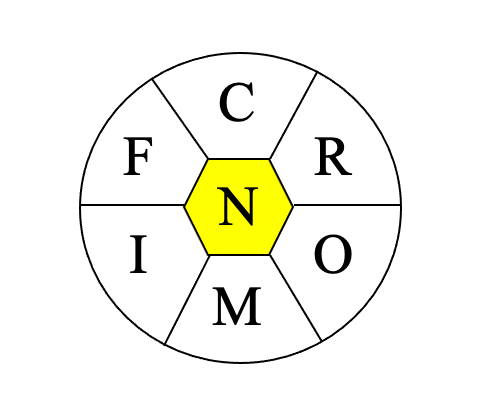
C, F, I, M, O, R, and center N (all words must include N).
Merriam-Webster says…
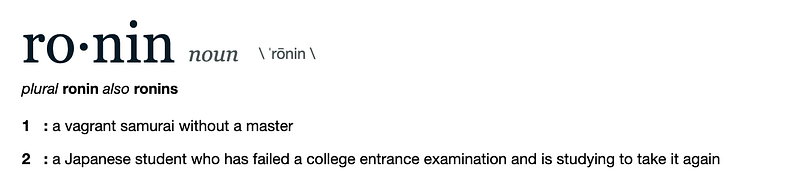
Silly little dictionary! Don’t you know that ronin can’t possibly be a word if the New York Times says it ain’t?
For further fascinating facts, check out the Spelling Bee Master.
What’s your favorite dord* from today’s puzzle?
My Two Cents
You would think a movie called Ronin starring Robert De Niro would be enough to convince the Spelling Bee editors that ronin is a word. Or maybe the fact that charismatic Keanu Reeves made a movie called 47 Ronin would give 47 good reasons to accept ronin as a word. Perhaps the New York Times eschews box office hits (the former) and commercial failures (the latter).
Okay, how about Japanese auteur and film icon Akira Kurosawa? Are his plethora of movies about ronin (including Seven Samurai) still not enough?
I’m the type of guy who will never settle down…
No, Dion was not singing about samurais when he recorded “The Wanderer” in 1961. After all, Ernie Maresca’s lyrics are more about a ladies man who hops from town to town kissing and telling, and less about masterless katana-carrying swordsmen roaming the wilderness of Japan.
The word ronin comes, unsurprisingly, from the Japanese rōnin (浪人), meaning “drifter” or “wanderer”. During Japan’s feudal period, which lasted from the late 12th to the late 19th centuries, the daimyo (feudal lords) hired warriors (bushi), usually military nobles or officers to protect them, their families, and their assets.
If the word bushi seems familiar, you may be thinking of Bushido, aka “the way of the warrior”. Traditionally compared to the knightly concept of chivalry, bushido was a moral code that espoused discipline, frugality, mastery of martial arts, and extreme honor.
The aristocratic bushi were also known as saburau or saburai, translated roughly as “those who serve in close attendance”. Eventually those word became synonymous with all bushi, and the pronunciation of saburai changed to the samurai we use today.
Now, one of the honor codes established in many bushido (there were several over the different feudal periods) was the seppuku, or ritual disembowelment. You may have heard of harakiri; it means the same thing as seppuku — belly-cutting — but the latter is the preferred written form while the former is a term usually reserved for speech.
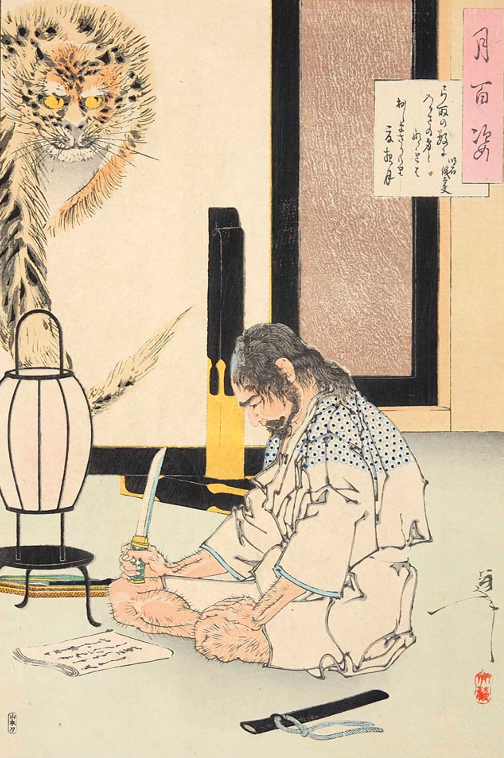
Seppuku was performed by samurai to die with honor and avoid being captured or killed by the enemy, or if they had suffered grave shame. The above illustration is of General Akashi Gidayu as he prepared to carry out seppuku after losing a battle for his master in 1582. The upper right corner shows the death poem which he wrote beforehand.
Seppuku was tough, and not just because you were expected to master the art of Japanese death poetry. You also had to stab yourself with a short sword (tanto) on the left side of the belly, slice over to the right, and then thrust upward. Extra points could be obtained for stabbing the sword again below the breastbone, slicing downwards, and then piercing your throat. All this in front a highly judgmental crowd.
This was also rough on the samurai’s wives… mainly because they were expected to commit ritual suicide, too. I guess “till death us part” was not applicable for samurai marriages.
One of the most famous cases of seppuku was that of the 47 ronin in the early 18th century. (See, we eventually got back to our word of the day, didn’t we?) The 47 samurai were loyal to feudal lord Asano Naganori, who was appointed, along with two other daimyo, to greet imperial envoys sent to what is now Tokyo.
The three feudal lords consulted with Kira Yoshinaka, an expert on the matter, and lavished him with gifts. Well, two of the three did. Apparently Asano didn’t know he had to do so, or was pranked by the others to come without anything. After putting up with Kira’s insults for his failure, Asano had enough and attacked him.
However, he was a failure at that, too. Kira’s shogun ordered Asana to commit seppuku immediately. By most accounts, Asana did not fail at his last assignment. But when news reached his samurai, they were pissed. Mostly because they had just become ronin and… were also expected to commit seppuku.
Oishi Yoshio, the head of the 47 ronin, decided that revenge was indeed a dish best served cold. He and his samurai pals pretended everything was hunky-dory for a year as they meticulously planned their vengeance. On the night of January 30, 1703 — sorry, I don’t know the exact time — Oishi and the other 46 ronin stormed Kira’s mansion and killed him and a bunch of his samurai.
Although Kira’s shogun was impressed (“mad respect” was the term he used, I think) he could not set a precedent by allowing ronin to take the law into their own hands. Can you guess what happened to them? That right! Seppuku.
I found two illustrations of the attack on Kira’s abode:
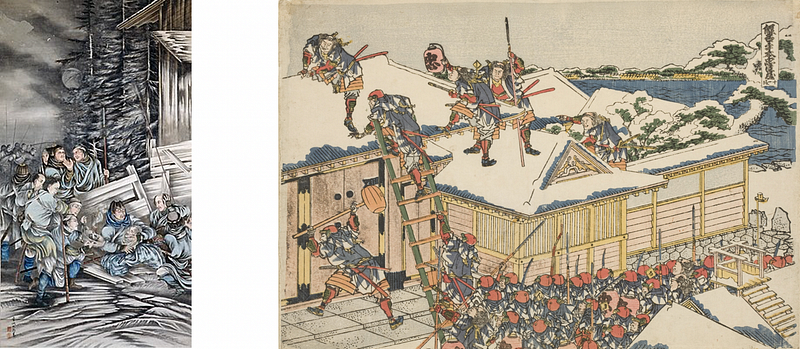
I’m not sure exactly what’s going on in the picture on the left, but the one on the right seems to be an accurate depiction of samurai badassery.
The whole incident shocked Japan and inspired people to believe in the bushido again and respect the samurai. Poems, essays, and stories were written about the 47 ronin. Movies were made… but that happened centuries later. And by the way, the movie actually named 47 Ronin, although based on the incident, does not actually portray the events, mostly because it is a fantasy action film set in a universe of witches and giants.
As I mentioned earlier, Japanese director Akira Kurosawa was well-known for his many movies about samurais, including several that featured ronin. The most famous of these was Seven Samurai, whose worldwide success was immediately remade by Hollywood into a Western called The Magnificent Seven.
Then there’s Robert De Niro’s 1998 international espionage action thriller, Ronin. This movie, directed by John Frankenheimer, was notable for its realistic car chase scenes in France and for being the last time De Niro actually acted for an entire film’s length.
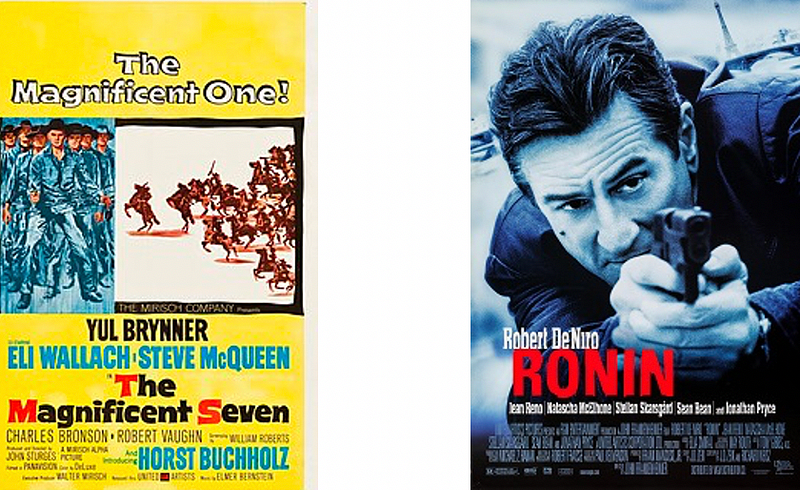
As you can see, Hollywood prefers guns to swords, a trend started by Indiana Jones when Harrison Ford had a bad case of diarrhea.
Now, De Niro’s flick is called Ronin because he plays an ex-CIA mercenary. That’s all I’ll say about this movie, in case you haven’t seen it… or if you did but don’t remember much of the plot. (Who does?)
We’re getting a bit metaphorical now with the meaning of ronin. This brings me to the second definition.
Stu, stu, studious
Ronin is also the word used in Japan to describe high school graduates (and sometimes middle school graduates, too) who have failed to advance to the next level of schooling and must continue studying in order to pass a future entrance exam.
Why ronin? Because they are studying outside the school system. Ronin is actually the slang expression; these students are formally known as kanendosei (過年度生).
So what do these youngsters do while they wait to retake the most important test of their lives? Do they roam about Japan, living stoically and using their swords to help small towns oppressed by evil rich corporations? Of course not! That would be a Hollywood movie, and there would be guns, not swords.
The ronin students attend the Yobiko, privately-run schools that specialize in helping these kids ace their exams. The schools charge a bunch of money, but when their students pass, they get to do this:
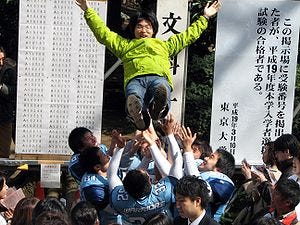
So it’s all worth it in the end. Wait a second… look at this:
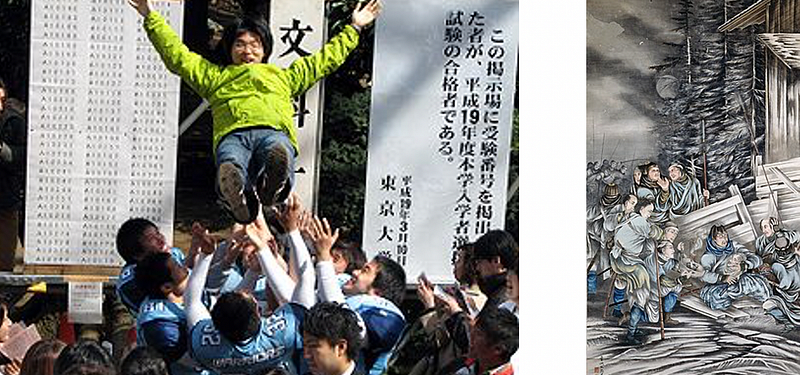
So that’s what those 47 ronin were doing! Mystery solved.
Today the term ronin can be used to designate any person who becomes a free spirit or a mercenary in their profession. For example, I have a good friend who is a sci-fi writer trapped in the body of a ronin lawyer. With no firm to call his own, by day he roams the rough-and-tumble world of corporate law, offering his legal acumen to the highest bidder. By night, however, he whips out his sword, er… pen, and writes amazing short stories about a race of aliens who face an eternal curse of unrequited love towards humans:
And that brings me to my coaching advice for you today: be the ronin of your own universe. I know that doesn’t make much sense, but neither does most life coaching advice. (Shhhh! Don’t tell that to Medium readers, though.)
As usual, I can’t finish without mentioning the editors of the Spelling Bee puzzle. Because despite overwhelming evidence that ronin is a word, they still decided that it’s a dord.*
You can check out my previous entry on another dord* here:
*What the heck is a dord, you ask? Here’s the answer: