
Romal
The Spelling Bee reined in its enthusiasm about this word

Today’s New York Times Spelling Bee letters:

A, J, L, O, R, Y, and center M (all words must include M)
Merriam-Webster says…

Silly little dictionary! Don’t you know that romal can’t possibly be a word if the New York Times says it ain’t?
For further fascinating facts, check out the Spelling Bee Master.
What’s your favorite dord* from today’s puzzle?
My Two Cents
When I play the Spelling Bee game, I always try out random letter combinations to see if I get lucky. Sometimes I do (attaint was one, years ago) and thus find a word that is accepted and add points to my score. Sometimes I type in a string of letters that get rejected, but my Spidey Sense tells me something is off. So I look up the term in the dictionary and discover that it is a word!
That’s exactly what happened with today’s daily dord*.
Whoa, nellie!
Romal was borrowed and modified from the Spanish ramal, meaning “strand of rope”, which itself may have come from rama, meaning “branch”. The romal itself is an attachment of the reins, but when connected, the whole shebang is referred to as “romal reins”.
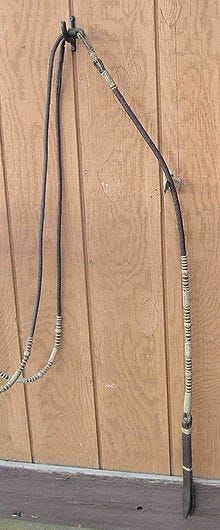
In the above photo, the reins are on the left side and the romal is the part on the right that begins just after the top, where the hook holding the reins is. In the next photo it’s easier to see where the romal joins the reins (at the right).

Romals were introduced to the United States in the 18th century courtesy of the vaqueros — which makes sense, considering the word’s Spanish-language origin. The vaqueros would roam in from the northern part of Mexico to raise their cattle in what is now a big part of the American West and Southwest.
The romal rein was practical to use with their well-trained horses, requiring very little movement to direct the animal. As Dennis Moreland in dmtack.com explains:
The late Luis Ortega, renowned braider of rawhide equipment is quoted as saying that “during my buckaroo days (early 1900s) the romal was often made to correspond with the owner’s waist size, so that when roping extensively, it could be removed from the rein and fastened around the rider’s waist, out of the way”.
The leather piece at the end of the romal is called a popper, although sometimes quirts (small whips) were attached, too. This was used for training horses and also when herding cattle.
Today romals are mostly used by riders in horse events and competitions. If you want to enter, please keep this very important rule in mind: “The non-rein hand must be on the romal (the keeper, or hobble, that attaches to the romal is considered to be part of the romal). The non-rein hand is not allowed, at any time, to touch the reins or a score of -0- will be applied.”
Don’t say I didn’t warn you.
Dennis sells romals on his web site, and they are beautiful works of craftsmanship… and shockingly expensive.
Whoa, intern!
Quirts, or riding crops, are called fustas in Spanish. How do I know this? Well, mostly because I grew up in Venezuela (where Spanish is spoken). The word fusta makes me think of two things:
(1) This Venezuelan horse-racing magazine, which gives gamblers tips about a given week’s races.

Horse racing was a big thing when I was growing up there in the 1970s and 1980s. My dad was not one to go all the way to the track and spend the day there placing bets, but he did like to play something called 5 y 6 on weekends. You filled out a form and had to pick a winner in each of six races to be held on Sunday. If you picked correctly in at least five of the six races, you got a share of the pot.
Picking all six winners could sometimes net you hundreds of thousands of bolivars back then — sometimes a million! And because the bolivar was a strong currency (a dollar was only four bolivars) and it was the 1970s… that was a ton of money. It depended on how many people played and if anyone had won the week before. Sort of like the lottery.
In each race there were usually twelve horses to pick from, and every pick cost a measly single bolivar. But there was a catch. You multiplied the picks to find out how much you had to pay. The minimum was 4 bolivars, which meant that in at least two races you had to pick two horses (2 x 2). And that was usually the amount my dad played. Sometimes, when he was feeling lucky, he would play a total of 8 or 16 bolivars.
Here is a photo of a very old form, filled out, with the total in the lower right corner.
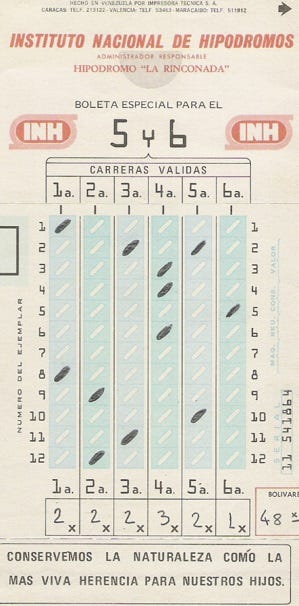
Now, in order to game the system, you’d have to pick all twelve horses in all six races. That meant investing 12 x 12 x 12 x 12 x 12 x 12 bolivars, or almost 3 million. In those days the pot rarely reached that amount, so even if you had that kind of money, it made no sense to risk it. Also, despite the fact you betting on all the horses guaranteed that you’d get all six winners, there was always the possibility that someone else had won, too. Then you’d have to split the pot with that person, meaning the return on your 3-million-bolivar investment would be half of what you had calculated.
The places where one filled in the forms and paid were known as “sellados” (because your form would get officially stamped). I have fond memories of being a little kid and going with my dad to our neighborhood sellado on Sunday mornings so he could place his weekly bet and dream big. Sometimes he would let me fill out my own form, always the minimum of 4 bolivars. That was a bid deal to me.
Our sellado was frequented by a Venezuelan actor who had a comedy show on television, so sometimes I’d get a glimpse of him and one of his pals sitting at a table, discussing which horses to pick. He would fill out stacks of forms and spend hundreds or even thousands of bolivars.
I never picked 5 or 6 winners, but my dad picked 5 on two different occasions. I think one of the times the pot was pretty decent for those who had picked 5.
The word fusta also reminds me of:
(2) Being an intern in my final year of med school at a small hospital outside Caracas. We spent ten weeks in five rotations: internal medicine, surgery, pediatrics, ob-gyn, and an outpatient clinic in the same small city/big town where the hospital was located.
The chief of internal medicine was in charge of us interns, and also in charge of the internal medicine department, obviously. He was a tall, skinny guy with a sharp mind and an even sharper tongue.
And he liked to walk around with a fusta in one hand.
We were never sure what the point of carrying a riding crop was. But that didn’t matter. It worked. It spread rumors and kept us in line. Not that we needed anyone with a fusta to do that. Our fear of screwing up as we saw and treated patients for the first time — under the supervision of residents and attendings, of course — was enough to frighten the crap out of us.
We were too scared and too tired to even consider screwing around.
Still, that chief of internal medicine (I can’t for the life of me remember his name) would stroll around the hospital, slapping the palm of one hand with his fusta, staring at us as though he might at any moment whip it across our faces if we made a mistake during a procedure or gave the wrong answer to a question a resident had asked.
Fond memories of that year, too, despite that man and other weird things that happened… which I may write about someday. So keep reading Silly Little Dictionary!
Well, we’ve reached the end of today’s column, so I will rant as I usually do. What about? Well, the fact that the editors of the Spelling Bee decided that the word romal is a dord.*
You can check out my previous entry on another dord* here:
*What the heck is a dord, you ask? Here’s the answer: