avatarAvi Kotzer

Free AI web copilot to create summaries, insights and extended knowledge, download it at here

4240

Abstract

"https://www.learnenglish.de/jokes/joke64.html">old joke</a>.</p><p id="534b">While in Japan they pick their <i>milt</i> from, among others, cod, salmon, and squid, Sicilians prefer their fish sperm to come — bad pun not intended — from tuna. Over there it’s known as <i>lattume</i>, and is considered a rate treat of hoity-toity gastronomy. It’s usually sprinkled on pasta, used as salad dressing, or eaten directly, fried. That last scenario is probably not as hoity-toity as the first two.</p><p id="b27f">Russians loved pickled herring, so why not pickle the herrings pickles, so to speak. And they do. Herring (or other fish) <i>milt</i> can also be fried or boiled after having been dumped in flour. It’s also minced in fish pies with semolina and onions.</p><p id="b7d1">After reading all this, you are probably <b>not</b> asking yourself “How is milt obtained for <b>artificial insemination</b>?” But I’ll tell you anyway. You can get yourself some milt from naturally mature male fish or not-so-mature fish that have had hormones injected into the pituitary gland. The <i>milt</i> is then… umm, milked, by lightly pressing on the fish’s abdomen.</p><p id="2606">In Russian, milt is called Моло́ки / моло́ка, or <i>moloka</i>. Which brings me to…</p><h2 id="70bf">What’s it going to be then, eh?</h2><p id="4f19">The above is the actual first sentence of the novel <i>A Clockwork Orange</i>, written by English author and composer Anthony Burgess and published in 1962. Most people who have read the novel or watched the Kubrick film may instead remember this as the beginning:</p><p id="35e7" type="7">“There was me, that is Alex, and my three droogs, that is Pete, Georgie, and Dim, Dim being really dim, and we sat in the Korova Milkbar making up our rassoodocks what to do with the evening, a flip dark chill winter bastard though dry.”</p><figure id="aff2"><img src="https://cdn-images-1.readmedium.com/v2/resize:fit:800/0*pMylNTpDVgMMCQll.jpg"><figcaption>Credit: wikipedia.com</figcaption></figure><p id="1349">And even those who have read the novel probably don’t remember the above book cover or any other book cover as much as they might remember this.</p><figure id="261d"><img src="https://cdn-images-1.readmedium.com/v2/resize:fit:800/0*usjnPFAVIU-p343z.png"><figcaption><b>Please! No more cute cat videos!</b></figcaption></figure><p id="1668">Burgess lived to repudiate his book, which he claimed was written in three weeks to make a quick buck — or pound — as the case may be, but it has since consistently made the lists of best novels.</p><p id="6c41">The basic story is that of Alex, the main character, and his gang of teenage friends who live in a dystopian future plagued with crime, referred to in the novel as <b>ultra-violence</b>. Ultra-violence that they just love to commit.</p><p id="e8fb">Spoilers coming up, so skip the next couple of paragraphs if you wish. The novel is divided into three parts, with seven chapters in each one. The first part concerns Alex and his gang of psychopaths as they rob, beat, murder, and rape people. the second part describes Alex’s forced rehabilitation through behavior modification via aversion therapy. The final part focuses on Alex’s return to society, including a final chapter showing him thinking about giving up his baser urges and becoming a productive member of society.</p><p id="9421">Andy Warhol’s 1965 film, <a href="https://www.moma.org/calendar/events/3643"><i>Vinyl</i></a>, was based on the novel, but Stanley Kubrick’s 1971 movie is the most famous version of the book. Except Kubrick had read the American edition that, for marketing reasons, was missing the last chapter… which is why the film has a much different ending than Burgess’s original story.</p><p id="b4ae"><i>A Clockwork Orange </i>is one of my favorite novels, not because of its content or possible interpretations about society and free will — although those are good reasons, too. What I like the most is how Burgess tricks the reader. The novel is told in first person by Alex as a very unreliable narrator. And he speaks heavily in the <a href="https://soomka.com/nadsat.html"><b>Nadsat</b></a> slang that the author created for the book. Most of the vocabulary is influenced b

Options

y the Russian language, but the point is that you have to learn this slang as you read the novel. Burgess does a fantastic job of providing enough context and usage to help you along, and by the end of the story you’re quite fluent.</p><p id="189c">And therein lies the rub.</p><p id="6606">By learning the lingo, you become part of Alex’s gang; the invented language helps you form a more intimate and personal connection with this sociopath teen. This serves two functions: (1) it keeps you invested as a reader and keeps you turning the pages despite the horrific things you are reading about and (2) it makes Alex more sympathetic as a protagonist, turning him into an antihero of sorts.</p><p id="5124">Earlier, right below the title, I asked how fish sperm is connected to a clockwork orange. Here’s my answer.</p><p id="7f69">As I mentioned before, the Russian word for <i>milt</i> is <b>moloka</b>, which is akin to the word for milk, <b>moloko</b>. And in Burgess’s novel, Alex and his buddies love to drink the spiked <b>moloko </b>that stimulates their ultra-violence urges. Here is an example from the very beginning of the novel:</p><blockquote id="7528"><p>The Korova Milkbar was a milk-plus mesto, and you may, O my brothers, have forgotten what these mestos were like, things changing so skorry these days and everybody very quick to forget, newspapers not being read much neither. Well, what they sold there was milk plus something else. They had no licence for selling liquor, but there was no law yet against prodding some of the new veshches which they used to put into the old <b>moloko</b>, so you could peet it with vellocet or synthemesc or drencrom or one or two other veshches which would give you a nice quiet horrorshow fifteen minutes admiring Bog And All His Holy Angels and Saints in your left shoe with lights bursting all over your mozg.</p></blockquote><p id="f0b0">The above passage also gives you a very good idea of the slang crafted by the author.</p><p id="feca">There. I promised… and delivered.</p><p id="eab9">You’re thinking I could have just written a single paragraph (or maybe two) about that at the very beginning. But then you wouldn’t have scrolled down — slowly, I hope — to read the rest of the article and help me earn $0.13 for today’s effort.</p><p id="2e54">So, my dear <i>devotchka</i> or <i>malchick</i>, I just want to <i>skazat</i> thank you for reading my <i>raskazz</i> and helping me make some <i>pretty polly</i>.</p><p id="cec1">However, despite the fact that <i>milt</i> has likely appeared in the New York Times restaurant review pages and is connected via Russian neoslang to one of the best novels of the 20th century, the editors of the Spelling Bee decided that <i>milt</i> is<i> </i>a <a href="https://www.merriam-webster.com/words-at-play/dord-a-ghost-word"><b>dord</b></a><b>.</b></p><p id="8fbb">You can check out my previous entry on another <b>dord </b>here:</p><div id="bdba" class="link-block"> <a href="https://readmedium.com/infanta-9615145a12b6"> <div> <div> <h2>Infanta</h2> <div><h3>Rejecting this word was a childish act by the New York Times</h3></div> <div><p>medium.com</p></div> </div> <div> <div style="background-image: url(https://miro.readmedium.com/v2/resize:fit:320/1*o-3BwTJdnLRbekcQflAnIw.png)"></div> </div> </div> </a> </div><p id="e3c6">*What the heck is a <b>dord, </b>you ask? Here’s the answer:</p><div id="9585" class="link-block"> <a href="https://www.merriam-webster.com/words-at-play/dord-a-ghost-word"> <div> <div> <h2>'Dord': A Ghost Word</h2> <div><h3>One of the questions people like to ask lexicographers is this: Can you sneak something into the dictionary? Can you…</h3></div> <div><p>www.merriam-webster.com</p></div> </div> <div> <div style="background-image: url(https://miro.readmedium.com/v2/resize:fit:320/0*ELbCYAQppV1cuXpD)"></div> </div> </div> </a> </div></article></body>

Milt

How is fish sperm connected to A Clockwork Orange? Read on!

Image by Mario AGF from Pixabay

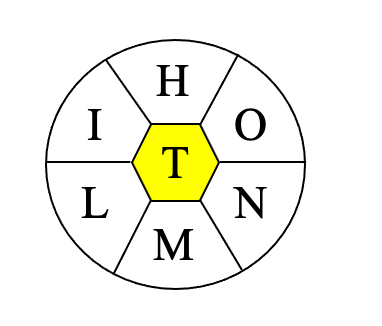
Today’s New York Times Spelling Bee letters:
Art: Iva Reztok

H, I, L, M, N, O, and center T (all words must include T)

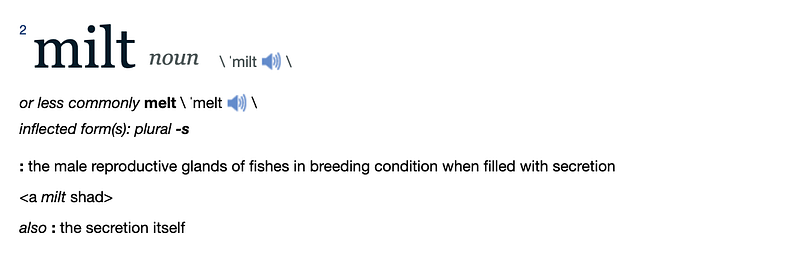
Merriam-Webster says…
Credit: merriam-webster.com

Silly little dictionary! Don’t you know that milt can’t possibly be a word if the New York Times says it ain’t?

For further fascinating facts, check out the Spelling Bee Master.

What’s your favorite dord* from today’s puzzle?

My Two Cents

The likely origin of the word milt, according to the dictionary, is the Old English milte meaning “spleen”. This word, in turn, came from the Old High German miltzi with the same meaning. What does a spleen have to do with fish sperm? I have no idea, but that’s never stopped me from throwing out a theory.

Fish sperm is stored in sacs, which would be the piscine equivalent of human testicles. It’s likely possible that whoever gave that organ the name milt either (1) thought it was the spleen or (2) thought it looked very much like the spleen, but the term “spleen” was taken already… for the spleen.

The word milt is used not only to refer to the glands and the secretion, but also as a verb to describe the act of spraying the secretion onto the roe, or fish eggs. So if you’re a fish breeder, this is a subject that interests you very much. Maybe less so if you’re just interested in eating fish.

And yet… there are those who consider milt a delicacy.

As Jessica Thompson explains in her article on 10best.com:

“The fish sperm (or milt) is extracted in its entirety from the fish, and looks like the result of a human lobotomy. Depending on the level of seminal fluid contained in the sac, the color ranges from translucent and whitish with a pink hue to opaque and white as snow, hence shirako being represented by kanji characters meaning “white children.”

In what sounds like a twisted chauvinistic joke — but is, in fact, entirely real — it’s believed to be good for the skin and have anti-aging properties, with high levels of protein, and vitamins B12 and D.”

Photo courtesy of iStock / Love, via https://www.10best.com

I tried sheep testicles once, years ago, and I’ve heard of bull testicles being served in Spain (called criadillas), but today I discovered the wonderful world of fish balls. The literal ones — like in the above photo — not the G-rated ones made by rolling cod flakes into a sphere and deep-frying them.

And speaking of bull testicles, I’m reminded of that old joke.

While in Japan they pick their milt from, among others, cod, salmon, and squid, Sicilians prefer their fish sperm to come — bad pun not intended — from tuna. Over there it’s known as lattume, and is considered a rate treat of hoity-toity gastronomy. It’s usually sprinkled on pasta, used as salad dressing, or eaten directly, fried. That last scenario is probably not as hoity-toity as the first two.

Russians loved pickled herring, so why not pickle the herrings pickles, so to speak. And they do. Herring (or other fish) milt can also be fried or boiled after having been dumped in flour. It’s also minced in fish pies with semolina and onions.

After reading all this, you are probably not asking yourself “How is milt obtained for artificial insemination?” But I’ll tell you anyway. You can get yourself some milt from naturally mature male fish or not-so-mature fish that have had hormones injected into the pituitary gland. The milt is then… umm, milked, by lightly pressing on the fish’s abdomen.

In Russian, milt is called Моло́ки / моло́ка, or moloka. Which brings me to…

What’s it going to be then, eh?

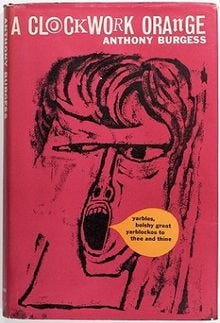
The above is the actual first sentence of the novel A Clockwork Orange, written by English author and composer Anthony Burgess and published in 1962. Most people who have read the novel or watched the Kubrick film may instead remember this as the beginning:

“There was me, that is Alex, and my three droogs, that is Pete, Georgie, and Dim, Dim being really dim, and we sat in the Korova Milkbar making up our rassoodocks what to do with the evening, a flip dark chill winter bastard though dry.”
Credit: wikipedia.com

And even those who have read the novel probably don’t remember the above book cover or any other book cover as much as they might remember this.

Please! No more cute cat videos!

Burgess lived to repudiate his book, which he claimed was written in three weeks to make a quick buck — or pound — as the case may be, but it has since consistently made the lists of best novels.

The basic story is that of Alex, the main character, and his gang of teenage friends who live in a dystopian future plagued with crime, referred to in the novel as ultra-violence. Ultra-violence that they just love to commit.

Spoilers coming up, so skip the next couple of paragraphs if you wish. The novel is divided into three parts, with seven chapters in each one. The first part concerns Alex and his gang of psychopaths as they rob, beat, murder, and rape people. the second part describes Alex’s forced rehabilitation through behavior modification via aversion therapy. The final part focuses on Alex’s return to society, including a final chapter showing him thinking about giving up his baser urges and becoming a productive member of society.

Andy Warhol’s 1965 film, Vinyl, was based on the novel, but Stanley Kubrick’s 1971 movie is the most famous version of the book. Except Kubrick had read the American edition that, for marketing reasons, was missing the last chapter… which is why the film has a much different ending than Burgess’s original story.

A Clockwork Orange is one of my favorite novels, not because of its content or possible interpretations about society and free will — although those are good reasons, too. What I like the most is how Burgess tricks the reader. The novel is told in first person by Alex as a very unreliable narrator. And he speaks heavily in the Nadsat slang that the author created for the book. Most of the vocabulary is influenced by the Russian language, but the point is that you have to learn this slang as you read the novel. Burgess does a fantastic job of providing enough context and usage to help you along, and by the end of the story you’re quite fluent.

And therein lies the rub.

By learning the lingo, you become part of Alex’s gang; the invented language helps you form a more intimate and personal connection with this sociopath teen. This serves two functions: (1) it keeps you invested as a reader and keeps you turning the pages despite the horrific things you are reading about and (2) it makes Alex more sympathetic as a protagonist, turning him into an antihero of sorts.

Earlier, right below the title, I asked how fish sperm is connected to a clockwork orange. Here’s my answer.

As I mentioned before, the Russian word for milt is moloka, which is akin to the word for milk, moloko. And in Burgess’s novel, Alex and his buddies love to drink the spiked moloko that stimulates their ultra-violence urges. Here is an example from the very beginning of the novel:

The Korova Milkbar was a milk-plus mesto, and you may, O my brothers, have forgotten what these mestos were like, things changing so skorry these days and everybody very quick to forget, newspapers not being read much neither. Well, what they sold there was milk plus something else. They had no licence for selling liquor, but there was no law yet against prodding some of the new veshches which they used to put into the old moloko, so you could peet it with vellocet or synthemesc or drencrom or one or two other veshches which would give you a nice quiet horrorshow fifteen minutes admiring Bog And All His Holy Angels and Saints in your left shoe with lights bursting all over your mozg.

The above passage also gives you a very good idea of the slang crafted by the author.

There. I promised… and delivered.

You’re thinking I could have just written a single paragraph (or maybe two) about that at the very beginning. But then you wouldn’t have scrolled down — slowly, I hope — to read the rest of the article and help me earn $0.13 for today’s effort.

So, my dear devotchka or malchick, I just want to skazat thank you for reading my raskazz and helping me make some pretty polly.

However, despite the fact that milt has likely appeared in the New York Times restaurant review pages and is connected via Russian neoslang to one of the best novels of the 20th century, the editors of the Spelling Bee decided that milt is a dord.*

You can check out my previous entry on another dord* here:

*What the heck is a dord, you ask? Here’s the answer:

Spelling Bee
Language
Film
Books
Food
Recommended from ReadMedium