
Infanta
Rejecting this word was a childish act by the New York Times
Today’s New York Times Spelling Bee letters:
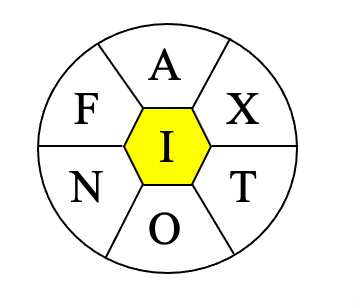
A, F, N, O, T, X, and center I (all words must include I)
Merriam-Webster says…

Silly little dictionary! Don’t you know that infanta can’t possibly be a word if the New York Times says it ain’t?
For further fascinating facts, check out the Spelling Bee Master.
What’s your favorite dord* from today’s puzzle?
My Two Cents
What is the justification for rejecting the word infanta? Could it be because it’s a borrowed Spanish word that’s very specific in meaning and is not used often?
Well, then, what should I make of parador, a borrowed Spanish word that’s very specific in meaning and is not used often… but is a valid word in the Spelling Bee puzzle?

Who knows what evil lurks in the hearts of the Spelling Bee editors? I certainly don’t. [Cue a winking emoji with tongue sticking out so that the editors of the New York Times understand I’m teasing.]
Ladies-in-waiting
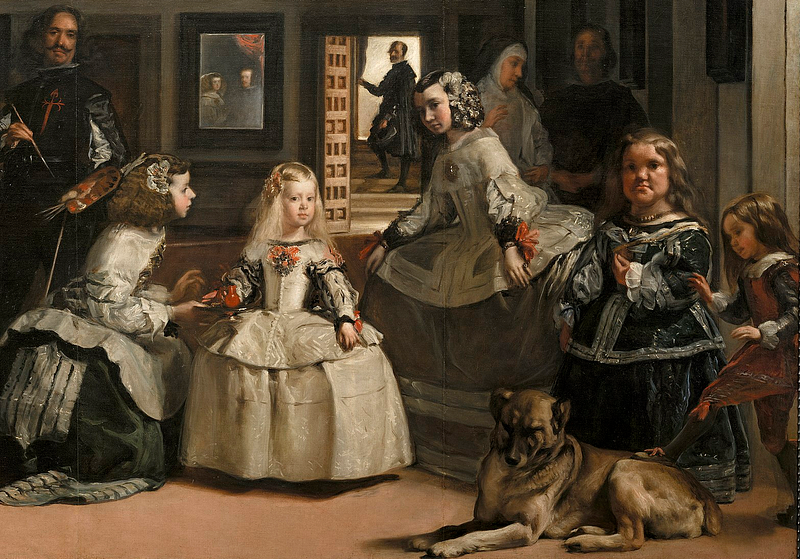
The photo at the top of the article is cropped from a famous painting by Spaniard Diego Velázquez. Las meninas was completed in 1656 as part of Velázquez’s portrait duties to the family of King Philip IV. Here is the masterpiece in its entirety.
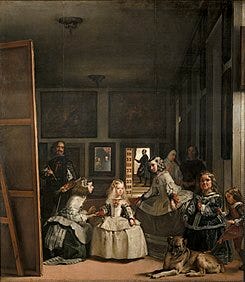
A menina was a girl from the nobility entrusted with serving the Queen or her children at the palace. A hired maidservant of sorts… or perhaps a life-size, lifelike toy, if your point of view was the spoiled son or daughter of a king.
Which brings us to the infanta in the painting, Margaret Theresa of Spain. Not that I have a clue whether she was spoiled or not. Her short life (she died at age 21) was mostly concerned with being married off to satisfy the geopolitics of her times.
At age eleven the infanta was betrothed to Archduke Leopold Ignaz, also known as Leopold I, Holy Roman Emperor and king of a handful of countries. Three years later she married him by proxy (he was too busy to show up), and finally managed to meet her husband in person for the first time seven months after the wedding. What an inspiring and romantic story, right?
Oh, by the way, I forgot to mention this charming detail: Margaret Theresa was King Leopold’s maternal niece and paternal cousin. Despite their incestuous pairing, their age difference, and the fact that her husband looked more like a toad than a prince, they seemed to get along well and had four children.
Then poor Marge dropped dead at the age of 21. Leopold married two more times and had twelve more children. Out of the sixteen kids he had in total with three different wives, only half made it past age 16.
But before her short, convoluted life adulthood, the infanta Margaret had a blessed and fun childhood at her parent’s royal fortress, eating candy and playing with her many meninas. Two of them are in the painting, on either side of the infanta.
The original can be viewed at Madrid’s Museo del Prado in its 12- by 8- foot glory. Interestingly, the people in the painting occupy the bottom half, leaving a lot of apparent “dead space” above them. This was all part of masterful Velázquez’s master plan of composition, which has been analyzed and re-analyzed for centuries. Here is one thorough explanation:
If you handle Spanish pretty well, you can read El Prado’s own explanation here.
The word infanta is still used today in Spain. Although its Latin root is the same as the one for “infant”, in Spanish and Portuguese the meaning extends to childhood. The terms infanta and infante (the male counterpart in Spanish) refer to children descended legitimately from a royal sovereign; in Spain, however, the king or queen may confer this title upon anyone else. For example, the spouse of their infanta or infante. This is a photo of the current King of Spain (Felipe VI), his wife, and their two infantas.
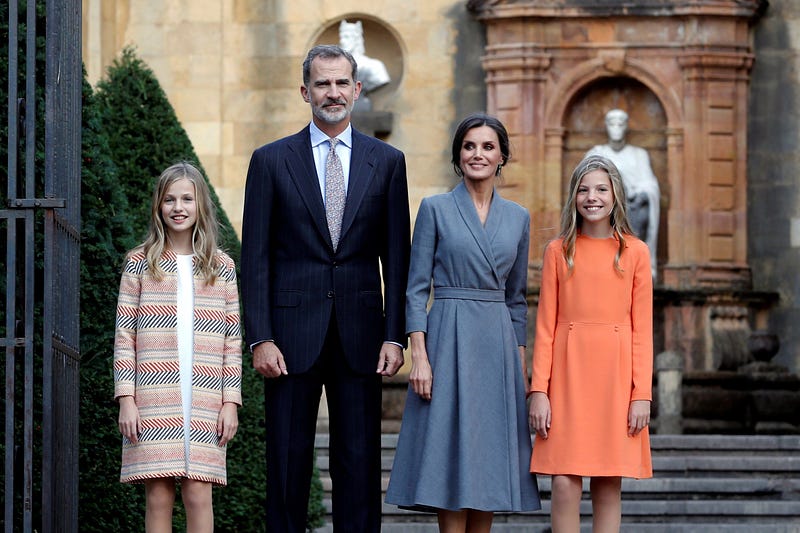
So fashionable!
The dictionary also tells us that infanta can be used as an adjective:
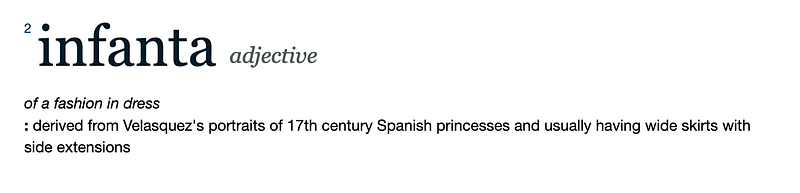
So, in Velazquez’s painting, it’s the dress worn by the infanta herself, and seemingly also by her ladies-in-waiting.
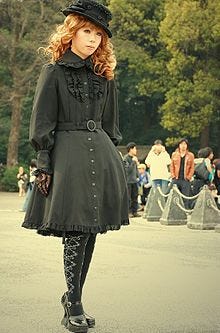
Infanta dresses are a big part of the Japanese subculture known as Lolita fashion. And I learned this the hard and disturbing way, by googling infanta dresses as part of my research for this article. However, you’ll be happy to know that in Japan the term Lolita has more of a cuteness and elegance connotation than one related to sexual attraction or pedophilia. Believe it not, this culture of cuteness that emerged in the 1970s, known as kawaii in Japanese, is related to such mass-merchandised characters like Hello Kitty.
Lolita is usually classified as gothic, classic, or sweet, with plenty of stores in Japan catering to this fashion style, its clothes, and its accessories. Here is a photo of a woman wearing an infanta dress. I assume she’s gothic, perhaps in the sub-style known as kuro (black).
The infanta dress is also featured in a 2018 project called Meninas Madrid Gallery, conceived by Venezuelan artist Antonio Azzato. He asked a bunch of artists to re-imagine the meninas in Velázquez’s painting as three-dimensional objects, and then placed them around the city of Madrid. Sort of like the CowParade venture. Except they are not cows, and they all have the infanta dresses.
Here is a short video discussing the Meninas Madrid Gallery.
However, despite the importance of the word infanta in the art world and the royal family of Spain, the editors of the Spelling Bee rejected this word as a dord.*
You can check out my previous entry on another dord* here:
*What the heck is a dord, you ask? Here’s the answer: