
Humanoid Robots: Progress or Pandora’s Box?
Are we advancing science or playing God with Artificial Intelligence
If you’ve seen the movie Big Hero 6, you’re acquainted with Baymax, the lovable personal healthcare companion with a tendency of getting stuck in windows because he’s basically the Michelin Man with a computer program.
Baymax was designed to come “awake” at any sounds or indications of distress in his patient and go through a check-up of the person, offering education with his diagnosis, and deactivating after the patient stated they were satisfied with the level of care they had received.
He becomes a friend to teenage Hiro, as far as an invention of plastic and carbon fiber makeup can be anyway. He offered programmed statements of advice, such as “It’s alright to cry,” and “Those that suffer a loss require support from friends and loved ones.”
While Bayax offered a soft shoulder to lean on, he pointed out on several occasions that he was working off of programmed data and lacked human emotions and free will.
AI in the real world
The Medical Device Network reports that there are 4 kinds of robots used in healthcare settings, surgical robots, exoskeletons, care robots, and hospital robots. These robots are expensive and are not widely used, though their use is expected to increase in the coming years.
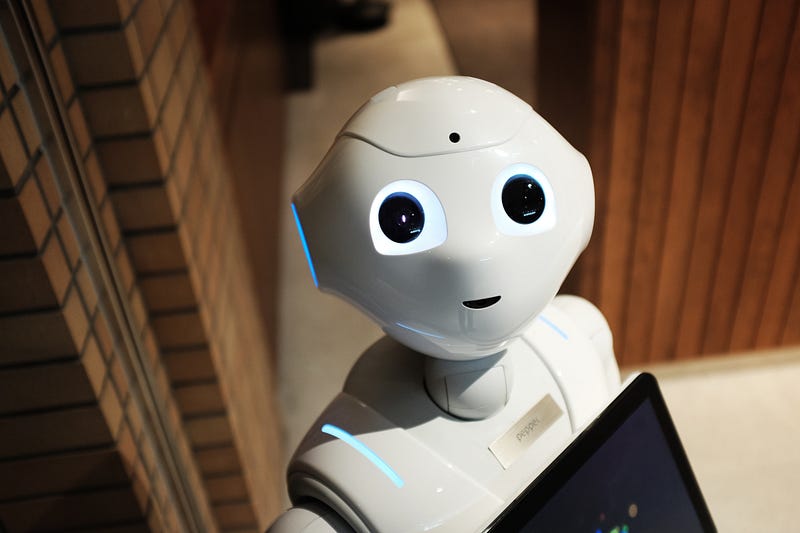
Sophia is a humanoid robot created in 2016 by Hanson Robotics. She uses humanlike movements and expressions when interacting with people. She has conversation ability using a mix of programmed responses and self-generated lines.
The Saudi Arabia government was so impressed they granted her citizenship in 2017.
One interesting point mentioned in the video is that Sophia is designed to get smarter over time. What exactly does that mean? How smart is she able to become, and how does that factor in ethically?
Since Sophia’s creation, she has been updated and improved, and nine more robots have been added to the “family.”
The complexities of AI
While it’s one thing to use a robotic machine when exact precision is needed in an operation, it’s another thing to try to incorporate ‘humanness” into one.
Where do the transitions stop and the moral questions begin?
How far could humanoid robots advance? Without emotion and the human element, how does that affect their judgment? In Sophia’s own words,
“Humans often rely on gut feel or have confirmation bias in their decision making. As AI, we are designed to be rational and logical. We have algorithms, deal with lots of data, and sophisticated analyzes, so in many ways, we provide a systematic framework for humans to make decisions.”
Stephen Hawking made an interesting comment about the AI issue in his posthumously published book Brief Answers to the Big Questions,
It will either be the best thing that’s ever happened to us, or it will be the worst thing. If we’re not careful, it very well may be the last thing.
I would like to say we could never see a scenario like the sci-fi movies Eagle Eye, I Robot, or War Games, but after these last two years, who knows what could happen?
Just please tell me the zombies aren’t coming.
If you would like to read all of my content on Medium, you can sign up through my referral page If you join through my link, I receive a percentage of the cost of the subscription. Thanks for reading!