avatarAvi Kotzer

Free AI web copilot to create summaries, insights and extended knowledge, download it at here

3334

Abstract

f="https://unsplash.com/@taitenmiller?utm_source=medium&amp;utm_medium=referral">taiten miller</a> on <a href="https://unsplash.com?utm_source=medium&amp;utm_medium=referral">Unsplash</a></figcaption></figure><p id="f43d">So, it’s clear that <i>riprap</i> is “a primitive system of hand painted rocks designed to protect millionaire’s beach homes”. Right?</p><p id="d6e6">Well, obviously if you read the definition I thoughtfully provided before, you know that’s not what <i>riprap</i> means. Although “primitive”, “rocks”, and “protect” do factor in.</p><h2 id="c133">S.O.S.</h2><p id="f53b">In this case, save our shores.</p><p id="9cdb"><i>Riprap</i>’s etymology is very simple. It comes from the now archaic word for the sound of rapping rocks. And what was that obscure term that turned into the modern word?</p><p id="4c81">Riprap. How unexpected, right?</p><p id="3add">AKAs for this thuggish rock band include the not-so-creative “rip rap” and “rip-rap”, the tough-sounding “shot rock” and “rock armor”, and the very common and debasing “rubble”. But wait… there’s more. The word is also a verb. Of course it is! English speakers just loooove to turn nouns into verbs. It’s like one of the pastimes of lexicographers.</p><p id="79c3">Now, as a noun, riprap refers to the wall of stones or rocks you place to protect shorelines against erosion. But it’s also the material used, the rocks themselves.</p><p id="200f">The verb also has two definitions: the act of building a riprap or any activity done to strengthen it.</p><p id="a414">In other words, you can riprap a riprap you had riprapped with ripraps . Notice that in each of the four instances, the word means a different thing.</p><p id="ac7e">See? I told you it was a fun word!</p><p id="6ac5">Ripraps are used to protect shorelines, streambeds, bridge abutments and foundational supports against erosion. In theory, they’re supposed to be good things. But, as always, we humans come up with not-so-great ideas. Turns out <i>ripraps</i> can also cause erosion. Downstream from where they are. And scouring of riverbeds. How? I don’t know. I mean, I tried to find out, but couldn’t access the Ohio Department of Natural Resources Riprap Guide. Yes, there is such a thing, <b>in theory</b>. If you are able to open the document below, please (1) summarize it, (2) publish an article here on Medium, and (3) link the article to this one so we can both get more people reading this transcendental, life-changing information.</p><div id="3ca0" class="link-block"> <a href="http://soilandwater.ohiodnr.gov/portals/soilwater/pdf/stream/stfs16.pdf"> <div> <div> <h2>Ohio Department of Natural Resources | Ohio.gov</h2> <div><h3>A department of incredible diversity, ODNR owns and manages more than 800,000 acres of land, including 75 state parks…</h3></div> <div><p>soilandwater.ohiodnr.gov</p></div> </div> <div> <div style="background-image: url(https://miro.readmedium.com/v2/resize:fit:320/)"></div> </div> </div> </a> </div><h2 id="7f0d">Domino effect</h2><p id="ce72">Perhaps in order to improve upon the activity known as “hand placing rocks to prevent and cause erosion at the same time”, humans de

Options

cided to invent silly alternatives.</p><p id="1e23">So, in 1950, Pierre Danel and Paul Anglès d’Auriac invented tetrapods in France. According to experts, tetrapods are made of concrete, and their tetrahedral shape helps dispel the force of waves by forcing water around rather than against them. They also interlock. Whoopee!</p><p id="c9de">From an engineering and design standpoint, tetrapods represented a tremendous improvement over <i>ripraps</i>. I guess? You tell me:</p><figure id="627c"><img src="https://cdn-images-1.readmedium.com/v2/resize:fit:800/1*SuIaoe4wwOOOSoSjtpmFIA.png"><figcaption>Credit: wikicommons</figcaption></figure><p id="3100">Can you tell which is which? (Hint: the ones on the right are French.)</p><p id="4ec6">In reality, the biggest advantage tetrapods had was that Danel and d’Auriac were able to patent them, making them the Elon Musks of the 1950s.</p><p id="63d8">Not to be left behind in the “let’s reinvent the wheel” category, other concrete entrepreneurs came up with similar ideas in their countries.</p><p id="c81d">First up were the Americans, of course. They came up with “modified cubes” in 1959. Two years later the Brits started using Stabits. The Netherlands followed suit in 1962 with the Akmon.</p><p id="9a29">The dolos — a reinforced concrete block with complex geometric shapes weighing up to 90 tons —was invented in 1963 in South Africa. Then someone in India decided to improve on that, and called it KOLOS.</p><p id="a49d">Other countries joined the party, and some countries reinvented the reinvention.:</p><ul><li>Stabilopod (Romania, 1969)</li><li>Seabee (Australia, 1978)</li><li>Accropode (France, 1981)</li><li>Hollow Cube (Germany, 1991)</li><li>A-jack (United States, 1998)</li><li>Xbloc (The Netherlands, 2001)</li></ul><p id="9b2e">With all these cute names, maybe someone should come up with a video game similar to Minecraft in which you use all these characters to protect and damage your shoreline simultaneously.</p><p id="270d">In any case, we won’t see the character named riprap, because the editors of the New York Times Spelling Bee said: “It<b></b>s a <a href="https://www.merriam-webster.com/words-at-play/dord-a-ghost-word"><b>dord</b></a>!”</p><p id="b3e3">Please check out my previous entry on <b>dords</b>. The one below, appropriately, is called “Dord”.</p><div id="bd2e" class="link-block"> <a href="https://readmedium.com/dord-dc3bb884398"> <div> <div> <h2>Dord</h2> <div><h3>A frighteningly funny tale about a ghost word</h3></div> <div><p>medium.com</p></div> </div> <div> <div style="background-image: url(https://miro.readmedium.com/v2/resize:fit:320/0*1IMClGCEY0AGIFyH)"></div> </div> </div> </a> </div><p id="5691">*I started using the word “dord” today to refer to “ghost words”. Please see the above article or this <a href="https://www.merriam-webster.com/words-at-play/dord-a-ghost-word">link</a> for an explanation. I’ll probably go back and tweak previous articles. I think I like it better than “g.n.a.w.” I’m hoping that, as usually happens in the English language, usage of “dord” will turn it into the recognized word it deserves to be.</p></article></body>

Riprap

These stones are most likely gathering moss
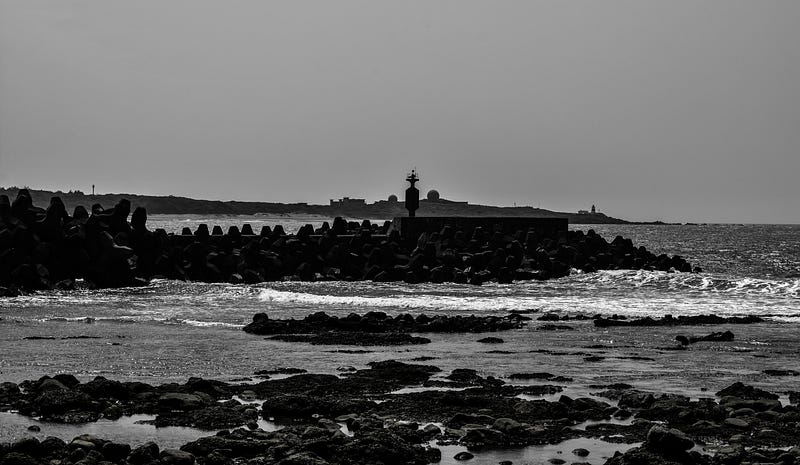
Photo by Elton Yung on Unsplash

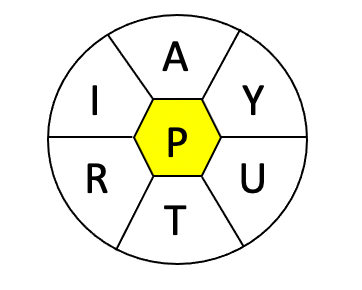
Today’s New York Times Spelling Bee letters:
Art: Iva Reztok

A, I, R, T, U, Y, and center P (all words must include P).

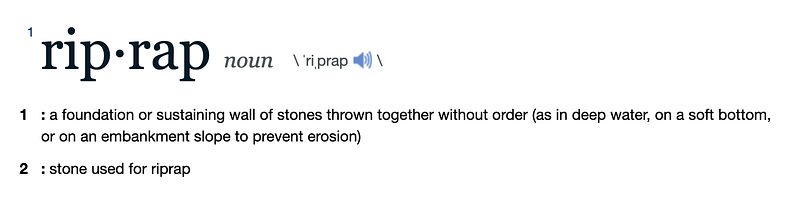
Merriam-Webster says…
Credit: merriam-webster.com

Silly little dictionary! Don’t you know riprap can’t possibly be a word if the New York Times says it ain’t?

For further fascinating facts, check out the Spelling Bee Master.

What’s your favorite dord* from today’s puzzle?

My Two Cents

Some words are just fun to say. Riprap is, in my opinion, one of those words. And no, it’s not an exhortation to savagely criticize hip hop music.

One of the many advantages of wiring on Medium is access to photos via Unsplash. Medium started a partnership with the stock photography web site just over three years ago. You click on the + button at the beginning of a line, press the magnifying glass and type words to search for a photo. the system returns search results and you can pick which image you prefer to use. The system then places it into your article, along with the credit for photographer.

It’s incredibly convenient, on the one hand, and also stubbornly frustrating on the other. At least for me. Maybe that’s because I’ve focused my writing on not-so-common words that are not always easy searchable in web sites that offer stock images. Plus I’m sure there may be some tricks for searching that I’m not aware of. So, really… mea culpa.

All this to serve as an introduction for the fact that I was pleasantly surprised when I searched Unsplash for the word riprap. I got instant results. Well, okay, only one photo popped up. But that was one more photo than I was actually expecting. That’s why I decided to use it. To acknowledge and honor the fact that Elton Yung tagged the image with the word “riprap”.

Now, it may not have been the best lexical choice; I don’t feel it conveys the meaning of the word very clearly. For example, this one does a better job:
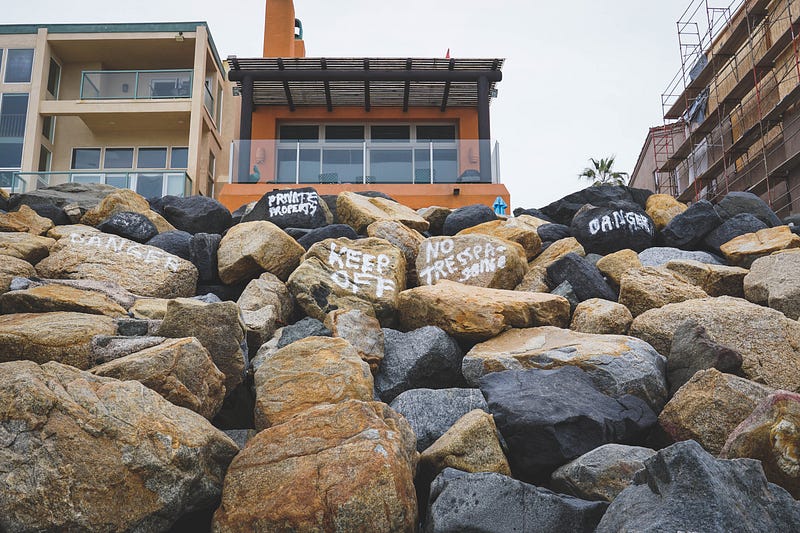
Photo by taiten miller on Unsplash

So, it’s clear that riprap is “a primitive system of hand painted rocks designed to protect millionaire’s beach homes”. Right?

Well, obviously if you read the definition I thoughtfully provided before, you know that’s not what riprap means. Although “primitive”, “rocks”, and “protect” do factor in.

S.O.S.

In this case, save our shores.

Riprap’s etymology is very simple. It comes from the now archaic word for the sound of rapping rocks. And what was that obscure term that turned into the modern word?

Riprap. How unexpected, right?

AKAs for this thuggish rock band include the not-so-creative “rip rap” and “rip-rap”, the tough-sounding “shot rock” and “rock armor”, and the very common and debasing “rubble”. But wait… there’s more. The word is also a verb. Of course it is! English speakers just loooove to turn nouns into verbs. It’s like one of the pastimes of lexicographers.

Now, as a noun, riprap refers to the wall of stones or rocks you place to protect shorelines against erosion. But it’s also the material used, the rocks themselves.

The verb also has two definitions: the act of building a riprap or any activity done to strengthen it.

In other words, you can riprap a riprap you had riprapped with ripraps . Notice that in each of the four instances, the word means a different thing.

See? I told you it was a fun word!

Ripraps are used to protect shorelines, streambeds, bridge abutments and foundational supports against erosion. In theory, they’re supposed to be good things. But, as always, we humans come up with not-so-great ideas. Turns out ripraps can also cause erosion. Downstream from where they are. And scouring of riverbeds. How? I don’t know. I mean, I tried to find out, but couldn’t access the Ohio Department of Natural Resources Riprap Guide. Yes, there is such a thing, in theory. If you are able to open the document below, please (1) summarize it, (2) publish an article here on Medium, and (3) link the article to this one so we can both get more people reading this transcendental, life-changing information.

Domino effect

Perhaps in order to improve upon the activity known as “hand placing rocks to prevent and cause erosion at the same time”, humans decided to invent silly alternatives.

So, in 1950, Pierre Danel and Paul Anglès d’Auriac invented tetrapods in France. According to experts, tetrapods are made of concrete, and their tetrahedral shape helps dispel the force of waves by forcing water around rather than against them. They also interlock. Whoopee!

From an engineering and design standpoint, tetrapods represented a tremendous improvement over ripraps. I guess? You tell me:
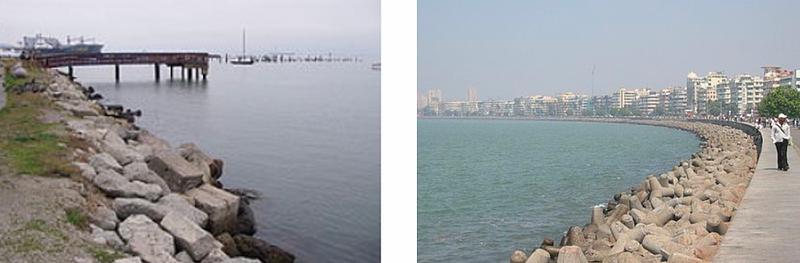
Credit: wikicommons

Can you tell which is which? (Hint: the ones on the right are French.)

In reality, the biggest advantage tetrapods had was that Danel and d’Auriac were able to patent them, making them the Elon Musks of the 1950s.

Not to be left behind in the “let’s reinvent the wheel” category, other concrete entrepreneurs came up with similar ideas in their countries.

First up were the Americans, of course. They came up with “modified cubes” in 1959. Two years later the Brits started using Stabits. The Netherlands followed suit in 1962 with the Akmon.

The dolos — a reinforced concrete block with complex geometric shapes weighing up to 90 tons —was invented in 1963 in South Africa. Then someone in India decided to improve on that, and called it KOLOS.

Other countries joined the party, and some countries reinvented the reinvention.:

  • Stabilopod (Romania, 1969)
  • Seabee (Australia, 1978)
  • Accropode (France, 1981)
  • Hollow Cube (Germany, 1991)
  • A-jack (United States, 1998)
  • Xbloc (The Netherlands, 2001)

With all these cute names, maybe someone should come up with a video game similar to Minecraft in which you use all these characters to protect and damage your shoreline simultaneously.

In any case, we won’t see the character named riprap, because the editors of the New York Times Spelling Bee said: “Its a dord!”

Please check out my previous entry on dords. The one below, appropriately, is called “Dord”.

*I started using the word “dord” today to refer to “ghost words”. Please see the above article or this link for an explanation. I’ll probably go back and tweak previous articles. I think I like it better than “g.n.a.w.” I’m hoping that, as usually happens in the English language, usage of “dord” will turn it into the recognized word it deserves to be.

Spelling Bee
History
Culture
Innovation
Language
Recommended from ReadMedium