
Ripping out hearts, cannibalism and a great empire. Why did the Aztec civilization lose to the conquistadors?
The Aztec civilization managed to create a vast empire, which only came to an end with the arrival of the conquistadors. They went down in history as the bloodiest of all pre-Columbian peoples. They earned this reputation not only by their aggressive policies. Above all, their barbarism was evidenced by their bloody rituals, performed in honor of deities. What do we know about the Aztecs? Below you will find the most important information and surprising trivia about this remarkable civilization.
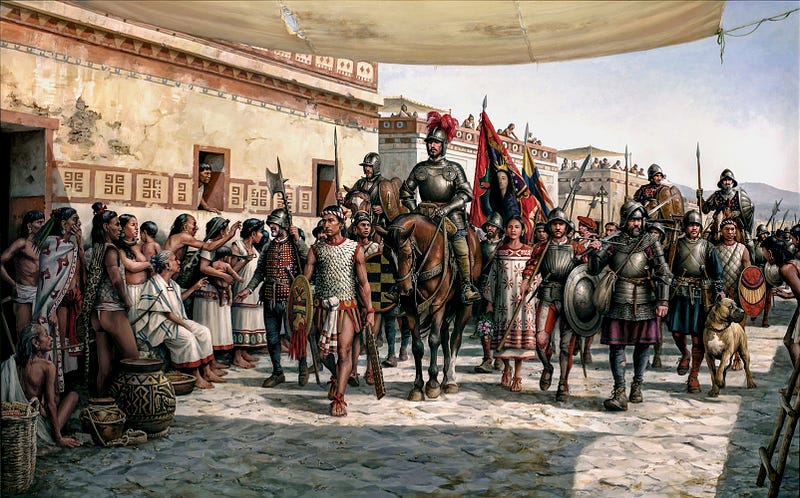

In the days before Europeans arrived in the Americas, the Aztecs became the greatest power of the pre-Columbian world. Although there were two other highly developed cultures operating side by side — the Mayan civilization (which was already in decline in Aztec times) and the Inca civilization — it was the Aztecs who managed to conquer and subjugate most of the tribes.
Who were the Aztecs?
The Aztecs are referred to as an Indian people from central Mexico, who managed to create one of the largest empires in pre-Columbian America. They arrived in the valley of Mexico in the 13th century, where they founded the city of Tenochtitlán, which in time became the capital of the entire empire.
Initially, the Aztecs were too weak to conquer the surrounding peoples. They managed to do so two centuries later, when they formed a confederation with two allied cities: Texcoco and Tlacopan. They made the surrounding rulers completely dependent on them, forcing them to pay tribute, participate in wars and provide captives to be sacrificed.
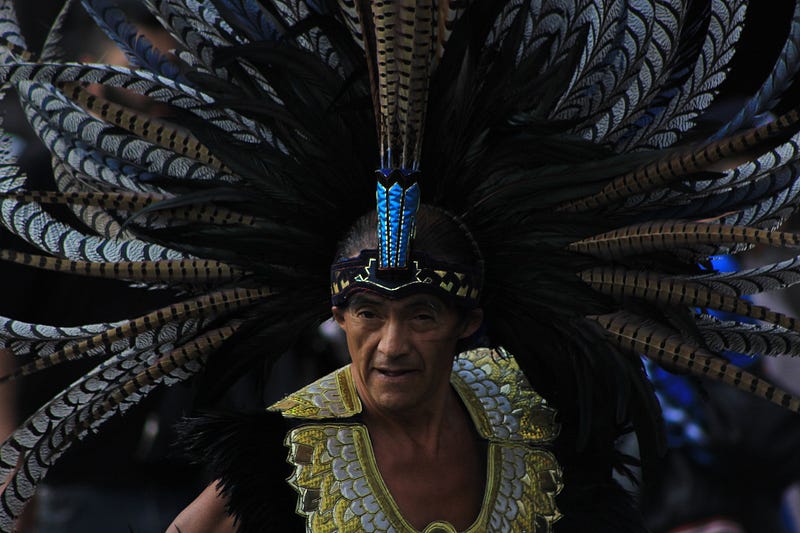
How did the Aztecs live?
The Aztec state did not have a centralized structure. It resembled a tribal union. Individual peoples were ruled by superiors approved by the capital.
The mainstay of the Aztec economy was agriculture and ranching. They grew corn, tomatoes, broad beans, figs, cacao, agave and cotton. They raised ducks, geese and turkeys in homesteads. They also engaged in crafts. The Aztecs highly mastered the processing of copper, gold and bronze, were able to produce rubber and reached a high level in weaving. One cannot fail to mention that trade was a highly developed field in the Aztec community. A market square was located in every town.
What did the Aztecs build?
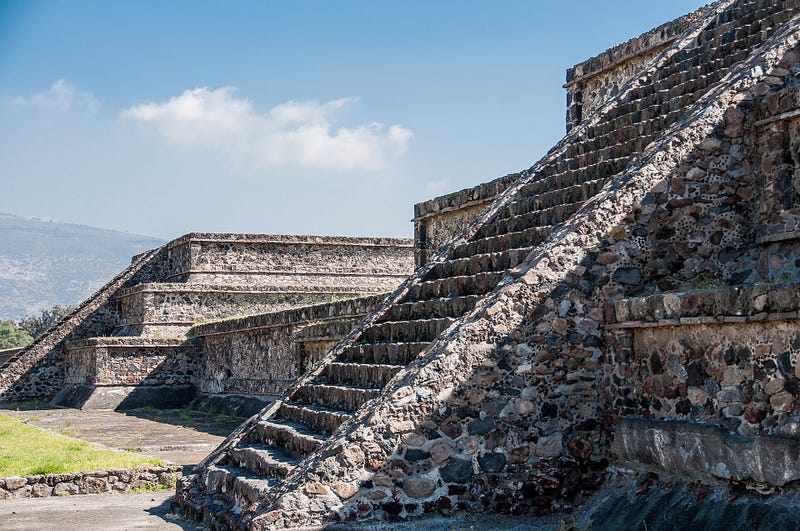
The Aztec civilization was built on the achievements of other pre-Columbian peoples, primarily the Toltecs and Mayans. It was from them that they took over the ability to erect monumental stone buildings. Therefore, one should not be surprised that the structures built by the Aztecs — huge temples in the form of stepped pyramids, palaces, houses and plazas — are deceptively reminiscent of structures that were built before their time.
Aztec achievements
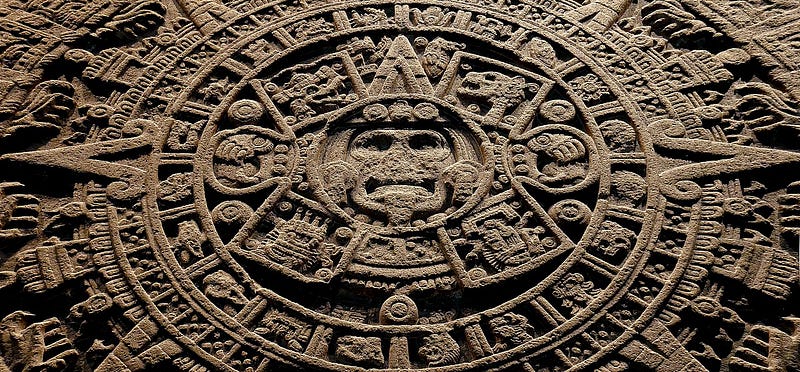
From other civilizations, the Aztecs also adopted the calendar or writing system (modified to suit their needs). They further developed astronomical and mathematical knowledge. At this point it should be noted that the Aztecs did not just duplicate earlier patterns. They developed their own variety of arithmetic, in which the counting system was based not on dots, dashes or nodes, but on a whole series of symbols.
The greatest achievement of the Aztecs was their capital. The city of Tenochtitlán, built on a regular plan, was partially built on water. It was connected to the mainland by three straight causeways and an aqueduct.

Aztec rituals
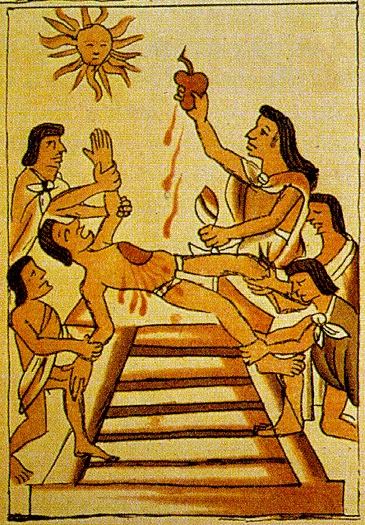
Like many other peoples of Mesoamerica, the Aztecs made sacrifices to their gods, with it being noted that it was the Aztec civilization that went down in history as the bloodiest. The victims were mostly prisoners of war. The selected individuals were led up the stairs to the highest level of the pyramid, into the temple located there. The victim was placed on an altar and immobilized. What happened next? This was vividly described by Bernal Diaz del Casstillo, one of the conquistadors.
His records show that the victim’s chest was opened with a flint knife. The still-beating heart was then hurriedly removed and, together with the blood of the unfortunate, sacrificed to the gods. The Aztecs were also supposed to cut off the victim’s head, arms and legs. The limbs were eaten during ritual feasts. The head was impaled, and the remains of the dismembered body were thrown to be eaten by animals.
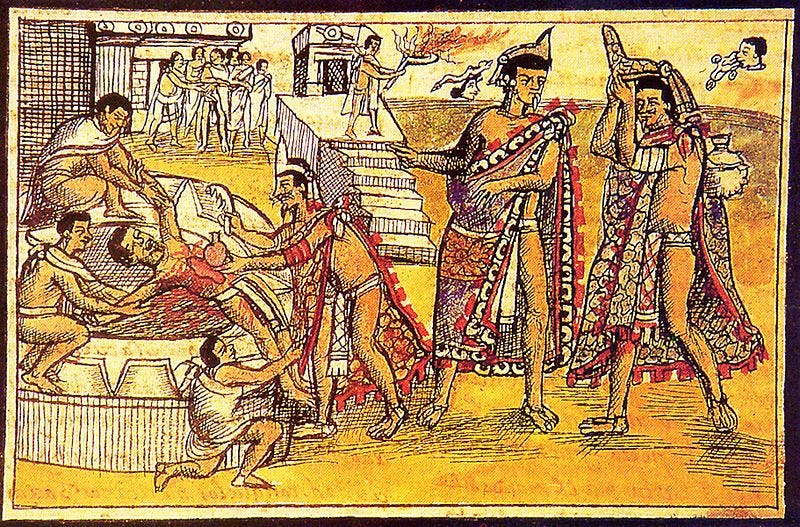

Such rituals were performed in honor of the Sun. The Aztecs believed that without a blood sacrifice, the fireball would stop moving in the sky and the end of the world would come.
Another sacrifice was made in honor of Tezcatlipoka, the god who patronizes war, feuds and rulers. Before the ritual shedding of blood could take place, the victim had to be prepared by treating him like a king for a year.
The ritual began with the selection of a captive who showed no physical imperfections. He was then clothed in the garb of a Tezcatlipoka, given a flute and assigned eight claws. When 20 days remained until the Toxcal festival, the young man was assigned four wives. On the day of the ritual, the victim was to voluntarily appear at the foot of the temple, climb to the very top of the pyramid and break the flute on the way. The priests waiting there stripped her of her heart, but as a sign of respect, the body of the unfortunate was not dropped, but carried down the stairs.
A sacrifice made in honor of Xipe Totec — the god of ripening corn — was killed differently. In this case, the food for the deity was to be a prisoner of war who distinguished himself on the battlefield with incredible bravery.
Such a wretch was tied to a round stone and handed a mace, which, however, was not equipped with obsidian blades, but with feathers. Thus prepared, he had to fight the Aztec warriors in full force. If the victim managed to defeat four warriors, he had to face a left-handed opponent, which actually determined the outcome of the skirmish.
The defeated victim was handed over to the priests, who not only removed its heart, but also stripped it of its skin. The corpse was partially eaten. The skin was worn by selected men for 20 days. During this time they had to beg, and the gifts thus collected were given to the poor. After this time, the skin was buried, which was supposed to ensure a bountiful harvest.
It should be noted that almost all pre-Columbian civilizations offered sacrifices to their gods. However, none sacrificed on such a large scale as the Aztecs did.

Why did the Aztec civilization collapse?
If no tribe was able to stand up to the Aztec power, why did this civilization fall? The answer is simple — the Aztecs were unable to stand up to the conquistadors. However, this is a big oversimplification, so it’s worth breaking this topic down.
In 1519, Hernán Cortés led an army of 500 soldiers. This was an extremely modest force, as there were about 10,000 Indians per conquistador! True, the technological advantage of the Spaniards and Portuguese was enormous. The Indians had weapons made of wood and stones, the invaders had black powder and lead at their disposal. However, it cannot be said that the firearms at the colonizers’ disposal reduced the indigenous population’s advantage to zero, nothing of the sort. Initially, the Aztecs were not going to put up a fight.
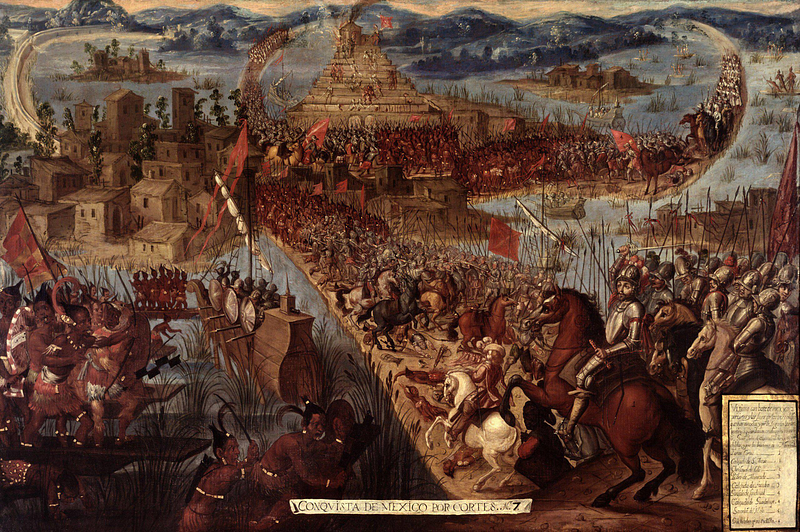

Why? Simple — they mistook the invaders responsible for their annihilation for emissaries of the gods. So the conquistadors were welcomed with all honors. When fighting occurred (which was inevitable), it suddenly became clear that in practice the Aztec forces were not as numerous as in theory. It is important to realize that the empire was made up of conquered tribes who were not necessarily happy with a superior tyranny. Religion is one thing, but we are convinced that no one wanted to make a living on a sacrificial altar.
However, that’s not all. The final blow was dealt to the Aztec civilization by an invisible adversary. I’m talking about viruses and other pathogenic microorganisms that had not previously been present in the New World. Consequently, the immune system of the Indians was unable to cope with the unknown adversary.
Other interesting facts about the Aztec civilization
Finally, we list some intriguing tidbits about the Aztec civilization.
- People sacrificed in honor of the gods were treated with considerable respect. This is because the Aztecs believed that after death they would suffer the same fate as warriors killed in battle. They would take their place at the side of the sun for four years, then return as butterflies or birds.
- In the Aztec empire, up to 20,000 sacrifices were made annually. The Aztecs believed that the sacrifices they made would save the world from total annihilation.
- Several apocalypse scenarios appeared in Aztec mythology. People were supposed to be slaughtered by bloodthirsty jaguars, hurricane winds, floods and even the fall of the sun from heaven to earth.
- When the conquistadors began their conquest of the pre-Columbian world, the Aztecs mistook them for emissaries of the gods. As a result, the soldiers initially encountered no resistance.
Cool that you made it to the end of this article. I will be very pleased if you appreciate the effort of creating it and leave some claps here, or maybe even start following me. It would be nice if you also left a tip! Thank you!