
Ricardian Contracts can become the next generation of Smart Contracts
Ricardian contracts go a step further than the smart contracts
Some of the most popular Blockchain concepts seeing practical implementation now have been in theoretical existence since the 1990s e.g Proof of Work, Ricardian contracts & Smart contracts. As I had said in one of my previous articles that technological progress is an iterative process & while we are led to believe that all these advancements have taken place in the last few years, work has been in progress for a couple of decades.
And this is where today’s conversation between smart contract & Ricardian contract comes in. Both entities have been in existence for more since the late ’90s but only recently came into limelight with the emergence of Blockchain technology.
Before getting into details about both of them let’s try to decipher them in a simple way — While Smart contract is an agreement between two parties which gets executed based on a set of predefined instructions, Ricardian contract goes a step further by recording all the details of the agreement in a machine-readable format & executing it subsequently if required.
For those of you that don’t know, smart contract functionality was introduced by the Ethereum platform and it becomes one of the most desirable & innovative features not just for the native platform but for all the subsequent projects since it will eventually help in the issuance of digital assets which are becoming commonplace with every passing day.
EOS, which is considered as the successor to Ethereum and one of the biggest digital coins/platforms by market cap has announced the support for the use of Ricardian contracts on its platform.
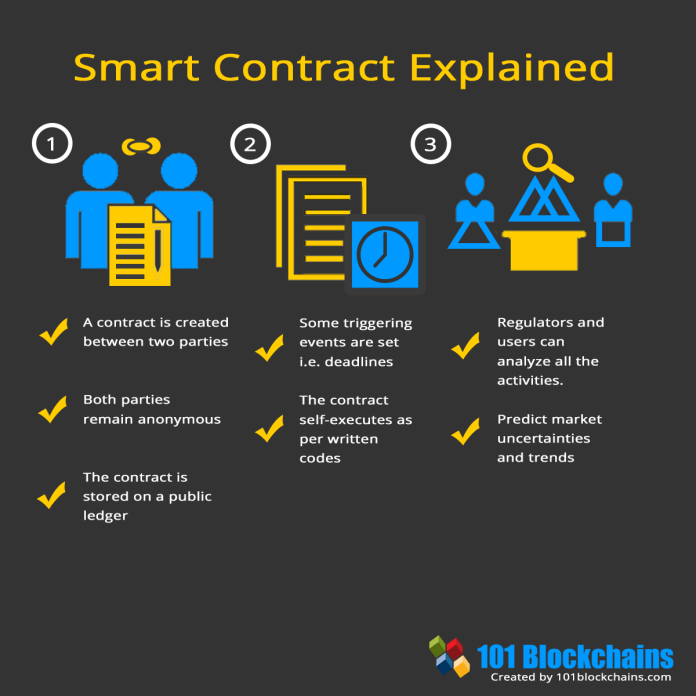
The history of smart contracts can be traced back to Nick Szabo who came up with the idea in 1994. He is the same guy who also went on to invent a digital currency called ‘Bit Gold’ in 1998, which had a smart code having the ability to self-execute to perform certain tasks. This was way before the invention of Bitcoin, but the idea of Bit Gold never really took off & smart contract remained dormant until the rise of Bitcoin & more subsequently Ethereum in 2015.
The inception of the Ricardian contract came via Ricardo payment system by Ian Grigg (honoring David Ricardo). Grigg was a Programmer by profession & one of the pioneers in financial cryptography. He first talked about these contracts in his paper published as Financial Cryptography in 7 Layers, where he defined it as follows:
“a digital contract that defines the terms and conditions of an interaction, between two or more peers, that is cryptographically signed and verified. Importantly it is both human and machine readable and digitally signed”.
And while one can’t deny the utility of smart contracts with their auto-enforcing ability, immutable nature, cost-effectiveness & self-execution that they have brought to various blockchain projects, they are technically not legally binding agreements since they are instructions of code which is readable by machine only.
This becomes one of its biggest weaknesses as well since if something goes wrong, you can’t prove malicious intent in the court of law as it is not a legally binding contract. Also, the immutable nature creates another hindrance for legally binding contracts — what if a mistake is made in the contract and it needs to be corrected/amended.
There is no way to change the contents of the contract. Basically, Ricardian contracts have improved on the limitations of the smart contracts by converting human-readable legal contract between multiple parties into machine-readable software code which can be executed with all the features of the smart contract.
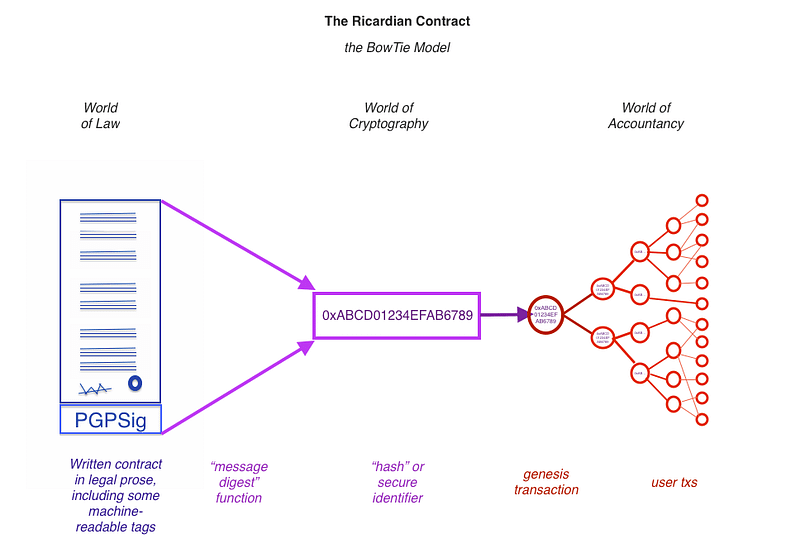
This feature alone gives Ricardian contracts great credibility & presents an immense use case potential in real-world applications by adding authenticity to the buying/selling of any type of physical or digital assets online. Here is a brief list of the main features of the Ricardian contracts:
- Documentation — Allows recording of the terms & conditions of the agreement between parties and its execution, whereas the smart contracts only execute the predefined terms.
- Automation — Operations can be easily automated on any blockchain-based application similar to smart contracts.
- Legality — Presents itself as a legally binding document unlike its contemporary
- Flexibility — Any Ricardian contract can function as a smart contract but the reverse is not true.
- Readability — Ricardian contracts are both human & machine-readable whereas smart contracts just have the machine-readable code.
- Security — Implement two-layered security to contracts — digital cryptographic signatures are used along with each contract having a unique identifier in the form of a hash key.
So is there a current use case of Ricardian contracts — the biggest example in this regard is OpenBazaar, an online P2P marketplace where can buy/sell anything. Implementation of these contracts on this e-commerce portal makes the transactions very secure & legally binding on the transacting parties.
Every time the exchange of goods takes place on the platform a Ricardian contract is created which is digitally signed by the parties involved giving legitimacy to the transaction. Therefore, Ricardian contracts can be used anywhere in the ecosystem since it acts as an electronic form of a legal agreement. The following are some of the other blockchain-based business platforms implementing variations of Ricardian contracts in some form & shape.
SciDex — Implementing readable & adaptable Ricardian smart contracts
BOSCoin — Coming out with “trust contracts” designed to be machine & human readable
Kadena — Developed a smart contract programming language, Pact, with the functionality of producing Ricardian contracts which can be directly written onto a blockchain
Integration & Arbitration issues still need to be sorted out before something concrete takes shape but once figured this would add another layer of transparency to the blockchain networks. Legal & Regulatory framework for Ricardian contracts is still in the early stages of development & we will see more clarity on the issue going forward.
Recent Articles:
Stay in touch: Twitter | LinkedIn | Tradealike | StockTwits | Telegram
Originally published at www.datadriveninvestor.com on November 20, 2018.


