
avatarFaisal Khan

Free AI web copilot to create summaries, insights and extended knowledge, download it at here

3885

Abstract

oes down. These kind of incidents are going to become more commonplace with the increasing number of networks going online, especially with billions of devices connecting under the umbrella of IoT.</p><figure id="3fc2"><img src="https://cdn-images-1.readmedium.com/v2/resize:fit:800/0*6aaXMyB1LPZxm6Ho"><figcaption></figcaption></figure><p id="92ed">IPFS File storage network was originally launched on the Bitcoin Blockchain by <a href="https://protocol.ai/"><b>Protocol Labs</b></a> in 2014, but moved to Ethereum in 2016, citing better development support & innovative features. IPFS has been on a mission to decentralize the Web by providing support for distributed applications, content addressing & digital signatures.</p><p id="68d6">Conventionally, when we are accessing the Internet or the Web we always use HTTP:// before the site address that we are trying the access online. HTTP or the HyperText Transfer Protocol encompasses a location-based address system.</p><p id="b212">In this system, the content stored at a location (server) is assigned an IP number like 192.68.10.152 which is mapped on to the name of the website like google.com. Therefore, when you type google.com in your browser if fetches the content for you that is residing on the IP address assigned to the Google website.</p><p id="d003">IPFS, on the other hand, uses a cryptographic hash on the address ‘<b>QmXnnyufdzAWL5CqZ2RnSNgPbvCc1ALT73s6epPrRnZ1X</b>‘ exactly like the blockchain networks. The content with that hash address can be stored in multiple locations. That means if one of the nodes goes down for some reason, the network will look for content on another node with the same hash value.</p> <figure id="ddad"> <div> <div> <img class="ratio" src="http://placehold.it/16x9"> <iframe class="" src="https://cdn.embedly.com/widgets/media.html?src=https%3A%2F%2Fwww.youtube.com%2Fembed%2F8CMxDNuuAiQ%3Ffeature%3Doembed&amp;display_name=YouTube&amp;url=https%3A%2F%2Fwww.youtube.com%2Fwatch%3Fv%3D8CMxDNuuAiQ&amp;image=https%3A%2F%2Fi.ytimg.com%2Fvi%2F8CMxDNuuAiQ%2Fhqdefault.jpg&amp;key=a19fcc184b9711e1b4764040d3dc5c07&amp;type=text%2Fhtml&amp;schema=youtube" allowfullscreen="" frameborder="0" height="480" width="854"> </div> </div> </figure></iframe></div></div></figure><p id="865f">IPFS is laying the foundation of tomorrow’s Web. Here are some of the reasons why IPFS beats the HTTP system hands down.</p><ul><li><b><i>Efficient & Inexpensive</i></b> — Unlike the HTTP which only accesses files from a single server at a time, IPFS can gather large volumes of data from multiple servers simultaneously with zero duplication, which means savings in storage & time. Bandwidth costs are significantly lower as well since you don’t have to keep increasing it with higher traffic volumes in the traditional model.</li><li><b><i>Data accessibility </i></b>— The average lifespan of a website on the traditional Web is about 100 days, not with IPFS which makes it easier to save all your files on resilient networks for mirroring & storage of data for the long haul.</li><li><b><i>Complete Decentralization</i></b> — The Internet has provided us an excellent medium for accelerating innovation with Free & Equal access to all but increasing central control is threatening the model. The IPFS model of decentralization provides a true vision of access to all without a manipulating central authority. The emerging blockchain networks go hand in hand with this philosophy and these two are a perfect match.</li><li><b><i>Persistent Availability</i></b> — Breakdown caused by natural disasters, weak infrastructure, cyber attacks are part of the current problem-prone Web accessibility. IPFS is powering us into the 21st century with resilience, redundancy and 24/7 access

Options

without the use of a backbone.</li></ul><p id="2a81">You can just use your standard browser to access the files on the IPFS & also create a website hosted on this new gateway with the same old customized domain name. The launch of Cloudflare was a game-changer for web access with features like security, efficiency & redundancy. The addition of the IPFS gateway to this mix has opened doors to decentralized web content creation & storage.</p><p id="5ba2"><b><i>Recent Articles:</i></b></p><div id="86f8" class="link-block"> <a href="https://readmedium.com/innovation-alert-a-coinless-blockchain-reversible-ico-more-dde1dd9c4dbe"> <div> <div> <h2>Innovation Alert: A coinless Blockchain, Reversible ICO & more</h2> <div><h3>The involvement of big companies in the blockchain space bodes well for the DLT. This has meant more funding &…</h3></div> <div><p>medium.com</p></div> </div> <div> <div style="background-image: url(https://miro.readmedium.com/v2/resize:fit:320/1*o1if1lvQQEEFOfG6BfUKEA.jpeg)"></div> </div> </div> </a> </div><div id="ff22" class="link-block"> <a href="https://readmedium.com/what-is-a-target-date-fund-should-you-consider-it-for-retirement-2623ceb7f6a1"> <div> <div> <h2>What is a Target Date Fund & should you consider it for retirement?</h2> <div><h3>Retirement planning is one of the key aspects of the Personal financial management which a lot of us conveniently…</h3></div> <div><p>medium.com</p></div> </div> <div> <div style="background-image: url(https://miro.readmedium.com/v2/resize:fit:320/0*AIAizq14S2rWaLDp)"></div> </div> </div> </a> </div><div id="cace" class="link-block"> <a href="https://readmedium.com/10-years-of-bitcoin-its-origin-facts-figures-211f89b66207"> <div> <div> <h2>10 years of Bitcoin: it’s Origin, Facts & Figures</h2> <div><h3>It all started 10 years ago with the notorious Satoshi Nakamoto publishing the infamous white paper (Bitcoin: A…</h3></div> <div><p>medium.com</p></div> </div> <div> <div style="background-image: url(https://miro.readmedium.com/v2/resize:fit:320/0*dil0WhniSwE8lhqJ)"></div> </div> </div> </a> </div><div id="b97e" class="link-block"> <a href="https://readmedium.com/educate-yourself-with-content-that-matters-20b119d593ea"> <div> <div> <h2>Educate yourself with content that matters…</h2> <div><h3>I stay active on Twitter most of the week with posting content on Blockchain/Cryptocurrencies, Fintech, Technology &…</h3></div> <div><p>medium.com</p></div> </div> <div> <div style="background-image: url(https://miro.readmedium.com/v2/resize:fit:320/0*FXW6P2YIEruJLfl1)"></div> </div> </div> </a> </div><p id="8c8a">Stay in touch: <a href="https://twitter.com/fklivestolearn">Twitter</a> | <a href="https://www.linkedin.com/in/faisal-khan-2a3009b/">LinkedIn</a> | <a href="http://www.tradealike.com/">Tradealike</a> | <a href="https://stocktwits.com/trade_nut">StockTwits</a> | <a href="https://t.me/joinchat/IWzyHBGWCFwPQTe8Tm5H_Q">Telegram</a></p><p id="bc45"><i>Originally published at <a href="https://www.datadriveninvestor.com/2018/11/14/clouldflare-employing-ipfs-to-decentralize-the-internet/">www.datadriveninvestor.com</a> on November 14, 2018.</i></p></article></body>

ClouldFlare employing IPFS to decentralize the Internet

The peer to peer hypermedia open-source protocol is the future of connectivity

The theme of decentralization has become the talking point of everyday conversation with the emergence of Digital Ledger Technology (DLT). The integration of this technology seems to have become the mantra of every enterprise, established business model & the current ecosystems.

Taking this discussion further let’s talk about a company called CloudFlare‘s content delivery network (CDN), Inter-Planetary File System (IPFS) — a peer to peer hypermedia open-source protocol & the decentralization of Internet using a combination of the previous two technology setups.

Cloudflare was created by three partners in 2009 at the Harvard Business School. The final product emerged from their initial study of how spammers harvested email addresses online. Their project went on to win the Harvard Business School Business Plan competition.

The beta version of the service was launched in Sep. 2010. They have grown significantly ever since its inception serving 8 million internet properties and about 10% of all internet requests as reported on their website.

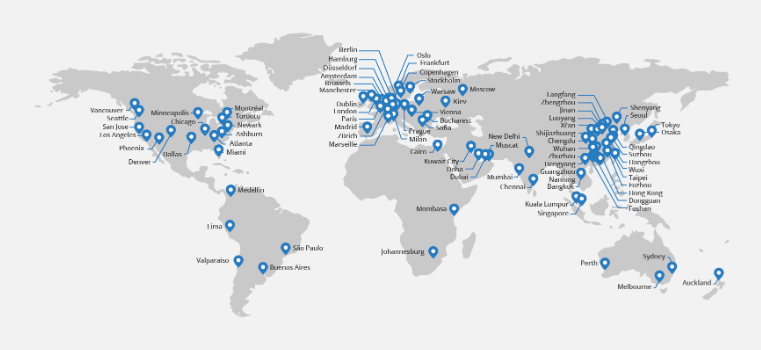
Cloudflare has 152 data centers located in different regions of the world setting up a redundancy network that can be accessed in a decentralized way. These data centers act like a decentralized network where if one location goes down for some reason, there is no disruption in service since other nodes (or locations) are still functioning.
The company itself is a big proponent of net neutrality championing the decentralized model based on the IPFS protocol. They were embroiled in some controversy initially when they were blamed for optimizing content for controversial websites & malicious players. Fuel was added to the fire when they failed to drop such clients from their service.

Finally after getting a lot of heat from the Press & being dubbed as “terrorists’ little helper” they decided to update their abuse reporting system to allow people to file complaints about material on their sites on which action could be taken. Dust seems to have settled down on this front after they banned one such racist website setting a precedent going forward.
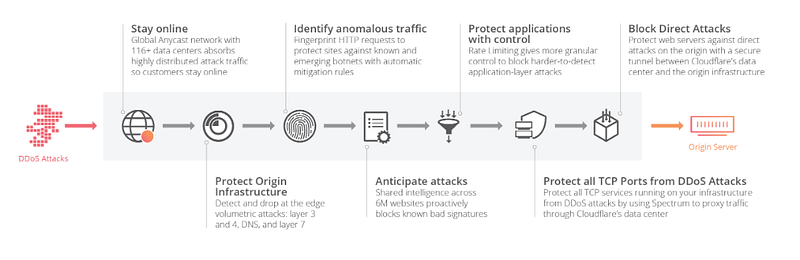
Simply put, Cloudflare claims to provide a fast, reliable & safe Cloud hosting service (or content delivery network) by integrating the emerging technologies — most notably the IPFS. It has recently announced the introduction of the IPFS gateway which allows the creation of websites on distributed P2P technology.

Before moving on to discussing IPFS in more detail, let’s take a look at how Cloudflare prides itself to be a DDoS (Distributed Denial of Service) mitigation service & how it accomplishes this (figure above). DDoS is basically a malicious attack on a server by flooding it with unwanted traffic.

These computers are then infected with malware converting them into a bot which can be controlled remotely and used for further attacks. You might have seen this online when one of the websites goes down. These kind of incidents are going to become more commonplace with the increasing number of networks going online, especially with billions of devices connecting under the umbrella of IoT.
IPFS File storage network was originally launched on the Bitcoin Blockchain by Protocol Labs in 2014, but moved to Ethereum in 2016, citing better development support & innovative features. IPFS has been on a mission to decentralize the Web by providing support for distributed applications, content addressing & digital signatures.

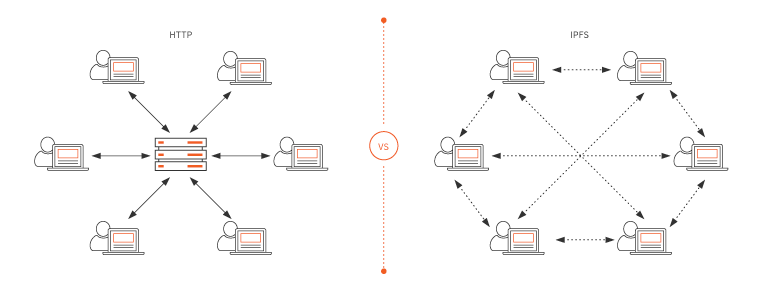
Conventionally, when we are accessing the Internet or the Web we always use HTTP:// before the site address that we are trying the access online. HTTP or the HyperText Transfer Protocol encompasses a location-based address system.

In this system, the content stored at a location (server) is assigned an IP number like 192.68.10.152 which is mapped on to the name of the website like google.com. Therefore, when you type google.com in your browser if fetches the content for you that is residing on the IP address assigned to the Google website.

IPFS, on the other hand, uses a cryptographic hash on the address ‘QmXnnyufdzAWL5CqZ2RnSNgPbvCc1ALT73s6epPrRnZ1X‘ exactly like the blockchain networks. The content with that hash address can be stored in multiple locations. That means if one of the nodes goes down for some reason, the network will look for content on another node with the same hash value.

IPFS is laying the foundation of tomorrow’s Web. Here are some of the reasons why IPFS beats the HTTP system hands down.

  • Efficient & Inexpensive — Unlike the HTTP which only accesses files from a single server at a time, IPFS can gather large volumes of data from multiple servers simultaneously with zero duplication, which means savings in storage & time. Bandwidth costs are significantly lower as well since you don’t have to keep increasing it with higher traffic volumes in the traditional model.
  • Data accessibility — The average lifespan of a website on the traditional Web is about 100 days, not with IPFS which makes it easier to save all your files on resilient networks for mirroring & storage of data for the long haul.
  • Complete Decentralization — The Internet has provided us an excellent medium for accelerating innovation with Free & Equal access to all but increasing central control is threatening the model. The IPFS model of decentralization provides a true vision of access to all without a manipulating central authority. The emerging blockchain networks go hand in hand with this philosophy and these two are a perfect match.
  • Persistent Availability — Breakdown caused by natural disasters, weak infrastructure, cyber attacks are part of the current problem-prone Web accessibility. IPFS is powering us into the 21st century with resilience, redundancy and 24/7 access without the use of a backbone.

You can just use your standard browser to access the files on the IPFS & also create a website hosted on this new gateway with the same old customized domain name. The launch of Cloudflare was a game-changer for web access with features like security, efficiency & redundancy. The addition of the IPFS gateway to this mix has opened doors to decentralized web content creation & storage.

Recent Articles:

Stay in touch: Twitter | LinkedIn | Tradealike | StockTwits | Telegram

Originally published at www.datadriveninvestor.com on November 14, 2018.

Technology
Internet
Bitcoin
Future
Artificial Intelligence
Recommended from ReadMedium