
LITERATURE
Rhymes of Reform: Idealism in William Blake’s Poetry
Exploring Enlightenment values in the ‘The Lamb’ and ‘The Tyger’

“How can the bird that is born for joy sit in a cage and sing?” — William Blake
The English poet, William Blake, was considered a visionary and a reformist who felt rather strongly about the Industrial Revolution. His famous poems, ‘The Lamb’ and ‘The Tyger’, are two illustrated poems from his collection Songs of Innocence and of Experience (1789). Written during the very height of the Romantic Era, both poems explore Christian sentiments towards nature, morality and God during the throes of the Industrial Revolution.
‘The Lamb’ paints an idealistic portrait of nature, untainted by the lens of the Industrial Revolution. Throughout the poem, the Lamb evokes sentiments of purity, youth and innocence. For instance, we hear the speaker musing over a “Little Lamb” with clothing of “wooly bright”, one with a “tender” voice that became a “little child”.
By the stream & o’er the mead; Gave thee clothing of delight, Softest clothing wooly bright; Gave thee such a tender voice
On the other hand, ‘The Tyger’ unveils the grim reality of the Industrial Revolution:
What the hammer? what the chain, In what furnace was thy brain? What the anvil? what dread grasp. Dare its deadly terrors clasp?
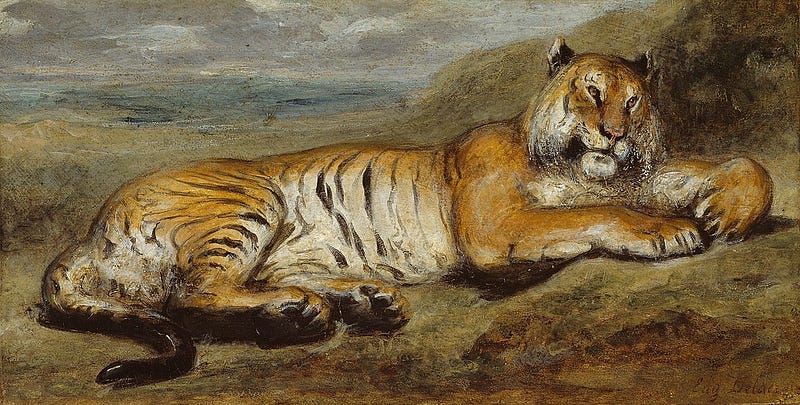
The Tyger does not represent a freedom conventionally associated with the animal. Rather, it symbolises industrial imprisonment amongst an unfamiliar and corrupt world. Here, Blake paints industrialisation in a dark light, where we watch the stars “[throw] down their spears” in retreat and abandon it to return to the safety of nature.
‘The Lamb’ and ‘The Tyger’ complement each other through their contrasting elements, where we understand nature in opposition to the industrialised city and vice versa. The contrast reinforces the idealism of nature and the gloom of industrialisation.
Enlightenment philosophers, like Jean-Jacques Rousseau, spoke of nature as being the solution to social ills. He entreated that man is inherently good and, as long as man “remains in a state of nature”, he remains moral.
These Enlightenment values Blake entreats for manifest themselves in the two poems, where ‘The Lamb’ represents morality and ‘The Tyger; represents corruption.
Works Cited
Blake, William, Songs of Innocence and of Experience, (London: York Press, 2009).
Rousseau, Jean-Jacques, The Social Contract: And, The First And Second Discourses, (Binghamton, New York: Vail-Ballou Press, 2002).
If you enjoy my work, I’d love a tip of appreciation from you! Thank you ♡