avatarBritni Pepper

Free AI web copilot to create summaries, insights and extended knowledge, download it at here

4420

Abstract

eat at the head of the table, but the family members are adults and have their own lives. They discuss matters amongst themselves, but ultimately each member of the family makes their own decisions.</p><h2 id="f534">The republican journey</h2><p id="4a93">Australia, founded as a convict settlement, had a fair share of the rowdier members of the lower orders of British society. The Irish, in particular, were never entirely happy with their place in the Empire, and when Australia federated there was some momentum towards ditching the monarchy entirely in favour of an American-style republic.</p><p id="2d90">This never happened, but it would be wrong to portray Australia as a land of loyal subjects supremely content to have the monarch’s head on the coinage, to serve as members of the <i>Royal</i> Australian Navy, to see the British Union flag taking up a quarter of the Australian national flag.</p><p id="cd95">These symbols rankled with some, and there have always been grumblings and murmurings about finding some way to remove the monarchy.</p><p id="7201">The <a href="https://en.wikipedia.org/wiki/1975_Australian_constitutional_crisis">events of November 1975</a>, when the Governor-General in Canberra removed the then Australian Prime Minister and sent the country off to an election, sparked a resurgence of republicanism.</p><figure id="c953"><img src="https://cdn-images-1.readmedium.com/v2/resize:fit:800/1*DZZ6u5CxK9vFibeckhAqJg.jpeg"><figcaption>Governor-General Sir John Kerr (<a href="https://commons.wikimedia.org/wiki/File:John_Kerr_1965.jpg">PD image</a> via <a href="https://en.wikipedia.org/wiki/Sir_John_Kerr_(Australian_Governor-General)">Wikipedia</a>)</figcaption></figure><p id="9173">The Governor-General was seen as the Queen’s man and there was some suspicion that there may have been some move from Buckingham Palace to get rid of a reforming Prime Minister.</p><p id="0cf0">Not true — the Queen’s powers under the <a href="https://en.wikipedia.org/wiki/Constitution_of_Australia">Australian Constitution</a> are almost entirely notional and she is unable to direct the Governor-General in the exercise of his own powers. The Governor-General alone has power to appoint ministers and call elections (usually exercised on the advice of the Prime Minister) and though his actions were remarkably ham-fisted, they were his own.</p><p id="471e">Nevertheless, a fresh republican spirit was born that day, and twenty years later there were increasingly urgent calls to sever the last remaining ties to the United Kingdom.</p><h2 id="5295">The Constitutional Convention and referendum</h2><p id="705f">In 1991, the <a href="https://en.wikipedia.org/wiki/Australian_Republic_Movement">Australian Republican Movement</a> (ARM) was formed, aiming for the establishment of an Australian republic on the centenary of Federation: 1 January 2001.</p><p id="5298">This would involve a referendum to change the Constitution, a rare occurrence in Australia, but the political ducks lined up, and a <a href="https://en.wikipedia.org/wiki/1998_Australian_Constitutional_Convention#Aftermath">Constitutional Convention</a> was held during February 1998 in Canberra for two weeks of discussion and drafting of a model for a republic.</p><p id="6d61">The ARM was the major single group at the convention, ahead of Australians for a Constitutional Monarchy, and a rag-bag coalition advocating the popular election of a president, as opposed to the ARM’s parliamentary selection, and ACM’s no change position.</p><p id="60fd">The ARM’s model emerged as the one to be put to the voters. In an odd twist, the direct-election republicans joined forces with the monarchists campaigning for a NO vote, and the proposition was put to the people in November 1999. Four out of six States needed to support the referendum, as well as a majority of votes overall.</p><figure id="ae06"><img src="https://cdn-images-1.readmedium.com/v2/resize:fit:800/1*_5dINgEdSqdxSaVWnPo_Iw.jpeg"><figcaption>How to vote card for the YES case (<a href="https://creativecommons.org/licenses/by/2.0">CC image</a> via <a href="https://en.wikipedia.org/wiki/1999_Australian_republic_referendum#/media/File:How_to_Vote_Yes_1999.jpg">Wikipedia</a>)</figcaption></figure><p id="62fe">In the event, the model was soundly defeated, with not one State voting YES.</p><h2 id="3ddd">Devastation and despair</h2><p id="bed6"><a href="https://e

Options

n.wikipedia.org/wiki/Malcolm_Turnbull">Malcolm Turnbull</a>, leader of the ARM, declared that Prime Minister <a href="https://en.wikipedia.org/wiki/John_Howard">John Howard</a>, who had campaigned for no change, had “broken the nation’s heart”.</p><p id="a2cf">Politicians choosing opposing sides are no surprise in politics. Turnbull really only had himself to blame, for choosing a model which didn’t find favour with all republicans, and for indirectly pitting himself against the Queen, who has spent her long reign in assiduous royal duties and built up a considerable personal appeal.</p><p id="56db">In the twenty years since the referendum, the republicans have put forward regular griping sessions every Australia Day and every Queen’s Birthday holiday, made noises about another referendum, this time in a two-stage process to find the preferred model and then put that to the voters, and otherwise been remarkably quiet.</p><p id="f5c7">Turnbull became Prime Minister himself in 2015, but despite having opposition parties broadly in favour of a change, took no action on a fresh referendum.</p><h2 id="2c9c">Waiting on the Queen</h2><p id="5764">It all seems to be up to the Queen now. The position of the ARM is that they won’t push for a change while the Queen is alive. Presumably, the accession of <a href="https://en.wikipedia.org/wiki/Charles,_Prince_of_Wales">King Charles III</a> would signal a renewed push. Charles is certainly not as popular as his mother, but then again, all the fuss of a royal funeral and a coronation might well give him a sort of honeymoon boost.</p><figure id="16a8"><img src="https://cdn-images-1.readmedium.com/v2/resize:fit:800/1*c8XzfJAya7LXzPzxexPtXQ.jpeg"><figcaption>HM Queen Elizabeth II (<a href="http://www.nationalarchives.gov.uk/doc/open-government-licence/version/3/">OGL license </a>via <a href="https://en.wikipedia.org/wiki/Elizabeth_II#/media/File:Queen_Elizabeth_II_in_March_2015.jpg">Wikipedia</a>)</figcaption></figure><p id="e934">Not to mention the very real difficulties of choosing a model and fighting a referendum campaign. Do Australians really care enough about the monarchy to set aside time and effort from more important affairs?</p><p id="f1fe">Time will tell, I suppose. The Queen is 94 years old and could pass on any tick of the clock. Her <a href="https://en.wikipedia.org/wiki/Queen_Elizabeth_The_Queen_Mother#Death">mother</a> died at 101 — her longevity sometimes attributed to being preserved in alcohol; she caused some amusement by getting into a stoush with the Archbishop of Canterbury at her 100th birthday party over a glass of wine — and there is no reason to think that Her Majesty will not last at least as long.</p><h2 id="74b4">Long live our gracious Queen</h2><p id="1410">While the Queen reigns over us, happy and glorious, Australia will take no further steps on the republican road.</p><p id="53ed">But as soon as her long reign comes to an end — presumably some time within the next ten years or so, unless the anti-aging pill John Howard has been working on is a success — then Australia is in for a year or two of public debate and another referendum. Oh joy.</p><p id="2221"><b><i>Britni</i></b></p><p id="1872"><i>More Australian Constitutional articles:</i></p><div id="770d" class="link-block"> <a href="https://readmedium.com/queen-of-england-cea3cb0437a2"> <div> <div> <h2>The Queen of England is Dead. Long Live the King!</h2> <div><h3>Hadn’t you heard?</h3></div> <div><p>medium.com</p></div> </div> <div> <div style="background-image: url(https://miro.readmedium.com/v2/resize:fit:320/1*jXHdtq_purt1MyBUsM3avA.jpeg)"></div> </div> </div> </a> </div><div id="54ca" class="link-block"> <a href="https://readmedium.com/australia-young-and-free-b1f5336414e7"> <div> <div> <h2>Australia: Young and Free</h2> <div><h3>Can you believe the national anthem?</h3></div> <div><p>medium.com</p></div> </div> <div> <div style="background-image: url(https://miro.readmedium.com/v2/resize:fit:320/1*_vhgcdEoX0FdW-2LS_9OPA.jpeg)"></div> </div> </div> </a> </div></article></body>

Republicans are Praying for this Woman to Die!

No, America, it’s not who you think it is

A light for hope (CC image by Shawn Carpenter)

It is vanishingly rare that one person can change the nature of a nation. Genghis Khan, Julius Caesar, Napoleon Bonaparte, Adolf Hitler. Leaders of mighty armies. They set out to change the world, and by golly, they did it.

Some can change a nation from a distance. The Ayatollah Khomeini, in exile in France, caused a revolution in Iran. King George III had a similar effect in reverse, annoying his American subjects so much that they revolted. Vladimir Putin’s clever tactics may yet result in the United States coming apart under the chaotic administration of his chosen candidate.

And some can change the world quietly, with no armies, no malice, no cunning schemes. Jesus sparked such a change. It began with words of love and caused untold suffering over the centuries.

There is one woman alive today who has already had an enormous effect, simply by doing her duty. And that is the reason that when she dies, my land of Australia will be a different country.

Australia, land without war

Australia has never known a battle. Skirmishes and raids, certainly, but nothing along the lines of the invasions, battles and wars of other lands.

Yes, you can talk about the British colonisation of Australia. It was pretty hard on the existing residents, descendants of some of the first of our species to leave Africa tens of thousands of years ago. They had walked here, found a home, and lived a hunter-gatherer life until the British arrived, and then things went downhill, at least for them.

Any conflict was pretty one-sided, with hand-carved wood and stone weapons against muskets and men on horses.

And in the Second World War, the Japanese raided Darwin and Broome. They sank a ship or two, bombed a few buildings, and shot up a few aircraft, but it wasn’t Pearl Harbour.

And that’s it.
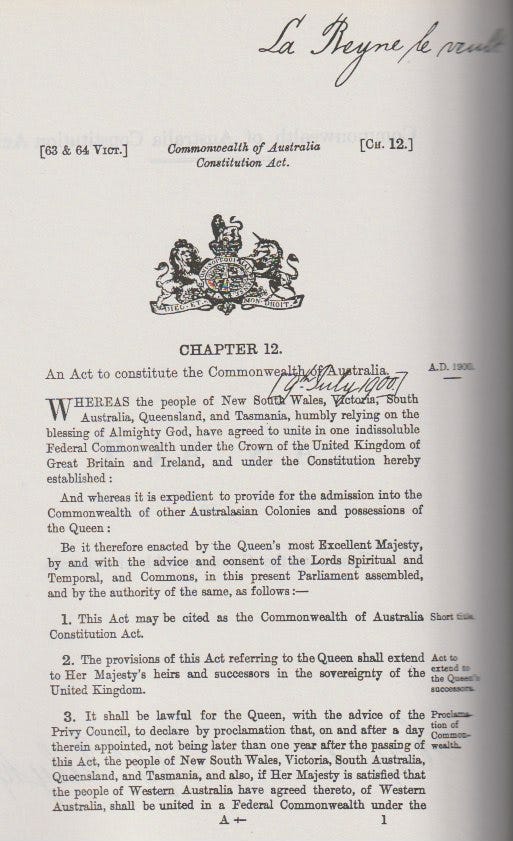
Assent copy of Australian Constitution 1900 (copyright expired)

Australia became a series of British colonies with barely a shot being fired, and later the colonies drew up a federal commonwealth, making Australia the only nation to occupy an entire continent.

Australia was happy to remain within the British Empire. Like Canada, New Zealand, India and all the other major colonial possessions, Australia was a self-governing Dominion, with the British Government exercising control through a Governor-General in the new federal capital of Canberra.

Over the years the Dominions became Realms, with the British relinquishing all control, and retaining the monarch as a notional head.

Some dominions — such as India and Ireland — became republics with presidents taking the role of the imperial governors, but otherwise retaining the Westminster-style legislatures of the imperial era.

All told, the old British Empire was more or less peacefully dismantled, and the resulting British Commonwealth of Nations might have the United Kingdom as an unspoken senior member with its own head of state — currently Queen Elizabeth II — holding the title Head of the Commonwealth, but there is no compulsion, no control from London, no chain of command.

I like to think of the British Commonwealth as a grown-up family. The paterfamilias occupies the seat at the head of the table, but the family members are adults and have their own lives. They discuss matters amongst themselves, but ultimately each member of the family makes their own decisions.

The republican journey

Australia, founded as a convict settlement, had a fair share of the rowdier members of the lower orders of British society. The Irish, in particular, were never entirely happy with their place in the Empire, and when Australia federated there was some momentum towards ditching the monarchy entirely in favour of an American-style republic.

This never happened, but it would be wrong to portray Australia as a land of loyal subjects supremely content to have the monarch’s head on the coinage, to serve as members of the Royal Australian Navy, to see the British Union flag taking up a quarter of the Australian national flag.

These symbols rankled with some, and there have always been grumblings and murmurings about finding some way to remove the monarchy.

The events of November 1975, when the Governor-General in Canberra removed the then Australian Prime Minister and sent the country off to an election, sparked a resurgence of republicanism.
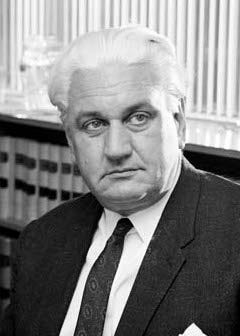
Governor-General Sir John Kerr (PD image via Wikipedia)

The Governor-General was seen as the Queen’s man and there was some suspicion that there may have been some move from Buckingham Palace to get rid of a reforming Prime Minister.

Not true — the Queen’s powers under the Australian Constitution are almost entirely notional and she is unable to direct the Governor-General in the exercise of his own powers. The Governor-General alone has power to appoint ministers and call elections (usually exercised on the advice of the Prime Minister) and though his actions were remarkably ham-fisted, they were his own.

Nevertheless, a fresh republican spirit was born that day, and twenty years later there were increasingly urgent calls to sever the last remaining ties to the United Kingdom.

The Constitutional Convention and referendum

In 1991, the Australian Republican Movement (ARM) was formed, aiming for the establishment of an Australian republic on the centenary of Federation: 1 January 2001.

This would involve a referendum to change the Constitution, a rare occurrence in Australia, but the political ducks lined up, and a Constitutional Convention was held during February 1998 in Canberra for two weeks of discussion and drafting of a model for a republic.

The ARM was the major single group at the convention, ahead of Australians for a Constitutional Monarchy, and a rag-bag coalition advocating the popular election of a president, as opposed to the ARM’s parliamentary selection, and ACM’s no change position.

The ARM’s model emerged as the one to be put to the voters. In an odd twist, the direct-election republicans joined forces with the monarchists campaigning for a NO vote, and the proposition was put to the people in November 1999. Four out of six States needed to support the referendum, as well as a majority of votes overall.
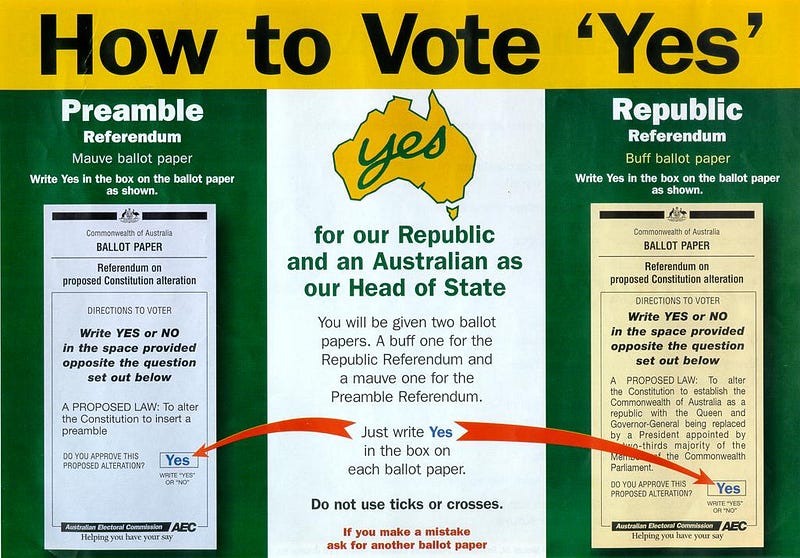
How to vote card for the YES case (CC image via Wikipedia)

In the event, the model was soundly defeated, with not one State voting YES.

Devastation and despair

Malcolm Turnbull, leader of the ARM, declared that Prime Minister John Howard, who had campaigned for no change, had “broken the nation’s heart”.

Politicians choosing opposing sides are no surprise in politics. Turnbull really only had himself to blame, for choosing a model which didn’t find favour with all republicans, and for indirectly pitting himself against the Queen, who has spent her long reign in assiduous royal duties and built up a considerable personal appeal.

In the twenty years since the referendum, the republicans have put forward regular griping sessions every Australia Day and every Queen’s Birthday holiday, made noises about another referendum, this time in a two-stage process to find the preferred model and then put that to the voters, and otherwise been remarkably quiet.

Turnbull became Prime Minister himself in 2015, but despite having opposition parties broadly in favour of a change, took no action on a fresh referendum.

Waiting on the Queen

It all seems to be up to the Queen now. The position of the ARM is that they won’t push for a change while the Queen is alive. Presumably, the accession of King Charles III would signal a renewed push. Charles is certainly not as popular as his mother, but then again, all the fuss of a royal funeral and a coronation might well give him a sort of honeymoon boost.
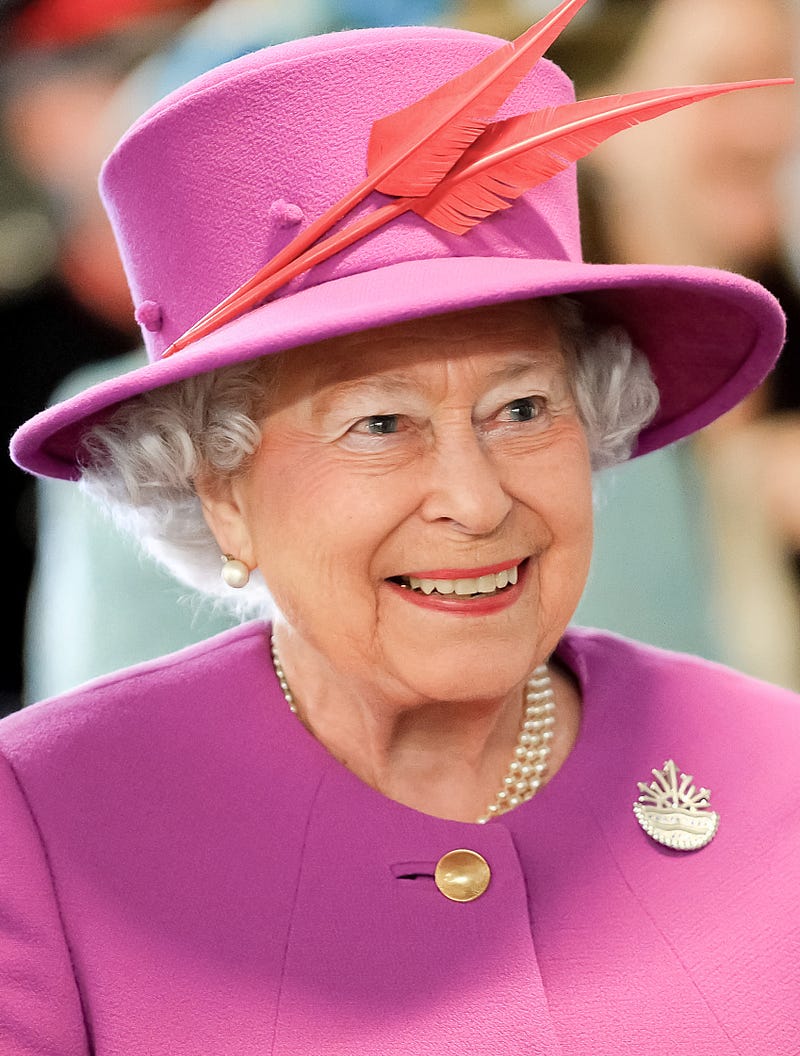
HM Queen Elizabeth II (OGL license via Wikipedia)

Not to mention the very real difficulties of choosing a model and fighting a referendum campaign. Do Australians really care enough about the monarchy to set aside time and effort from more important affairs?

Time will tell, I suppose. The Queen is 94 years old and could pass on any tick of the clock. Her mother died at 101 — her longevity sometimes attributed to being preserved in alcohol; she caused some amusement by getting into a stoush with the Archbishop of Canterbury at her 100th birthday party over a glass of wine — and there is no reason to think that Her Majesty will not last at least as long.

Long live our gracious Queen

While the Queen reigns over us, happy and glorious, Australia will take no further steps on the republican road.

But as soon as her long reign comes to an end — presumably some time within the next ten years or so, unless the anti-aging pill John Howard has been working on is a success — then Australia is in for a year or two of public debate and another referendum. Oh joy.

Britni

More Australian Constitutional articles:

History
Politics
Australia
Republic
Women
Recommended from ReadMedium