
Australia: Young and Free
Can you believe the national anthem?
Australians all let us rejoice For we are young and free. We’ve golden soil And wealth for toil; Our home is girt by sea. — Advance Australia Fair
The best part of our national anthem/dirge is that it fits the theme song of Gilligan’s Island perfectly. Or Emily Dickinson’s Because I Could Not Stop for Death, if you are less flippantly inclined.
The song, which was written in 1878, and did not become the national anthem — supplanting God Save the Queen — until 1984, stresses the youth and potential of the great southern land. Not to mention the uniqueness of our island continent home.
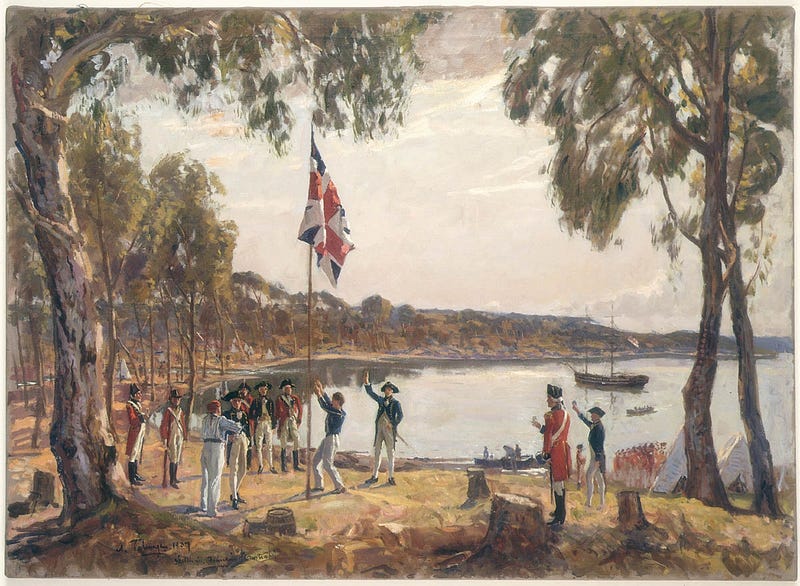
Australia was settled by the British in 1788, so our colony was already ninety years old when the song was first sung, and if we take Federation in 1901 as the birth of the Australian nation, it is 119 years old. Hardly young.
Each of the various States and Territories have their own histories and constitutions, but the Commonwealth of Australia came into being under a British Act of Parliament, to which the Australian constitution is an annex.
Australia’s birthday
One may argue that Captain James Cook claimed Australia for the British in 1770, that settlement began on 26 January 1788 when the flag was raised in Sydney Cove and permanent occupation began, or in a different sense one could say that the question was decided tens of thousands of years earlier when human beings arrived from Africa and took over the joint from the wombats.

Nevertheless, the nation of Australia really came into existence as a polity on the first day of the Twentieth Century when the federation of the various British colonies was proclaimed and a national government established, along with a Governor-General, Prime Minister, military forces, postal service and so on.
From that date the government has operated unobstructed under the same constitution, national elections every few years have provided representatives in parliament, there has been no foreign invasion, and sovereignty has been in the hands of Australians under more or less the same rules since that day.
Like any other creation over the years, changes have been made, and the current state, where minorities are able to vote, where marriage is extended beyond a man and a woman, where the independence from the British motherland is unquestioned, all these have occurred over the decades in a more or less seamless and natural progression.
And now we are very, very old
In that time empires have fallen and risen, wars have ravaged the world, nations which existed in 1901 are now distant memories, and countries which had kings and queens now do not.
Australia is now one of the oldest nations in the world. The United States, some European monarchies, a few others have escaped revolution, coups, constitutional restructuring, decolonisation and so on, and now Australia is very much a senior citizen.
What may have been true in the days of Queen Victoria, when it seemed that every other nation had a longer and prouder history than the infant Australia, is no longer the case. France, for example, in the time since the British raised the flag in Sydney Cove, has been three different monarchies, two empires, and five distinct republics, not to mention Vichy France and the German Occupation.
China, an ancient civilisation, began the last century as an empire, and has seen two revolutions since. It is certainly not the same nation that saw the sun rise on 1 January 1901.
Just one burr under the saddle
It may be a minor irritant, and for some it is a national shame, but the final unfinished business of Australian nationhood may be found in our constitution, and in reality has but the barest existence here, comfortably residing in various British palaces according to the season.
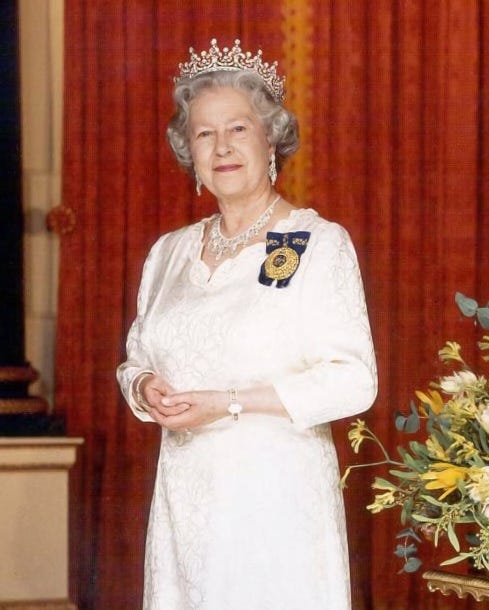

The British monarch retains a role in Australian affairs. While most people regard this as something like a Disney Queen ruling her far dominions from Buckingham Palace, the reality is that her influence is very minor. A paper monarchy. She might have the title of Queen of Australia, but nowadays that’s much like the notional titles of King of France, or Duke of Normandy, that the British monarchy kept on the books for form’s sake.
Since 1988, when Australia celebrated the Bicentennial, and 2001, when we had our Centenary, there has been a steadily increasing movement towards a more overtly republican form of government. After a popular referendum in 1999 resulted in a decision to retain the monarchy, the republicans have been lying in wait. Her Majesty, they say, is too popular to overthrow. Let’s wait until she is gone, and have another go.
Her Majesty is, as the Beatles noted, a pretty nice girl, and not every Australian feels the need to tell her to piss off. But she’s getting on a bit, and although everyone hopes that her reign is happy and glorious, long to reign over us, those days cannot last forever.
For myself, I’ve found the issue of Australian independence evolving over the years a fascinating story, and one with a chapter or two yet to be told.
Britni
Britni Pepper writes for Kindle Direct Publishing. She runs a blog where she reviews erotica, and rambles on about this and that. She may be reached on Twitter and Facebook.
More Australian history: