
Republican Governors Now Agree That Stock Buybacks Harm Working Americans
Corporate donors are going to be furious. Did Republican Governors just shoot S&P 500 corporations in the foot?

Related
• 5 Things You Need to Know About U.S. Stock Buybacks • Taxpayer Money Will Pay for Intel’s $81 Billion in Stock Buybacks…? • Starbucks Was Profitable Enough in 2019 to Double Employee Wages or Buy Back More Stock • Did This Happen by Accident to 89% of America’s Stock Market Wealth?
Recent
• Bruce Springsteen and 6 Fundamental Human Values Key to His Success • The 2 Reasons Populations Are Collapsing in Developed Countries • 3 Key Facts Everyone Is Missing About Biden’s Student Loan Debt Relief • Is It Up to Our Kids to Win the War Against Climate Change?
Potential to Change the Way You Think
• Why Are Fundamental Human Values Critically Important for Successful, Enduring Brands? • Life Expectancy vs. Healthcare Costs in the U.S. (and Japan, Germany, France, Spain, Portugal, etc.) • Pressing Where It Hurts: How to Win Fights That Matter • (1a/9) “Top-Down” Makes More Sense Than “Left-Right” in the U.S.

On September 12, 2022, Republican governors from 22 states sent a letter to President Joe Biden opposing Biden’s “plan to force American taxpayers to pay off the student loan debt of an elite few...
…a plan that is estimated to cost the American taxpayer more than $2,000 each or $600 billion total, a price the people of our states cannot afford.”
I am happy — no, I am thrilled — to take each of these 22 governors at their word that what they say is correct and that they are speaking honestly and from the heart about their motives.
Specifically:
- The governors oppose this spending to pay off student loan debt.
- Let’s assume that they are correct that the ultimate cost will be $600 billion over 10 years.
- And let’s take at face value that their only real objection is that there will be a transfer of a substantial amount of money — $600 billion — over 10 years from working Americans/taxpayers up to “an elite few.”
The governors say that:
“only 16–17 percent of Americans have federal student loan debt, and yet, your plan will require their debts be redistributed and paid by the vast majority of taxpayers. Shifting the burden of debt from the wealthy to working Americans has a regressive impact that harms lower income families.”
This leads us to 2 questions:
- How do we connect the dots from student loan debt relief to corporate stock buybacks?
- And are corporate stock buybacks really as big a deal as forgiving $600 billion of student loan debt?
Let’s answer both questions.
Connecting the dots from student loan debt relief to corporate stock buybacks
These Republican governors clearly state that what they have an issue with is the idea that Biden is is taking money away from working class people and giving it to wealthy doctors and lawyers and professors.
Specifically, they say that “only 16–17 percent of Americans have federal student loan debt, and yet, your plan will require their debts be redistributed and paid by the vast majority of taxpayers.”
They also note that Biden’s plan will “force American taxpayers to pay off the student loan debt of an elite few.”
I would note that the Penn Wharton Budget Model estimates “that a one-time maximum debt forgiveness of $10,000 per borrower will cost around $300 billion for borrowers with incomes less than $125,000. This cost increases to $330 billion if the program is continued over the standard 10-year budget window. Eliminating the borrower income limit threshold produces a 10-year cost of $344 billion.”
The worst-case scenario from this model is that the 10-year cost is $344 billion, not the $600 billion that the Governors called out in their letter.
For the remainder of this article, I will continue using the Governors’ incorrect number of $600 billion to be “conservative,” but I suspect strongly that they were using wrong assumptions to arrive at that number.
Let’s go connect some dots:
- The $600 billion that the Governors are frantic enough about to send this letter to Biden is actually $600 billion over 10 years. Let’s assume the costs are spread out evenly over those 10 years. That means the per-year cost is $60 billion.
- By contrast, stock buybacks by S&P 500 corporations in 2022 alone are projected to be more than $1 Trillion. That is the same as $1,000 Billion.
- For more detail on this, please see my article from earlier this week: “5 Things You Need to Know About U.S. Stock Buybacks”
- But the key “size” takeaway is that $1,000 billion is a lot more than $60 billion.
- Unlike the Governors’ stated concern about the benefit of the student loan debt relief going to “only 16–17% of Americans [who] have federal student loan debt,” the benefits of stock buybacks accrue mainly to the Top 10% of Americans who own over 89% of U.S. stock. And the Top 1% Wealthiest Americans own over 53% of U.S. stock.
- The key “who gets the money?” takeaway is that a far smaller slice of truly elite Americans are getting the fruits from that $1 trillion than is the case with the student loan debt relief.
Are corporate stock buybacks really as big a deal as forgiving $600 billion of student loan debt?
If the Republican Governors are concerned about $60 billion in benefits going to only 16–17% of the population . . .
. . . then their hair must be on fire when 16 TIMES that amount — $900 billion! — is going to the Top 10% of Americans in just 2022 in the form of stock buybacks.
- This number is 15 TIMES the $60 billion number for student loan debt relief they called out in their letter.
- And they must be so angry that they’re levitating 10 feet in the air at the prospect of $530 billion going to the Top 1%.
- That’s almost 9 times the $60 billion number they used . . . and this 9X number is going to the Top 1%, not the “Top 16 or 17%” that they called out.
But what does corporate stock buyback money have to do with taxpayer money.
Turns out, buyback money has a lot to do with taxpayer money.
I discussed this also in the “5 Things You Need to Know About U.S. Stock Buybacks” article from earlier this week.
When companies do stock buybacks:
- That is money that the company no longer has to invest in things like: capital equipment, employee compensation, saving money for a rainy day, starting new projects that might mean new revenue sources, etc.
- For instance, Starbucks was profitable enough in 2019 to double everyone’s wages or buy back more stock. So when Starbucks board member Howard Schultz claimed they didn’t have enough money to pay employees more, he was lying. They had the money, but they chose to use it instead to pump up the stock price by buying back more stock. It was a choice, not a necessity.
- Working class Americans — the majority of Starbucks employees — were hurt by the choice to buy back stock instead of paying employees more or investing to make Starbucks stores more productive.
A key reason why companies buy back stock is to avoid having to pay taxes on it.
- So $1 trillion worth of stock buybacks that won’t have federal or state taxes paid on it is — in technical terms — a lot of tax revenue that these corporations get to avoid paying.
- That means that the regular working class Americans that the governors are so concerned about will have to make up that amount of money.
How much money are we talking about?
- If we assume only a 20% corporate tax rate, that is $200 billion in tax revenue that working class Americans will have to make up in 2022 alone.
- $200 billion is QUITE A BIT LARGER than the $60 billion (incorrect) number that the 22 Republican governors are incensed about. It’s 3.3 times larger, as a matter of fact.
- So just on this basis, we can safely assume that these 22 Republican governors would be 3.3 times more angry and outraged about corporate stock buybacks than they are about Biden’s student loan debt relief.
But it’s also fair to suggest that since the largest component of inflation over the past 12+ months in the U.S. has been due to companies price-gouging their customers — just because they could — and making windfall profits as a result, the tax rate should be higher.
Let’s call it the “50% Windfall Tax on Price Gouging Corporations” tax.
Now, these corporations might push back some and that the tax will actually get collected when the owners of the stock sell it, so if they — the corporations — were to be taxed, those profits would be double-taxed.
No. That’s not correct, and it is self-serving. The wealthy beneficiaries of these stock buybacks can fairly easily avoid paying ANY tax on the stock gains.
For details, see this Forbes article “How The Rich Use The Buy, Borrow Die Strategy To Avoid Large Tax Bills” or this article from White Coat Investor “The Buy, Borrow, and Die Strategy.”
Remember that while this approach generally only gets used by wealthy investors, it’s wealthy investors who own the majority of stock in the U.S.
So it really is working class Americans who end up footing the tax bill for the hole left by truly tax-free stock buybacks. BOHICA!
But wait — the sense of injustice and unfairness filling the hearts of the Republican governors wouldn’t stop there.
Because in their heart of hearts, they certainly know that money given to The Top 1% doesn’t really circulate in the economy to any significant extent. It’s like a stagnant dead pool of money that just sits there and does nothing.
By contrast, money given to the working class — whether it’s blue collar or white collar workers circulates within communities to a MUCH larger degree. So when working class families have money to spend, they spend it in their communities — grocery stores, dry cleaners, car repair shops, general shopping, etc. — so there is a “multiplier effect.”
So money given to the wealthiest 1% in the wealthiest 10% of the population hurts working Americans (1) not only because they have to make up the difference through their taxes, but (2) also because that money won't be circulating in their communities and supporting the local businesses through a multiplier effect.
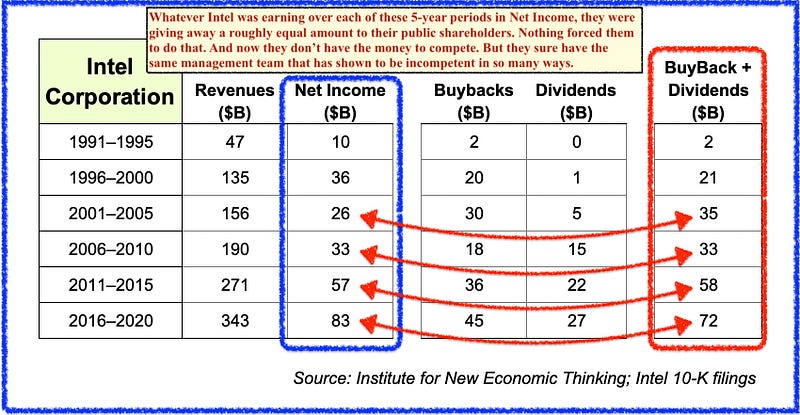
Also, I alluded to this earlier, but when companies give away all of their free cash, it means they can’t handle emergencies. They are more likely to have to go hat in hand to the Federal government or to various state governments to hit them up for a bailout.
You know . . . the way Intel went begging for money recently, as detailed in “WTF! Our Taxpayer Money Will Pay for Intel’s $130 Billion in Stock Buybacks and Dividends?”
So when this happens, working class taxpayers have to foot the bill for bailing out companies like Intel that actually HAD far more cash in the bank than they needed to compete globally . . . but chose instead to blow that money on stock buybacks.
As I noted in the “5 Things You Need to Know About U.S. Stock Buybacks” article, over the past 15 years from 2008 to 2022, “S&P 500 corporations are on track to have spent over $8 TRILLION on stock buybacks.”
If there were only a 20% corporate tax on that $8 trillion in stock buybacks, that would have been an extra $1.6 TRILLION in tax revenue.
Folks, I am furious about this and about the fact that over the past 15 years, nobody in any Congress or any White House administration has called this out for the corrupt dealing that it is . . . and for the massive harm that it does to America’s working families.
To use the Governors’ own words, with that $1.6 trillion of foregone tax revenue, the U.S. government shifted the burden of $1.6 trillion “from the wealthy to working Americans” and it absolutely “has a regressive impact that harms lower income families.”
If the 22 Republican governors are true to the letter and spirit of their joint letter to President Biden, then I am thrilled to know that they share my fury and outrage.
I am also thrilled to be able to assume that they will be fighting 5X to 10X harder against corporate stock buybacks than they are against student loan debt relief.
After all:
(1) there’s far more than 10X the amount of money at stake with stock buybacks, and
(2) it is going to a FAR narrower and wealthier slice of the population than is the case with the student loan debt relief.
Related
• 5 Things You Need to Know About U.S. Stock Buybacks • Taxpayer Money Will Pay for Intel’s $81 Billion in Stock Buybacks…? • Starbucks Was Profitable Enough in 2019 to Double Employee Wages or Buy Back More Stock • Did This Happen by Accident to 89% of America’s Stock Market Wealth?
Recent
• Bruce Springsteen and 6 Fundamental Human Values Key to His Success • The 2 Reasons Populations Are Collapsing in Developed Countries • 3 Key Facts Everyone Is Missing About Biden’s Student Loan Debt Relief • Is It Up to Our Kids to Win the War Against Climate Change?
Potential to Change the Way You Think
• Why Are Fundamental Human Values Critically Important for Successful, Enduring Brands? • Life Expectancy vs. Healthcare Costs in the U.S. (and Japan, Germany, France, Spain, Portugal, etc.) • Pressing Where It Hurts: How to Win Fights That Matter • (1a/9) “Top-Down” Makes More Sense Than “Left-Right” in the U.S.
Want me to cover a topic? Please post suggestions in the comments, and I’ll use your input to help prioritize my writing and research.
If you appreciate my writing, please share it on social media.
Want unlimited access to all Medium articles? Become a member!
Again, thank you for reading, subscribing, clapping, and sharing — your time and attention are deeply appreciated!


