
Renegade Daisies
Life lessons from the garden
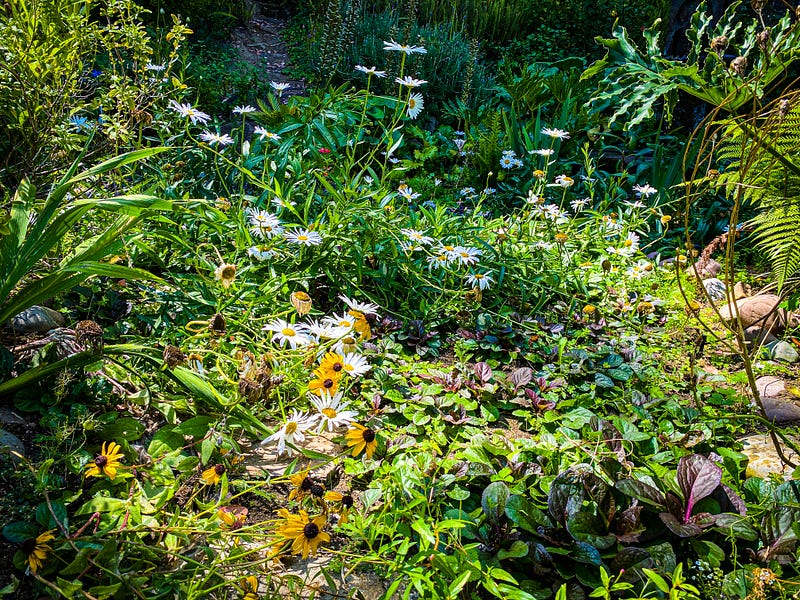
Every spring, I sprinkle seeds within the outlines of my rock borders. And every summer the daisies ignore my attempts to tell them where to grow, and instead, sprout exactly where they have chosen to appear. They have done this magical migrating act for more years than I can remember.
They emerge from the earth in unruly eruptions of fluttering petals and golden crowns, right alongside their companions, the renegade coneflowers, smack dab in the middle of the garden. They spill across the stepping stones and crowd out the ajuga ground cover. They seem to know, somehow, that the light, slipping through the trees on the hill, will be “just right” exactly there.
My husband has always told me that I am not very good at “staying inside the lines.” And I suppose that is true. And for a creative person, I take that as a compliment. Thinking outside the box has always allowed me to catch glimpses of things that a lot of people never even look for.
It has always seemed to me that Nature has a grander plan than we do. She doesn’t color “in the lines” and she knows how to thrive in unexpected niches. She seeps from the earth in tender mosses in the shady spots puddling near my rock walls. And the mint that I once planted, almost twenty years ago, has a life plan of its own — re-emerging year after year in my front yard and under my lemon tree, far-far away from the little garden herb plot that I so naively planted long ago. People had warned me about mint. But, I, for some reason — youthful stubbornness I suppose — did not listen.
We recently had a friend over to our house. While floating around the pool, wine glass in hand, he took in the wildness and commented, “You really need to trim your trees.” What he didn’t realize was that the Giant Bird of Paradise he was eyeing, which arches up from the hillside to reach out over the balcony, has evolved to thrive in its environment. It now stands thirty feet tall. But I planted it from a gallon container when we first moved into our house. It learned to follow the light, threading its way through the shadows of the taller trees.
That Bird of Paradise has put down roots that counterbalance the weight of a solitary arm that reaches out into the sun to bring the life-giving gift of photosynthesis back to the rest of the organism. The other branches also bow more and more towards the hillside with every passing season to provide additional counterweight.
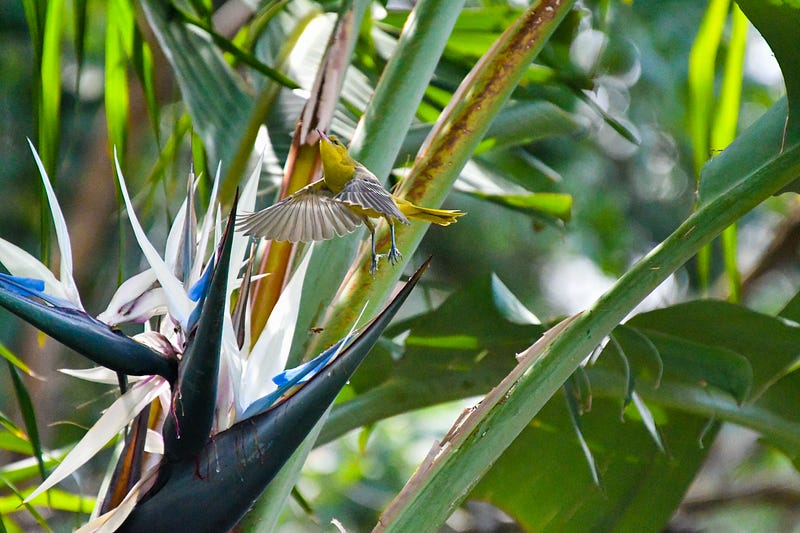
Every year, orioles, bright yellow males and paler (more like the color of lemonade) females, migrate all the way from Mexico to our backyard. It is said that they return to the same yard each year and that their children do the same. I wonder sometimes about how many generations of orioles have been raised here.
Those orioles know that the Giant Bird of Paradise’s milky white flower will be dripping with nectar when they arrive from their great trek. And they also know that our two native palm trees, the ones a landscape architect-friend once told us we should pull out, will be here waiting for them to build their nests in a hundred feet up off of the ground, where they are safe from most predators.
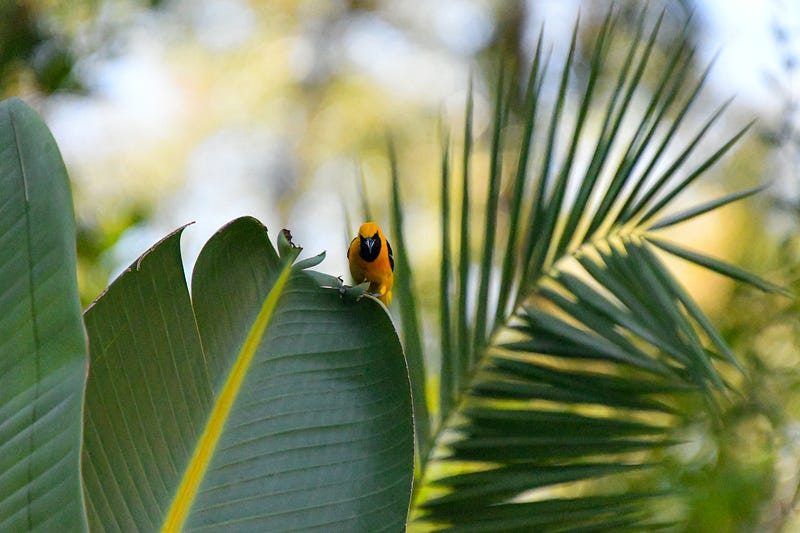
Two summers ago, we watched a pair of orioles darting, one after the other, over and over, into the entrance of the coconut-shaped nest they had constructed up in the palm fronds. Like a blimp hanger, it had two holes. They would fly into the entrance, worm or bug in their beaks, and pop back out the other side again, in quest of the next snack. Their tirelessness in the time of their chickling’s need exhausted me.
Eventually, their baby made an appearance on the edge of the nest, wobbling precariously a hundred feet up. We held our breath, terrified he would fall. But he didn’t. Within a day or two he learned to hop out onto a frond. And about a week later he took his first swooping flight, dad in tow, to a nearby tree.
Mother Nature knows what she’s doing. Sometimes, I think that we, humans, try way too hard to stamp our own ideas about what she should look like onto her ever-changing form. But she will always find her way, with or without us. And she will always paint a more elaborate picture than we will ever truly understand.
I am so glad we never chopped down those palm trees or trimmed our unruly Giant Bird of Paradise. Otherwise, we wouldn’t have been gifted with the chance to watch a baby oriole take its first tenuous flight.
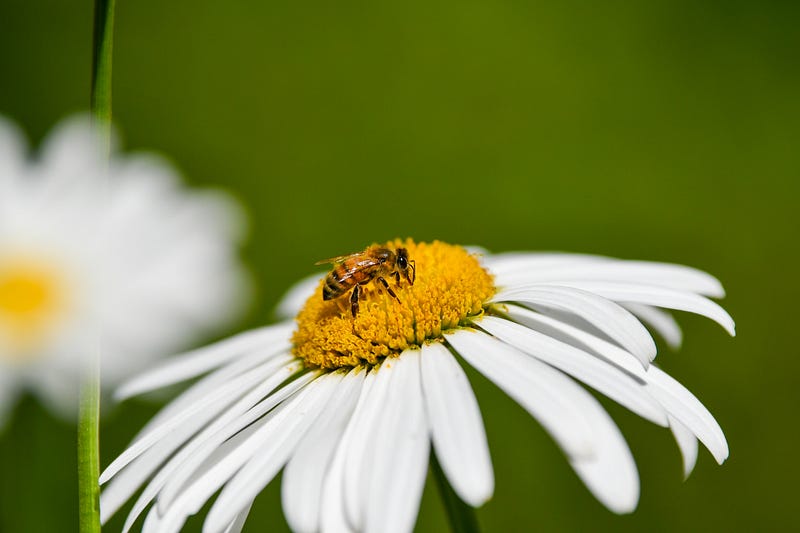
So, every summer when I watch my renegade daisies bobbing in the breeze, buzzing with bees and moths and butterflies, it makes my heart happy to know that they have found their way back to where they will flourish. Within that little patch of flowers, an entire eco-system exists.
And that tiny eco-system is integrated into the larger scope of my wild garden in a complex, cascading symbiotic relationship. The daisies need the sun, and the bees need the daisies, and we need the bees to pollinate our fruits and vegetables and flowers. And, coming full circle, the daisies need me to just stay out of their way and let them do what daisies do, which is to dance in the light of the late afternoon.
I think, sometimes, that we try too hard to make sense of everything we encounter in the natural world. It’s human nature to feel like we have some control over our environment. But, perhaps, the lesson Mother Nature most wants to teach us is simply to step back, to observe, and begin to understand our own small part in the vaster workings of the Universe, beginning right here in our own backyards.
Erika Burkhalter is a yogi, neurophilosopher, cat-mom, photographer, and lover of travel and nature, spreading her love and amazement for Mother Earth’s glories, one photo, poem or story at a time. (MS Neuropsychology, MA Yoga Studies). Erika is also an editor for Dharma Talk.
Thank you for reading. You might also enjoy:
Story and photos © Erika Burkhalter 2020. All rights reserved.