
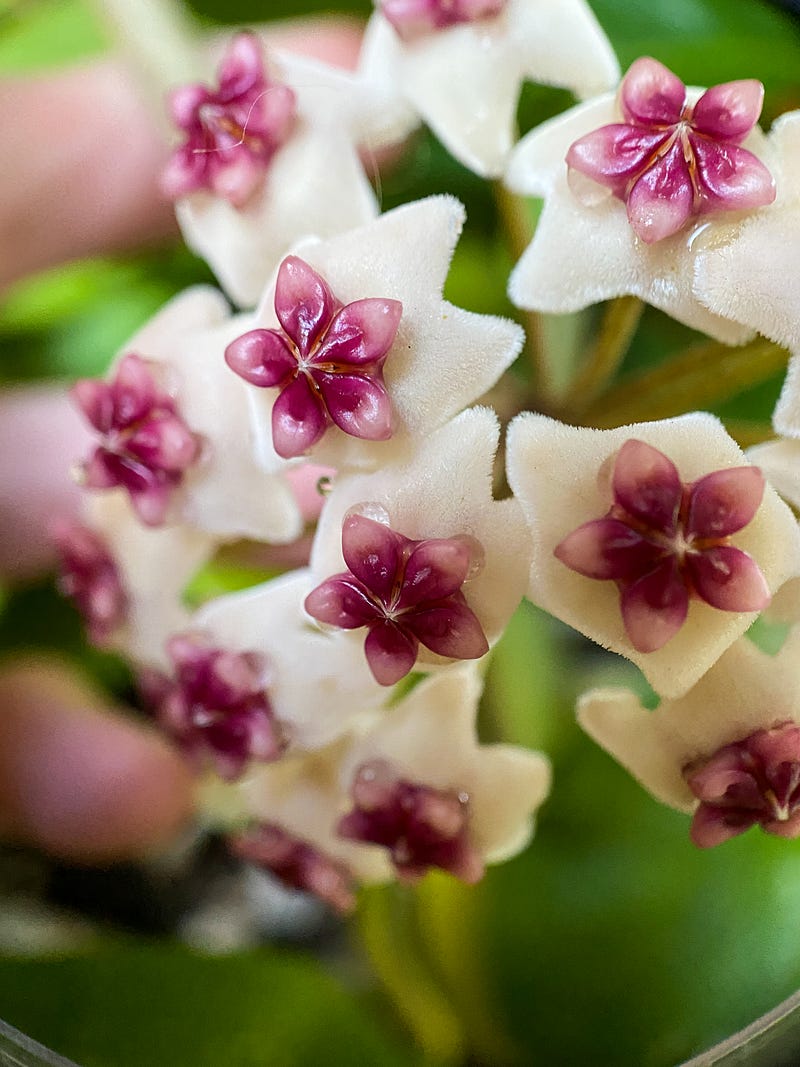
The Upside-Down Flower
Learning to see with our “wholeness of being”
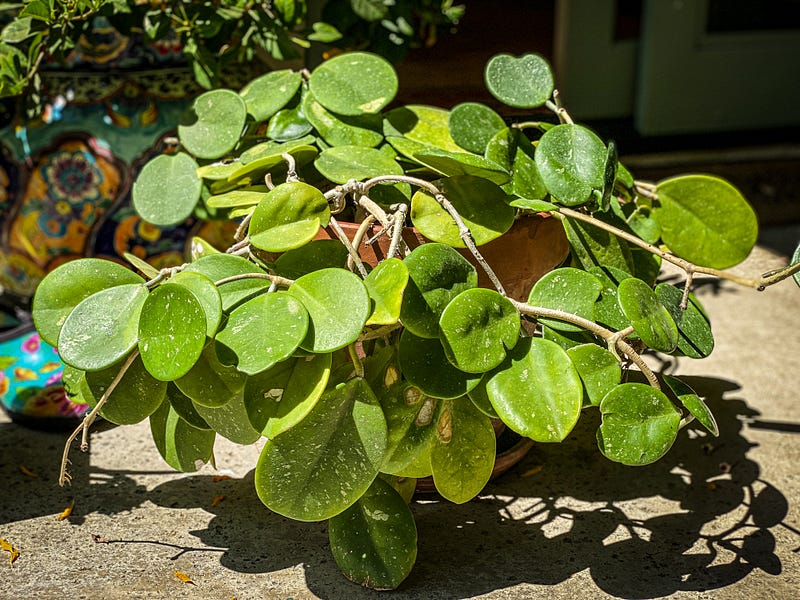
I first saw it tucked under the weathered-grey planks of an old potting bench in one of the little family-owned nurseries which I frequent. Its waxy rounded leaves did not seem to fit in with the other succulents it was surrounded by — which is precisely why I bought it.
I love growing succulents. Their blooms, arching into lipstick-orange fireworks or candied pink buds, always delight me with their showiness. The plants, beautiful in-and-of themselves, really outdo themselves though when it is time to flower. I’ve often wondered how the goddess could even imagine such intricate beauty. It seems like no two blossom stalks, let alone the individual flowers, are ever the same.
So, when I bought the humble hoya carnosa, I imagined it might produce some sort of blossom, but it was hard to say what it would look like, since the plant really didn’t look like a succulent at all.
I potted the hoya carnosa up and placed it outside the door to my back porch and admired it for a few years, not for its elaborate flowers (it didn’t seem to flower at all), but for its steadfastness. It was, honestly, not a very flashy plant. It was a surviver, but never looked as if it was flourishing.
So, this summer, when I noticed an odd upside-down flower erupting from the underside of the plant, it was with a certain amount of incredulity. I turned the orchid-like stalk, from which it hung, upright and marveled at the nectar-dripping, waxy pink flower cluster reaching down from the underside of the plant towards the earth.
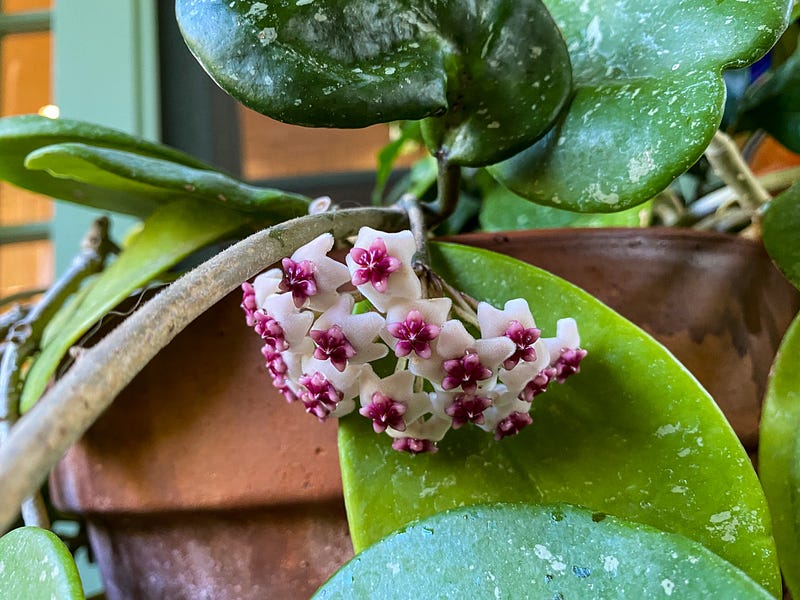
As far as I know, my hoya carnosa had never flowered before. Or, if it had, I had utterly missed this display for years.
The flower’s emergence was startling. But the most moving things in life often derive from the most ordinary sources. And this cluster of cotton-candy and lollipop pink buds, laden with the stickiness of fertility, inspired a renewed hope for the future of our troubled world in me. Somehow, if Mother Nature could create something this beautiful out of something so plain, it demonstrates to me that she is adaptable enough to survive her current plight.
Nature always surprises me — with her ferocity, her adaptability and her moments of anticipated extraordinariness.
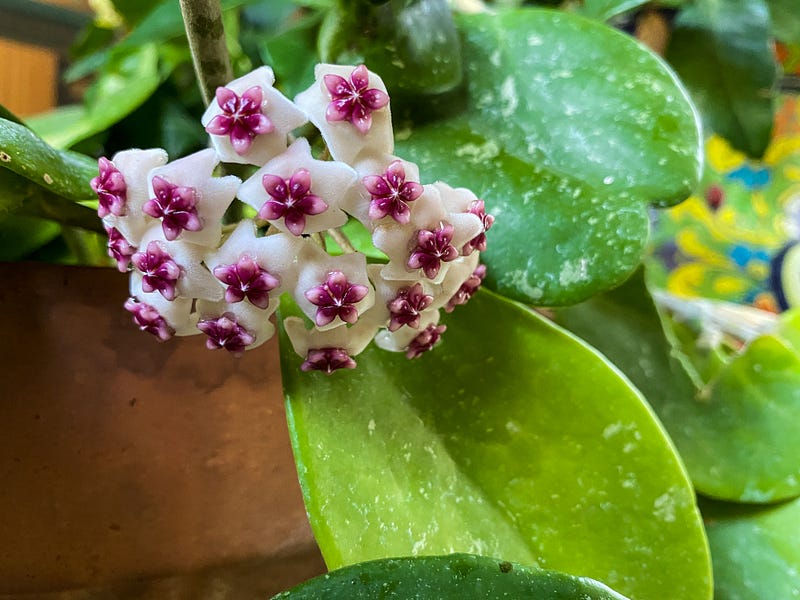
A few days after discovering the magnificent bloom, I found myself crouched down by my hoya carnosa, peering at its underside again, and I found a new surprise awaiting me. What looked almost like an embryonic flower, with smooth pentagonal pods, had spring from further down the same spur from which the original flower had sprung.
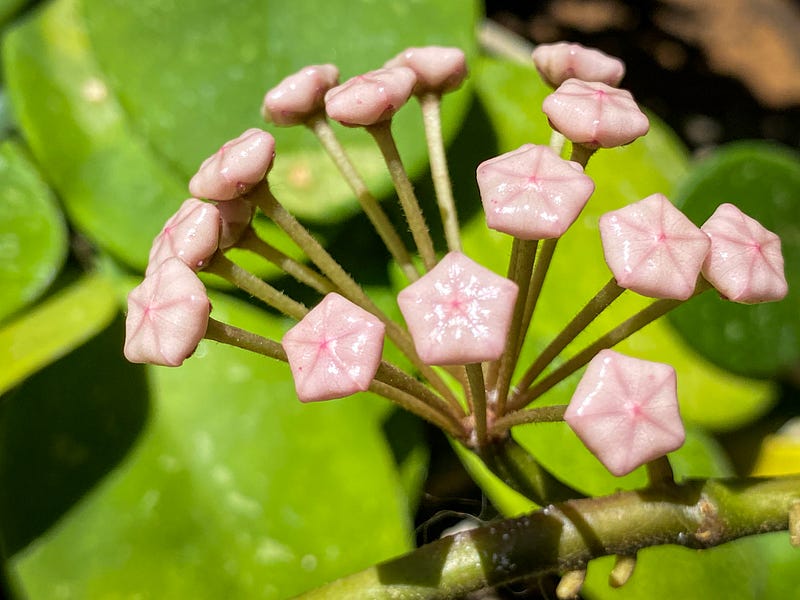
After a little investigation, I discovered that these spurs should never be cut off because, although it may take a while before it buds the first time, all of the flowers in following years will spring from these same spurs.
My humble plant has inspired a new-found love in me. It also made me really stop to think a bit about the things in life that we maybe never see because we are expecting to see something else entirely. If we can only open our eyes to see with the infinity of our wholeness of being, rather than through the lens we have been taught to look through, who knows what other wonders await us?
Erika Burkhalter is a yogi, neurophilosopher, cat-mom, photographer, and lover of travel and nature, spreading her love and amazement for Mother Earth’s glories, one photo, poem or story at a time. (MS Neuropsychology, MA Yoga Studies). Erika is also an editor for Dharma Talk.
Thank you for reading. You might also enjoy:
Story and photos © Erika Burkhalter 2020. All rights reserved.