
Remembering the Horrific Nuclear Disaster of Fukushima, Eleven Years Later
A personal reflection in light of current world events
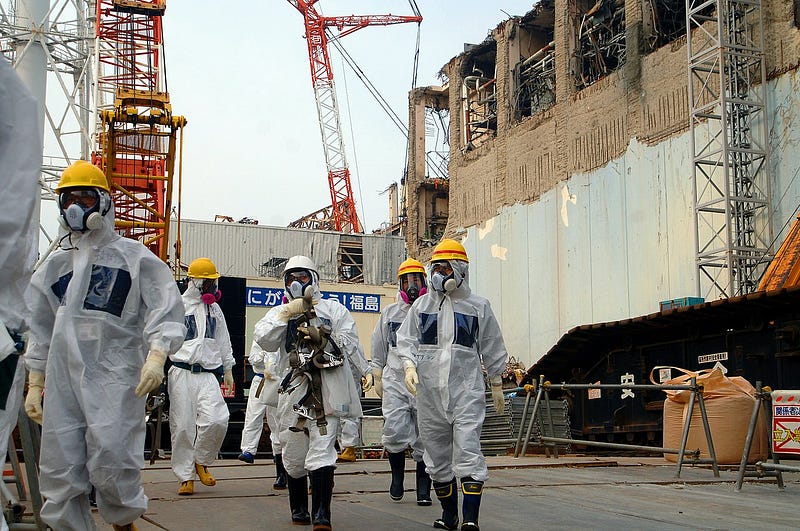
This is a personal reflection that was written in response to Japonica Publication’s call-for-submissions to commemorate the eleventh anniversary of the disaster of Fukushima on 2011, March 11.
To be honest, it has been very hard for me to write about anything these days. My mind is somewhere else. Specifically, thinking about the tragedy that is playing out in Ukraine, even as I write this story.
Don’t worry, this is a story for Japonica Publication, so this is a story about Japan.
When Disaster Struck Fukushima
I still recall the day when calamity struck the Eastern coast of Japan on 2011, March 11. I was in Singapore, at that time still a graduate student in sociology. When I first heard the news about the massive earthquake that had rattled the eastern part of Japan, I did not know that there was a nuclear power plant in Fukushima.
Little did I know that the damage from the tsunami would soon begin one of the most frightening nuclear accidents in history.
The tsunami that struck Fukushima breached the sea walls and the Fukushima reactors, shutting off the power that kept the cooling systems online. The excess heat had nowhere to go, and this set off a series of chain reactions that led to a nuclear meltdown.
Over the next couple of weeks, the world would tune in to see how the Japanese would deal with a nuclear disaster unrivaled in severity since the Chernobyl accident in 1986.
Lucky for Fukushima, the radioactive fallout did not disperse into the environment like it did in Chernobyl. Workers on site kept pumping cool water into the melted nuclear cores to keep them from overheating and exploding.
The only problem? There was nowhere to release the water without poisoning the ocean with toxic radiation. Every day the news would report more and more tanks of water being filled. The only option was to store it on site.
The wastewater is still there today, and there is a lot of it.
More than one million tons of radioactive water.
It is not possible to keep storing the wastewater on-site. In 2021, the Japanese government announced the plan to release the treated wastewater into the ocean. This will most likely begin as soon as 2023.
For the folk whose livelihoods depend on the sea, the idea of releasing radioactive wastewater into the ocean must no doubt be anxiety-inducing — perhaps even anger-provoking. Needless to say, neighboring countries are having none of it.
I trust that the Japanese government and the relevant scientific agencies have done their research. I believe that they have decided to take the least risky approach. Still, I cannot help but feel concerned, because I understand where the opposition is coming from.
After all, dumping contaminated wastewater into the sea is a practice that has a historical antecedent in Japan.
Before Fukushima, there was Minamata
In the 1950s, industrial pollution of water by a form of mercury called methylmercury in the city of Minamata, Kumamoto Prefecture, caused mysterious deaths.
The first case was recorded in 1956. The symptoms were baffling. The disease struck all of a sudden, out of nowhere.
Previously healthy people would suddenly experience “difficulty walking, difficulty speaking, and convulsions.” And no one had any idea what was causing it. After a three-year investigation period, the Kumamoto University Research Group, which had been formed to study the outbreak, finally discovered the cause. It was not contagious, as was previously believed.
It was due to nervous system poisoning by a heavy metal, methylmercury, that enters the human body primarily through fish and shellfish.
The outbreak of Minamata disease took a long time to be socially and institutionally recognized. The factory that had directly caused the pollution even tried to deny any responsibility, and even installed a “purification system” that in reality, did nothing.
Unfortunately for the citizens of the city, many victims succumbed and died. Even if they survived, they never recovered from their severe debilitating ailments. The damage is permanent. Even unborn children were not immune.
Methylmercury accumulates in the unborn fetus, and it causes severe neurological development problems.
Even today, many victims are still waiting to be recognized as victims. Despite it being a non-contagious disease, the rumors and taboo associated with it stuck around, and many victims were also discriminated against.
Japan’s Uneasy Relationship with Nuclear Power
The Japanese government has the backing of the International Atomic Energy Agency to discharge the treated wastewater, in line with international protocol.
Even so, some scientists have voiced concerns about whether the treatment will reduce the radioactivity of the contaminated water to a sufficiently low enough level, given that the sludge is made up of dangerous isotopes with longer half-lives that escape the current treatment process.
It is beyond the scope of this article to go into the technical and scientific details. If you are interested, you can read more here.
Obviously, low risk doesn’t mean zero risk. Let’s hope we don’t see a repeat of a similar tragedy like that of Minamata.
Japan doesn’t need another one.
About a month after the Fukushima earthquake hit, I traveled to Japan. I reasoned that the low-priced air tickets were worth the risk. And on top of that, I believed that most travelers would be avoiding Japan.
I was a lot younger, and a lot more fearless.
Traveling to Japan right after the earthquake gave me a perspective that most foreigners living outside of Japan might not have had. People were putting up “no nuclear” signages — I remember this was in the Kamakura or Shōnan region, near Tokyo.
Not surprisingly, with the rising public protest against nuclear energy, the Japanese authorities started to shut down nuclear plants. Prior to 2011, Japan was generating 30% of its energy from nuclear energy. In 2019, this amount had shrunk to only 7.5%.
Japan is a modern nation that is energy-hungry. Just think of all the modern technology like fax machines and the ubiquitous vending machines all over the country that require energy to run. Japan needs energy, and it needs to import most of it.
To become more self-reliant, from the standpoint of the Japanese government, there is no other practical option but nuclear energy. Unlike solar energy or wind energy, nuclear energy is efficient, predictable, and works 24/7.
The only risk — black swan events that no one can predict.
There is no quick and practical alternative, and the choice is clear.
Still, it is a fact that Japan has a very uneasy relationship with nuclear power.
As everyone knows, Japan is the only country in the world that has suffered a nuclear attack. Not one, but two atomic bombs were detonated over the country.
Atomic bombs are a curse and should never have been invented.
Ukraine and Fukushima
The story comes full circle back to Ukraine.
Ever since the news of the invasion of Ukraine hit the news on the 24th February 2022 and upended the modern geopolitical world order as we know it, it has been quite difficult for me to write about anything else. Almost everything I see and read online is about the disaster happening in Ukraine.
Russian soldiers made one of their first advances via the Chernobyl exclusion zone. No one lives here, since it is contaminated with radiation, even to this day.
Fighting near a decommissioned nuclear power plant, the meltdown of which caused a massive radioactive fallout across northeastern Europe in 1986?
That sounds like bad news.
Within about a week, Russian forces quickly captured another nuclear power station — Zaporizhzhya Nuclear Power Plant. I remember waking up to the news that Russian forces were “shelling” the nuclear facility, and that a fire had broken out at the plant.
Utter madness.
If the nuclear reactor becomes compromised, either due to military bombing, or human error from the stress of the war, I cannot imagine the ecological disaster that will ensue:
However, an accident or explosion at Zaporizhzhia, which is far bigger than Chernobyl, could lead to far more serious consequences than the 1986 incident. This could result from fresh attacks, or even a loss of electricity. The latter situation could prevent the reactor cooling system from working, and lead to an explosion (this was the cause of the Chernobyl disaster). — UN News, Russian military control of Ukraine nuclear plants cause for grave concern, nuclear energy agency warns
Putin’s forces are already gunning for a third nuclear plant. By this time this article is published, it might already be under Russian control.
That the war in Ukraine involves nuclear power plants is bad news. The fact that Russia has nuclear weapons is even more bad news. And the fact that NATO also has nuclear weapons is triple bad news.
The Cold War doctrine of Mutually Assured Destruction means that if we do get a third world war, and if it devolves into global nuclear warfare, we should start saying our prayers. It will ensure the swift destruction of all sides embroiled in the fighting, and possibly the entire world.
No one wants to risk it.
Even Prime Minister Kishida spoke out on the attack on the nuclear power plant, based on the Japanese experience of the Fukushima Daiichi Nuclear Power Station.
Japan knows very well what a nuclear accident could bring.
Japan also knows very well the devastation that a nuclear war will bring.
And so, on March 11, 2022, as we remember the pain, tragedy, and anguish of Fukushima, we should also remember not to take peace for granted.
I pray for the fighting in Ukraine to cease, but some part of me wonders if I pray in vain.
©Alvin T. 2022
For further reading on nuclear energy in Japan and the accident surrounding Fukushima, see the links below:1. Fukushima Daiichi Accident — World Nuclear Association (world-nuclear.org)2. Nuclear Power in Japan | Japanese Nuclear Energy - World Nuclear Association (world-nuclear.org)3. Nuclear Power 10 Years After Fukushima: The Long Road Back | IAEAThe author writes on a variety of topics. His key topics are society, culture, modern work, and cryptocurrency, with the occasional fictional story, creative piece, or reflective essay. Discover his most-read stories here.
If these topics interest you, consider subscribing to receive new stories from the author via e-mail.


.jpg)