
Remembering Herbert
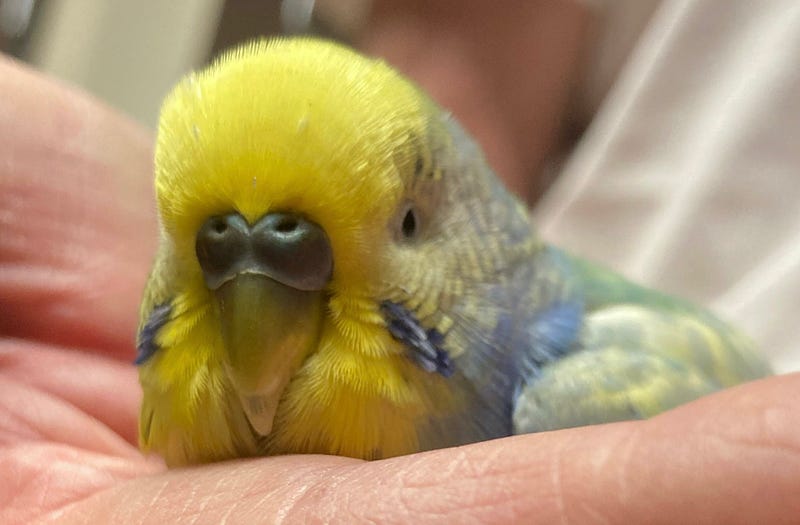
A few days ago, my husband and I had to say goodbye to Herbert, our best little buddy of nine years. Though he had been in gradual decline for a few months, we didn’t think he was sick — just slowing down, maybe.
But then we noticed he couldn’t use one foot, and a few days later, he lost use of the other one. He was uncomfortable and could no longer perch, climb, or groom himself. He became lethargic and stopped singing, and he could barely get around because of his useless legs and feet. At first, we thought he might have a bird malady, new to us, called bumblefoot, which seemed to be curable from what we could surmise online.
When we took him to the vet, expecting to discover how we could help him recover, she diagnosed him with advanced gout and told us that it was likely his kidneys were essentially shot. She rehydrated him and showed us how to feed him drops of tasty pain medication. She gave us more to take home with us and asked us to return in two days, ostensibly to recheck him, though we understood that she was gently advising us to have him euthanized. Over the next couple of days, we slowly came to terms with the fact of his condition. We took him back for his second appointment and left without him.
It’s been three days, and the silence in our mountain cabin is thick and heavy. This small but significant light has left us, and we’re deeply sad.
Maybe you have to believe in the value of everything to believe in the value of anything. ~ Jon Mooallem
Herbert’s death brought to mind other losses in my life. Some might find it strange to compare the loss of a parakeet to the loss of a human life, but I have come to understand that death is death. Whatever animated Herbert no longer does. Whatever made his tiny heart beat and wings flap, whatever mysterious energy embroidered the silence in our home with seemingly endless warbling and birdsong is gone. His little body, all 22 grams of it, is likely ash by now, and we are left with poor, second-hand equivalents — videos, pictures, and memories.
His cage was always open, so he would often fly over, land on our heads, and share meals with us by perching on the side of a plate and nibbling. Other times, he preferred to stay in his home territory and eat seeds from his hopper or millet spray with us while we ate.
He would fight, cuddle, argue, and flirt with his toys. His favorite was a small, brown, plastic bear that says, “Oh, honey!” when you push the button. I bought one of these for my husband for a birthday or Christmas, a whimsical keychain that proved too bulky to use. We showed it to Herbert for grins, and it quickly became one of his favorite companions.
He also loved his mirrors. Two of them moved and one formed a kind of three-sided alcove affixed to one side of his cage. He would spend long periods nuzzling that mirror, warbling the latest gossip to it in his secret language.
Daily, Herbert slipped into ongoing virtuoso performances of highly animated, exuberant singing, where low-pitched throaty sounds were the auditory equivalent of a crouch preceding leaps into higher-pitched, inexhaustible riffing.
I sometimes wondered if there were any patterns to his singing that a trained ear could pick out. For me (and phone callers, who usually guessed we had more than one bird), his singing sounded like abundant, highly skilled improvisation.
Herbert never got the hang of mimicking human language, but his overall range of sounds was impressive. He was a champion water-sound interpreter — drips, bubbles, and burbles were his specialties. He also occasionally unleashed a sound very much like a kiss, but only rarely and usually in the evening.
The first few years after he came to live with us, my husband and I were his primary love objects. Perching on an outstretched finger, he would gently nibble the entire surface of our noses, or lovingly offer regurgitated seeds from his crop to the nearest hand.
When he’d been with us for a while, he would fly over to my husband or me, at least once daily, and perform a mating ritual which included wriggling against something soft (my scarves in winter were a favorite), frenetic chirping, and extending one wing around his imaginary lover, very much like Dracula’s one-armed cape-swooping maneuver. We marveled at his libido and zest for life and sometimes wondered how usual it was for a parakeet to be in the mood so often.
Like all animals, Herbert was a superb meditation teacher. Never did he struggle to sort out or explain the meaning of present moment awareness — it was the only way for him to be. When he was happy, he sang. When he was tired, he slept. When he was hungry, he ate. When he was lonely, he argued with honey bear or spoke his truth to one of his mirrors. When he was in the mood, he sought out a shoulder or a scarf.
In these ways, his wisdom far surpassed my own. At moments when I felt lonely or bored, I turned to him for advice, even if just by casting a glance in his direction, and he was always there for me, fully engaged with life as it was unfolding in that moment. Again and again, he helped me to remember the only lesson worth knowing.
In his essay “Why Look at Animals?” John Berger observes that pets offer their owners “a mirror to a part [of their character] that is otherwise never reflected” (About Looking, 1980). (For a beautiful interpretation and guide to Berger’s key ideas, see Maria Popova’s article.)
This was certainly true in my interactions with Herbert, which brought out a penchant for baby-talk that I would firmly squelch in the presence of any human child, for fear of anyone interpreting it, especially the child, as condescension. But since I felt free to talk to Herbert this way, I was also free to discover that it was reconnecting with the childlike elements of my nature that so comforted me in these exchanges. Herbert was a mirror for certain foolish and innocent aspects I find difficult to share with human others.
Now that he’s gone, that may change.
Thanks, little buddy.