
Reflections on Meditation — III — How to Get it Right
Techniques and tips from my experience
Meditating is hard. It’s not a natural trait of ours. While we are awake, the brain naturally keeps thinking at some level. I have been attempting to achieve a thoughtless state in my daily morning meditation. I am currently meditating for only 8 minutes. Even that is a challenge to do well.
Each person’s experience, methods, and effectiveness at meditating differs. I am writing this post on meditation techniques with two intentions — The first is to share my observations and thoughts to help others; the second is to hear my readers’ reactions, unique techniques, and experiences to help me meditate better.
The Body
It is best to sit in a balanced and neutral position with no strain points or pain in the feet, legs, back, shoulders, neck, or hands. There are many options for sitting comfortably, but here are three good ones.
- The ‘lotus’ pose pose
- A simple cross-legged pose
- The folded-leg pose
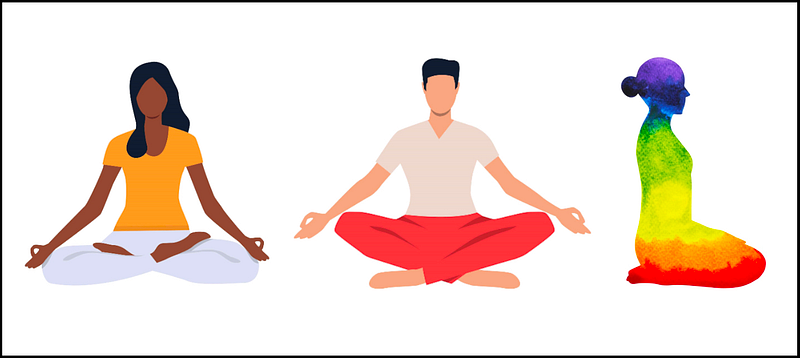
The lotus pose is a bit tough and not a must. Use it if you are used to it. The folded-leg squat is my favourite, as I find I can keep my back upright and relaxed in it most naturally.
Whichever pose you adopt, sit with your back and head upright and relaxed. The hands can be on your knees or lap, whichever feels more natural. Find a pose that does not gradually start drawing your mind’s attention to your body as you meditate.
The best time to meditate is in the morning. Our mind starts becoming active in the morning and planning for the day ahead. As meditation is intended to empty and focus the mind, it’s probably most difficult in the morning. But this is a good thing. Please take it as a challenge, as it will make your mind stronger. It will also set you up nicely for the rest of the day.
Try to find a quiet and comfortable place to meditate where you are least likely to be disturbed. It is best if you use a timer to be consistent and gradually increase meditation time. Plus, you will meditate rather than wonder how much time has passed since you began.
The Mind
You may have learnt that one way to achieve an empty mind during meditation is to focus your attention on something. The idea behind this is to stop our minds from thinking. E.g., if we focus on our breathing, we’ll prevent other thoughts. I found other options to stop thinking, like feeling your heartbeat, listening to a steady sound or gazing at something. I wish it were so simple, though! Our brain is very capable of multi-tasking and flitting. So even while we focus on one thing, it merrily starts thinking about others. So the strong-willed concentration of the whole mind on only the focal point is vital.
Begin by floating your attention out to observe in your mind’s eye yourself sitting in your room meditating as billions of humans and animals around the world are waking, sleeping or going about their tasks on a planet that is a speck in the galaxy which is a speck in the universe. Just see all of this as a tableau without thinking about it.
Then bring your attention back within your mind and choose from one or more of the following:
- Observe your breaths in and out. (It also has the benefit of deepening and slowing down our breathing, which is good for calming and lung health.)
- Focus on a word or phrase and repeat it mentally. E.g., I use ‘Just breathe’ or ‘Meditate’ or ‘Thoughtless’. ‘Om’ would be a popular choice, although I find other words more effective.
- As your eyes are closed, look at what you can see in the blackness. You are not sightless behind closed eyelids. You’ll see eddies, swirls, and shapes that undulate and converge, and move across the darkness. Watch them and focus on them.
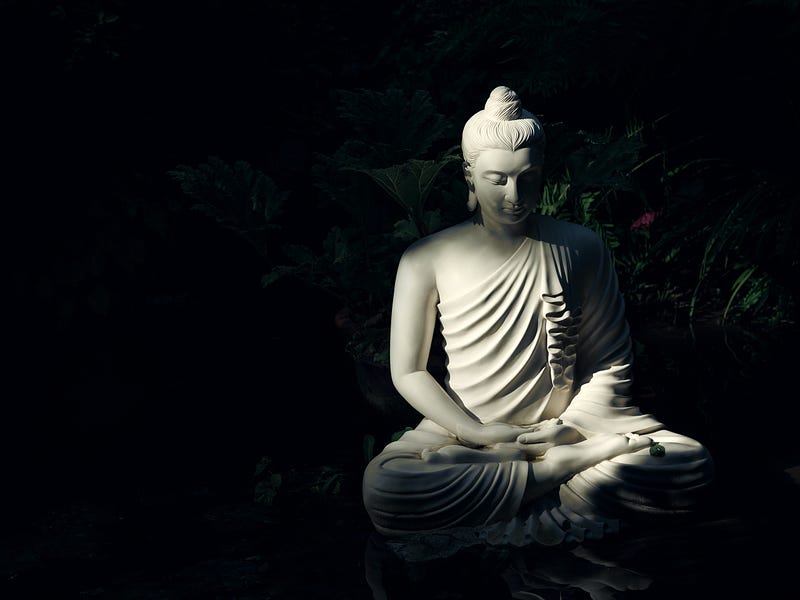
- Visualise and gaze at an imagined serene face of Buddha.
- Imagine a 3D EEG graph showing the thought waves throughout your brain as a grid, with spikes for high activity regions. Then imagine that all the peaks gradually die down, and the whole graph is a hemisphere with a regular square grid pattern. Then keep it like that.
- Imagine your two hands forming a virtual circle around your brain to keep it still and quiet and keep all sensations out.
- Imagine your brain filled with a glowing, white, peaceful light.
- Imagine your mind as a dark and empty cave.
- Imagine every molecule of your mind coming to a standstill, all forces in perfect balance, and nothing happening.
- Imagine a horizontal plane intersecting your body as it passes down from the crown through your head, throat, shoulders, chest, abdomen, waist, buttocks, thighs, knees, lower leg, ankles, foot, and toes; then in reverse; visualise cross-sections as the plane transits your body. You won’t be able to think of anything else. It is one of my favourites.
- Imagine your forebrain (pre-frontal cortex) holding down the mid-brain and brain stem to stop all their activity. It is one of my favourites.
Whichever you use, it’s okay for your mind to wander from the focus point. As soon as you realise you are thinking, bring it back to the same point. Even this exercise strengthens the mind.
You will find that when you concentrate on one of the above and are not thinking of anything else, you’re still thinking about focusing on the focus point! You are observing and noting yourself doing it. The idea is to remove even this self-observation and ultimately make it automatic.
Do’s
Be patient. We cannot easily achieve thoughtlessness. Our mind starts thinking, remembering, wondering, hoping, worrying — all the usual things it does. Notice that these are trains of thought. Focus on making these trains as short as possible. As soon as you observe one starting up, terminate it as quickly as you can.
Also, try to make your thoughts as simple as possible. It’s better to think ‘wish that dog would stop barking’ than consider a nuclear physics problem. Having short and simple wanders from which you keep coming back is a commendable start.
Remember that the quality of your meditation and its duration will only improve gradually. Start with 3 minutes, increase it to 5, then 8, then 10. Meditating for more than 15 minutes at a stretch may not be possible for most people. It could even be counter-productive.
Be satisfied if you achieve thoughtlessness or something close to it for 10 to 25% of the session. Achieving 100% may be impossible for anyone. Getting to 50% could be your goal.
Just do it regularly, do it every day.
Don’ts
You will hear sounds like a fan, birds, neighbours’ TVs, people, or vehicles. It is okay. Anyway, it is hard to get a tranquil place for meditation. Hear the sounds but don’t think about them and their associations. An accomplished meditator can meditate even in the busiest place.
The key is to aim to ‘be’ in a specific state, not to ‘do’ meditation. So be in the moment. Tell yourself that you don’t want your mind to move to the future or the past. It has to stay in the now.
One of the things to not do is question the utility and purpose of meditation. While doing it, we should assume it has value and trust that it works. You can think about it afterwards or before the next session, but not during it.
Signs you are doing it right
You’ll realise that the observation of your mind has itself receded to the background. It has become tiny inside. You know without explicit consciousness that you are close to or at thoughtlessness. You will feel a sense of floating, of weightlessness. If you sustain this even for a few seconds, you may find that a pleasant pulsation or vibration starts and spreads through your mind, then through your body, and your attention alternates between feeling this and maintaining your peaceful mind.
Once you get the hang of it, the passage of time will slow down. Even eight minutes seems like a long time to me now in an excellent way. Each moment seems like an eternity. But when the timer comes to an end, it feels like the session passed in no time! You will feel like continuing, meditating more. Be content, for tomorrow you’ll do it again. Move on to your daily tasks, taking advantage of the ever so slightly improved you.
Each day your meditation will be a bit different from the last. You will progress, learn, get more control, slowly calm down your anticipation. One day that feeling will come of knowing that you are in a genuinely meditative “nothing” state, even if just briefly.
You may not achieve advanced ‘Buddhist monk’ levels of meditation. But any attempt and persisting with it will add value to your life. Combined with other forms of self-improvement, it can be an integral part of your progress, as it has been of mine.
Shashi / June 20, 2014
If you are interested in meditation, you can read the stories below to explore it from different viewpoints.
Please consider subscribing to Medium for $5 a month from this referral link if you enjoy my stories and those of other excellent writers here.
Shashi on LinkedIn and quality-thinking.com.


