avatarRebecca Kojetin

Free AI web copilot to create summaries, insights and extended knowledge, download it at here

5641

Abstract

habits that got my brain turning.</p><p id="d0c5">“Start by searching for the reason in your routine. Finding the <i>why</i> in what you do is an excellent precursor to rooting out the undesirable.” (from “<a href="https://readmedium.com/5-habits-that-will-help-you-write-more-a819cef5476f">5 Habits That Will Help You Write More</a>”) I needed, however, to take his idea one step further. I needed to look for why I do things like I do before I could discover the “Why should I?” in what I want to accomplish.</p><p id="9031">It was an eye-opener for me.</p><h2 id="c220">So, here are my “Why do I do’s,” at least the big three.</h2><blockquote id="be54"><p>Why do I have so many incomplete projects?</p></blockquote><blockquote id="fe35"><p>Why is my environment chaotic?</p></blockquote><blockquote id="17d7"><p>Why do I succumb to time wasters?</p></blockquote><p id="e7f7">One of the things I noticed when working to discover the “why” in what I do and do not do is the repetitive and limiting nature of the training my mind has received. Not minute by minute, hour by hour, or day by day; but semester by semester and year by year.</p><p id="f04c">Seventeen years as a student and 34 years as a teacher trained my brain to function in a never-ending cycle of 18-week semesters.</p><p id="40f3">As a student and as a teacher, I lived my life in semesters. In 18 short weeks, the grammar and composition course, literature course, creative writing course, public speaking course, acting course, or technical theater course would end; and I would have had to accomplish a certain number of units, assignments or projects, and lectures. If I didn’t get finished with the syllabus in those 18 weeks, I didn’t get an extension. Finals were given and graded, books collected, and grades submitted. After a long weekend, new students would enter my classroom and the course would begin again.</p><p id="608b">When some courses became yearlong courses (think Freshman, Sophomore, Junior, or Senior English), the challenge to squeeze material into 18 weeks still existed. Assignments, projects, and tests didn’t carry over to the next semester if the students really got into the study of a literary piece or a specific project. Really, the only one thing changed: teachers retained the same students for a full school year.</p><p id="ecc8">You might argue that I am stuck in a routine, but I would like to refute that I am stuck in a cycle. Why? A routine makes me feel good; it makes me feel like I accomplished something. (My morning routine: coffee and a novel for 30 minutes before I make breakfast. My bedtime routine signals my brain that the day is done and I am ready for bed.) A cycle makes me feel trapped like a hamster running forever on that exercise wheel.</p><h2 id="4e80">Let’s look at each of the three “Why do I do’s”</h2><blockquote id="a665"><p>Why do I have so many incomplete projects?</p></blockquote><p id="688c">When I start a project, I have that limited scope of a cycle that I have no control over. Instead, I need to allow myself to envision the project with a clear idea of the depth and length and time I need to see it through to the finish.</p><p id="c572">For example, to write a historical novel I need to understand a great deal more about the time period than I need to understand if I am going to teach a historical novel. If I am going to write a fantasy novel (or most any novel), I have to build the world; but if I am going to teach a fantasy novel, I just need to understand the world the author has built.</p><p id="4766">As a teacher, I only waded in the wealth of information available. I had a time frame for a unit or a specific lesson which limited what I allowed myself to learn because I needed to stay within shallows of information my high school students had time to absorb within the time frame of the class period.</p><p id="9672">As a writer, I need to create the world with more depth and detail than I will ever probably share with my reader; I need to know at least my protagonist and my antagonist better than I know my best friend from kindergarten.</p><p id="65b0">This is where the cyclical semester learning has me trapped. When I don’t finish in my “allotted” time, I table the project. It’s taking too long. There is too much information.</p><blockquote id="1f02"><p>Why is my environment chaotic?</p></blockquote><p id="9366">My student and teacher training has also shaped my chaotic environment.</p><p id="f88e">First, I tend to flit from one thing to another, or so my husband says, without finishing anything.</p><p id="0837">Think about it . . .</p><p id="479f">Elementary teachers break their day into minutes (or at least they did my first year teaching): 30 minutes each day for reading, 20 minutes for science — you can see the pattern. Middle and high school teachers have their day divided for them into a certain number of class periods that only last so long. The bell rings, but there were three more discussion points that you wanted to address. Save them for tomorrow? Toss them out? It depends on what those points were and if they are part of a department, district, or state test.</p><p id="4f0b">New class? Move on to different subject; or worse, move to a different room with your teaching cart.</p><p id="04d1">Books, directions for projects, various versions of grading sheets, materials to put on bulletin boards? It all gets collected AND saved. You never know when you might need that picture or article again.</p><p id="cd4c">To add to the chaotic paper and artifact tiger, I inherited the massive files that my mother had collected in her years as

Options

an elementary school teacher, AND I collected pictures and supplies so my own children could complete creative projects when they were in school. (Note: They are now 35 and 33. It’s time to toss stuff.)</p><p id="e6b6">I am working to tame the chaotic tiger in my home. My studio was first. Now, when I enter it, I feel at peace and ready to get some writing done. I am looking forward to that feeling throughout my home.</p><blockquote id="790e"><p>Why do I succumb to time wasters?</p></blockquote><p id="bf6a">This one goes beyond the realm of teaching. Digging deep within my soul, I find that the force of resistance is sometimes strong. It starts out innocently. I had errands that should have taken little time, but the trip to the pharmacy requires me to wait for them to finish filling a prescription. Now what? Download a game to the phone while I wait. When the prescription is ready, I pocket the phone and get on my way. But wait. I finally get home and I have a bit of time to relax before I get dinner started. What do I do while I sit? You guessed it. I pull out that game on my phone. It is my WORST enemy.</p><p id="e295">With these realizations made, I can now buckle down and create a “Why should I?” list. I can make my own rules about my writing schedule and my writing routine.</p><p id="84bc"><i>Rebecca (Becky) spent 34 years in a teaching career, but when she retired in 2014, she picked up her pen and pursued her passion to write. As a high school English teacher, Becky held the philosophy that she wouldn’t give any writing assignment that she personally wouldn’t or couldn’t do. That philosophy strengthened and broadened her own writing.</i></p><p id="1883"><i>In addition to publishing her writing on various platforms, Becky also blogs at <a href="https://www.rebeccakojetin.com/"><b>Life is for Living</b></a>, a blog to encourage, motivate, and help others live the best life possible. As an extension of <b>Life is for Living</b>, she also publishes a weekly newsletter, <b>Let’s Chat</b>. (Check it out <a href="https://www.rebeccakojetin.com/subscribe-to-laiki/"><b>HERE</b></a>.) <b>Life is for Living</b> also has a social media presence with the group <b>Coffee on my Porch</b>. (Check it out <a href="https://www.facebook.com/groups/229433334908338"><b>HERE</b></a>.)</i></p><p id="af1f"><i>After teaching writing for 34 years, Becky began <a href="https://www.inkandkeyboard.com/"><b>Ink & Keyboard</b></a>, a blog for writers at all levels. She supplements what she writes on the blog with a subscription newsletter, <b>The Writer’s Notebook</b> (Check it out <a href="https://inkandkeyboardmonthly.substack.com/p/coming-soon"><b>HERE</b></a>.) and the social media group Ink & Keyboard (Check it out <a href="https://www.facebook.com/groups/2416122425340194"><b>HERE</b></a>.)</i></p><p id="21e5">Thanks for reading.</p><p id="b77e">If you enjoyed what you just read, feel free to share.</p><div id="19de" class="link-block"> <a href="https://rebeccakojetin.medium.com/membership"> <div> <div> <h2>Join Medium with my referral link - Rebecca Kojetin</h2> <div><h3>As a Medium member, a portion of your membership fee goes to writers you read, and you get full access to every story…</h3></div> <div><p>rebeccakojetin.medium.com</p></div> </div> <div> <div style="background-image: url(https://miro.readmedium.com/v2/resize:fit:320/0*il9EmTr_fa7wvQny)"></div> </div> </div> </a> </div><p id="e569">If you enjoyed this article, you might enjoy these:</p><div id="78db" class="link-block"> <a href="https://readmedium.com/why-im-jumping-on-homeschooling-my-mfa-d0f9c5094fc9"> <div> <div> <h2>Why I’m Jumping on Homeschooling my MFA</h2> <div><h3>And so it begins</h3></div> <div><p>medium.com</p></div> </div> <div> <div style="background-image: url(https://miro.readmedium.com/v2/resize:fit:320/0*4dy1T_6sNMJMXLhz)"></div> </div> </div> </a> </div><div id="6ff5" class="link-block"> <a href="https://readmedium.com/5-strategies-to-silence-your-fear-of-running-out-of-ideas-4565ecf0252f"> <div> <div> <h2>5 Strategies to Silence Your Fear of Running Out of Ideas</h2> <div><h3>I was reading this morning on Medium while I was eating my breakfast, an activity that is becoming a habit. I either…</h3></div> <div><p>medium.com</p></div> </div> <div> <div style="background-image: url(https://miro.readmedium.com/v2/resize:fit:320/0*6yRTH6S4i2sJUBCD)"></div> </div> </div> </a> </div><div id="9b26" class="link-block"> <a href="https://readmedium.com/write-with-variety-a-handout-from-the-1980s-986ab302b33a"> <div> <div> <h2>Write With Variety: A Handout from the 1980s</h2> <div><h3>I first started teaching with a high school English department back in the ’80s. Over my 34 years of teaching, I saw…</h3></div> <div><p>medium.com</p></div> </div> <div> <div style="background-image: url(https://miro.readmedium.com/v2/resize:fit:320/0*0ilO2xOMLE6_Nq6N)"></div> </div> </div> </a> </div></article></body>

Reflect on the Past to Move Forward with Your Writing Habits

Happy New Year? In September?

Photo by Crazy nana on Unsplash

For 34 years, I greeted students in August (sometimes September) and January with the words “Happy New Year.” At the high school level, both months bring a change of classes and a new schedule, a new start / a new year. Since grades begin fresh and assignments don’t carry over from one semester to the next, I even used the words with students in a yearlong course. It was a way to allow them turn life in more positive direction.

Before I entered that classroom, I also took time to reflect on the job I had done the previous semester, and even the job I had done the previous year.

Now, as a writer moving into my “new year,” I have started to do some reflecting on my writing habits. (Even though I have been retired from the classroom for five years, I am still a slave to September being my “new year.”

Photo by Kelly Sikkema on Unsplash

Reflecting on where I am RIGHT NOW . . .

I am not happy with the number of incomplete projects that I have sitting around.

I am not happy with the chaotic environment that I have let spring up around me.

I am not happy with the ease at which I succumb to time wasters.

I am not happy . . .

You get the picture, right?

Will that ever change? I don’t know.

Where was I a year ago? . . . In the same place I am today! (And that sucks.)

Rewind to a year ago . . .

Last year at this time I was getting ready to travel to Northern Illinois for two weddings and a workshop titled “Awaken Your Dreamer” as part of a month-long camping trip.

Kelly Epperson (the self-proclaimed Joy Fairy) ran “Awaken Your Dreamer” in her home “The Joy House.” (I’ve known Kelly for years and jump at the chance to participate in her workshops.) The workshop left me motivated and energized.

But then, I got back to our camper and reality and those motivations and energies faded as the realities of life invaded.
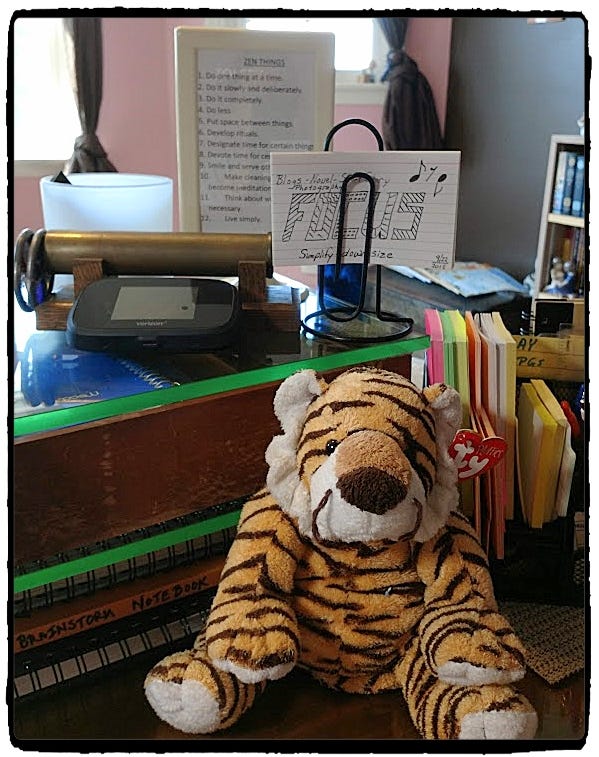
The affirmation cards from that workshop found their way to my desk. For the first few days I was home, I read them. I wish I had continued to read them all year because I think if I had read through them every day, I might have moved forward in the development of my writing habit.

What are my affirmation cards? Let’s take a look.

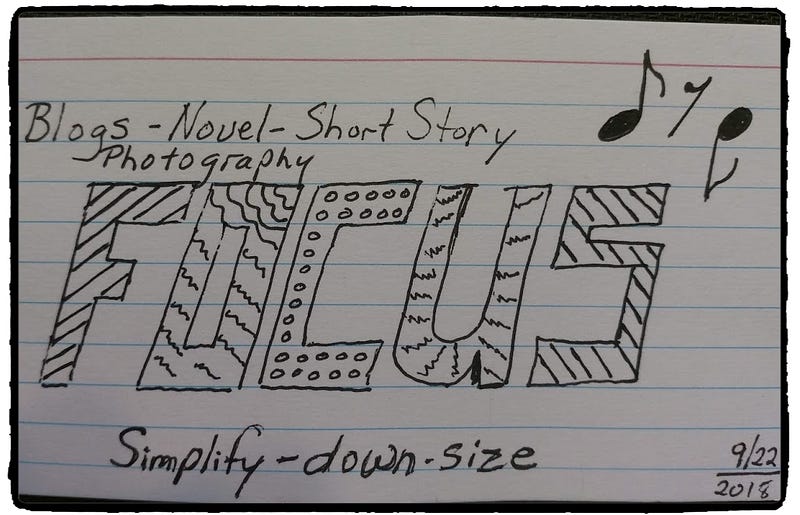
The first was a WORD card. What one single word most defined what I thought I needed to guide my year?
The next card identified what FEELINGS I wanted? The words on this card surprise me, but they are the feelings we turned into our affirmation statements.
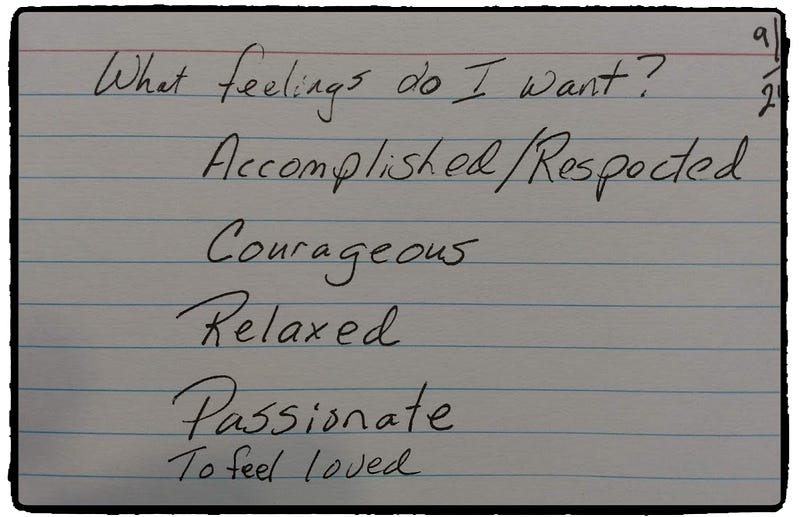
These then became my AFFIRMATION STATEMENTS:

I am accomplished and respected!

I am courageous!

I am relaxed!

I am passionate!

I am intelligent and knowledgeable!

I am healthy!

I am curious!

I am a musician!

I am a writer!

I am worthy!

These affirmations would have moved me forward IF I had believed them and owned them.

Recently, I started telling myself “I am a writer.”

AGAIN?

Yes, again.

This time, however, I am not only saying it to myself, but I have started telling it to other people. (Before, I would begin with “I’m a retired teacher.”) AND, I am working to ACT like a writer.

To do that, I started working to read at least one article here on Medium each and every day. The other night I came across “5 Habits That Will Help You Write More.” It was more a statement in the introduction than the five habits that got my brain turning.

“Start by searching for the reason in your routine. Finding the why in what you do is an excellent precursor to rooting out the undesirable.” (from “5 Habits That Will Help You Write More”) I needed, however, to take his idea one step further. I needed to look for why I do things like I do before I could discover the “Why should I?” in what I want to accomplish.

It was an eye-opener for me.

So, here are my “Why do I do’s,” at least the big three.

Why do I have so many incomplete projects?

Why is my environment chaotic?

Why do I succumb to time wasters?

One of the things I noticed when working to discover the “why” in what I do and do not do is the repetitive and limiting nature of the training my mind has received. Not minute by minute, hour by hour, or day by day; but semester by semester and year by year.

Seventeen years as a student and 34 years as a teacher trained my brain to function in a never-ending cycle of 18-week semesters.

As a student and as a teacher, I lived my life in semesters. In 18 short weeks, the grammar and composition course, literature course, creative writing course, public speaking course, acting course, or technical theater course would end; and I would have had to accomplish a certain number of units, assignments or projects, and lectures. If I didn’t get finished with the syllabus in those 18 weeks, I didn’t get an extension. Finals were given and graded, books collected, and grades submitted. After a long weekend, new students would enter my classroom and the course would begin again.

When some courses became yearlong courses (think Freshman, Sophomore, Junior, or Senior English), the challenge to squeeze material into 18 weeks still existed. Assignments, projects, and tests didn’t carry over to the next semester if the students really got into the study of a literary piece or a specific project. Really, the only one thing changed: teachers retained the same students for a full school year.

You might argue that I am stuck in a routine, but I would like to refute that I am stuck in a cycle. Why? A routine makes me feel good; it makes me feel like I accomplished something. (My morning routine: coffee and a novel for 30 minutes before I make breakfast. My bedtime routine signals my brain that the day is done and I am ready for bed.) A cycle makes me feel trapped like a hamster running forever on that exercise wheel.

Let’s look at each of the three “Why do I do’s”

Why do I have so many incomplete projects?

When I start a project, I have that limited scope of a cycle that I have no control over. Instead, I need to allow myself to envision the project with a clear idea of the depth and length and time I need to see it through to the finish.

For example, to write a historical novel I need to understand a great deal more about the time period than I need to understand if I am going to teach a historical novel. If I am going to write a fantasy novel (or most any novel), I have to build the world; but if I am going to teach a fantasy novel, I just need to understand the world the author has built.

As a teacher, I only waded in the wealth of information available. I had a time frame for a unit or a specific lesson which limited what I allowed myself to learn because I needed to stay within shallows of information my high school students had time to absorb within the time frame of the class period.

As a writer, I need to create the world with more depth and detail than I will ever probably share with my reader; I need to know at least my protagonist and my antagonist better than I know my best friend from kindergarten.

This is where the cyclical semester learning has me trapped. When I don’t finish in my “allotted” time, I table the project. It’s taking too long. There is too much information.

Why is my environment chaotic?

My student and teacher training has also shaped my chaotic environment.

First, I tend to flit from one thing to another, or so my husband says, without finishing anything.

Think about it . . .

Elementary teachers break their day into minutes (or at least they did my first year teaching): 30 minutes each day for reading, 20 minutes for science — you can see the pattern. Middle and high school teachers have their day divided for them into a certain number of class periods that only last so long. The bell rings, but there were three more discussion points that you wanted to address. Save them for tomorrow? Toss them out? It depends on what those points were and if they are part of a department, district, or state test.

New class? Move on to different subject; or worse, move to a different room with your teaching cart.

Books, directions for projects, various versions of grading sheets, materials to put on bulletin boards? It all gets collected AND saved. You never know when you might need that picture or article again.

To add to the chaotic paper and artifact tiger, I inherited the massive files that my mother had collected in her years as an elementary school teacher, AND I collected pictures and supplies so my own children could complete creative projects when they were in school. (Note: They are now 35 and 33. It’s time to toss stuff.)

I am working to tame the chaotic tiger in my home. My studio was first. Now, when I enter it, I feel at peace and ready to get some writing done. I am looking forward to that feeling throughout my home.

Why do I succumb to time wasters?

This one goes beyond the realm of teaching. Digging deep within my soul, I find that the force of resistance is sometimes strong. It starts out innocently. I had errands that should have taken little time, but the trip to the pharmacy requires me to wait for them to finish filling a prescription. Now what? Download a game to the phone while I wait. When the prescription is ready, I pocket the phone and get on my way. But wait. I finally get home and I have a bit of time to relax before I get dinner started. What do I do while I sit? You guessed it. I pull out that game on my phone. It is my WORST enemy.

With these realizations made, I can now buckle down and create a “Why should I?” list. I can make my own rules about my writing schedule and my writing routine.

Rebecca (Becky) spent 34 years in a teaching career, but when she retired in 2014, she picked up her pen and pursued her passion to write. As a high school English teacher, Becky held the philosophy that she wouldn’t give any writing assignment that she personally wouldn’t or couldn’t do. That philosophy strengthened and broadened her own writing.

In addition to publishing her writing on various platforms, Becky also blogs at Life is for Living, a blog to encourage, motivate, and help others live the best life possible. As an extension of Life is for Living, she also publishes a weekly newsletter, Let’s Chat. (Check it out HERE.) Life is for Living also has a social media presence with the group Coffee on my Porch. (Check it out HERE.)

After teaching writing for 34 years, Becky began Ink & Keyboard, a blog for writers at all levels. She supplements what she writes on the blog with a subscription newsletter, The Writer’s Notebook (Check it out HERE.) and the social media group Ink & Keyboard (Check it out HERE.)

Thanks for reading.

If you enjoyed what you just read, feel free to share.

If you enjoyed this article, you might enjoy these:

Writing
Writing Life
Writing Habits
Writing Tips
Recommended from ReadMedium