
5 Strategies to Silence Your Fear of Running Out of Ideas

I was reading this morning on Medium while I was eating my breakfast, an activity that is becoming a habit. I either read a book (fiction or non-fiction) or I find myself reading new articles on Medium.
The conversation I find this morning goes something like this:
“What is your biggest fear as a writer?” (This question is repeated throughout the writer world at writer groups, at conferences and workshops, and online.)
“I fear I will run out of things to write about.”
Afraid of WHAT? Don’t worry, I get it. I’ve been there with the “What if this is the only thing I EVER write?”
It hit me the hardest when I was teaching Sophomore English and we were working with Harper Lee’s book To Kill a Mockingbird. A couple of students asked what else Lee had written. They were surprised when I told them that To Kill a Mockingbird was her only novel (This was years before the 2015 release of Go Set a Watchman.), but she had also written a few essays.
BUT the fear of running out of things to write about stands in front of us in all its glory when we sit down at a blank screen or piece of paper. Its taunts include
“There really is nothing to write about.”
“You don’t really think you have enough ideas to sustain a career in writing, do you?”
“That’s already been done before.”
“No one would want to read an article about that.”
“Didn’t so-and-so just write about that?”
Really? There is so much around you to give you ideas and inspiration. You will probably always have the fear that you will run out of ideas, but doesn’t mean it has to control you.
And as for a topic being covered already? It hasn’t been covered with your eyes, your perception, your intelligence, your wit, your voice, your style, your personality.
If the fear of running out of ideas will always be with you to some extent, just like any other fear, I’d like to share 5 strategies to at least give you some control over that fear. (By the way, these can work for other fears as well.)
1. NAME THE FEAR
I don’t mean to call it what it is “I have a fear of running out of ideas.” I mean give it a name like Mergatroid or Sally. Then you can say, “Mergatroid, I’ve got plenty of ideas in my head. You are a bad influence; therefore, you can go stand in the corner.” OR more assertive, “Mergatroid, shut up! I’ve got this.”
2. PUT HER IN JAIL
Need something stronger? PUT HER IN JAIL. What? Yup, put her in an actual jail cell of your creation. Take some time out of your weekly errands to search either the Goodwill or Salvation Army stores, or a thrift store, or one of those cheap dollar stores for a doll that you can name Mergatroid. (Garage and yard sales are also good for finding dolls to use.)

Then, get a box (I like cigar boxes) that she will fit in (or even use the box she came in) and create “bars” on the box with pipe cleaners, or masking tape, or straws, or — oh the choices out there are unlimited.
Finally, make a “museum label” for her. For example: “This is Mergatroid. She represents my fear of running out of ideas. She has been convicted of giving me bad advice.”
3. PAPER & PEN — CARRY IT WITH YOU
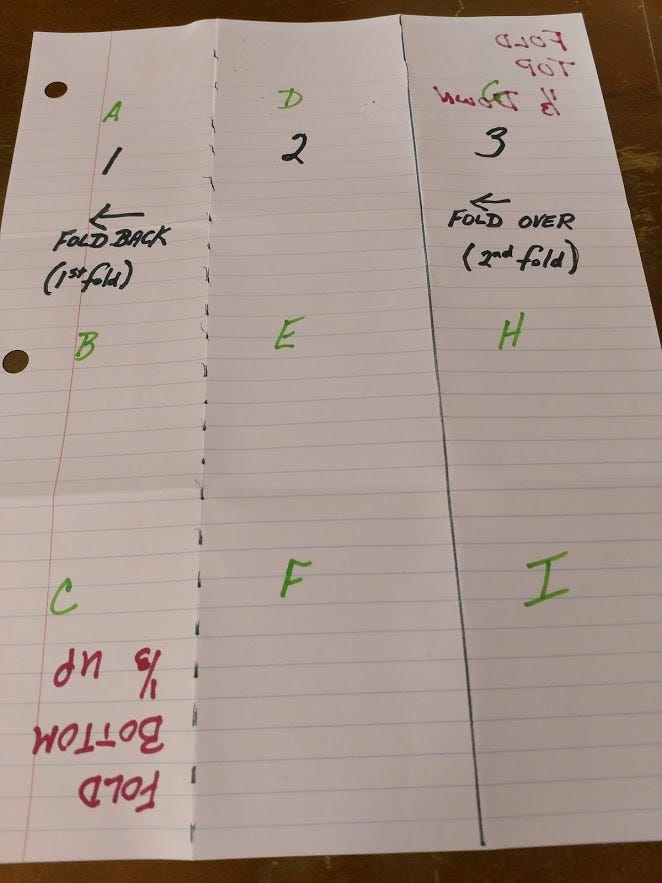
If you don’t want to carry a notebook with you all the time, try this trick I learned at a workshop years ago using a piece of ruled notebook paper. Fold it in thirds longways. Then fold it in thirds top to bottom. This can easily fit in your jeans pocket with a small pen. Now, record things that catch your eye as you go through the day.
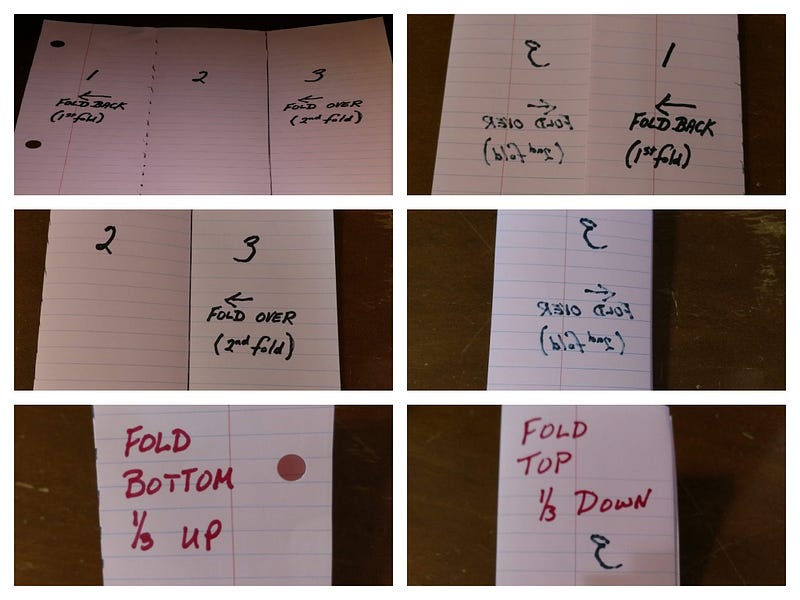
Keep it folded. As you write, you will fill section “A,” then “B,” and “C.” Then, open it and fold that first piece under so that you have the second column. It takes a few minutes to work out the mechanics, but when you finish the day, you can place the page in a three ring notebook.
4. RECORDING DEVICE OR “VOICE TO TEXT” DEVICE/APP
Carry a small, hand-held tape recorder and record things that catch your attention or come to your mind.
For years, I used one that held little cassette tapes as I drove the thirty minutes to and from work. When I’m driving, my brain begins to create. It’s kind of like the parent in that commercial who loads the cranky toddler into the car and drives. Soon the child is quiet and napping, only my mind begins to churn out ideas.
Using a recording device can be good even when you are taking a walk, watching television, or listening to music. The only problem is to take time to transcribe the recording.
Enter “voice to text” products. I have been learning to use apps like Evernote that allow you to use a voice to text feature so you don’t have to transcribe. Problem solved.
5. UTILIZE IDEA CARDS
When you are reading a book, jot down ideas (not the exact words) on 3x5 index cards. On the upper right line, give the card a category, and later file the cards according to category. At a loss for something to write about. Thumb through the categories, choose one, and pull the idea cards out. Pick one and start to write. It doesn’t matter if you are reading fiction or non-fiction.
BONUS: IDEA BOOKS
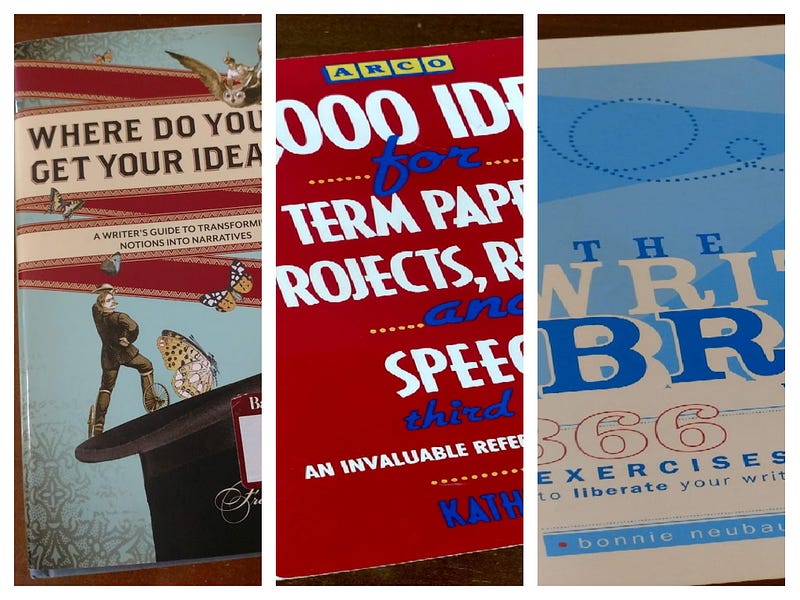
Years ago (1983 to be exact), I was hired by a school district to teach Oral Communications, a public speaking class. I found that students were often plagued with the loss of what to speak about. At that time, I began to put together a list of topics, but then I found that some people had put books together that just listed topics to write and talk about. I started purchasing a few.
When at a loss for what to write about, I can go to my bookshelf and pull one of these gems.
YOUR TURN
Could you share in the comments one of the strategies you follow when you are struggling to find ideas to write about?
Rebecca (Becky) spent 34 years in a teaching career, but when she retired in 2014, she picked up her pen and pursued her passion to write. As a high school English teacher, Becky held the philosophy that she wouldn’t give any writing assignment that she personally wouldn’t or couldn’t do. That philosophy strengthened and broadened her own writing.
In addition to publishing her writing on various platforms, Becky also blogs at Life is for Living, a blog to encourage, motivate, and help others live the best life possible. As an extension of Life is for Living, she also publishes a weekly newsletter, Let’s Chat. (Check it out HERE.) Life is for Living also has a social media presence with the group Coffee on my Porch. (Check it out HERE.)
After teaching writing for 34 years, Becky began Ink & Keyboard, a blog for writers at all levels. She supplements what she writes on the blog with a subscription newsletter, The Writer’s Notebook (Check it out HERE.) and the social media group Ink & Keyboard (Check it out HERE.)
Thanks for taking the time to read.


