
Tesla Alum Recycles Li-Ion Batteries
And how toxic are those little buggers?
1. Lithium-ion batteries power the world
Lithium-ion (Li-ion) batteries power devices like your phones, laptop computers, uninterrupted power supplies (UPS), solar energy storage systems, and electric vehicles. Perhaps not the world, but much of the important parts of our world are powered by Li-ion cells.
Li-ion batteries are safer than other types of batteries which may contain toxic elements such as cadmium (nickel-cadmium batteries) or lead (lead-acid batteries). Instead, Li-ion cells are made from metals such as iron, copper, nickel, and cobalt — and of course lithium. Therefore, despite the continual misinformation from opponents of renewable energy and electric vehicles, Li-ion batteries are categorized as non-hazardous waste and may safely be incinerated or landfilled.
Despite the safety of Li-ion cells and the materials they are made from, mining of these (or any) metals cause both environmental and humanitarian concerns. Cobalt, in particular, is found in economical deposits mostly in the Democratic Republic of the Congo. Cobalt production from Congo is more than twelve times higher than the next largest producer, Russia.
In 2016 the Washington Post traced the supply chain of cobalt and found that mining companies in Congo abused human rights, used child labor, and caused environmental and health catastrophes in the area.
Since the accelerating production and sales of electric vehicles will continue into the foreseeable future, demand for Li-ion batteries, and the materials within them, will also accelerate. Today, it costs less to mine new metals for Li-ion cells from countries like Congo than to recycle.
But that may be about to change.
2. Who is J.B. Straubel?
Jeffrey Brian Straubel was the Chief Technical Officer, the fifth employee, and a co-founder of Tesla — until he left in 2019 to start up Redwood Materials to recycle battery packs.
Although you might be surprised that there was anyone at Tesla other than Elon Musk running the company, designing the cars, turning the wrenches and building the cars, and selling them… Elon actually surrounded himself with a constellation of brilliant stars. And Straubel was the brightest of the lot.
Straubel’s name is on the majority of Tesla’s patents. He is the one who campaigned for the Supercharger network, rather than the battery-swapping path that was announced early on. And that’s just for starters.
Thankfully for Tesla shareholders, Straubel remains as a Senior Advisor to the company.

Straubel, 45, got his B.S. (1998) and M.S. (2000) degrees in energy systems engineering from Stanford University and joined Tesla in 2004. Straubel’s responsibilities at Tesla included technical and design engineering of vehicles, new technology evaluation, research and development, technical reviews of critical vendors and partners, intellectual property, and systems validation testing. In 2017 he established Redwood Materials intending to recycle Li-ion battery packs on an industrial scale. And in 2019 Straubel left Tesla to run Redwood Materials full time.
3. Redwood Materials
Tesla has long had plans to recycle Li-ion battery packs. Even as Tesla’s very first car, the Roadster, started being sold in 2008, Tesla had publicized plans for pack recycling, and emphasized their non-toxic composition. As early as 2011, Tesla had launched programs to recycle batteries in Europe.
However, the volume of materials coming through these recycling operations must have been very small so far. Tesla designed and manufactured their battery packs to outlast their cars. Before recycling, Tesla does everything they can to, instead, prolong the useful life of the pack. The data from their fleet of over a million Tesla vehicles shows that cars driven between 150 to 200 thousand miles had packs retaining over 85% of their capacity. Tesla’s emphasis to date has been to refurbish and reuse battery packs before recycling them.
As a result, the number of packs Tesla has recycled to date has been minimal, and most recycled packs come from their own R&D and quality control test parts. The 2019 Tesla Impact report says that the global annual amount of Li-ion battery metals sent for recycling during the year was about 1,000 tons of nickel, 320 tons of copper, and 110 tons of cobalt.
Those sound like big numbers, but to put them into perspective, the Bloomberg New Energy Finance report forecasts Li-ion batteries in 2030 will require 1.8 million tons of nickel. Tesla alone, by some forecasts, may require up to 1.15 million tons of nickel per year by 2030, and about 275 thousand tons per year by 2025 — to meet their production targets. Far more than any other battery manufacturer.
This is the context for Redwood Materials’ goals to maximize the recycling of Li-ion batteries. Recycling will help to minimize the need for a new supply of these important strategic metals, therefore minimizing the impact of mining and waste disposal on the environment, and also reducing the costs of the battery pack — currently the most expensive part of the electric vehicle.
The Wall Street Journal recently reported that Straubel has won over some marquee investors including about $40 million from environmental investment funds Capricorn Investment Group (founded by Jeff Skoll) and Breakthrough Energy Ventures (founded by Bill Gates). Redwood Materials currently has about 50 employees but plans to have about 200 by the end of this year.
One of the strategic goals of Redwood Materials is to bring the price of raw materials for Li-ion cells down to about half of what it costs to mine them — within ten years.
Redwood Materials is starting small for now, and working on recycling consumer electronics such as phones. And due to the still-small electric car market, the amount of recycled car battery packs will remain small for a while.
But an immediate source of revenue will likely be the high rate of scrap in current battery manufacturing operations, estimated at 10%. That amount of production scrap is currently wasted. By 2025 estimates are that 80 gigawatts hours of cells will be scrapped, equal to the size of the whole 2016 global battery market. That scrap amounts to 64,000 tons of lithium per year, or the annual production of two mines, worth up to $1.5 billion. And that does not include the other even more costly materials such as cobalt and nickel.
The WSJ reports that Panasonic is already sending Redwood Materials some of its scraps and started with a trial of about 400 pounds of scrap last year, and is now sending up to 2 tons this year.
4. How are Li-ion cells made
The materials used in making Li-ion cells fall into several categories: an anode, a cathode, and an electrolyte.
The cathode is the positive terminal of the battery and is therefore where the electrons enter the battery. Cathode materials may include lithium cobalt oxide, lithium manganese oxide, etc.
The anode is the negative terminal, and where electrons exit the battery. Anode materials may include lithium, graphite, silicon, and various lithium-alloying materials and intermetallics.
The electrolyte is the chemical source for producing electricity in the battery and connects the anode to the cathode. Ions from the electrolyte react with the anode and releases electrons. Those electrons leave the anode, travel through the device being powered, and return to the cathode. Electrolyte materials include liquid, polymer, and solid-state electrolytes.
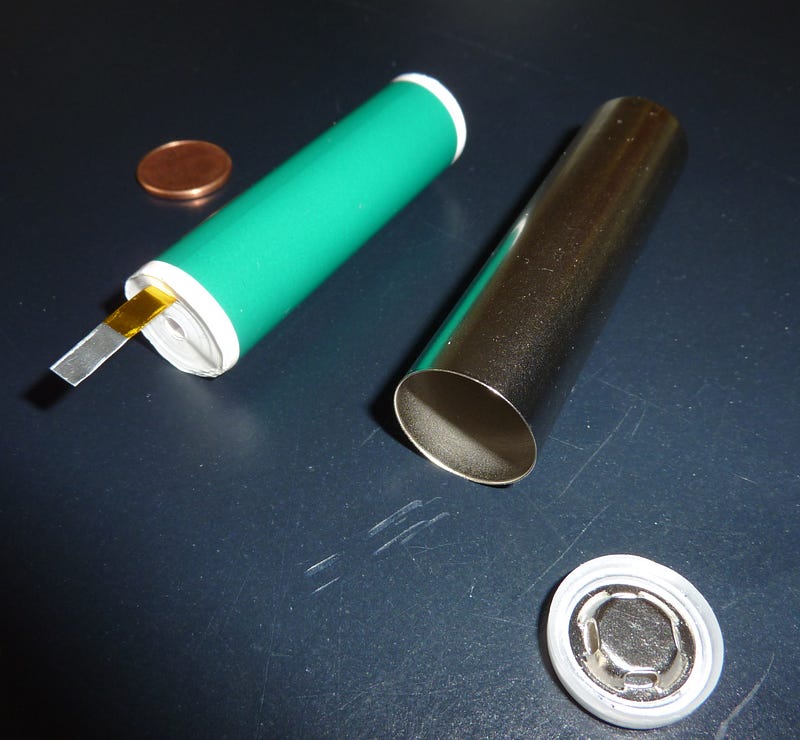
There are a few other materials required aside from the holy trinity of battery materials mentioned above.
An important one is the separator, which separates the anode from the cathode to prevent a short-circuit within the battery. For a liquid electrolyte, the separator is a foam soaked with electrolyte.
And of course, there is the container, the can, which encloses all these components in a durable package.
The most cost-effective form of a battery is cylindrical, so although other forms such as prismatic and pouch batteries are discussed by some, we will stick with the lowest-cost and highest-volume form which is cylindrical. This is the form that Tesla uses.
To make a cylindrical battery, the electrodes are manufactured in the form of pastes which coating machines spread onto foils such as aluminum foil for the cathode and copper foil for the anode. The electrode-coated foils and separator are stacked and rolled, like a jelly roll, and packaged into the cylindrical can. The cells are then filled with electrolyte which must soak into the foam separator (often the slowest step in production). Finally, the remaining components such as insulators, seals, and safety devices are connected and the can is welded shut.
Redwood Materials processing for recycling appears, from the WSJ report, to involve simply melting down the batteries. This minimizes the high-cost of manually disassembling the cells and sorting the recovered materials. Of course there is much more to learn about the specific processing involved in recycling and reconstituting the raw materials that battery manufacturers can purchase. These will come in time — but for now Redwood Materials is keeping things under wraps until they are ready to start production.
5. Disclosure…
I am a happy owner of just about the oldest used Tesla Model S (a 2013 MS P85), and am also happily invested in Tesla the company.
If you liked this article on Li-ion batteries, you may also like the following recent articles.
This is a review of Tesla’s energy division:
This is an introduction to SpaceX’s Starlink:
And this is a followup on Starlink’s recent beta test:
And this is a look at Netflix’s culture:
Thank you for reading, and please share!
And thank you to Pavle Marinkovic for suggesting this topic of recycling batteries!