
Reconstruction of the face of the famous “skull of Jericho”. Who was the man whose bones were plastered?
After 70 years of discovery, scientists have decided to reconstruct the face of a Jericho man whose skull was plastered 9,000 years ago. Who was the mysterious man?
Near the Jordan River in the West Bank is located one of the oldest cities in the world. People inhabited it as far back as ca. 11 thousand years ago. Today Jericho belongs to the Palestinian Authority and is inhabited by just over 22,000 people.
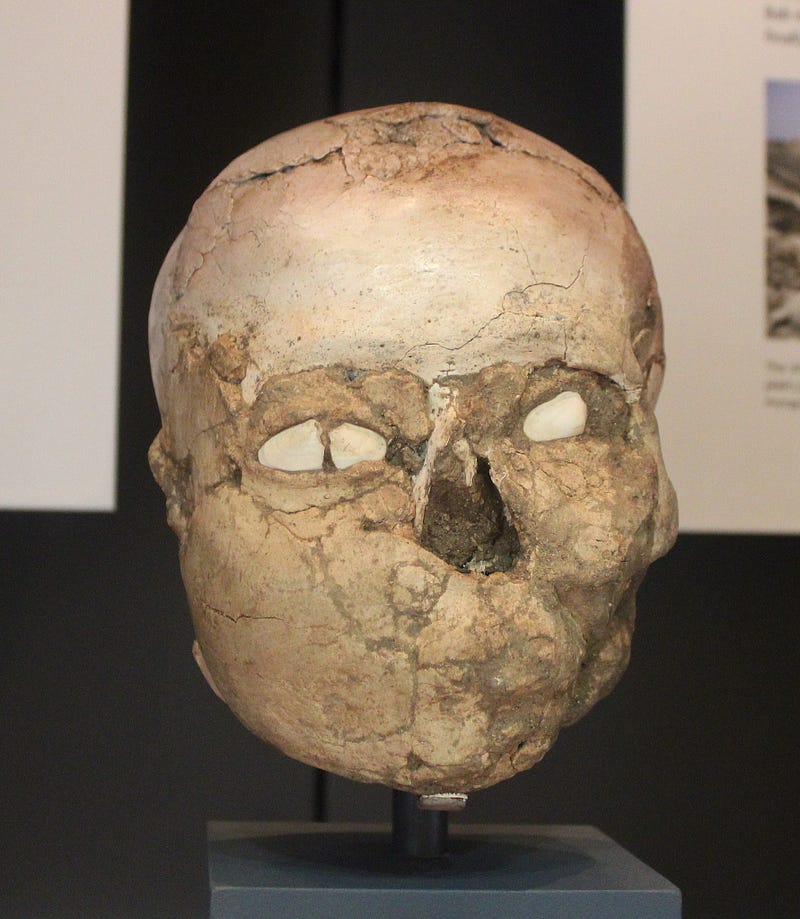
This small town is also where archaeologist Kathleen Kenyon discovered a total of seven plastered skulls 70 years ago. But it was one, later dubbed the “Jericho skull,” that sparked the most interest years later.
Who was the man who lived in Jericho 9500 years ago?
Kenyon concluded years ago that the skulls belonged to some of the earliest inhabitants of Jericho. Radiocarbon dating showed that they could date back as far as 9,500 years ago. They were covered with plaster presumably to recreate the image of the dead to whom they belonged. In addition, shells were inserted into the eye sockets, and traces of red paint were visible on several of them. The researchers concluded that the artifacts may have been used for religious purposes.
The skull from Jericho is in the British Museum. Research had been underway since 2016 to reconstruct the appearance of the person to whom it belonged. The researchers published their work in the scientific journal Ortog Online. Using the latest technology, an international team of researchers reconstructed the face of a Neolithic man.
Researchers have created a reconstruction of a prehistoric man’s face
The authors admit that this required considerable effort. The researchers had to carefully uncover the bones that were under the layer of plaster, while not destroying any part of the skull. To do this, they performed, among other things, an examination using computed microtomography. Then, based on the measurements, they created a virtual 3D model.
“An unusual feature of the skull from Jericho is that, its upper part is much larger than in modern humans,” — says Cícero Moraes, lead author of the research project.
The man seen in the photo published by the researchers is male. He has dark, curly hair and dark stubble all over his face. The researchers suspect that he is one of the first inhabitants of prehistoric Jericho.
Why did the settlers of Jericho plaster their skulls?
Scientists say that more than 9,000 years ago Jericho was one of the largest settlements in the Middle East. Mourning and commemorating the dead was a ritual that helped establish greater bonds and relationships of Neolithic communities.
Scholars suggest that originally each plastered skull belonged to a close friend or relative. Settlers would come to the site where they were located to worship them. Over time, the skulls began to remind people of extended family and people who were believed to be the founders of Jericho. Experts say that after the identities of some people were forgotten, the bone fragments were buried.
Jericho is probably the oldest continuously existing human city
Archaeological excavations in Jericho have shown that the city is probably the oldest continuously existing human habitat. The oldest traces, dating back to the Preceramic Neolithic period, were found in the area of present-day Tell es-Sultan a few kilometers from the city.
Jericho appears more than 70 times in the Bible, including in the Book of Numbers, the Book of Joshua and 1 Kings. Mentions of the city can also be found in the New Testament and all four Gospels.
Interestingly, in the Book of Joshua (6:26) we read that Jericho was captured by Joshua’s army during the conquest of the Promised Land. According to biblical chronology, this was supposed to have taken place between 1220–1200 BC. However, research has shown that the destruction of the city occurred several hundred years earlier, during the period of Egyptian invasions.
Cool that you made it to the end of this article. I will be very pleased if you appreciate the effort of creating it and leave some claps here, or maybe even start following me. It would be nice if you also left a tip! Thank you!


